Why Does All the Food Have to Be Sad?

Every so often, one book seems to make its way through several of the blogs I read.  One of these books, a few months ago, was The Particular Sadness of Lemon Cake by Aimee Bender.  Since I’d already read the jacket description in Green Apple Booksellers in San Francisco when I was visiting over New Year’s and been intrigued, I decided to request it at the library.

Six months later, I finally read it.  When I joined the hold list, I was around #130 in line.  Good thing I wasn’t in any particular hurry!

It was a good book and I’m not sorry I let it sit in my hold list long enough to get all the way though the LONG line…but I’m also not sorry I didn’t buy it six months ago, despite my great fondness for Green Apple.

The book is about Rosie, who, whenever she eats, can taste the emotions of the people who cooked the food.  She discovers this talent/curse when she eats the lemon cake her mother made for her ninth birthday, and realizes that her happy-seeming mother is…well, depressed is simplifying–empty, unfulfilled, desperately seeking something else in her life and probably wanting someone else to provide it.

The book follows Rosie into adulthood, as she grapples with eating and with the hidden tensions in her family–revealed only in their food.

I love the premise–I was so intrigued by it at Green Apple.  I do feel it lived up to the promise of that premise, at least in how that part of the book was handled.  Rosie develops a complex palette for food–she can tell where the ingredients came from, has insights about every stage of the process, sees into the hidden emotions of the people who touched it all along the way, often seeing the things that they don’t know themselves.  I didn’t understand why she couldn’t cook her own food–where’s the harm in feeling your own emotions?–but when she does finally try that, it reveals hidden feelings in herself that are even more terrifying than other people’s.

I did have some problems with parts of the book, though.  People seem to only ever transmit negative emotions into food.  Maybe I’m just a hopeless idealist, but I refuse to believe that the vast majority of people are leading desperately unhappy lives, secretly or otherwise.  In all the food she eats throughout the book, I can think of only one example where the people making the food seem to be truly happy.  Rosie also finds one restaurant where she loves the food, but it’s not so much that the cook is happy as that she really loves food, and puts that into the dishes.

So I had trouble with that part.  I also don’t see why it was necessary.  Being overwhelmed by other people’s emotions every time you eat is compelling enough–being hit by other people’s positive emotions would be difficult too, and maybe even more interesting.

The second part I bumped into some problems with was Rosie’s brother, Joseph.  He possesses his own strange talents which, if you take it all at face-value, make tasting emotion in food seem comparatively tame.  At the risk of a slight spoiler, I’ll mention that he disappears most of the way through the book.  I won’t spoil how, except to say that it’s part of that strange talent.

This, odd though it may sound, is where I found the book implausible.  Not the way Joseph disappears–I was willing to accept that as the universe of the book–but the way other people react.  I’ve read other books about family members who disappear, probably kidnapped or run away, and the reaction here just didn’t feel right.  He was twenty or so when it happened, but there still should have been quite a lot of police calls, a lot of trying to hunt down anyone he had talked to or knew who might have an insight, a lot more searching.  Deciding to live in a fantasy where he’s off skiing the Alps and might come back any time just didn’t ring true to me, even for these rather odd characters.

I am probably over-exaggerating the issues of the book.  Do you ever find it’s sometimes easier to explain the parts that didn’t work than the parts that did?  Well, let me wind up by saying I did enjoy the book, and if you’re intrigued by the premise it’s worth a try.  You might want to lay in a Terry Pratchett book or two, though, in case you find yourself needing a laugh by the end.

Author’s site: http://www.flammableskirt.com/ (I don’t know what it means either…)
A Book by a Family Friend–Distantly

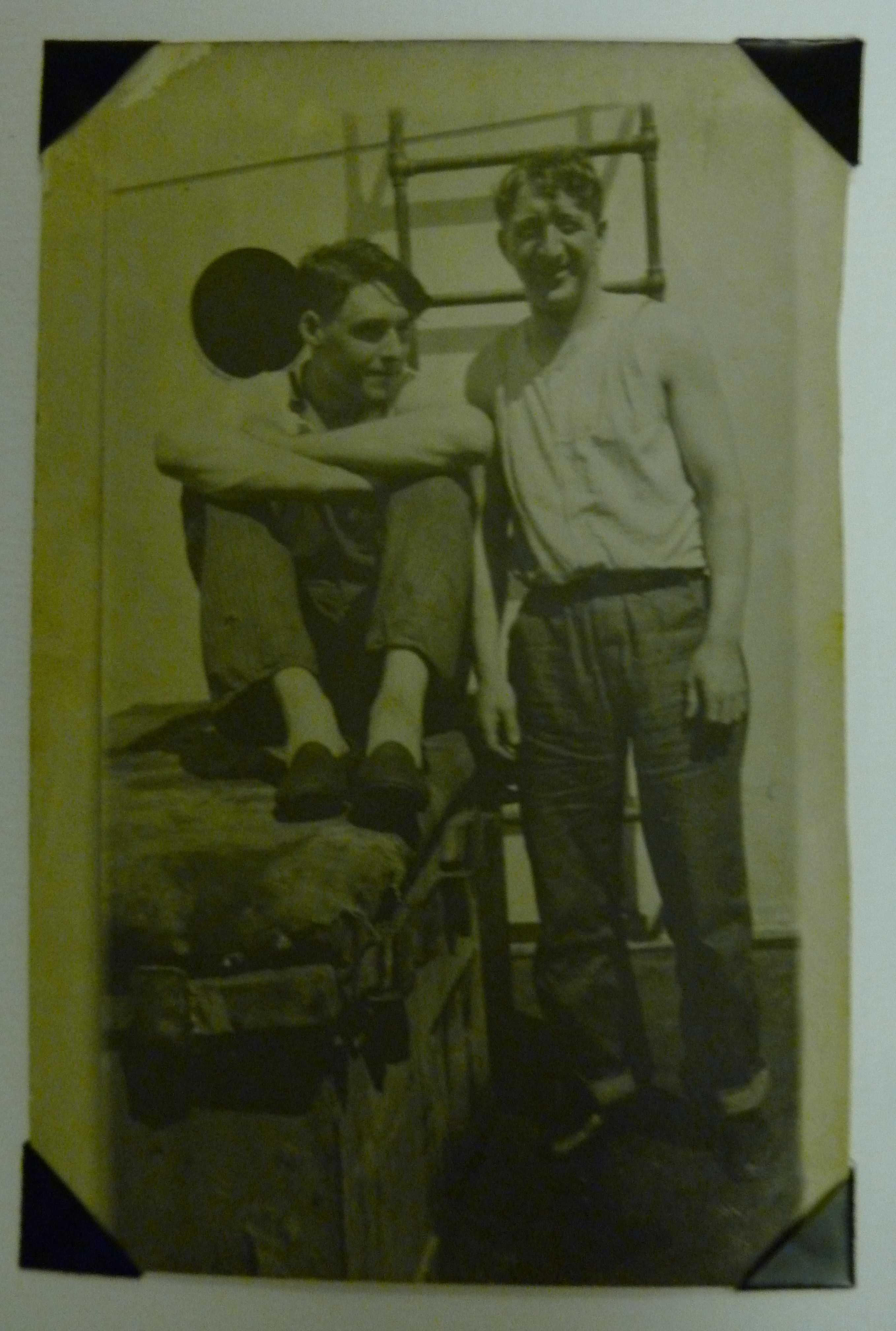
My great-grandfather is on the right. At left...anything's possible!

We have a family legend that my great-grandfather, who was in the Merchant Marines in the early part of the 1900s, was a friend of Jack London’s.  The embroidered version is that they were drinking buddies; the verified version is, well, non-existent.  But we do have several old pictures of my great-grandfather traveling the world, often with unidentified companions.  So who knows–one of them could be Jack London…

Despite the family connection, I’d only read one novel by Jack London (The Sea-Wolf), until recently when I delved into The Call of the Wild.  Ol’ Jack may have been great fun to visit a bar with, but I’m sorry to say he’s never going to be a favorite author of mine.

It was an interesting story, and the point of view of the dog brought a lot to it.  The picture of life up in the Klondike during the mining time was engaging (not that I’d want to visit, but it was fine to read about) and there were exciting moments.  But the nearly unrelenting harshness of it all was too much for me.

The story follows Buck, a family pet who is stolen and sold to become a sled dog.  Buck gradually sheds civilization, adjusts to life as a sled dog, and eventually finds his inner wolf, responding to the “call of the wild.”

As Buck passes from one owner to another, meets and (usually) fights with other dogs, and gets pushed through one test of endurance to another, the story is so bleak, and so harsh.  For most of the book, rarely is there an act of kindness or a pleasant word.  Buck does finally find a loving master who he worships in return.  If he hadn’t, I might have completely despaired of the book (or at least London’s opinion of humanity).  But, while I don’t want to give away spoilers, let’s just say it doesn’t end up happily with that master either.

I should have known what I was getting into, of course.  The Sea-Wolf  was not exactly cheerful, and, more significantly, I had read “To Build a Fire,” an incredibly bleak story about a man who managed to get wet in the Arctic and struggles, strains and strives to build a fire so that he won’t freeze to death.

Incidentally, you can also find a story by Mark Twain, I think part of Roughing It, called “Lost in the Snow.”  A group of men get lost in the snow and try to build a fire so that they won’t freeze.  Because it’s Twain and not London, it’s a very funny story.

I respect London’s knowledge and worldview…but it’s not a world I’d want to visit too often.  The Call of the Wild is a good book as a book, but not my style.  I’d rather hang out in Twain’s world.

Update on the Once Upon a Time Challenge

It’s the beginning of summer, which means…a lot of things, actually, but among them is that the Once Upon a Time Challenge concluded yesterday.

I had a lot of fun finding some books to fit the categories.  Here’s how the reading went (links go to my reviews):

Quest the First: Read five books that are fantasy, fable, fairy tale or mythology.
Quest the Second: Read four books, one from each category.

It seems easiest to combine the lists for these two:

Fantasy

The Lies of Locke Lamora by Scott Lynch

Among Others by Jo Walton

The Colour of Magic by Terry Pratchett

The Seven Towers by Patricia C. Wrede

Johannes Cabal the Necromancer by Jonathan L. Howard

Artemis Fowl by Eoin Colfer

The Particular Sadness of Lemon Cake by Aimee Bender

Son of the Shadows by Juliet Marillier

The Light Fantastic by Terry Pratchett

Mythology

The Last Olympian by Rick Riordan (Greek)

The Red Pyramid by Rick Riordan (Egyptian)

Abandon by Meg Cabot (Greek)

Fairy Tale-Inspired

Fire and Hemlock by Diana Wynne Jones (Tam Lin)

The Stepsister Scheme by Jim C. Hines (mostly Cinderella)

Sleeping Helena by Erzebot Yellowboy (Sleeping Beauty)

Fables

Aesop’s Fables

Fables: Volume 15: Rose Red

Quest the Third: Quest one or two, plus reading or watching A Midsummer’s Night’s Dream in June.

I watched a BBC version from 1968 last week.  I’ve seen a number of versions, but this was a new one.  It was truly bizarre on several levels.  For one thing, the fairies were all painted green.  For another, it was full of actors who I know really well in much later roles, so it was a trip to see them forty years younger.  Most notably, a very young Helen Mirren plays Hermia, and a nearly nude (and green) Judi Dench plays Titania.  It was an…interesting version.  Worth watching, but probably not going to be my new favorite telling of the story.

Quest on Film: Watch any movies or TV that also tell stories fitting the categories.

Fairy Tale: Disney’s Beauty and the Beast

Mythology: Hercules and the Underworld, Hercules and the Amazon Women

Fantasy: Dragonheart, The Page Master, Disney’s Peter Pan, Pete’s Dragon

By the end of this challenge, I can only conclude that if someone was going to design a challenge which required reading everything I normally read…it would look a lot like this one!

We’re coming up on the end of June, so stay tuned for an update on other challenges next week!

Wizards and Luggage, Traversing a Disc

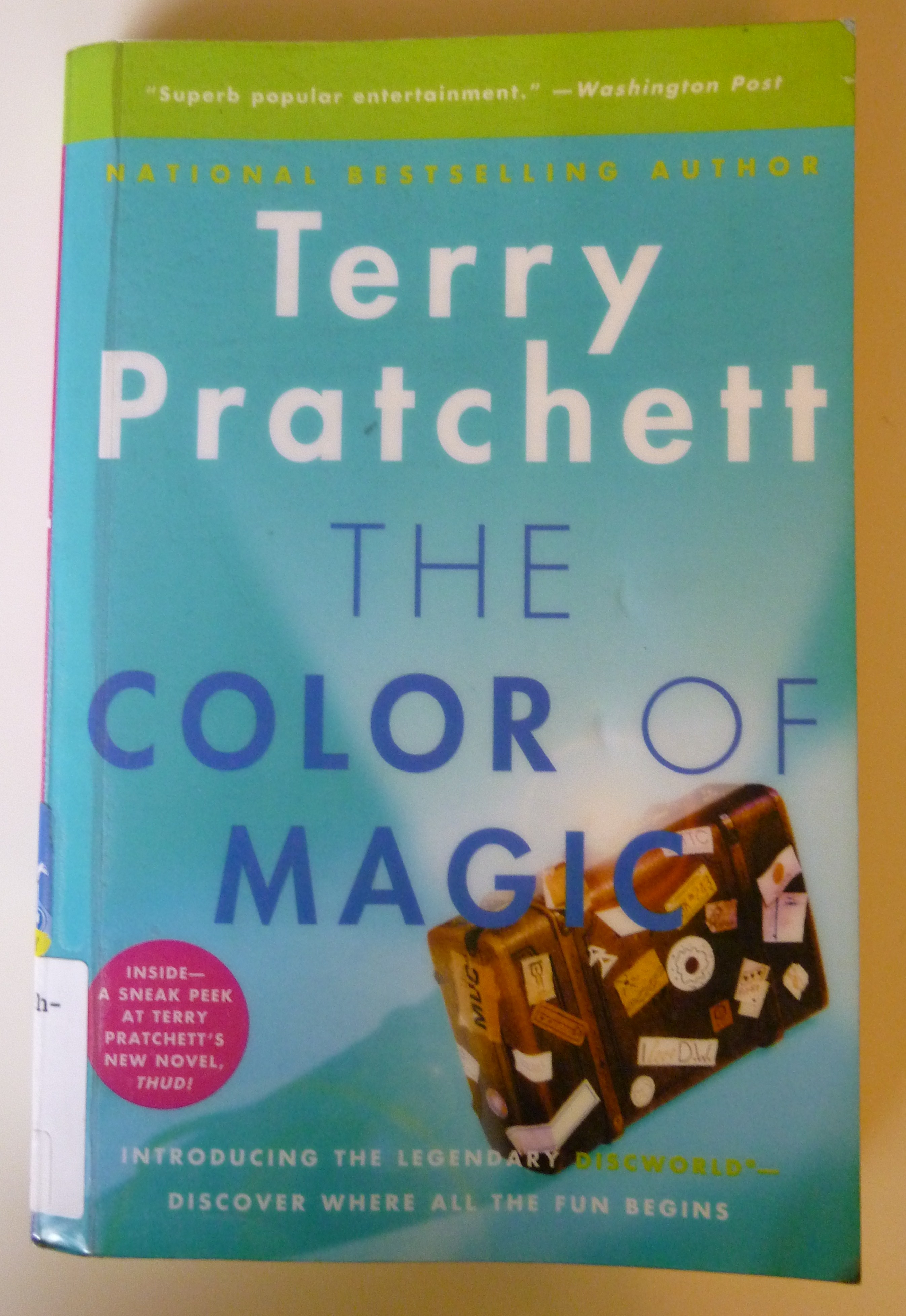
I’ve read upwards of ten books in Terry Pratchett’s Discworld series, but until recently I hadn’t actually read book one, The Colour of Magic.  It’s one of those series where you can really drop in at any point (though some books are better starting places than others).  I think there are over thirty books in the series, so if you, like me, feel a little baffled at where to begin, don’t bother–just grab something and go (though I recommend Guards! Guards! or The Truth as good starting points).  Or, of course, you could start with #1.

The Colour of Magic introduces us to Discworld, an alternate world which exists as a flat disc, riding on the back of four elephants, who are on the back of a giant turtle.  That right there may give you some idea of what we’re dealing with–a truly bizarre and wonderfully hilarious world.

The Colour of Magic begins in the ancient and cheerfully corrupt city of Ankh-Morpork, where Twoflower has come as the Disc’s first tourist, thrilled by the quaint bars and eager to meet heroes and see real Ankh-Morporkian brawls.  Rincewind the not-very-good wizard ends up roped in as his guide, and they embark on a perilous and hysterical adventure around the Disc.

It sounds almost reasonable, until I mention that Twoflower is followed everywhere by an animate trunk with hundreds of legs known as The Luggage, Death shows up every so often and is rather put out that Rincewind keeps stubbornly not dying, and at one point they encounter imaginary dragons who live inside a giant inverted mountain.  And that, of course, is only the half of it.

If you’re having a gloomy, depressing day, read a Discworld novel.  It will brighten everything.  Pratchett’s books are gritty but hilarious, have a grown-up feel but aren’t really inappropriate for young adults either.

There’s a vast cast of characters who wander in and out of the Discworld novels, and there are some subseries within the larger series (although good luck finding a comprehensive, helpful list of which books fall into which subseries), which focus on particular groups of characters.  There are the witches; the City Guard; the magicians; and let’s not forget Death.  I’m especially attached to the City Guard, led by noble but cynical Sam Vimes.

The Colour of Magic doesn’t focus particularly on any group of characters I recognize from later books, but it will definitely give you a solid introduction to the world of the Disc.

And, a random story: years ago I was on a bus, and overheard a couple of people talking about a book.  A wizard wound up in a tree, and was being visited by what seemed to be Death, but turned out to be a non-fatal disease.  The wizard objected that no one died of that disease, and he couldn’t be killed by him.  Sounds fun, right?  Of course I didn’t hear the book title, and I didn’t ask, and despite a little Googling I never could figure out what the reference was.  But now I’m reading along through The Colour of Magic and lo and behold: Rincewind lands himself in a tree, a cloaked figure appears with a scythe–but it’s not Death, it’s Scrofula.  Death was busy.  Rincewind objects, “I can’t die of scrofula!  I’ve got rights.”

Long-time mystery solved.  And almost as randomly as Discworld itself.

Of Reindeer and a Very Large Fish

I have an odd little story for you today.  The backstory to how it was written is that it was for a writing class, where the assignment was to focus on repetition.  The backstory within the story is that the narrator is my pirate captain, Red Ballantyne.  He and Tam develop this habit where he tells her stories about his father’s profession; the stories are never consistent and are often contradictory, because after all, he’s a pirate and has only a loose attachment to the truth.  And the point is really the stories anyway.

But you don’t actually have to know any of that.  Outside of the backstory, it’s just a slightly odd but I hope funny story about Arctic fishing, a reindeer, and a Very Large Fish.

*********************

So my father, you see, was a fisherman.  He was a more interesting fisherman than most, seeing as he did his fishing up in the Arctic.  The funny thing about fishing up there is that the water is all frozen.  So when you fish up in the Arctic, you have to cut holes in the ice.  Because the water is frozen.  Into ice, you see.

Continue reading “Of Reindeer and a Very Large Fish”