The View from the Ground

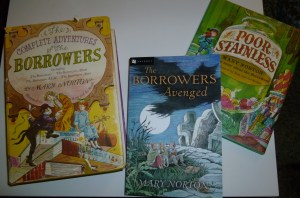
Have you ever lost your keys?  Or a safety pin or a paperclip or maybe a spoon or a roll of thread?  Maybe they were borrowed.  Not by a houseguest–at least, not a human one.  The Borrowers series by Mary Norton tells the story of tiny people who live among us, hidden from sight.  Only a few inches tall, they live inside walls and under floorboards, and survive by “borrowing” odds and ends from the human world.
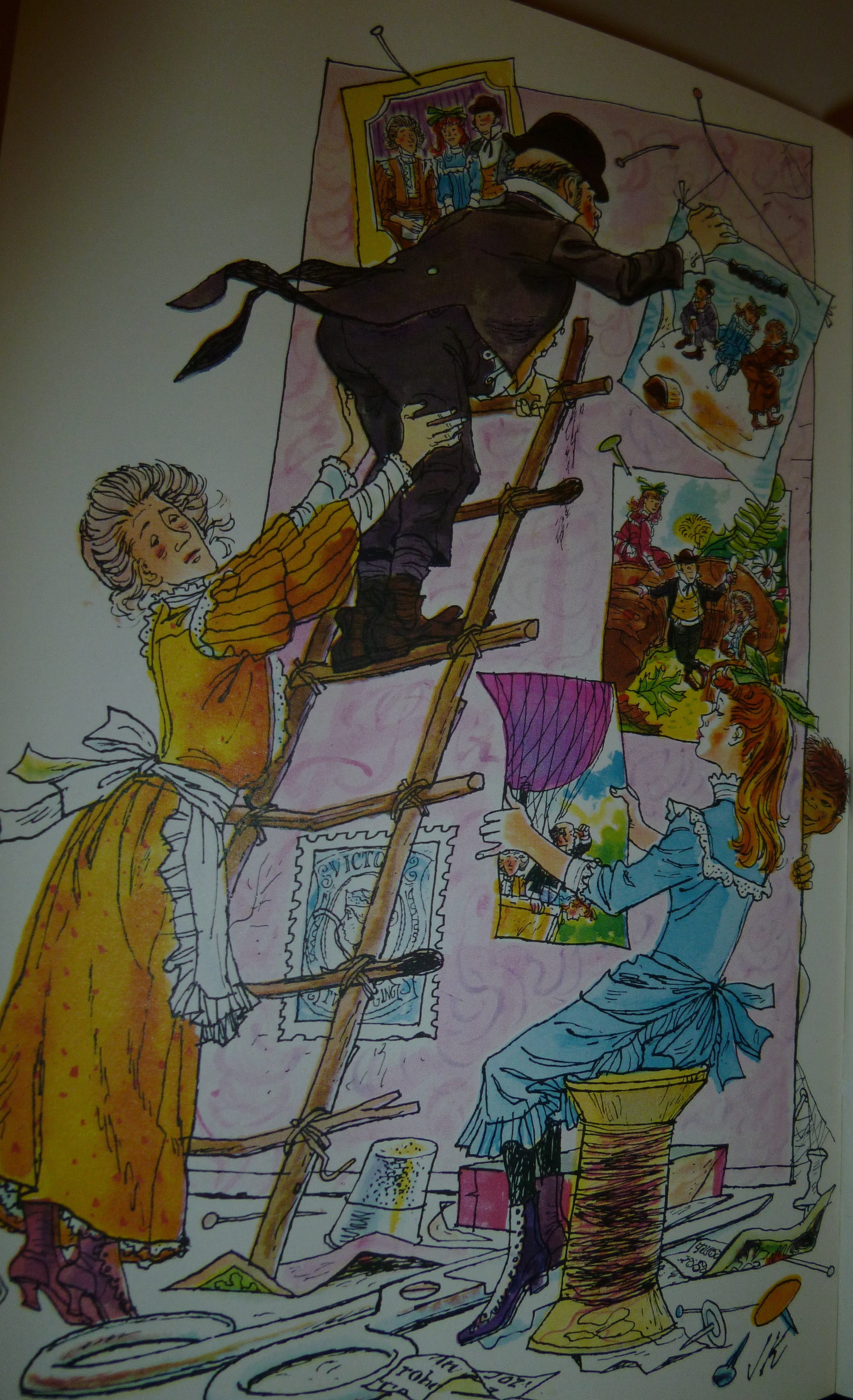
One of my favorite parts of the whole idea is the details on how the Borrowers live.  The stories are set in England, I think in the early 1900s (though it’s a bit vague) and despite being so much smaller than everyone else, the Borrowers have clothes and rooms and furniture that is all quite proper to the time.  Except, of course, that the walls of the rooms are made of stacked books, the table was originally a pill box, and the chest of drawers is made out of match boxes.  I love the ways ordinary objects are cleverly and creatively repurposed.  And it’s fun to imagine the adventures of a family who can (and do) live inside of a boot in one book, and float down a stream in a tea kettle in another.

The Borrowers series focuses on Arrietty, who I think is about fourteen (although I’ve been paging through the first few chapters and can’t actually find an age!) and her parents, Pod and Homily.  It’s the greatest crisis in the world for a Borrower to be seen by a human–but Arrietty has a fascination with humans, which leads to any amount of trouble.

There are five books in the series (plus a very short prequel named Poor Stainless), starting with The Borrowers.  They’re all good, but I think they get better from the second one on.  It’s in the second one that they leave their home in the old manor house and go out into the wider world for adventures–as mentioned, living in a boot for a while, and ending up in a tea kettle floating down a stream, among others.  Norton keeps the suspense up through the Borrowers’ need to evade humans who want to capture and exploit them, and through the ongoing hazards of surviving in the world when you’re much smaller than everyone else.

One aspect to the book that’s interesting and I think unusual, is that it’s actually a family having an adventure.  In most children’s fantasy, the child in the story has the adventure–think of Dorothy, Alice, Jane and Michael, Wendy or any of the children in Edith Nesbit’s books.  The parents are dead, or oblivious to any magic goings-on, or can be conveniently left behind for the length of the adventure.  In The Borrowers, however, we see a family unit of father, mother and daughter launch into the world.  It’s slightly more Arrietty’s story than anyone else’s, but Pod and Homily are the next two lead characters.

One note if you pick this up and find the first few pages slow going–there is a frame story to this, something about humans who saw the Borrowers telling the story to others.  I can tell you intimate details about the Borrowers’ adventures, but I’m extremely hazy on the frame story because I’ve never actually read it.  I probably should someday, but it’s never seemed as interesting, and at some point (probably by the time I’d read the first book or two) I discovered that it’s very easy to just flip ahead a few pages until I found the first chapter that was from Arrietty’s point of view.  So I could be missing a few details of the story, but I’ve never felt their loss if I am.

As it is, the books are a wonderful adventure with excellent characters and a completely different perspective on the world, from the vantage point of a few inches off the ground.
Bear and Psyche, Sort Of

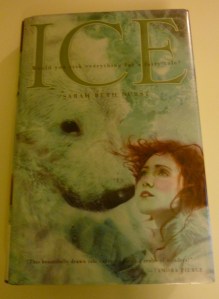
As you might know, one of my reading challenges for the year is to read novels that are fairy tales retold–because I really need to read more than I already do!  🙂  But, that goal is what led me to Ice by Sarah Beth Durst.

Cassie lives in the Arctic, at a research station with her scientist father.  Her mother, she believes, died when she was young.  Her grandmother, however, tells a fairy tale about Cassie’s mother–she was the daughter of the North Wind, and was promised to marry the Polar Bear King.  But she fell in love with a human, Cassie’s father, and bartered with the King–he could marry her daughter instead.  And when the North Wind found out that his daughter married a human, in his fury he blew her away to the castle of the trolls.

Such is the swiftly-established backstory, which probably could have been a novel (or at least Part One of a novel) in its own right.  But Ice really starts when Cassie is eighteen, and past believing in fairy tales–until the Polar Bear King actually shows up and wants to marry her.

As you might guess, the Polar Bear King is in fact a magical polar bear.  He asks her to call him Bear, and can conveniently change shape to a human on occasion–although there are complications.  Durst created a very interesting magical framework for her tale, which I enjoyed.  The unfolding romance was sweet as well, and when some of those complications separate Cassie and Bear, Cassie’s quest to find him is an exciting one.  It’s also implausible in certain ways I don’t want to get into to avoid spoilers, but if you suspend disbelief, it’s a good read.

Ice has a very strong fairy tale feel, complete with the fairy tale backstory and a castle of the trolls located “east of the sun and west of the moon.”  But it wasn’t actually immediately apparent which fairy tale this was.  A video interview with the author describes it as “Beauty and the Beast,” and from the initial premise I went into it expecting that.  Maybe I shouldn’t argue with the author, but I have to say, the farther I read the more I think it’s actually “Cupid and Psyche.”  Granted, Cupid is not usually a polar bear, but that complication involving Bear’s human shape was that Cassie couldn’t see what he looked like–which is straight out of “Cupid and Psyche.”  It also wouldn’t shock me to find out there’s a minor tale somewhere in Grimm’s that this follows even more closely.  It just has that archetypal fairy tale feel to it, and I imagine some of the elements have come up in a lot of different places.

I did have a few reservations about the book.  One of the biggest involves Cassie’s mother.  It’s not giving too much away to reveal that she does come back from the castle of the trolls–it happens fairly early on in the book.  Not knowing her mother was a huge motivation for Cassie at the beginning of the book, but then when her mother actually comes back, I didn’t feel like that was adequately developed.  It’s fair enough to say that meeting your mother for the first time at eighteen does not necessarily lead to immediate closeness, but I didn’t feel like Durst properly explored any relationship between the two of them, even if it was going to be an awkward or strained relationship.

Second, I had some trouble with the points where magic and reality met.  I believed in the research station.  I believed (in a fantasy book way, I mean) in Bear’s castle and in his magic.  But sometimes the two intersected, and I had a lot more trouble believing in a scene where a scientist doing research in the Arctic says, “yes, my wife was held captive by the trolls for many years.”  I don’t think it was just magic and the modern day intersecting–I’ve read urban fantasy that I really enjoyed.  I think it was that characters who showed no sign of believing in magic suddenly started talking about it as an accepted fact, and that was a little hard to buy.

However–it was still a good book.  And when I was getting down to the last few chapters, I even stayed up late to finish reading and see how it would turn out.

Author’s site: http://sarahbethdurst.com/contact.htm (check out the best ever FAQ section!)

Because It’s There

I want to begin this review by saying that I have never been mountain-climbing.  Nor do I ever plan to go.  The truth is, I don’t even like steep hills (which, believe me, can be a problem if you live in San Francisco).  I can walk very happily for miles on flat ground, but give me a hill and it’s all over.  But this is why I love books.  I love that they let me live lives I would never actually live, whether that involves casting magical spells, visiting a distant planet, or climbing a mountain.

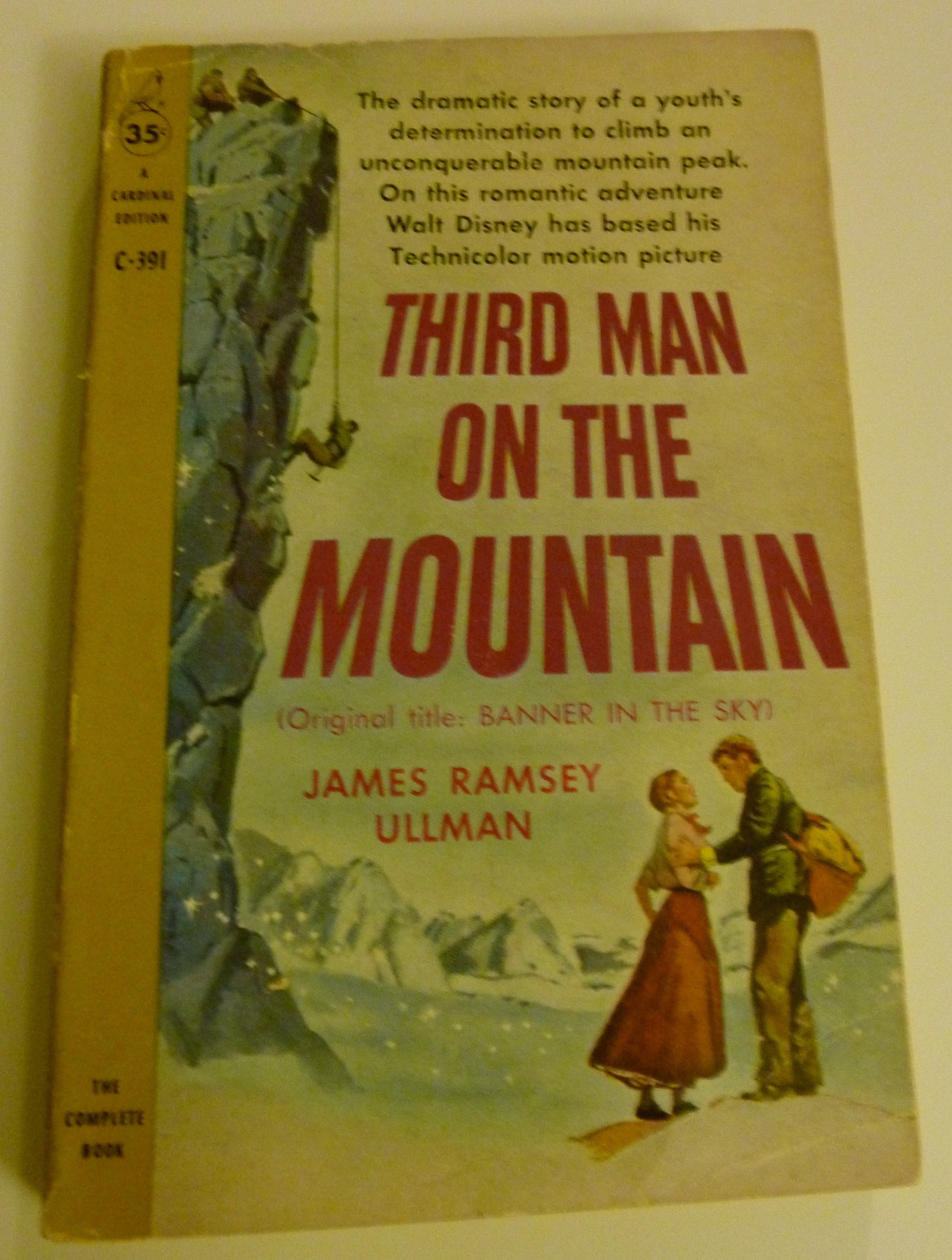
That last brings me to Banner in the Sky by James Ramsey Ullman.  You’ll notice I have a picture of Third Man on the Mountain.  Walt Disney changed the title for his movie version, and then they reprinted the book with the new title.  I like Banner in the Sky better–for one thing, I’m not sure what Disney’s title is even supposed to mean!

With either title, the book is about Rudi Matt, and about the Citadel.  Rudi is a teenager living in a small village in the Alps in the 1800s, and he dreams of climbing the Citadel.  It’s the one unconquered peak, the one no man has ever reached the top of.  No one has tried for years, since the failed expedition that killed Rudi’s father.  Rudi’s mother has forbidden him to become a mountain climber (and I do understand her viewpoint!) but when an Englishman comes determined to lead an expedition up the unclimbable mountain, Rudi is determined to go.

The book is as much about Rudi’s growth as it is about the mountain.  He learns that there’s more to climbing a mountain than just scrambling over rocks, learns about things like trusting others and never leaving a comrade.  He learns to follow his father’s footsteps in more ways than one.  My best guess on Disney’s title is that Rudi becomes a man on the mountain, rather than a boy–but I can’t quite figure out how Disney calculates him as the third one.

This makes it all sound like it’s deep and reflective, and occasionally it is–but there’s also plenty of scrambling over rocks, and getting caught on ledges, and even an avalanche or two.  It’s an exciting story as well as a meaningful one.

It reminds me a little bit of stories about Scott’s expedition to the South Pole.  Not because of the snow similarity, but because they’re both about men trying to achieve a feat that has been considered unachievable.  They’re about pursuing the impossible dream.  And while I personally don’t have any desire to climb a mountain or ski to the South Pole, when the story is told right, I can get very enthused about someone else’s dream.

Why does someone climb a mountain?  “Because it’s there” is always a good answer.  Because it’s there to be conquered.  For Rudi, it’s because he wants to take his climbing staff and his father’s red sweater, and plant them as a flag at the top of the Citadel–a banner in the sky.

Even though I need a good reason to climb a steep hill and can’t imagine climbing a mountain, Banner in the Sky makes me believe in Rudi’s dream, makes me see it as vital and important for him, and makes me want to see him succeed.

Watching Opera with the Phantom

Looking back over my Fiction Fridays, I find there’s at least one representative of almost all my major writing projects.  My Golden Age of Piracy story and my Fairy Tale Retelling, as well as the significant interests of my fanfiction years, Star Trek and Pirates of the Caribbean.  But–I am missing my one other fanfiction interest.  And the Phantom of the Opera does not like to be ignored (somewhat paradoxically, he also doesn’t like being noticed–a complex character).

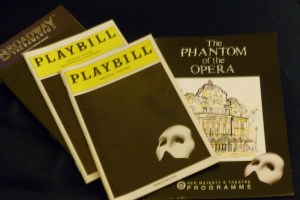
My Phantom Programs

To round things out, and keep the Phantom happy 🙂 I thought I’d share a scene from my Phantom novel.  There’s not a lot of context needed for this particular scene.  Backstory (spoilers for the original, you have been warned)–the Phantom is a masked musical genius who lives beneath the Paris Opera House.  One of his demands for the opera company is that Box Five be reserved for his exclusive use.  He falls in love with Christine, a singer at the Opera, there’s a romantic triangle and a lot of upheaval, and she eventually leaves and he’s left at the Opera House with a broken heart.

My story picks up from there.  It’s mostly but not exclusively based on the Webber musical (the original, NOT in any way, in any form, in the slightest bit, on the sequel–and if you don’t know what I’m talking about, good, you’ve been spared).  It primarily focuses on the Phantom, whose name is Erik (not something Webber mentioned), and on Meg Giry, a supporting character in the original.  She’s not actually in this scene, although she’s loosely referenced in the remarks about blondes.

This scene is a little while into the story, a few months after the original ends, and the management of the Opera has just decided to sell Box Five for the first time.

I think I’m okay on copyright here…Leroux’s Phantom has got to be public domain by now, and nothing here is directly from any other version.

********************************

            The young man who bought the seats in Box Five was named Pierre.  His lady friend, whom he had met exactly two days previously, was named Jacqueline, and so far he had done very well impressing her.  They greatly enjoyed Act One.  Then, in the middle of Act Two, the voice started.

            “You’re in my box, you know.”  It was really a very nice sounding voice.  Definitely male, almost melodious in nature, and conversational in tone.

            That didn’t stop Pierre from taking issue with the words.  He rose from his seat and turned to address the apparent direction of the speaker.  “It so happens that I paid for these seats—”  He broke off abruptly, looking wildly around the box.  There was no one there.

Continue reading “Watching Opera with the Phantom”

Beauty (Maybe) and Her Beast

Beauty and the Beast has always been one of my favorite fairy tales–probably because the retellings are so good.  If you go back to the original story, it’s almost as flawed as any other traditional fairy tale.  But the retellings…are SO good.  Beauty by Robin McKinley is a particular favorite of mine.

The basic story is familiar, if you’ve read the original or even if you’ve seen the Disney movie.  From the Disney movie you’ll recognize the part about the terrifying Beast living in the castle in the woods.  A lost traveler spends the night and, upon offending the Beast, agrees to bring back his daughter, Beauty, to stay at the castle.  From the original story you’ll recognize the part about Beauty’s father being a rich merchant who lost his fortune, forcing them to move out to the country.  And Beauty had two sisters as well, and it was Beauty’s request for a rose when her father began his ill-fated journey that, in a way, put everything else in motion.

I think I read Beauty before I read the original fairy tale, so when I did read the original, I kept thinking, “oh, now I see where McKinley got that detail or this part from!”  But, like any great fairy tale retelling, McKinley has taken the slender original story and embroidered and expanded upon it, bringing the characters to life and explaining the bits that never quite made sense.

Beauty’s father and two sisters are very real characters, and the tragedy of going to the Beast’s castle is as much about leaving them as it is about going to an unknown fate with a monstrous Beast.  How a rich merchant family makes their way in a country village is a detailed and developed part of the story.

Beauty and the Beast are my favorite characters though.  Beauty, like the original and the Disney version, loves to read.  She’s also ugly, or at least considers herself so (not something from either version).  I LOVE that element.  If you read enough fairy tales, breathlessly beautiful heroines get very old.  They’re all very much the same, sweet-tempered and beautiful and sickeningly good.  So I love McKinley’s scrawny, mouse-haired, stubborn-minded Beauty–a name she picked up as a child and has been too embarrassed to request dropped.  The Beast is charming, sometimes unsure of himself, and really rather sweet.  I thought the romance was very cute.

My other favorite part is probably the castle itself.  It’s enchanted, of course, but there’s a wonderful practical side to the magic.  Beauty has a couple of enchanted breezes (sort of) attending to her, and in personality they’re quite fussy and straight-forward and focused on common sense.  And I’m so very, very amused by enchanted candles that light themselves–and sometimes have to admonish each other, “Hsst–wake up, you” when one of them doesn’t light.

Robin McKinley wrote another retelling of Beauty and the Beast called Rose-Daughter which, despite following the same basic plotline, is quite different (a lot more roses, for one thing).  It’s very good also, but much more surreal.  The magic, and even the non-magical characters, like the two sisters, feel less real-world to me–not unrealistic, exactly, but not so realistic either.  I recommend it too, but personally I prefer the more grounded Beauty.

But by all means, read both.  Or either.  Or pretty much anything else by Robin McKinley, because I can’t honestly say I’ve met a book by her I didn’t like.  Beauty may be my favorite, though.

Author’s Site: http://www.robinmckinley.com/