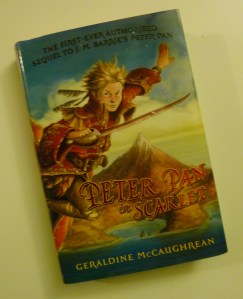
As a general rule, I’m against sequels to classic novels written by new authors, especially when the primary appeal of the original was the author’s voice. How do you ever do that right? I’ve only see it happen once. Peter Pan in Scarlet by Geraldine McCaughrean is a beautiful sequel to Peter Pan.
I give a lot of the credit to her–and a lot of the credit to the way the sequel came to be. That’s a fascinating story too. In 1929, J. M. Barrie gave the rights to Peter Pan to the Great Ormond Street Hospital for Children, meaning that they receive all the royalty money, as well as controlling the rights. Several years ago they held a contest inviting authors to submit a sample chapter and synopsis for a sequel. All of this means that the people involved in the publishing had a primary interest, not in a later version, but in the original work–and you can tell.
I can’t say that Peter Pan in Scarlet feels like J. M. Barrie is telling the story, but I feel like the story is very much about the world and the characters that he created. McCaughrean has done a very impressive job at staying true to the story J. M. Barrie gave us, and yet giving us another story that is, I think, what we all want.
Mr. Barrie was in some ways not kind to anyone who wanted to follow him with a sequel. He left a lot of challenges behind him. To name the chief ones–he killed off his villain, he grew up his supporting characters, and his heroine was rather annoyingly maternal all along. So what is a sequel-writer, saddled with Wendy and knowing that readers really want to see Peter Pan and the (grown-up) Lost Boys fight (the deceased) Captain Hook, to do?
McCaughrean handles it all neatly and effectively, and with the kind of magical and whimsical solutions that are worthy of Mr. Barrie. I don’t want to give it all away…but I can’t resist just a little. Suppose a person wants to get back to Neverland but you can’t depend on Peter to show up at your window, how do you go about it? Well, you’ve got to find a fairy for their dust, right? And the best place to look…Kensington Gardens, of course. And the way to find a fairy is to find a baby out with its nurse, and to catch the baby’s first laugh just as it turns into a fairy. Brilliant, magical and whimsical.
 Peter Pan in Scarlet opens with Wendy and the Lost Boys as grown-ups, but they’ve begun to dream about Neverland again. They decide that something must be wrong, that perhaps Peter is in trouble. They have to find a way to become children again so that they can return to Neverland and help him–and from there the adventures begin. In Neverland they find that summer has turned into autumn, and something seems to be inexplicably wrong.
McCaughrean even handles Wendy well, successfully portraying her as simply a rather practical-minded child (after the grown-ups become children again), rather than a child who wasted all her time in Neverland darning socks.
After we return to Neverland and find everyone’s favorite Wonderful Boy, the adventures are “nicely crammed together,” and we have the chance to explore the greater geography of the magic lands. Everyone’s favorite pirate captain appears too. Again McCaughrean finds a way to stay true to the end of Mr. Barrie’s book, where the Crocodile eats Hook, and yet still bring the villain back.
Even if there was nothing else in this book to recommend it–which is obviously not the case!–there is a single line in here which would alone put it miles above Peter and the Starcatchers in my estimation. At one point in the book, Wendy tells Peter and the Lost Boys a fairy story about a little white bird in the Kensington Gardens. We don’t hear the story; we don’t even know what the story is supposed to be about. But that doesn’t matter. McCaughrean knew that a little white bird in Kensington Gardens is significant in Peter Pan lore.
Thank you, Geraldine McCaughrean, for knowing what you’re writing about, and for writing it so well.
Author’s site: http://www.geraldinemccaughrean.co.uk/
 by Geraldine McCaughrean.
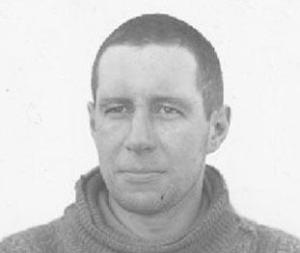 Captain Lawrence “Titus” Oates (at right, though he smiles more in the book) was an Antarctic explorer who went to the South Pole with Robert Falcon Scott. As Sym notes, Titus has been dead for over ninety years—he died in Antarctica in 1910, with Scott and the rest of their party. But he lives on in the present day in Sym’s head. It’s not a fantasy—he’s not a ghost—it isn’t a time travel story—she’s not insane. Titus is Sym’s imaginary friend. And who wouldn’t want to be with “the fortunate Captain Oates,” as Titus describes himself in Chapter Twenty-one. He’s charming and witty and chivalrous, the kind of friend any girl would want.
 Tales of the Marvelous