Going Postal Group-Read, Week One

Today is our first installment of the Going Postal group-read.  Read the details about the challenge, and see my review of Going Postal if you’d like a little more context.

We’re starting off the discussion with a few questions about the first hundred pages of the book.

1)      For those new to Pratchett or Going Postal, what are your first impressions?  For re-readers, is anything striking you this time that you didn’t notice on a first read?

I’m obviously a re-reader.  This is actually one of my first Discworld re-reads–there are so many books, I’ve mostly been seeking out new ones to explore!  I find that the satire is making a bigger impression this time around–I noticed it before, but I’m seeing it more now.  I think I get distracted by all the wonderful humor on an initial read, and while a second time through is still very, very funny, the deeper aspects of the book are coming through more clearly as well.  In just this first section Pratchett has already started touching on so many ideas, about government, truth, civil rights, collectors culture…  I’ll leave it at that for now, as I want to discuss the satire in more depth in a later post, after it’s been developed further!

2)      We’ve started to get to know our protagonist, Moist von Lipvig, by now.  What are your thoughts on him so far?

Pratchett’s makes a lot of Moist’s charm.  Everyone seems to love him, despite the fact that he’s a crook and a scoundrel–and somehow they seem to love him because of it.  I love that Moist himself directly observes this paradox.  I also feel like Pratchett is playing the reader much the way Moist plays the crowd.  We fall under the spell of Moist’s charm too.  He’s friendly, he’s pleasant, he’s completely honest about being a crook, and he has style.  I think readers always love a scoundrel, especially one who never really hurts anyone.  Pratchett makes a point early on that Moist cons people, but he doesn’t kill anyone, or even hit people over the head.  He starts out as the charming rogue that we want to root for.  Having read the book before, I know Pratchett is going to delve into this idea more, and I’m enjoying watching its initial set-up.

3)      We’ve also met quite a few rather unusual supporting characters.  Who are you most looking forward to reading more about?

Strangely enough, Moist is a relatively normal main character surrounded by even weirder figures.  Groat stands out, completely bonkers in some ways but he also has such devotion to the post office, and to the memory of how it used to be.  He’s almost a tragic figure–in a really bad toupee!

I’m also really enjoying Vetinari.  He shows up in a lot of Discworld books, and I think he gets a particularly good turn in this one.  I love that he’s a tyrant who makes things work.  I think I’m stealing that phrase from one of the City Guards books, but it describes him so well.  He’s always four steps ahead of everyone else, nothing ever ruffles him, and despite a well-deserved reputation for ruthlessness, he always makes things work for the greater good.

4)      What are your favorite quotes or moments from this section of the book?

Oh, so many…Pratchett really hits the ground running with the humor.  For instance:

Mr. Groat, re: Stanley: “Orphan, sir.  Very sad.  Came to us from the Siblings of Offler charity home, sir.  Both parents passed away of the Gnats on their farm out in the wilds, sir, and he was raised by peas.”

“Surely you mean on peas, Mr. Groat?”

By peas, sir.  Very unusual case.  A good lad if he doesn’t get upset, but he tends to twist toward the sun, sir, if you get my meaning.”

I don’t get his meaning at all, but it’s hilarious.  If he explained it, it would ruin everything.  A more philosophical favorite moment:

“It was…odd to think of all those letters heaped in that old building.  You could imagine them as little packets of history.  Deliver them, and history went one way.  But if you dropped them in the gap between the floorboards, it went the other.”

*************************************

If you’re participating in the group read, leave a comment with a link to your first post.  I can’t wait to see what everyone thinks!  And if you’re thinking you’d like to join in, it’s not a long read and there’s plenty of time still to catch up; just let me know, and I’ll send you the questions for next Tuesday’s post. 🙂
Favorites Friday: Discworld Moments

Continuing our Discworld theme this Friday…I originally thought of doing favorite quotes, but as I compiled them I realized there were several that were all about the dialogue or the back-and-forth.  So here are some favorite Discworld moments.

First, a philosophical one, about the power of knowledge:

They thought the Library was a dangerous place because of all the magical books, which was true enough, but what made it really one of the most dangerous places there could ever be was the simple fact that it was a library.

– Guards! Guards!

And another time, Death waxes philosophical.  It should be noted that Death always speaks IN ALL CAPITAL LETTERS:

WHO KNOWS WHAT EVIL LURKS IN THE HEART OF MEN?
The Death of Rats looked up from the feast of potato.
SQUEAK, he said.
Death waved a hand dismissively. WELL, YES, OBVIOUSLY ME, he said. I JUST WONDERED IF THERE WAS ANYONE ELSE.

– The Truth

And because Death is so brilliant, another one, after someone suggested that he should be “more of a people person”:

KNOCK KNOCK.
He looked up.
“Who’s there?”
DEATH.
“Death who?”
There was a chill in the air. Beano waited…
I WONDER… CAN WE START AGAIN? I DON’T SEEM TO HAVE THE HANG OF THIS…

– Men at Arms

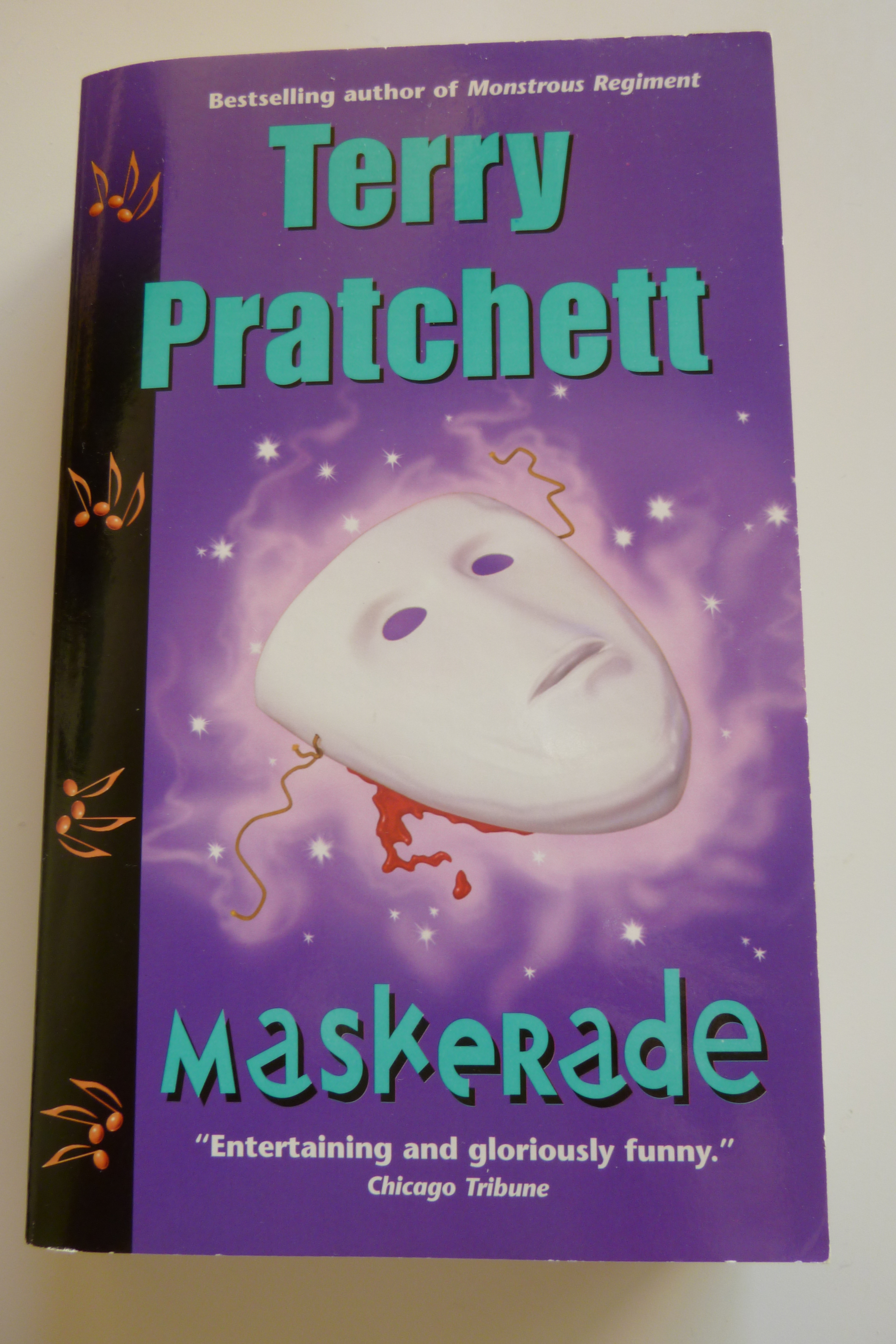
Maskerade is probably a favorite moment in its entirety, and I could quote most of it…but here’s just one moment.  A dead body turns up, along with a note from the Opera Ghost:

Hahahahaha!  Ahahahahaha!
Yrs, The Opera Ghost
P.S. Ahahahahaha!

“I don’t understand!  Is this man mad?”

Salzella put an arm around his shoulders and led him away from the crowd.  “Well, now,” he said as kindly as he could.  “A man who wears evening dress all the time, lurks in the shadows and occasionally kills people.  Then he sends little notes, writing maniacal laughter.  Five exclamation marks again, I notice.  We have to ask ourselves: is this the career of a sane man?”

“But why is he doing it?” Bucket wailed.

“That is only a relevant question if he is sane,” said Salzella calmly.  “He may be doing it because the little yellow pixies tell him to.”

– Maskerade

The image of the Phantom of the Opera, chatting with the little yellow pixies, never fails to crack me up.  It’s the same for this very odd bit below, about a crazed artist:

“He was convinced that if he went to sleep at night, he would turn into a chicken.  He’d leave little notes for himself saying, ‘You are not a chicken,’ although sometimes he thought he was lying…  Scholars have puzzled over the notes ever since, seeking some insight into the poor man’s tortured mind.  They are not in any order, you see.  Some are very…odd.”

“Odder than ‘You are not a chicken’?”

– Thud!

I think I need to re-read all of these books now.  🙂  Other Discworld readers, what are your favorite quotes or moments?

Gender Equality in Discworld

So far, I’ve seen Terry Pratchett be hysterically funny while tackling subjects like racial tension, politically-motivated war, business competition, and murder investigations.  In my most recent Discworld read, Equal Rites, he took on gender equality–and if not hysterically funny, he was at the least quite amusing.

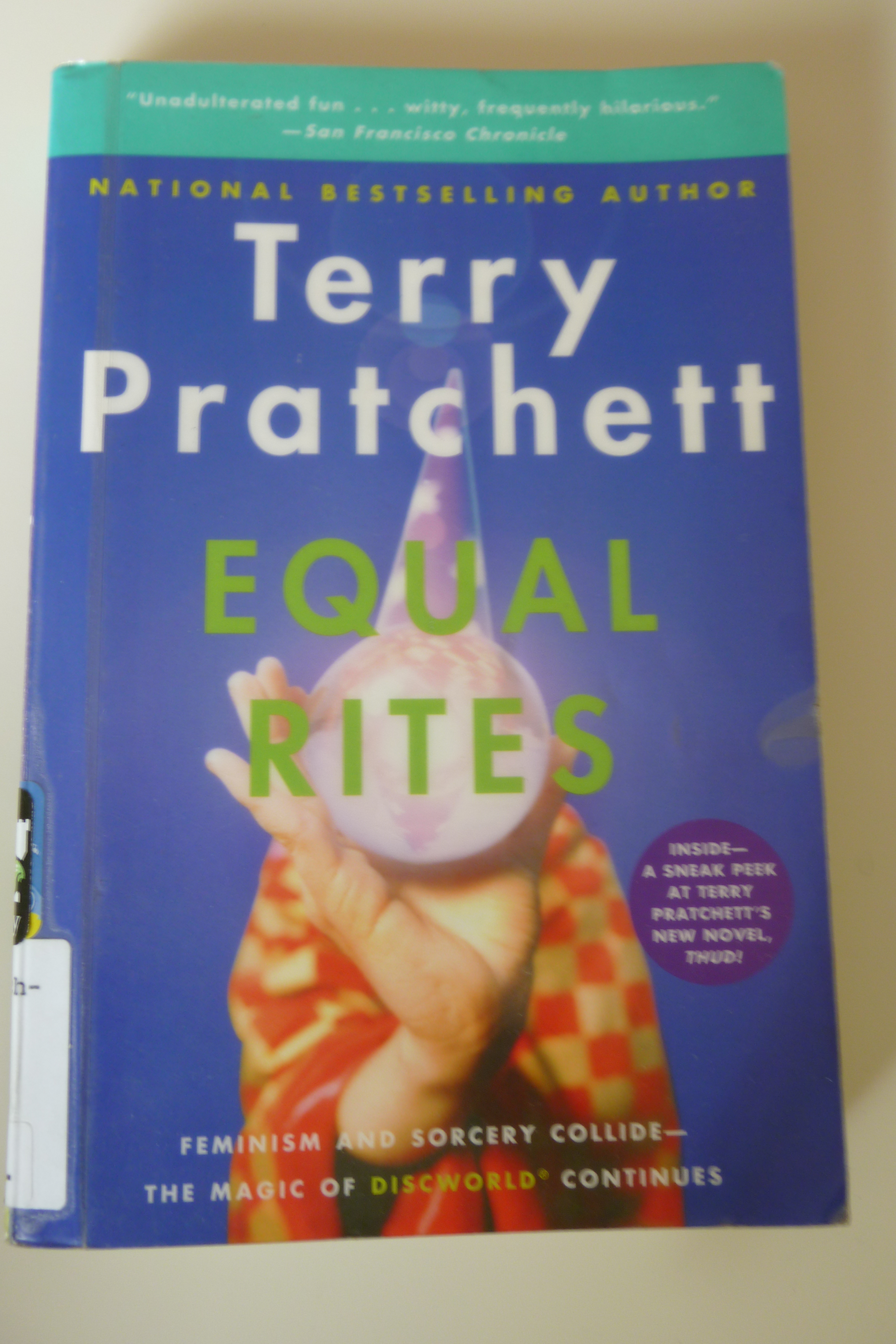
This is a new one for me but not for him, as it’s actually the third book in the Discworld series.  Unfortunately, it shows.  It took a few books for Pratchett to quite work out Discworld, and there seems to be universal agreement that the first couple are simply not as funny.  It’s true for the third one too–it’s funny, but something’s off.  Timing, style, character…I can’t put my finger on it, but it’s just not AS funny.  Don’t get me wrong here–that still makes it one of the funniest books I’ve read this year.  It pales only in comparison to the rest of the series.

I read this one because it’s the first book focusing on the Witches, one of the groups of major recurring characters within Discworld (along with the Wizards, the City Guard, and Death).  I read Maskerade, another Witches book, long before I read any other Discworld (it’s that Phantom connection), and I hadn’t read any Witches books since, so I couldn’t quite put Maskerade in context.  This helped a bit, though there’s much more to read.

As to the actual plot…a dying wizard passes his power on to what he thinks is a newborn boy–but turns out to be a girl.  This is a problem because girls never become wizards.  When Esk gets older, strange occurrences start happening around her–as when she turns her brother into a frog.  Her family sends her to the local witch, Granny Weatherwax, who starts teaching her witchcraft.  But Esk still has all this wizard power hovering around her, and eventually they set off for Unseen University, where all the wizards are trained, to see what can be done about a girl wizard.

There are certainly funny moments.  Granny is an excellent character, although she’s not quite there yet.  She’s a major character in Maskerade too, and she’s funnier then–but she’s funny here.  There’s chaos and there’s mayhem and there’s at least a bit of commentary on gender rights.

It’s a good book–but I only recommend it if you’re really interested in reading as much Discworld as possible.  If you want a fantasy novel about gender equality, read Tamora Pierce’s Song of the Lioness quartet.  If you want to read one book in Discworld, read Going Postal (and if you want to read a few more, check out my post here).  As for me, I’ve got my eye on another Witches novel, Lords and Ladies, which I’ve been told is a retelling of A Midsummer Night’s Dream

Author’s Site: http://www.terrypratchett.co.uk/

Other reviews:
Confessions of an English Literature Eater
Eyrie
Cubilone’s Dimension
Yours?

Favorites Friday: Discworld

The Discworld series by Terry Pratchett really is a world unto itself.  It’s a sprawling, chaotic hilarious tumult of a series, with forty-odd more and less connected books.  The biggest problem is where to begin, and that did put me off for a while…until a friend finally handed me one and told me to start.  I’ve read 18 since then (I think–I swear I counted my list five times and it kept coming out different, which is actually very appropriate for Discworld).  I found out it doesn’t really matter where you start, so if you enjoy humorous fantasy with a satirical bent, I highly recommend jumping in wherever you like.

But some places are perhaps better to start than others, and some books are more hysterically hilarious than others…so I thought I’d share a few favorites, to give you some ideas.  Don’t start with the first book in the series, The Colour of Magic; it’s fine, but there seems to be universal agreement that it’s not one of the best.

Maskerade is the first Discworld book I ever read, sort of.  I did read it first, but I came at it solely as a Phantom of the Opera retelling, had no context to put it in, and haven’t reread it (or enough of the books about the same characters) since reading others to really get it into my head as part of the larger whole.  But technically it was the first, and still a favorite.  There’s a masked madman who’s terrorizing the Ankh-Morpork Opera House with, among other things, little notes where he writes down maniacal laughter (as in “Ahahahahaha!!!!!  Yrs, The Opera Ghost”).  This book also has one of my all-time favorite lines.  Death, a recurring character, appears to a recently deceased man, and tells him he’s going to be a rat in his next life.  The character says, “But I don’t believe in reincarnation!”  To which Death replies… “But reincarnation believes in you.”  Actually, he says it in all capital letters, because he’s Death.

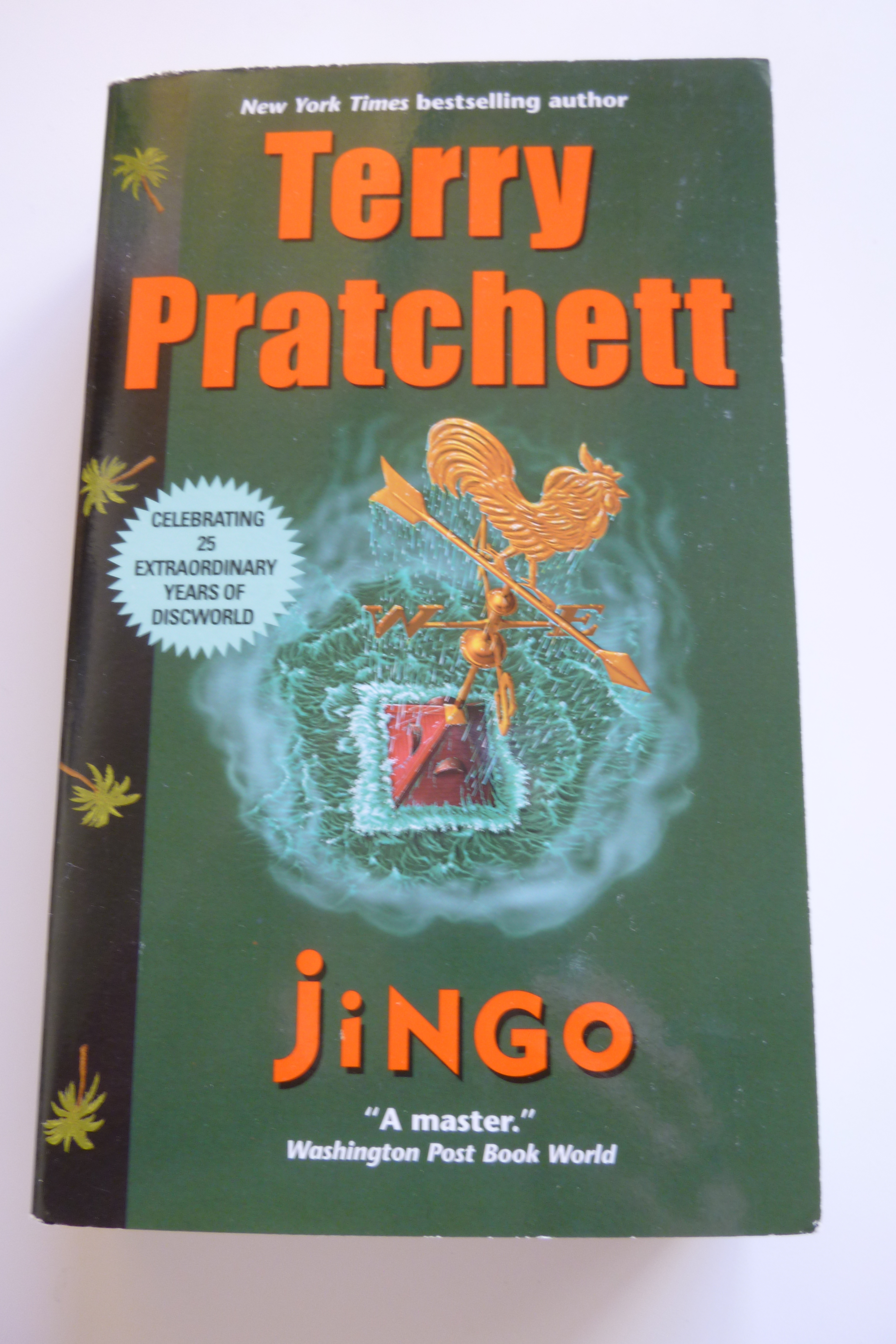
I began my proper reading of Discworld with The City Guard books.  There are eight books focused on Guard Captain Sam Vimes and his crew of more and less competent watchmen.  Guards! Guards! is the first, if you want to start there.  One of my favorites is Jingo, which satirizes the political jockeying around wars.  Vimes eventually prevents war by arresting both opposing armies for disturbing the peace.  Also, Nobby Nobbs gets in touch with his feminine side–which, trust me, says it all if you know the character, and is impossible to explain if you don’t.

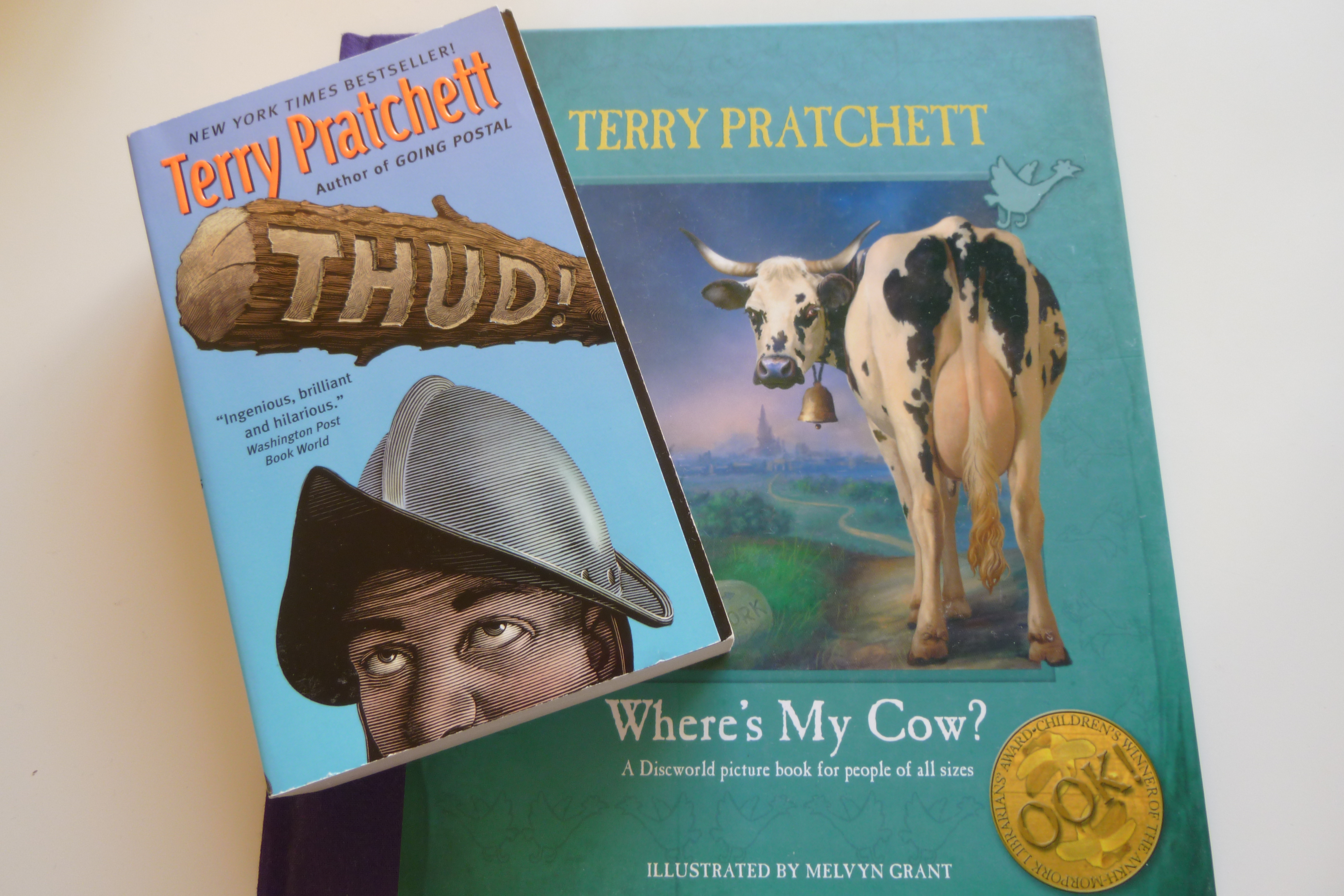
My other favorite City Guard book is Thud!  This one is about racial tension–and it’s hysterically funny.  No, really.  In this case, the two races are trolls and dwarfs, and Vimes has to prevent their ancient feud from exploding all over his city.  My favorite parts, though, are kind of sidenotes.  There’s a famous artist whose papers are almost impossible to decipher, because some of them were quite odd…even odder than “you are not a chicken.”  Also, there’s Vimes’ adorable practice of reading Where’s My Cow? to his son every night promptly at six o’clock, and he never misses.  Even if his men have to declare a state of city-wide emergency to get him home on time.  There’s a companion picture book of Where’s My Cow? which is simply adorably good fun.

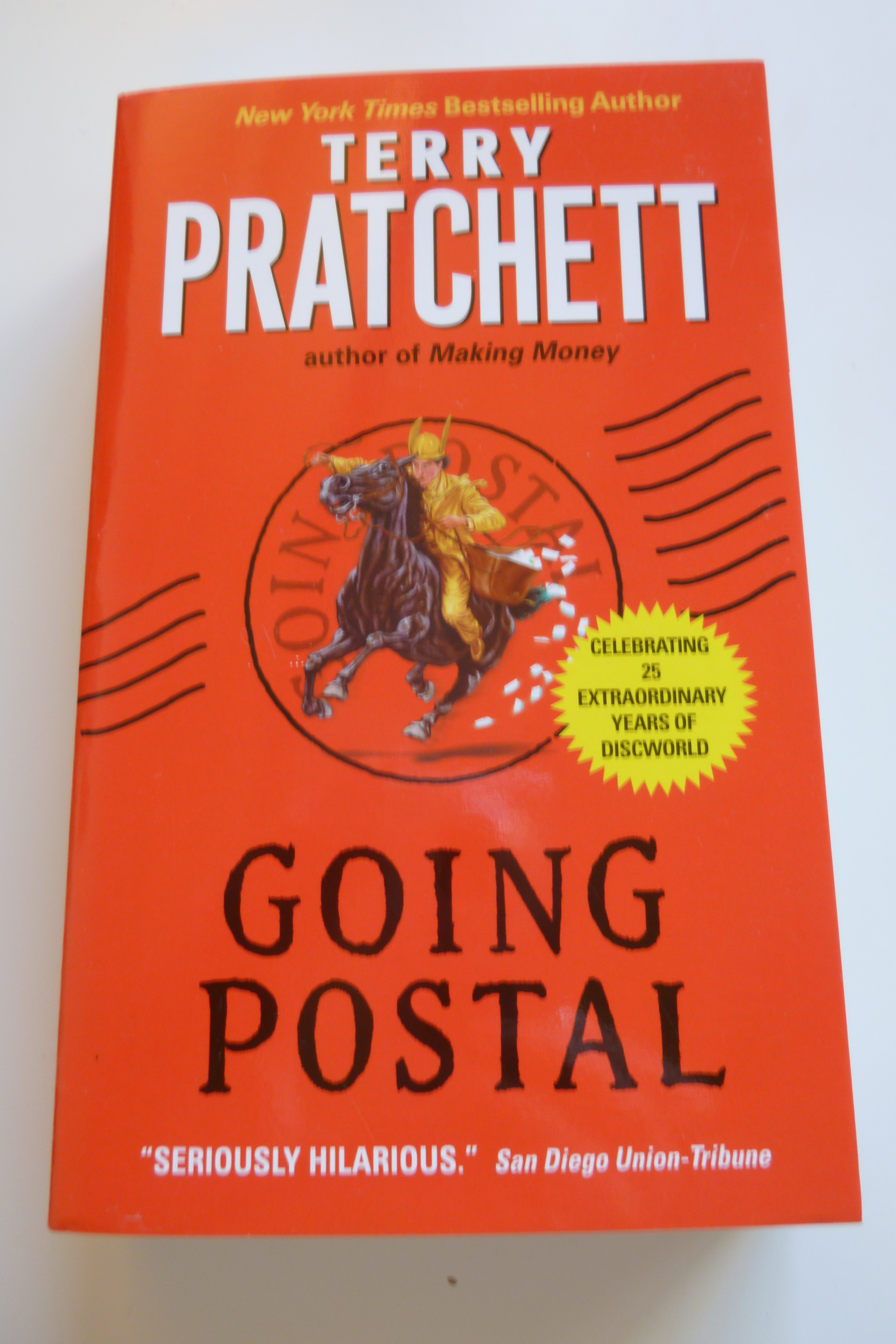
Going Postal is actually my usual recommendation to people of where to start.  I wrote a review earlier, so suffice to say here that it’s about a petty criminal who survives the gallows and is given a chance to become Ankh-Morpork’s new Postmaster.  The Post Office hasn’t functioned in twenty years and is literally filled with undelivered mail.  And I do mean literally.

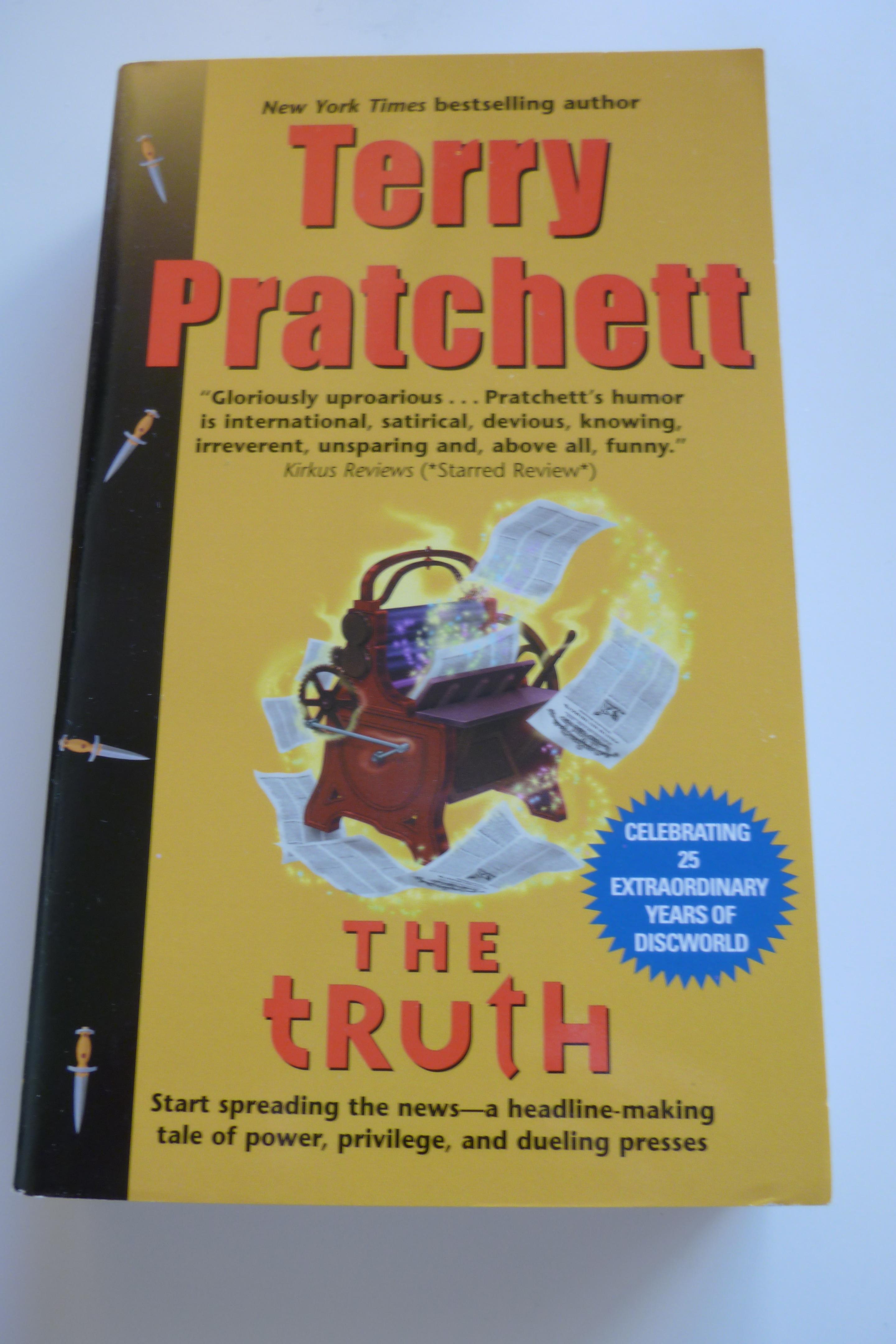
The Truth is another good starting place, another fairly independent one.  This one satirizes journalism, and features a vampire photographer.  The light from the flash turns him into dust every time he takes a picture.  But it’s okay, he has it rigged so he turns back again.

If this post is a little disjointed and incomprehensible, that’s just the nature of the series.  Not really disjointed and incomprehensible, but random and complex and marvelous.  You know you want to understand all my half-comprehensible jokes and carefully veiled references…so you ought to read the series!

Quotable Mark Twain

“I have had a ‘call’ to literature of a low order, i.e. humorous…to seriously scribbling to excite the laughter of God’s creatures.”

– Mark Twain