The Master of Heathcrest Hall by Galen Beckett

Master of Heathcrest HallI had insomnia one night last week, and the one silver lining was that I got to finish The Master of Heathcrest Hall at four that morning.  I’ve been working on this trilogy for both Once Upon a Time and my Finish-the-Series goal, and I’m so very glad I did–because I loved it.

If you like, you can jump back and read my reviews of the first two books, The Magicians and Mrs. Quent and The House on Durrow Street.  To give very quick context: the trilogy is set in an alternate England (Altania), where some men are magicians, others can craft illusions, and certain women can speak to the Wyrdwood–Old Trees that are self-aware and capable of movement.  Oh, and the day and the night are of uneven lengths, which fascinates me, and the whole writing style and society has a strong Austen feel.

The third installment brings us back to our three major characters.  Ivy is living on Durrow Street with her two sisters and her beloved husband, Mr. Quent, and still trying to puzzle out messages left her by her father.  Rafferdy has become fully involved in the Assembly, as well as a clandestine group of magicians, working to protect the Wyrdwood.  Eldyn is performing as an illusionist, and learning how to make impressions (a kind of magical photo).  All their lives are going along pretty well…but there are political rumblings, a revolutionary army on the march, and a red planet coming ever closer and bringing with it the Ashen, terrifying enemies set to destroy all life in their path.

All these bigger issues were largely in the background in the second book, which worked surprisingly well.  I was hoping they would become more central in the third book and (eventually) they did.  Beckett does very nicely gradually building up to the larger crises, while somehow never losing the feel of ordinary people who (mostly) are trying to go about ordinary lives.

I also hoped for more of Mr. Quent (he is, after all, the title character) but only partially got that.  There was a bit of a facepalm moment when, at the very beginning of the book, we find out Mr. Quent is out of town.  Again.  As usual.  He was perpetually out of town or working late in the second book.  He actually does end up being in this one a bit more, and I just love it whenever he and Ivy are together.  There’s such a Bronte feel to the two of them.  Bronte actually gives us those sweet conversations Austen likes to skim past.

Mr. Quent also gave me the most heart-wrenching moment of the book…which I can’t explain without spoilers, though those who’ve read it probably know.  It wasn’t actually when horrible things happened–it was when I realized horrible thing were going to happen, and how, and why.  Sigh.

These books are all around 700 pages each, so by the end of the third, I had spent a lot of time with our three main characters.  I loved how they grew and developed.  Ivy was always wonderful, but she found new strengths and confidence over the course of the trilogy.  There were a few moments in this book, however, when I felt like she did some really stupid things, which felt like they only happened to keep the plot moving.  I tried not to get too irked, and the book and Ivy both did get back on track…

Eldyn had some interesting growth, as he always wanted to do great things but had to learn his own right path.  Rafferdy grew the most, from a dandy with interest in nothing, to an honorable, caring man willing to sacrifice for a greater cause.

There’s a love triangle in here that I really liked, because it felt like a genuine conflict (though I guessed how it would ultimately resolve) while at the same time all three were so honorable, and respectful of everyone else involved.  It struck me as such a contradiction to the (false) idea that you can’t write a book about genuinely good people.

As noted, this is a long book and, considering it’s written in an Austenish style, it’s not usually in much of a hurry.  It works though–don’t expect fast paced action (except now and then) but there is a very satisfying slow unrolling of events and revealing of mysteries.  Without getting into spoiler specifics, I’ll also mention that, in the end, everything ties up happily, in a way that’s almost too convenient.   I know that bugs some people, so be aware…although personally, I like neatly happy endings.

I’ve been recommending this one to all of my friends who like Austen and fantasy.  I think you really do have to like both, but if you do, this trilogy is one not to be missed!

Author’s Site: http://wyrdwood.net/

Other reviews:
Stella Matutina
Fyrefly’s Book Blog
Just Book Reading
Anyone else?

Buy it here: The Master of Heathcrest Hall

A Gothic Parody from Miss Austen

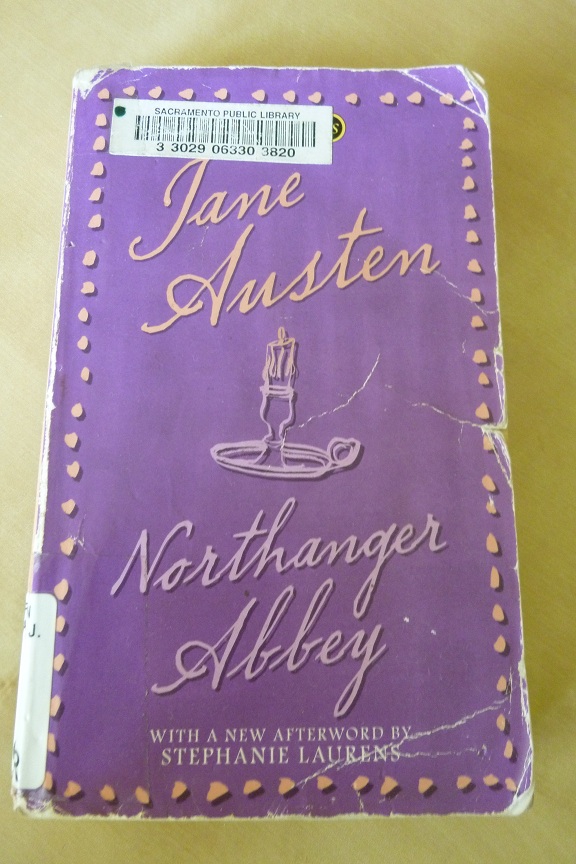
Forgive my battered library copy…I’ll be buying a better one.

I finally got to my last goal-book for R. I. P.Northanger Abbey by Jane Austen.  There’s even a little more of a “finally” to this, considering it was a chosen book for my high school book club and I never got around to it then.  But maybe it’s just as well; I don’t know if I would have found Austen as easy a read then–and I loved the book now.

Northanger Abbey is a spoof on gothic novels.  I haven’t actually read many, but it doesn’t seem to matter.  A lot of the concepts have slipped into the cultural awareness, and it always seemed pretty clear what Jane was poking fun at.

The book is about Catherine Morland who, the narrator tells us, doesn’t seem at all suitable to be a heroine–for instance, her father “is not in the least addicted to locking up his daughters.”  Catherine loves reading about heroines, and simply adores gothic novels.  Her opportunity for adventure comes when she’s invited to accompany some family friends to Bath.  There she makes the acquaintance of the charming Mr. Tilney and his sister, who eventually invite her to their family home of Northanger Abbey.  It’s the perfect setting for a gothic novel and Catherine’s imagination runs wild.

This book has the most delightful feel to it.  It’s the lightest Austen I’ve read, with a wonderful sense of humor throughout.  It’s frequently meta, with a narrator who comments on the ongoing story, noting at times how it does and doesn’t fit a gothic novel, with some lovely tongue-in-cheek observations.  Austen herself feels much more present here than in her other novels that I’ve read.

The characters are vivid, and the cast is a little smaller than usual, so the characters don’t get lost among the crowd.  Catherine is rather silly at times, but she’s also very honorable and good-hearted.  I don’t admire her as much as Elizabeth Bennet, but I like her very much.  She shows good character development as well, maturing through the novel.

And Mr. Tilney–well, with all due respect to Mr. Darcy, it takes Colin Firth five hours to crack a smile in the BBC miniseries.  It’s so nice here to meet an Austen hero with a perpetual smile.  Mr. Tilney makes jokes and is charming and fun.  I was talking about this book with two friends, and the opinion was unanimous in appreciation of Mr. Tilney.  Another note: even though I’m calling him “Mr. Tilney,” the narration actually refers to him as Henry at times, and you can’t imagine how much more human that makes him seem than the perpetual Mr. This and Mr. That we usually see in Austen.

The other major characters are Isabella Thorpe and her brother John who…well, I hate to give things away about them.  But Catherine learns something about real and imagined intrigue, and the difference between books and life.

Which reminds me–there’s a splendid rant from Austen at the end of chapter five, about the poor regard for novels and how wonderful they really are.  Bravi.

I think I’ll be recommending Northanger Abbey next time I’m talking to someone thinking about picking up Austen.  It’s a good gateway book, distinctly Austen but lighter and a less dense read.  And my new favorite!

Other reviews:
The Librarian Next Door
Allegraphy
Lost Generation Reader
All Things Bright and Beautiful
Any other Austen fans?

Austen and Bronte and Magicians

My next book for the R. I. P. Challenge is The Magicians and Mrs. Quent by Galen Beckett, which mostly comes into the category in the book’s second part.  I became interested because this was described as a blending of Austen and Bronte, in a fantasy world–and that’s exactly what it is!
The book is divided into three sections.  Book One is told by three narrators in rotating chapters.  We meet Ivy first, a young woman fascinated by magick [sic].  Her beloved father was a magician who has gone out of his mind; Ivy comes to realize that magick may relate to the cause, and also that he left her a riddle to solve, relating to vital work she must do.  Rafferdy is another narrator, a bored and cynical nobleman interested only in amusement and determined to do no harm by having no meaningful effect on the world at all.  Our third narrator is Eldyn, who is striving to create a better life for himself and his sister, but in the process falls into the power of a ruthless highwayman and revolutionary.

The personal stories of all three characters roll out against a backdrop of brewing revolution and a growing magical threat, which Ivy in particular must find a way to combat.

Book One has us very much in Austenland.  Book Two takes a dramatic shift towards Bronte, when Ivy accepts a position as governess at Heathcrest Hall, a gloomy manor out on the moors.  There’s a not too subtle resemblance in the premise to Jane Eyre, and Heathcrest Hall is presided over by Mr. Quent, who bears a not too subtle resemblance to Mr. Rochester.  Book Two is strictly about Ivy, and told by her in first person.  The book takes on a gothic feel, out on the misty moor where strange magick is afoot.

Book Three takes us back to the setting and narrative structure of Book One, as all the characters’ plotlines come to a head.

This book started slow for me, but I ended up really enjoying it.  In the first section, I was mostly only drawn into Ivy’s chapters.  Rafferdy and Eldyn are interesting, but they weren’t engaging me that much. The book picked up in the second section, when the plot gets more focused, and we get much more magick.  (And I have no idea why it’s spelled with a K, but it is.)

The book is set in Invarel, which is a very obvious parallel to England.  All the names are changed, but there are frequently details that are clear analogs; for instance, the brewing revolution centers around an obvious Bonny Prince Charlie equivalent.  There is the difference, of course, of the presence of magical forces, which exist in a few different varieties.  There are magicians who can work certain complex spells.  There are illusionists, who mostly work their marvels in theatres.  And there are witches, who have an affinity for the Wyrdwood, an ancient forest spread throughout the country and which, legends say, will fight back against its enemies.

All the magick is intriguing, although in a way what grabbed me the most was scientific (sort of).  The other biggest difference between Invarel and England is that Invarel’s planet is in a solar system which operates very differently from ours.  The crucial result is that they don’t have days and nights of set length.  People have to constantly check their almanacs to see how long the day will be–maybe four hours of daylight, maybe twenty-eight.  I was fascinated by the concept, and by all the details about how society can function under those circumstances.  I kind of wish there had been more of that!  I’ve seen at least one reviewer complain that it didn’t make sense and that’s probably true–but that didn’t worry me.  It was just so interesting!

The world of The Magicians and Mrs. Quent is an intriguing one, and I was also drawn into the characters.  As mentioned, it started slow for me, but Rafferdy eventually gains some depth and Eldyn’s plotline gets more intense.  I enjoyed Ivy from the beginning; her family circumstances and her character are both reminiscent of Elizabeth Bennet.  She’s a capable, intelligent, well-read young woman who is nevertheless constrained by her position in society.

I was essentially playing “spot the Austen character” all through Book One.  Ivy’s parents and two younger sisters all seem drawn from the Bennet household, and you can also find Lady Catherine de Burgh, Mr. Collins, and even Mr. Palmer from Sense and Sensibility.  There may be more–I’ve only read three Austen books.

I suspect this book is more fun if you’re familiar with both Pride and Prejudice and Jane Eyre, although I don’t think it’s essential.  It draws from them for the characters, and the circumstances those characters find themselves in (Ivy especially), but the plot goes in a different direction from either book.  If you don’t have the background knowledge, you could probably just take this as-is and be interested.

The style of the writing is also drawn from Austen and Bronte, although rarely in a heavy-handed way.  You can see it right in the first sentence: “It was generally held knowledge among the people who lived on Whitward Street that the eldest of the three Miss Lockwells had a peculiar habit of reading while walking.”  A few times I thought Beckett was trying too hard to make the dialogue sound Austenish and it came out stilted, but most of the time it’s a nice flavor in a very readable book.  Except, that is, when Beckett picked up Austen’s teeth-gnashing habit of skipping lightly past romantic declarations without any dialogue!  I always want to know what they said, not just the narrative fact that they said it!  Sigh.  On the plus side, near the very end of the book we get a little more Bronte-style adorable romantic teasing dialogue, so I was somewhat mollified.

All in all, I’d say, be warned that this may take some effort at the beginning, but it really is worth continuing.  I recommend this if you like fantasy, and highly recommend it if you like Austen and Bronte.  I know I’ll be going on to read the next two books!  This one gives us resolution, but there are still mysteries to be explored.  I may also be rereading Jane Eyre soon…

Author’s Site: http://wyrdwood.net

Other reviews:
Fyrefly’s Book Blog
Kid Lit Geek
Stewartry
Things Mean a Lot
Stella Matutina
Anyone else?

New Reading Experience: RIP VII

The “Readers Imbibing Peril” challenge (experience) is starting up at the beginning of September.  This is another reading event from Carl at Stainless Steel Droppings, and it’s my first year joining in.  As you might guess from the acronym, this challenge is about a creepier side of literature, focusing on mysteries and horror and gothic writing.

This is not quite so much my area as the Once Upon a Time challenge–in fact, it’s not at all my area!  But since Carl’s events are so much fun, I can’t resist jumping in anyway, and I’m willing to try a few books from the darker, more mysterious region of writing.

I have less planned than I’ve done for other challenges.  I think I’ll be conservative and aim for Peril the Second (read two books), Peril of the Short Story, and Peril on Screen.  I have Murder on the Orient Express by Agatha Christie and some Sherlock Holmes to get me started on mysteries.  Northanger Abbey is next on my list from Jane Austen, to bring in the gothic.  And maybe I’ll watch some Twilight Zone or Alfred Hitchcock.  Other than that, I’m curious to see what other people read and review, and expect to pick up some new ideas from that.

And I expect to have an excellent good time. 🙂

Persuaded to Read More Austen

Somehow–and I don’t really know how–I went all the way through a BA in English without being assigned any Jane Austen.  I’ve been trying to rectify that gap in my reading history, first with Pride and Prejudice and then Sense and Sensibility.  I picked up S&S because it was the most familiar title after P&P, and I did like it well enough though I wasn’t enamored.  Then several more Austen-familiar friends told me I had to read Persuasion–so I recently gave it a go.

Persuasion came in for me somewhere in between, not as good as Pride and Prejudice but better than Sense and Sensibility.  I learned my lesson from S&S and watched a movie version (1995) first, to help me get some grounding on who all the characters were.  This may have slanted my impressions somewhat, although mostly I think it was helpful.  Austen employs a large cast of characters related to each other in complicated ways, and it helped coming into it with some idea of how everyone fit together.

I had a little trouble with Austen’s language–some of her sentences are extraordinarily convoluted, so that I had to go back to the beginning and try again to follow their thread.  Like I’ve found with other authors, though, the more I read the easier it gets, so this was mostly only a difficulty in the beginning of the book.

This is largely a character-driven story, making it a little hard to give a plot description.  In a way, it’s a Cinderella story, about a Cinderella who mislaid her prince.  When Anne Elliot was 19, she was engaged to Captain Wentworth, splendid in every way except for a lack of fortune.  Lady Russell, a dear family friend, persuaded Anne to break off the match.  Eight years later, Anne is still single, disregarded and a bit downtrodden by her horrid father and two sisters.  You can even cast Lady Russell as the Fairy Godmother (if a slightly misguided one) who sees Anne’s value and wants to help her.  Such is the situation when Captain Wentworth comes back into Anne’s life and social circle, and then the question becomes whether she still loves him and, even more in doubt, whether he still loves her.

That sounds fairly straight-forward, but there are subplot romances, a couple other suitors for Anne, and a lot of going about making social calls in one place or another.

I enjoyed the characters–Anne is a complex, sympathetic heroine.  She’s under less societal threats than Elizabeth Bennett, whose whole family would collapse if the daughters didn’t marry well (or at least, her mother thought so).  Anne has Lady Russell as her refuge, and maybe that’s just as well.  Her desire to marry Captain Wentworth really seems to be about him, not societal pressures (which is not at all to criticize Lizzie’s attachment to Mr. Darcy, just observing context!)

And while I don’t want to give too much away–let’s just say that there is a final romantic conclusion, as seems to be usual in Austen, and she actually gave us more dialogue for a change!  Instead of narration along the lines of “and he expressed himself on the occasion as sensibly and as warmly as a man violently in love can be supposed to do” (which has me wishing to know what Mr. Darcy said), we actually get a quite beautiful declaration-of-love letter, and some real talking.  Probably still less than most authors would have done (sigh) but more than seems to be Austen’s norm.

One thing that struck me in this book was the question of servants.  I came to this book directly after watching Downton Abbey, which shows the life upstairs and the life downstairs with equal care and interest (and my favorite character is Anna, the head housemaid).  Persuasion is strictly the life upstairs.

Anne’s father is a baron of some sort.  He’s fallen on financially difficult times, but he is still determined to keep up the proper status.  He must have servants.  Anne’s snobbish elder sister cannot possibly be cooking or cleaning or probably even doing her own hair.  But servants aren’t mentioned at all!  They’re not even walk-on characters.  Finally halfway through the book, that snob sister decides not to hold a dinner party in Bath, because they have less servants at their lodgings than they used to have at their manor house, and that would be embarrassing.

Coming right off of Downton Abbey, I wondered a great deal about these completely disregarded people who really must be there but aren’t noticed by anyone.  It almost feels like a modern book where you wouldn’t bother to mention that a character has a refrigerator.  Of course they have one.  Of course Austen’s characters have servants.  Why say more about them?

That was my own particular quirky reaction to the novel.  On the whole, I did enjoy it, and it was nice to meet another cast of Austen characters–once I worked out who was who!

Other reviews:
Fyrefly’s Book Blog
It’s All About Books
Becky’s Book Reviews
And no doubt many, many others.  Suggestions?