Fairy Tale Round-Up: Beauty and the Beast

One of my favorite fairy tales is “Beauty and the Beast.”  If you read the original by Jeanne Marie Leprince de Beaumont, it has as many weirdnesses as any other fairy tale.  But it also has a heroine with more spirit than most (and who likes to read!) and a romance with at least the potential for more depth.

The story is pretty consistent, about a girl who goes to live with a Beast to save her father’s life.  She sees past the Beast’s forbidding exterior to fall in love with him, breaking the spell and turning him into a handsome prince.  And usually there are roses in it somewhere!  In the original, the Beast is kind of scary and manipulative, not to mention far too attached to his flowers.  But the retellings are some of my very favorite stories…
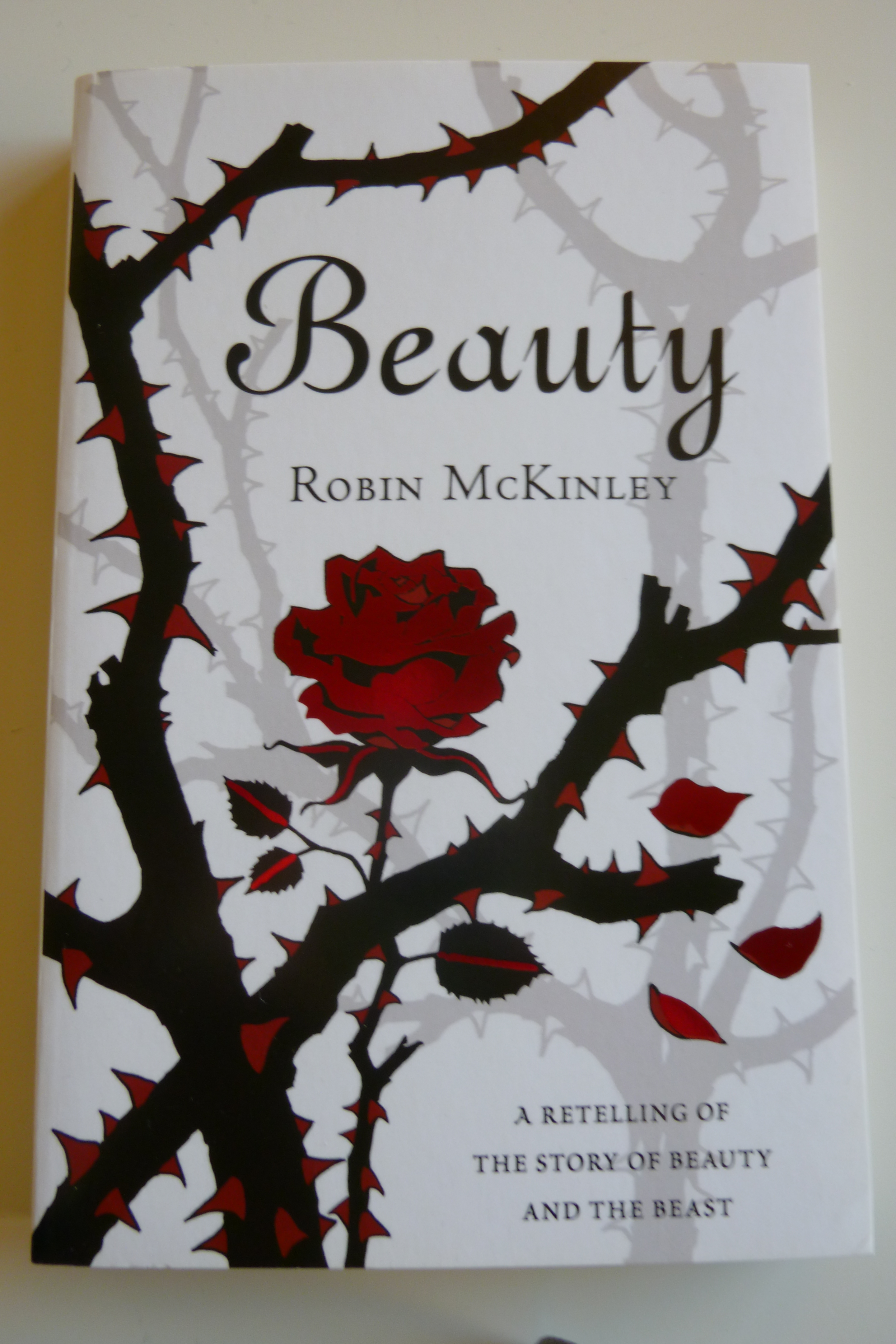
Beauty by Robin McKinley was probably one of the first fairy tale retellings I ever read.  It’s a beautiful book that’s as much about Beauty, her family and her own growth as it is about her romance with the Beast–which is still quite sweet.  The non-magical world feels very real, and even the enchanted castle, while appropriately magical, has a somewhat homey feel.  It’s a cosy book, sweet and lightly humorous.

McKinley returned to the story for Rose Daughter, another (unrelated) retelling.  This version is gorgeously written, and far more surreal.  If Beauty is all pastels and greens and browns, Rose Daughter is all vivid scarlets and purples and strange shadows.  The Beast’s castle is truly another world, where rules of magic supercede little things like the rules of physics.  I didn’t like the romance quite so well and there was a lot about roses, but it’s still an absolutely lovely book.

I’m not as fond of La Belle et La Bête, Jean Cocteau’s 1946 movie version.  It has a very surreal feeling too, but to some extent that kept me at a distance from the story.  The characters felt too much like archetypes and some parts were unexplained–and I don’t think it was a problem of the French dialogue.  The sets and effects are wonderful and it’s a landmark in fairy tale films, but it’s more interesting as an academic view than as simple entertainment.
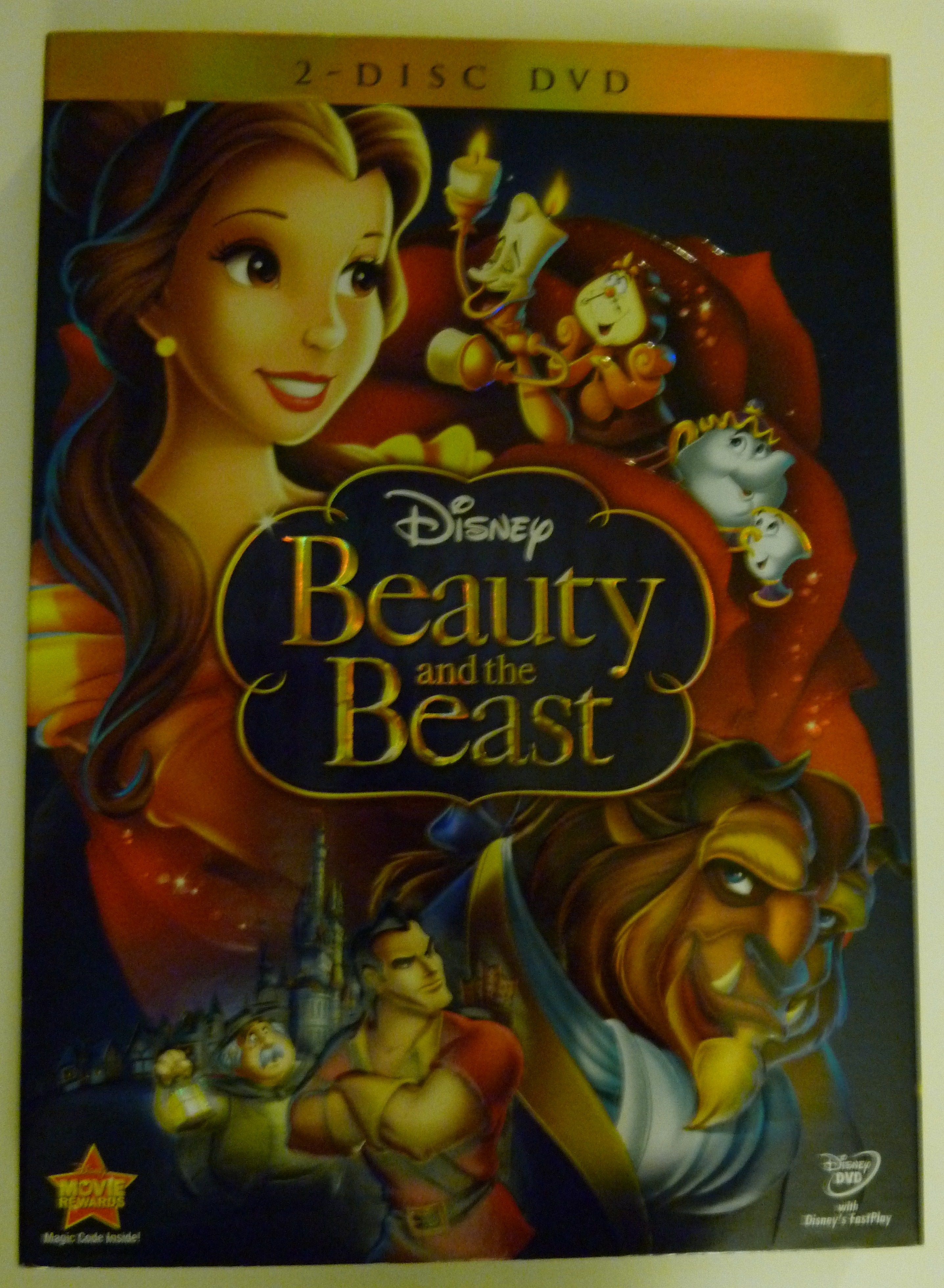
I do love the much lighter Disney Beauty and the Beast.  It has gorgeous scenery, excellent songs, and wonderful characters.  Belle, the Beast and the assortment of talking objects are all delightful characters, and the plot is much improved by the introduction of Gaston as a convincing villain.  This may be my favorite Disney cartoon (though there’s some stiff competition out there!)

Heart’s Blood by Juliet Marillier is a much looser, more mature retelling.  Caitrin comes to the castle to work as a scribe, fleeing her abusive family and an unwanted suitor.  She meets Anluan, crippled in body and even more so in spirit, and learns about his family curse that populates the fortress with ghosts.  It’s “Beauty and the Beast” only in the broad strokes, but there is an enchanted mirror and a curse to overcome–even though it’s really more about finding strength within than it is about meeting requirements to break a spell.

I’d love to find more good “Beauty and the Beast” retellings!  Any suggestions?

Tim Burton and Johnny Depp’s Dark and Shadowy Movie

The movie world seemed to be all abuzz recently over The Avengers.  I was more interested in another release—Dark Shadows, directed by Tim Burton and starring Johnny Depp.  This is their eighth collaboration, and if you’re looking for something new, well…better find another movie.  But if you want another ridiculous, campy, shadowy Tim Burton/Johnny Depp movie, you’re in luck.

The story is about Barnabas Collins, and the Hell-fury of a woman scorned.  Barnabas makes the mistake of scorning a witch, who kills his parents, kills his true love, turns Barnabas into a vampire, has him buried alive, and spends the next two hundred years trying to destroy the Collins family fishing business.  When Barnabas is finally dug up in 1972, he finds that the family has dwindled to just a few destitute members, though they have hung on to Collinswood, the enormous manor house.  Uncle Barnabas resolves to restore the family fortune, while casting an interested eye on the new governess and sparring with the evil witch.

There is blood.  There is ridiculous make-up.   There’s Helena Bonham Carter, as usual upstaged by her hair (bright orange this time), and Christopher Lee in a small role.  There are bizarre plot turns, a shadowy gothic atmosphere, and a lot of laughs.  In other words, it’s the usual fare for Johnny Depp and Tim Burton.

I have no familiarity with the original Dark Shadows, so I really can’t comment at all on how this compares.  I could feel the soap opera origins at times.  I can easily imagine how certain plot twists and character revelations, which happen in five minutes here, would have furnished three weeks of plotline, soap opera style.  The movie doesn’t feel rushed, though—just wild and unpredictable.

The best part of the movie for me was watching Barnabas try to adjust to the world of 1972.  He’s blown away by a lava lamp, doesn’t know what to make of a paved road, and attacks a television trying to figure out how the tiny songstress is inside.  In one of my favorite moments, he mistakes the arches of a McDonalds for the sign of Mephistopheles over the gates of Hell (kind of apt, actually).  He has a wonderful conversation with a group of hippies about wooing women (the hippies impart great wisdom, such as that modern girls don’t care about sheep).  Johnny delivers endless completely absurd lines, and manages a straight face through the whole movie.  I really hope this DVD has a blooper reel!

This is not a deep movie.  If there’s a moral, I don’t know what it is (other than, possibly, don’t make a witch angry).  If it’s about any important issues, I don’t know which ones.  But it is full of dark, shadowy, slightly creepy fun.

You know, just like Johnny Depp and Tim Burton’s other seven films.

La Belle et la Bête

In my ongoing quest for more fairy tales, I recently watched the French film, La Belle et la Bête.  This is another one for Once Upon a Time‘s Quest on Screen.  The movie was…odd.  I’ve heard this one touted so much as a landmark film in the realm of fairy tale retellings, but sadly, I just wasn’t impressed.  I’d actually seen it years ago, in a mythology class in high school.  I was hoping that I was wrong back then–because I disliked it the first time through.  I liked it better this time, but I’m still not really a fan.

The movie is based on the story by Jean-Marie Leprince de Beaumont, as all Beauty and the Beast retellings seem to be.  Beauty’s father is a wealthy merchant who loses all of his money, forcing his family to live in poverty in the country.  This particular version involved poverty that still featured footmen and a big house, but they were supposedly fallen from greater means.  Beauty has two sisters who are greedy and horrible, while Beauty is kind and sweet and devoted to her father.  This movie does get points from me for including Beauty’s brother (the original had three brothers), the only version I’ve seen do that–and the brother was my favorite character.  Beauty’s father gets lost in the woods one dark night, and is sheltered at a magical castle.  When he makes the fatal error in the morning of picking a rose from the garden, a terrible Beast appears, and demands that the merchant send one of his daughters to live with the Beast.  Beauty, of course, volunteers, to save her father’s life.  And so it goes from there…

The movie was made in 1946, but felt more like it was from the era of The Thief of Bagdad than Casablanca.  I had trouble with the acting, especially Beauty.  She had the big limpid eyes of the silent film stars (which was fine) and she did a lot of strange head tilts and hands waving about (which was not).  There are a few scenes of her walking around the Beast’s castle, and nobody actually walks like that.  On the plus side, like the silent films, I was impressed by…I don’t know whether to call them sets or special effects.  Everything in the Beast’s castle is alive–the statues, the arms holding candelabras, and so on.  Those were well-done, and often achieved a very good, slightly creepy effect.  I also very much liked the music, which I think did a lot to set the tone.

The Beast I found hard to take seriously when he first steps out in the garden.  He’s, well, furry.  He’s just really obviously a man in a Beast-suit.  Which he would have to be, it’s live-action, but…he’s not that ominous when he’s just standing there.  However, he actually was creepy at later moments.  The camera pans in and he kind of looms and it’s much more effective.  He also seems to lose control at times; from a plot standpoint this wasn’t very good because I’m still not clear exactly what happened, but a couple times he wanders around the corridors looking lost and dishevelled with magical smoke coming off of him and blood on his clothes.  In a strange way, he’s much scarier when he seems scared and confused.

I never got very attached to the characters, though.  I don’t think the problem was that it was in French, with subtitles.  There are long stretches without dialogue at all, so I don’t think the language mattered that much.  It was more the style of acting and storytelling that got me.  I mentioned Beauty seemed to be coming from the silent film school of acting, and the Beast and her father also seemed somehow distant.  All three of them felt like fairy tale characters–more archetypes than people.  That’s why I liked her brother best–Ludovic is the only one who seemed liked a real person.  He’s something of a scoundrel but I think good at heart, and the only one with any sign of a sense of humor.

There’s a subplot here involving Ludovic’s friend Avenant, who is also a suitor for Beauty.  When the Beast turns into a Prince (sorry if that was a spoiler…) he turns out to be the same actor as Avenant.  I’m sure this was intended to say something symbolic, but it still felt disconcerting, especially because Beauty noticed it.  She comments that he looks like her brother’s friend, and I feel like that fractures some version of the fourth wall, or something.  A more serious issue (and more of a spoiler so I’m trying to dance around it)…let’s just say something is happening to Avenant at the same moment the Beast is turning into a man, and while they’re related events, I feel like it distracts from what should be the pivotal moment of the story.

So all in all, I’m glad I saw La Belle et la Bête, but it’s never going to be a favorite, and I don’t quite understand the excitement over it.  After we watched it in my class, I went home and watched Disney’s Beauty and the Beast.  The French film may be a landmark in cinematography and certainly is much closer to the original…but I enjoy Disney more, especially the characters.

I did very much like the opening of La Belle et la Bête, a written message from the director.  Translated, it reads in part: “Children believe what we tell them. They have complete faith in us…They believe in a thousand simple things. I ask of you a little of this childlike simplicity, and to bring us luck let me speak four truly magic words, childhood’s Open Sesame: Once upon a time…”

A Silent But Enthusiastic Thief

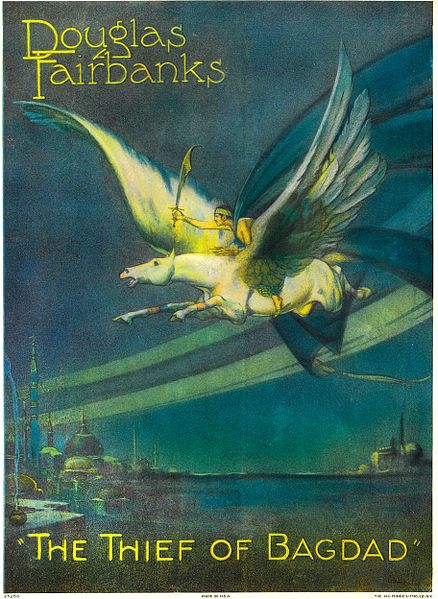
My first movie review for Once Upon a Time‘s Quest on Screen, Mirror, Mirror, came out just in March.  My next one is…a good bit older!  Thank you to Sarah, whose review got me intrigued by Douglas Fairbanks’ The Thief of Bagdad–from 1924!

I’ve been wanting to watch a good silent movie ever since seeing The Artist and Hugo, two homages to the silent film era.  So I was excited to find out this was streaming on Netflix.  I’m convinced this was the big-budget action film of its day, and it was excellent: fun, exciting, some very impressive effects and a handsome leading man.  My biggest complaint?  That missing H in “Bagdad.”  Other than that, it was a wonderful film, and a wonderful taste of the silent movie era.

Douglas Fairbanks plays the title role, as a devil-may-care thief who takes what he wants and lives life with gusto.  One night he sneaks into the royal palace, where he sees the princess and falls in love with her (as people do, in fairy tales and legends).  When suitors are summoned to the palace, the thief also returns, disguised as a prince.  It turns out the princess favors him too, but his ruse is soon found out.  To buy some time and avoid her villainous crop of other suitors, the princess demands that they all go on a quest, and whoever returns with the most impressive gift will be the one she marries.  Then it becomes your traditional fairy tale, with the hero and the villains all off on journeys through strange landscapes seeking magical artifacts.

Sound like a lengthy plot for a silent movie?  It is–and it’s a lengthy movie!  It’s two and a half hours long, so best be prepared to sit down and focus for a while.  It was well worth it!

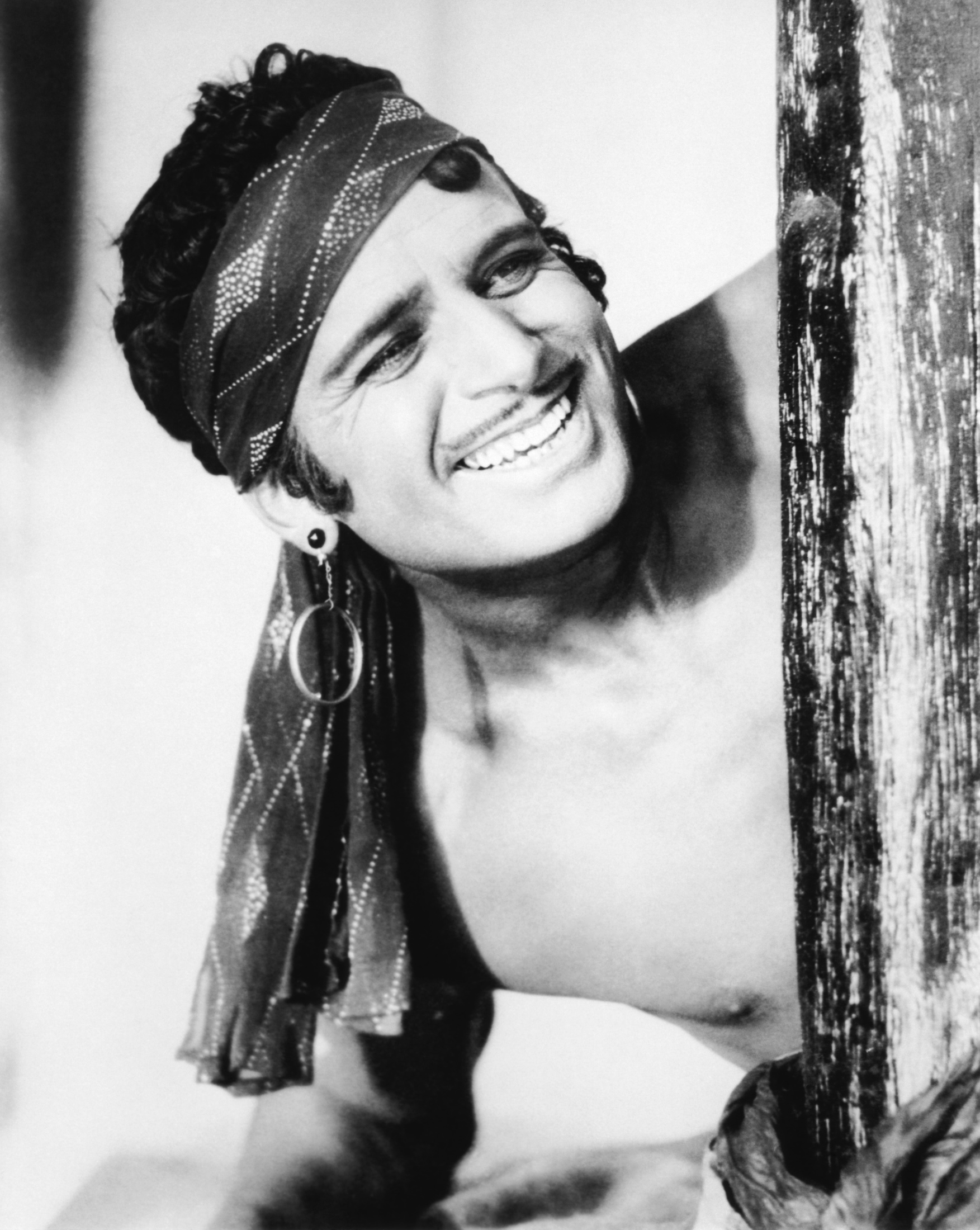
Douglas Fairbanks is enormous fun as a slightly campy, ever so enthusiastic and confident thief.  There are several scenes near the beginning as he pulls off clever sleights of hand and robberies, and one scene where he goes into such raptures over food he smells that I couldn’t imagine how he would get more excited about the princess.  It turns out he didn’t–he plays that more subdued and more realistic.  He gets more serious overall in the second half of the movie, but I also think the plot gets more interesting then, so it evens out.

For 1924 (and possibly even, say, 1960) the effects are incredible.  I couldn’t get over the sets.  If they had wanted to use the same sets for a movie about giants, they’d have been ready to go.  There are endless enormous walls and archways, sweeping staircases and giant doorways.  They’re the kind of things that seem like they must have been built in miniature, to only be shown from a distance–but they’re shown up close, with characters climbing over walls and going through archways.  So either they really built the sets to scale, or they used some very impressive camera angles, to create tricks I honestly couldn’t spot.  You know all those archways and long hallways in the new Star Wars trilogy, where it’s so painfully obvious that it’s all CGI?  Whatever they were doing back in 1924, it was more convincing to my eye.

There’s also a convincing flying carpet and magical rope that Douglas Fairbanks climbs up, and a few monsters to fight.  The monsters were, well, not what you’d get today, but I feel like I’ve also seen movies made in the forties or even the sixties with less convincing monsters.  Then there’s the cast of thousands for an army at the end.  Some may have been stock footage or clever angles, but I’m sure they had crowds.

I haven’t watched many silent movies, so it was fascinating to see this one.  I discovered that I recognized Douglas Fairbanks at once, even though I can’t honestly say that I’ve ever seen him in a movie before.  He must be one of those people who’s filtered into the consciousness.  I didn’t feel like I had trouble following anything, and (with a few exceptions) the acting didn’t feel over-the-top dramatic to make up for the minimal dialogue.  I did find, though, that I had to really focus.  I often do other things while watching TV, things that don’t require a lot of higher brain function but do require my eyes.  I realized how much I depend on listening to the TV to follow something…and for a silent movie, I had to really watch!

It wasn’t actually silent, of course, as there was music throughout.  It was a jaunty, fairly ignorable tune, and they honestly may have been playing the same five minutes of music again and again–I couldn’t really tell.  I think it did what it was supposed to do, avoiding an eerie actual silence and adding to the light-hearted tone of the movie.  There were moments where I thought they might have done more with the music to add a serious or suspenseful tone, but mostly it was good fun.

The whole movie was good fun–light, funny, exhuberant and fanciful.  If you’re looking for an enjoyable romp of a silent movie, I highly recommend it.  And if you’re a fan of Disney’s Aladdin (I am), I have no doubt that someone putting that movie together went back and watched The Thief of Bagdad first!

Other reviews:
Sarah @ Reading and Writing and Movies, Oh My!
Caught Frenching (French Press Vintage)
The League of Dead Films
Tell me if you’ve reviewed it!

…On the Wall

I told you how excited I was for Mirror, Mirror, didn’t I?  I had another excellent time at the movies this weekend!  Whatever’s going on in Hollywood lately, they have put out excellent movies this past month.

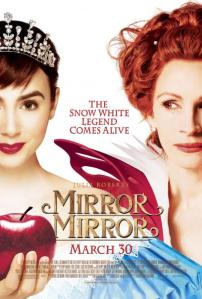
Mirror, Mirror is a very funny retelling of Snow White, putting it squarely on the track for the Once Upon a Time Challenge‘s Quest on Screen.  As the original story has it, Snow White has grown up under the control of her wicked stepmother, who is desperately jealous of Snow White’s beauty.  The Queen is inspired to take more drastic steps when a handsome prince arrives and is a little too interested in beautiful Snow White.  The Queen sends Snow off to the woods to be killed–and sets about to marry the prince herself.  Snow meets up with seven dwarfs who turn out to be bandits, reads them a lecture on not robbing poor people, then bands forces with them to fight the Queen instead.

From the beginning, what drew me to this movie the most was Julia Roberts as the wicked queen.  She was delightful–one of those terribly sweet and poisonous villains.  And oh-so-campy!  She looked like she was having enormous fun with the part.  She gets some snarky lines and occasionally brings a note of practicality to the fantasy world.  For instance, when the prince goes on about Snow White’s ivory skin, the Queen points out that Snow is eighteen and has never been outside, so of course she has good skin!  She’s not an epic fantasy villain evil queen, but she’s a very funny one–vain, condescending, self-absorbed, insulting, and utterly unable to concentrate while looking at Prince Charming’s bare chest.

Actually, it was Prince Alcott (which just made me think of Louisa May–anyone else?), played by Armie Hammer.  You might know him as the Winklevoss twins in The Social Network.  Only one of him this time, but still very attractive, and shirtless more than once (he keeps having unfortunate run-ins with those bandits…so it’s all very plot-relevant, really).  As a character, he’s a bit of a boor at times, but seems to have a good heart.

Lily Collins played Snow White (utterly unrecognizable from her role in The Blind Side), and she was a refreshing take on the character.  This was a sweet but also smart and scrappy Snow White.  And the dwarfs, while not as entertaining as their counterparts in Once Upon a Time, were nevertheless quite amusing.

And of course, no proper Wicked Queen would be without a down-trodden flunky, played in this movie by Nathan Lane.  He’s squirmy, devoted and lacking in all self-respect, as a down-trodden flunky should be.

Another fun side to this movie were the visuals.  I loved the set-design–the Wicked Queen has this gorgeous open-air bedroom with breathtaking views that I really want (aside from the practicalities of it).  The dwarfs apparently had the same architect as Peter Pan, with an underground home that you can reach through a hollow-tree, which looked both cosy and claustrophobic.

Then there were the costumes.  Oh, the costumes.  So many hoop skirts and massive bows and mounds of fabrics and headpieces that must have required special training in balancing.  Utterly fantastic.  There’s a masquerade at one point, and there are so many wonderful headpieces–and the prince has incredibly amusing bunny ears.

This is not a deep movie or a terribly complex movie and it doesn’t have terribly complex characters, but if you want some light-hearted fun with attractive costumes and an attractive leading man, it’s a good day at the movies!

Movie site: http://mirrormirrorfilm.com/