Good Omens from Terry Pratchett and Neil Gaiman

Good OmensTerry Pratchett is the funniest of authors and Neil Gaiman seems to be one of the coolest of people, so I’ve no idea why I didn’t read their co-authored Good Omens long ago…but I finally have, and it was wonderful!  And right on time for Once Upon a Time.

I realized after I opened the first page that I had almost no idea what this one was actually about.  Because, I mean, Pratchett and Gaiman–who cares what the plot is?  But in case you’re curious (and to add coherence to the rest of this review), I’ll give you an overview.

The book centers in large part around Crowley and Aziraphale, a demon and an angel, respectively, though the two have more in common than you might think.  Both have been on Earth for the past 6,000 years and have developed a solid working relationship in the process.  When the Antichrist is born, heralding the end of the world in eleven years, Crowley and Aziraphale both realize that they find Earth far more interesting than either Heaven or Hell, and set about to prevent the end of the world.

Meanwhile, the Four Horsemen of the Apocalypse are gathering, the last of the Army of Witchhunters is vigorously and ineptly pursuing his calling, and Anathema Device (witch) is following dictates set down by her ancestor in the Book, The Nice and Accurate Prophecies of Agnes Nutter, Witch.  And the Antichrist turns out to be a very nice young man.

The plot doesn’t even begin to do justice to the madness and hilarity of this book.  I don’t think there’s any way to discuss it very coherently, so perhaps a few representative examples…  Every cassette tape left in Crowley’s car for more than a week or so turns into something by Queen.  The Four Horsemen ride to the Apocalypse on motor bikes, accompanied by four more conventional Hell’s Angels, arguing about what horrible thing they want to be (including “People Covered in Fish,” for instance).  When the Antichrist (whose name, by the way, is Adam) starts latching onto some wild, part New Age, part urban legend concepts that he doesn’t quite understand, Atlantis rises and Tibetan monks start popping up out of holes everywhere.

The book is incredibly clever too.  Take the Four Horsemen–Famine goes around spreading his particular evil through fad diets and nutritionless fast food.  Pollution has replaced Pestilence, after penicillin was invented and Pestilence retired in a huff.  War makes a living first as an arms dealer and then as a war correspondent–who always gets to places just before war breaks out.  And Death, well…he’s not quite as funny as the Discworld Death, but he does speak in ALL CAPITAL LETTERS.

This book is all the more remarkable for being about a battle between angels and demons, drawing heavily from the Book of Revelations and occasionally Genesis, and pulls it off without being proselytizing or judgmental.  I wouldn’t recommend this as a source for theology, but it’s never offensive either–and I’m a practicing Catholic who found The Da Vinci Code deeply bothersome (for a number of reasons, scholarship as much as anything).

I could keep rambling on about this, but just take my word for it–it’s hilarious.  If you like either of these authors or think you might, then read it.  I mean, there’s a book-loving angel, a demon who “did not so much fall as saunter vaguely downwards,” a whole lot of footnotes, and Death.  And according to Wikipedia, once upon a time someone thought about casting Johnny Depp as Crowley, and now I so want to see that movie made!

Authors’ Sites: http://terrypratchettbooks.com/ and http://neilgaiman.com/

Other reviews:
Charley R’s Leaning Tower of Plot
Amidst the Meadow of Mind
Books, Writing, Tea
Death, Books and Tea (trend?)
Anyone else?

Buy it here: Good Omens: The Nice and Accurate Prophecies of Agnes Nutter, Witch

Springing Into Fantasy

Today marks the launch of spring–and of the Once Upon a Time Reading Experience, hosted by Carl at Stainless Steel Droppings.  This will be my third year participating, and I’ve been looking forward to joining in again.  If someone was going to design a reading challenge around my favorite kinds of books…it would look a lot like this one.  I mean, fantasy with an emphasis on fairy tales!  That’s what I read (and what I write too).
I’ve been telling myself that I’ll make progress on my To Be Read list over the next three months, since so many of the books on it are fantasy.  This, of course, ignores that fact that I’ll probably add tons of wonderful new books too…but shhh, let’s not talk about that right now!

I have far too many books that fall into this Experience to list them all here, but I’ll give you a few initial ideas…

~ Stardust by Neil Gaiman, for the group read-along

~ Chalice by Robin McKinley, which I started yesterday…but close enough

~ Princess of the Midnight Ball by Jessica Day George (a reread) and its once-removed sequel, Princess of the Silver Woods (because I already read the immediate sequel, Princess of Glass)

~ The Hobbit by J. R. R. Tolkien, to get me set up for the real challenge…

~ The Lord of the Rings trilogy–or at least a good attempt at them

~ Good Omens by Neil Gaiman and Terry Pratchett, because…Pratchett and Gaiman!  How have I not already read this?

~ The House on Durrow Street and The Master of Heathcrest Hall by Galen Beckett, as I thoroughly enjoyed the first book in the trilogy, The Magicians and Mrs. Quent

~ The Blue Sword and The Hero and the Crown by Robin McKinley, which I read SO long ago that I’ve completely forgotten them, and now I feel like they’re a gap in my McKinley reading

~ More installments of the Sevenwaters Series by Juliet Marillier, part of my goal to complete series

And, oh, so many, many random fantasy novels…really, the list above barely scratches the surface!  Well, scratches it, maybe, but not so far as a dent.  So, I’m not worrying too much about which books I read, or how many, or which Quests they fit into.  I’ll just toss lots of books into the air (metaphorically) and let them fall where they will.  I hope you’ll come along for the fun!

What Are You Reading This Spring?

itsmondayTime to join in again for the Book Journey meme, “It’s Monday, What Are You Reading?”

I finished reading and reviewing Les Miserables, which was quite the long haul.  Read the review(s!) here: Part One, Part Two and Part Three.

I read and enjoyed the other books on my previous list, with reviews coming up in the next week.  I’ll have Scarlet up tomorrow.  (Addendum: It’s up now!)

Right now I’m in the middle of My Cousin Rachel by Daphne du Maurier, because I love her most famous book, Rebecca.  I first heard about this one years ago, and thought I didn’t want to read it because it was too much like Rebecca–another mysterious woman who may be good or may be monstrous, though in this case it’s her husband who died under mysterious circumstances.  So I put that one at the back of my mind and read three other, very different, books by du Maurier…and didn’t find them to be all that good.  Yet I’m convinced by Rebecca that du Maurier is absolutely brilliant!  And thus I’m deciding that maybe it makes sense after all to read her most Rebecca-like other book.  So far, I’m liking it better than the others!

Spring BooksAfter this one, I have a big stack of fantasy I’m eager to jump into.  The Once Upon a Time “challenge” runs every spring, and I may just start in on the fantasy a few days early.  I have a number of rereads piled up, but I want to take a new perspective on them: Chalice by Robin McKinley, because I want to look at it as a Beauty and the Beast retelling; Princess of the Midnight Ball by Jessica Day George, because it was only the second “12 Dancing Princesses” story I ever read, and now I’ve read eight or ten, and written one; The Hobbit by J. R. R. Tolkien which I haven’t read since I was maybe twelve.  And I am vowing and swearing to read Lord of the Rings this spring, and The Hobbit seems like good gateway-Tolkien.

And last, I have been meaning to read Good Omens pretty much forever.  Because, I mean, Terry Pratchett and Neil Gaiman!

I’ll let you know how it goes.  🙂  Happy Spring and Happy Reading this week!

Beside the Shore with L. M. Montgomery

L. M. Montgomery Reading ChallengeI’m continuing my wander through L. M. Montgomery for the L. M. Montgomery Reading Challenge, and it’s a good day to remark on a few more short stories and poetry.

I’ve moved over to another collection, Along the Shore, which collects various short stories with a seaside focus.  It can get a little repetitive if you read it straight through, but there are some gems in here.

“A Sandshore Wooing” is a delightful story, told in journal fashion.  Marguerite is at the seashore with her domineering aunt, a man-hater who believes her niece still needs “bringing up.”  Marguerite catches sight of–and catches the eye of–a young man on another part of the shore, who conveniently turns out to be the brother of an old friend.  They carry on a clandestine and unconventional courtship, mostly by way of spyglasses and sign-language.  It all works out rather neatly, but is very fun and sweet.

The story also reminds me of the first part of Rebecca, when the narrator carries on her romance with Maxim behind the back of her domineering employer.  There’s a similar feel of the young girl finding the courage to defy the harpy in her life.  As far as I know, however, Marguerite’s love interest doesn’t have a first wife!

“Fair Exchange and No Robbery” is another fun one.  Katherine bumps into her friend Edith’s fiance while on vacation at the shore, and finds herself in a dreadful mess when she likes him a bit too much.  Meanwhile, Edith meets Katherine’s fiance and…well, it’s not terribly shocking when it all works out.

I’ll defend Montgomery’s conveniently happy endings by noting that they don’t all end so pleasantly.  Just drawing examples from this volume, “The Waking of Helen” and “Mackereling Out in the Gulf” both center around unrequited love, and end tragically.

But anyway, I like Montgomery’s happy endings.  Some dreadful quote somewhere says that a short story should begin with a question and end with a bigger question (which results in stories that make me tear my hair out, figuratively speaking).  I like better Neil Gaiman’s description of short stories as adventures you can have and still be home in time for dinner.  Most of the time Montgomery’s short stories pose a puzzle or a problem for the main character, and resolve it by the end, which I find much more satisfactory than being left with a bigger question.

Perhaps another poem to wind up this post?  And since I’m reading her seaside short stories, here’s a sea-focused poem too, with lovely magical images.

The Voyagers

We shall launch our shallop on waters blue from some dim primrose shore,
We shall sail with the magic of dusk behind and enchanted coasts before,
Over oceans that stretch to the sunset land where lost Atlantis lies,
And our pilot shall be the vesper star that shines in the amber skies.

The sirens will call to us again, all sweet and demon-fair,
And a pale mermaiden will beckon us, with mist on her night-black hair;
We shall see the flash of her ivory arms, her mocking and luring face,
And her guiling laughter will echo through the great, wind-winnowed space.

But we shall not linger for woven spell, or sea-nymph’s sorceries,
It is ours to seek for the fount of youth, and the gold of Hesperides,
Till the harp of the waves in its rhythmic beat keeps time to our pulses’ swing,
And the orient welkin is smit to flame with auroral crimsoning.

And at last, on some white and wondrous dawn, we shall reach the fairy isle
Where our hope and our dream are waiting us, and the to-morrows smile;
With song on our lips and faith in our hearts we sail on our ancient quest,
And each man shall find, at the end of the voyage, the thing he loves the best.

The Callista Trilogy: Children of the Jedi

Children of the Jedi 1I’ve been having a delightful time in recent months, revisiting “a galaxy far, far away.”  For the Sci Fi Experience this year, I decided to revisit the Callista Trilogy.  The first book is Children of the Jedi by Barbara Hambly.  This book seems to get very little love from reviewers (based on some brief Googling) but while I don’t claim it’s perfect, I did have a wonderful time with it.

As usual for me, I remembered some details with absolute precision, while most of the book was full of surprises in things I’ve forgotten.  The story follows two plotlines that link up at the end.  And despite the title, it’s not at all about Han and Leia’s children.

Luke, C-3PO and two other friends set out to investigate a disturbance in the Force, ending up aboard the Eye of Palpatine.  It’s a massive battleship that has been hibernating in deep space for thirty years, and now has been mysteriously reactivated, intent on following its original programming to attack the planet of Belsavis.  Part of its programming involves picking up groups of Stormtroopers that were supposed to be waiting–but failing to find Stormtroopers, the ship picks up any sentient lifeforms it encounters, including Jawas, Tusken Raiders, a pig-like warrior race, and some even stranger creatures.  But the Eye of Palpatine also has another inhabitant–the spirit of a long-dead Jedi named Callista.

Meanwhile, Leia and Han are pursuing a rumor about a community where Jedi children were raised in the past.  It just happens to be on the planet of Belsavis…and there’s also intrigue and plots afoot.

This book has just about everything I could want in a Star Wars novel.  There are crazy-weird aliens–including a group that apparently resemble flowers, but have been indoctrinated to think they’re Stormtroopers, with hilarious consequences.  There’s an interesting enemy to fight–and in this case, mopping up traces of the Empire works, because it’s made personal and intriguing.  Leia gets to be awesome.  And Luke gets a girl!

We all know things really didn’t work out for Luke romantically in the movie trilogy, and most of the books seem not to have gone the direction of giving him much romance.  I actually like that–I think a “girl of the week” direction would have become old very fast.  So I think it makes it meaningful when there’s a romance here.  I don’t normally like stories where people fall in love very quickly, but somehow this one worked for me.  We get enough details on Callista and enough reflection from Luke that I felt fine with it.

I picked this one up again because I remembered the Luke-storyline, but I also found myself really enjoying Han and Leia.  Their storyline is good, but it’s mostly the two of them being together that I enjoy.  They’re a happily married romantic couple–how often do you see that in a book?  It seems like authors more often write about people who are falling in love, or people who are experiencing marital problems.  I love that there’s conflict in the story, but not between Han and Leia.

I’m very glad that the Star Wars novel universe at some point made the decision to have Han and Leia be together.  My guess is I have Timothy Zahn to thank for this, considering his landmark Thrawn trilogy has them married and expecting twins.  Of course the original film trilogy shows them falling in love–but it would have been so easy (maybe easier than not) to complicate things in the books, in order to create endless plotlines of falling in and out of love, bringing in triangles, and so on.  You know, the soap opera route.  The novels do have occasional bumps in the road (The Courtship of Princess Leia comes to mind), but on the whole, they seem to just be together.  And if they break up at some point later in the chronology than I’ve read, don’t tell me.  I don’t want to know!

Besides the Han and Leia pairing…every so often, I have these revelatory moments where it strikes me anew just how awesome Leia really is.  It’s not that I ever forget exactly–but now and then it just comes to me all over again.  It happened here when she had an opportunity to trail an enemy…and sets off to do it.  There’s no hesitation, there’s no moment of thinking maybe she should get one of the guys.  She just handles the situation.  Trouble ensues and, at the risk of a slight spoiler (but it’s not something surprising), Han and Chewie do eventually show up, more or less intending a rescue.  But when Han tells Leia to run, instead she comes up and hits the guy Han’s fighting with over the head.

There are other strong women in sci fi–but maybe I particularly love Leia in part because I love that she’s a cultural icon.  And she’s amazing.  She’s not amazing because she can hit a villain over the head.  She’s amazing because she’s married with three kids, leads the New Republic, doesn’t run around in revealing clothing most of the time (occasionally), can use the Force, is smart, capable and confident–and she can hit a villain over the head.  This is a fantastic woman to have as a cultural icon.  Love it.

This book also gives us some hints and bits about Leia’s life before the Rebellion, and now I want to read a prequel about Leia growing up.

If I have a criticism of the book, it’s that Luke is injured early on, and spends a lot of time dragging around fighting pain and fatigue.  The point gets a bit belabored.  I want to mentioned one other criticism I’ve seen elsewhere, which I would consider completely invalid–some of the references to the pre-trilogy time aren’t consistent with the new movie prequels.  But the book was written first, so you can’t blame the author for that.  And I’d just as soon pretend the prequels never happened, so I’m really not going to be bothered by something contradicting them.

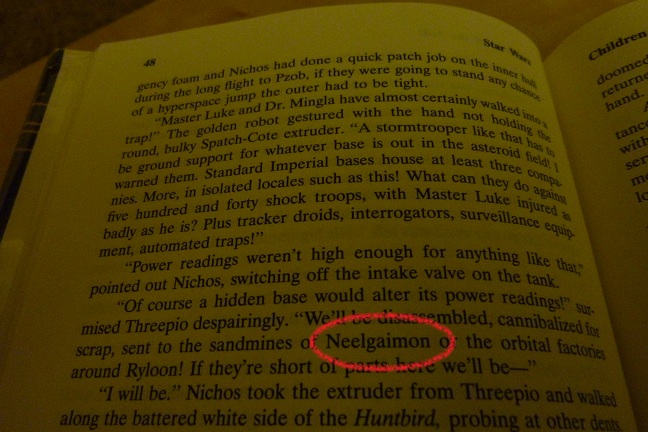
Children of the Jedi 2One other fun and random note: a planet is referenced here named Neelgaimon.  I actually looked up the timeline on Neil Gaiman’s career, and while there was plenty he hadn’t done yet when this was written, he was active in some areas…  Coincidence?  Or incredibly cool tribute? 🙂

So all in all, I look forward to finishing the rest of the Callista trilogy.  And then I need to finally track down the books where Luke gets together with Mara Jade…because I’m intrigued by that too!