It’s Monday, What Are You Reading?

Sheila at Book Journey does a fun meme every Monday, inviting people to share their reading plans for the coming week.  I’ve increasingly been thinking of my reading in that way, as I stack up library books each weekend for the coming week, so I thought it was about time I jumped in on this!

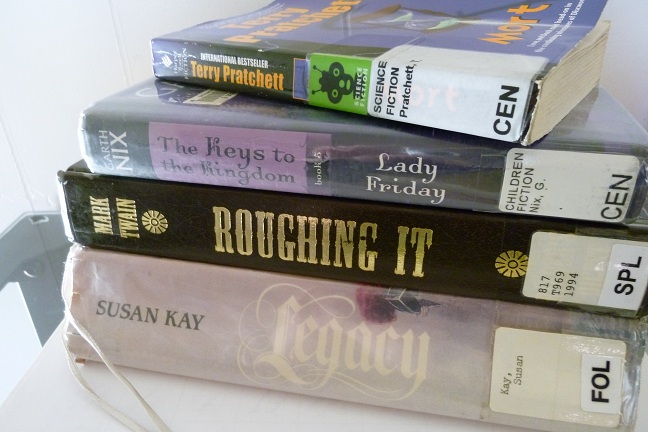
My book reviews have been slimmer than usual this past week because of NaNoWriMo, but my reading has continued unabated.  I’m currently reading Susan Kay’s Legacy, because I am hopelessly, completely, madly in love with Susan Kay’s Phantom.  I don’t know why it’s taken me eight years to pick up her only other novel!

Legacy is a 600-page behemoth that will probably take me most of the week.  I have a new-to-me Discworld book lined up for the Thanksgiving weekend, though–I’m finally going to read Mort, the first book in the Death series.  Despite what that summary sounds like, I expect it to be a rollicking good time.

I’ve planned out the next two weeks because the library is going to be closed for nearly a week over Thanksgiving.  I find this immensely alarming (understandable, of course, but no library for five days?  Eek!) and had to lay in a good stock ahead of time.  After Mort I plan on Roughing It by Mark Twain, because I promised myself I’d read a new Twain book this year, and we’re getting down to the end!

And then I have Lady Friday by Garth Nix, as part of my ongoing quest to finish his Keys to the Kingdom series by the end of the year.

So those are my plans, for roughly the next two weeks.  What are you reading?

Dodging Through Victorian London

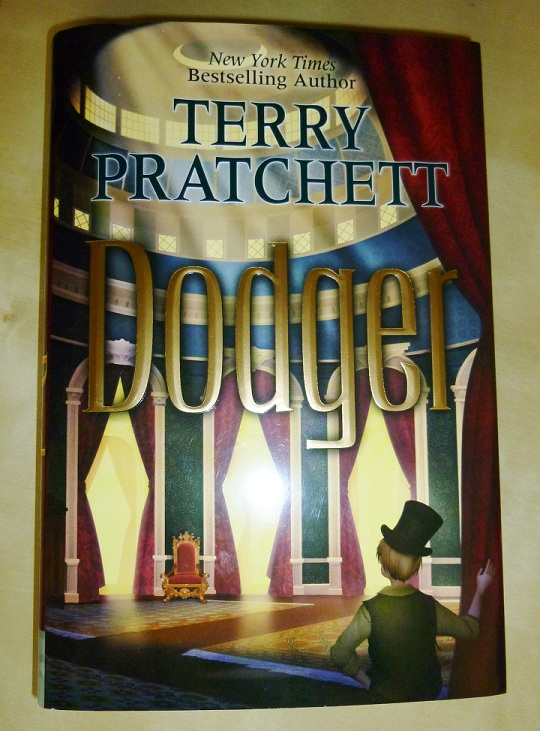
Considering how much I love Terry Pratchett’s Discworld books, I have been impatiently awaiting his latest book–even if it isn’t Discworld.  Dodger is not quite on the level of the best Discworld, but it was a fun read of its own.

To clarify one thing at the beginning, the book is not really about the Artful Dodger from Oliver Twist–at least, not exactly.  Say rather it’s a young man who could be the inspiration for the Artful Dodger–considering his connections to Charlie Dickens, and all.

Dodger is a tosher by trade, a seventeen year old boy who makes his living searching through the sewers of Victorian London in search of lost coins, jewelry and other treasure.  And if occasionally things happen to fall out of their owner’s possession and into Dodger’s hands, well, who is he to dispute with a bit of good fortune?  Everyone knows Dodger, and everyone knows Dodger never gets caught.

There’s no Fagin, but there is Solomon, a wise old Jewish watchmaker who gives Dodger a place to sleep and helps him stay on the straightish and somewhat narrow path.  There’s no Oliver Twist, but there is Simplicity, a young woman Dodger rescues from a couple of thugs–a young woman who turns out to have crowned heads of Europe intensely interested in her.  His efforts to help her will take Dodger into a whole new part of society and bring big changes into his life.

All in all, I didn’t love the book, but there is a great deal here to like very much.  There’s enormous fun in the various historical figures Dodger’s path crosses–from Fleet Street journalist Charlie Dickens to up-and-coming politican Benjamin Disraeli, and a host of others I didn’t have enough historical grounding to recognize (but there’s a helpful afterword).  We also wander into fictional territory when Dodger meets Sweeney Todd, more sad than demonic and a powerful lesson about the tendency of the world to create the story they want to hear.

Dodger’s character growth throughout the book is excellent.  At first, he seems a little too noble (in the character sense) for a boy on the streets, but as the book develops and his character does too, it fits more easily.  It’s not an easy growth, and Dodger finds a certain loss of identity (or at least uncertainty) in his sudden rise in standing and character.

My favorite things are a couple of character quirks.  First, especially near the beginning, Dickens has a tendency to make a remark, get a look in his eye, and hastily jot something down–as when he made a reference to “our mutual friend.”  I would have loved even more Dickens quotes sprinkled throughout–though there may have been more that I just missed.  Second, I love Solomon’s religious life.  He frequently explains situations to God, perhaps when someone is doing something a bit, well, dodgy.  But Solomon will make matters clear to Him, in a lightly humorous and never offensive way.  It has much the same feel as the beginning of the song “If I Were a Rich Man” in Fiddler on the Roof.

My least favorite thing…well, I found out a bit more than I really needed to know about Victorian sewers, and I could have lived with far fewer references to, shall we say, Victorian waste, human and animal, in and out of sewers.  The most recent Discworld book featured an interest in bathroom humor, and I sincerely hope this is a short-lived trend in Pratchett’s writing.  It’s more often nasty than funny, and frankly, I know he’s more clever than to need to resort to that.

Still, this is a fun trip through Victorian London with solid characters and a plot with a few good twists.  Don’t come here expecting the high hilarity of Discworld, but it is an enjoyable historical novel.

Author’s Site: http://terrypratchettbooks.com/

Other reviews:
Things Mean a Lot
Katie’s Book Blog
Wickersham’s Conscience
Book Aunt
Fyrefly’s Book Blog
Yours?

Summer in Discworld: Conclusion

First, a big thank you to everyone who came along to explore Discworld this summer!  It was fun to see what books people chose, and I loved reading reviews.  I think my favorite part was the group-read of Going Postal, which was small but enthusiastic.  I loved seeing the different (and same) parts that stood out for each person, and seeing how people read the book differently.

Here are the parts of Discworld I explored this summer.  I got to re-read two favorites, and finally get a clearer picture on the Witches!

Read:
Going Postal (re-read)
Lords and Ladies
Wyrd Sisters
Night Watch (re-read)

Watched:
Soul Music
Going Postal

Feel free to share any of your final thoughts in a comment, or with a link to a post!

Walking Ankh-Morpork with Sam Vimes–Both of Him

I wanted to read some new Discworld books this summer, but I’ve also been meaning to re-read Night Watch.  This was the first proper Discworld book I ever read.  Technically I read Maskerade first, but I read it as a Phantom parody, paid no attention to the larger context, and despite madly loving it, I was somehow not inspired to go on to the rest of the series (can’t quite explain that).

So Night Watch is where it really started for me.  I don’t recommend anyone else start here, as it makes absolutely no sense as a place to begin.  More on that in a bit.

The book focuses almost exclusively on Sam Vimes, who remains my favorite Discworld character.  He’s the head of Ankh-Morpork’s City Guard, and has been instrumental in making them into the force they are today (and weren’t a few books earlier).  While attempting to apprehend a serial killer, Vimes is caught in a freak storm above the Library of Unseen University, where the wizards reside.

Vimes and the killer are thrown thirty years back in time.  Due to complications and wibbly-wobbly timey-wimey technobabble, Vimes ends up taking the place of the copper who taught a young Sam Vimes how to be a copper–so it all becomes rather circular and you can’t think about it too hard (Vimes tries not to).  If mentoring his younger self while keeping an eye out for that killer on the loose isn’t enough, Ankh-Morpork of the past isn’t the comparatively well-ordered place of today.  Corruption is rife, plots are afoot, and a revolution is in the making.  Vimes remembers how it all came out, but there’s no guarantee things can’t change, wiping out his own future.

It’s a slightly complicated plot, but somehow it works right along while you’re actually reading it.  I think that was true the first time I read it too.  I liked it even better on a re-read, because I knew who everyone was.  Part of the fun of the book is seeing recognizable characters when they were much younger.  Nobby Nobs is a street urchin (and as ugly as ever), Cut-Me-Own-Throat Dibbler has yet to acquire his trademark phrase, and Vetinari is still in Assassin School.  None of that means anything without reading other books, which is why it makes no sense to start here (funny how that’s always a topic when discussing Discworld, and so rarely one for any other series!)

I can even argue that you get an extra layer if you read later books first.  The narration keeps referring to Vimes’ younger self as “Young Sam.”  In the present-day portion, Vimes’ wife is very pregnant, and in later books we see that their son is called (wait for it) Young Sam.  So there’s definitely a father theme going on that becomes much clearer when familiar with later books.  Discworld is so sequentially confused.

The best thing about Night Watch is that you get to see Vimes at his Vimesest.  He’s a copper and he’s tough and he’s practical.  He doesn’t seem to believe much in honor, while being very honorable.  He believes in Law and he believes his job is to keep the peace and protect the ordinary man–while having no illusions about the nobility of your typical Ankh-Morporkian.  He’s the kind of man who doesn’t fight a mob or yell them into submission.  He steps out in front of the mob, lights a cigar, asks if they’re having a pleasant night and would they like to step into the Watch House for some cocoa, and if not they really ought to go on home, it’s getting cold.  And it works.

Vimes understands Ankh-Morpork and its people, he knows the streets and he knows the crowds and he can handle all of it.  I love this book because we get to see all of this.  In some of the earlier books, Vimes is still evolving.  Some of the later ones deal more with politics, and the most recent, Snuff, takes him out of Ankh-Morpork (which was a mistake, I think, and though I like the book I’ve just now realized this is why it wasn’t better than it was).

Night Watch is set in a different time so a lot of regulars and recurring characters aren’t in it.  But that’s actually okay, because the result is that we get lots of Vimes instead.

My conclusion is, don’t start here, because significant portions won’t mean anything.  But if you’ve read any City Guard books to give you context and if you like Vimes, this is a particularly magnificent installment in the series.  It’s definitely one of my favorites.

Author’s Site: http://terrypratchettbooks.com/

Other reviews:
Ritual of the Stones
Puss Reboots
Sandstorm Reviews
Anyone else?
Discworld on Screen

To take a different direction for Summer in Discworld this week, I thought I’d look at the movie adaptations of Discworld books.  Books-to-movie adaptations are always a bit chancy, but on the whole Discworld seems to have fared well.  They’ve all been TV miniseries which allows more screen time, and that usually means a more accurate rendition.  And Terry Pratchett seems to have been heavily involved, which also helps!

I don’t have quite enough to say about any of them for a full review, so let’s do a round-up instead.

The Color of Magic: This is a two-episode miniseries (three hours) that covers The Color of Magic and The Light Fantastic, which makes sense as they’re a continuous story.  As far as I can recall it’s pretty accurate to the books, with some decent effects.  There’s an impressive cast, including Tim Curry, Jeremy Irons and Christopher Lee (as the voice of Death).  The most fun, though, was Sean Astin in a role not too far from his hobbit character.  This is fun, although don’t expect too much, as it is based on two of the weaker Discworld books.

Hogfather: If you need a new Christmas movie, this is excellent in a weird sort of way.  The Hogfather, Discworld’s Santa equivalent, has gone missing, and Death is trying to fill in.  Pretty soon Death’s granddaughter, Susan, who just wants to be normal, gets pulled into the mess.  Meanwhile there this a lunatic who makes assassins nervous, and he’s just a little too interested in the Tooth Fairy…  I particularly love Susan (played by Michelle Dockery, Lady Mary on Downton Abbey) and Marc Warren as Teatime is wonderfully creepy.  Both are excellent portrayals from the book.

Going Postal: This is wonderful, though it does diverge farther from the book than most.  Moist’s character is a little simpler (with a more straight-forward path from jerk to honorable), and some of the funniest bits are left out (including Grout’s trip to the hospital, and most parts involving the wizards).  However, they also play up the romance and Miss Dearheart’s character in a way that I think works very well, and much of the rest of the book is faithfully represented.  Barring the slight simplifying of Moist, the characters are all brought to life well, and even if the Post Office didn’t quite fit my vision of a building stuffed with letters, it got close at times!

There are also two animated miniseries:

Wyrd Sisters: I’ve only seen the first episode of this one, which was enough to convince me that it’s following the book practically line-by-line.  Since I just read the book in the last month, I thought I’d better wait a while before I watch a movie that’s such a close retelling–it’s like rereading something immediately.  Still, that kind of faithfulness is something I generally approve of, so if you want all those great Discworld jokes, you’ll do well here.  Don’t come looking for brilliant animation–it’s decent, not terrible, not approaching Pixar or Disney either.  It looks like a Saturday morning cartoon, but at least the depiction of characters seems to be pretty accurate.

Soul Music:  Similar animation, but also similar faithfulness to the book–and it has Christopher Lee as the voice of Death.  There’s a lot that’s fun here, especially the Death of Rats!  I also enjoy Death and Susan as characters, and they’re the major focus for much of this.  This is earlier chronologically than Hogfather, if you have any interest in watching things in order. 🙂

All of these are available on Netflix, and all but Going Postal are streaming.  If you’re going to just watch one, watch Hogfather or Going Postal, but I think any would be a good time.  And if you watch any live action ones, keep a close eye out for Terry Pratchett in cameos!