Curse Details and Burnt Spindles

This week’s Fiction Friday features another excerpt from my novel, The People the Fairies Forget.  You can read the first chapter here.  This excerpt is partway into chapter two.

The story so far: Tarragon is a unusual fairy.  Besides disliking sparkles, he prefers ordinary people to royalty.  The story opens when Tarry attends a christening where Echinacea curses the Princess Rosaline to prick her finger and die, and Tarry’s cousin Marjoram (a certified Good Fairy) changes the death into sleep.  Tarry suggests a bet with Marj on whether a non-royal couple can have True Love.  The details of the bet haven’t been explained yet, but sixteen years after the christening (give or take), Tarry is back at Rosaline’s castle looking for a couple who can prove his point.

**************************************

            I wandered out of the stable and into the courtyard, where a flock of kitchen girls were gathered in the sunshine.  They were pretty girls, and I drifted that way.  I might have anyway, but right now it served my business too.  Some of them had to be romantically involved with someone.  Maybe even with the goatherd who was sitting on the stoop in their midst.  I knew he was a goatherd because there was a baby goat sitting next to him, and because I’m magical.  Magic also told me his name was Jack.

            I sat down near the fringe of the group, to listen in on the conversation.  No one knew me, but none of them noticed anything odd in that.  That’s an easy piece of magic.  Not an invisibility spell, just a don’t-take-much-notice-or-think-about-it spell.  That’s a useful one when I really want to go at a banquet table without attracting stares.  Keeps people from reacting to the pointed ears too, if the hair isn’t enough to hide them.  Or a good hat works.

            The kitchen girls, and goatherd, were having an animated conversation about the princess and her curse.  It would’ve been more useful to me if they had been talking about their romances, but I stayed anyway, thinking I still might be able to pick up something.

            The head cook, a woman clearly fond of her own cooking, had been at the christening and was relating the story now in thrilling tones.  It had grown more dramatic over the years.  Echinacea was uglier, the smoke was darker, the general horror was greater, you know how it goes.  Though to give the cook credit, she wasn’t entirely silly.

            “There’s some who say that it has to be a prince that wakes the sleeping princess,” the cook said, “or that it has to be true love’s kiss to break the spell, but I was there, and all that fairy said was a kiss.  Could be anyone.”
Continue reading “Curse Details and Burnt Spindles”

On Garbage Bags and Poetry

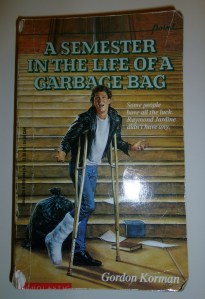
Every high school student should read this book.  Actually, everyone should read it, if only for the metaphor of the title.  A Semester in the Life of a Garbage Bag by Gordon Korman sounds utterly ridiculous–and it is.  It is a hysterical, hilarious, wonderful book.

My slightly battered, much-loved copy

But the title is actually remarkably profound.  It’s based on a one-scene reference (like To Kill a Mockingbird‘s title) when the main character describes a commercial for garbage bags.  The garbage bag is hooked up to a machine that keeps pumping in more and more pounds of pressure, and the smiling spokesman talks about how much pressure the bag is taking.  He keeps on cranking it up, while the poor bag is struggling to hold together.  Sound like high school to anyone?  Or life, for that matter?

The main character in the book is Raymond Jardine.  He has no luck.  Zero, zip, zilch.  His overriding dream is to somehow make it Theamelpos, an island in Greece which he is convinced grants extraordinary luck to all visitors.  Six students will be selected (methodology unknown) for a school trip this summer, and Jardine is determined to lie, steal, cheat, scheme, and connive his way into one of those six slots.

And that’s just the beginning of the story.  We’re guided through the book by the comparatively normal Sean Delancey, who is paired with Jardine for an English assignment.  Korman often takes the wise tactic of giving us someone relatively sane as a lead character, who can navigate us through the wild and wacky world of the book, where anything is possible.

Where it’s perfectly normal, for instance, for students to surf on trays down tables in the cafeteria–the temperature in the cafeteria is typically around 90 degrees, because the school is powered by the experimental SACGEN, which all the students know doesn’t work but which the school board is determined to insist is a great triumph.  That’s just one example of the world we find ourselves in.

The English assignment Sean and Jardine have to do together is a 30 page report on a poet of their choice.  Jardine is determined to pick a poet no one else will do (reasoning that if they pick a famous poet, another group will too, the teacher can compare the two reports, and his is bound to be worse).  Literally minutes before the deadline to choose a poet, Jardine selects Gavin Gunhold, the author of “Registration Day.”  They rave to their teacher about how much they love Gunhold’s work, and find out later that he never wrote anything else, having died in a freak accident shortly after writing his only poem.  Their solution is start writing their own poetry in Gunhold’s style, using for inspiration words they pick at random from the encyclopedia.

As to Gunhold’s one original poem:

On registration day at taxidermy school

I distinctly saw the eyes of the stuffed moose

Move.

I’m not usually a fan of poetry, and I have probably quoted Gavin Gunhold more often than almost any other poet.

A Semester in the Life of a Garbage Bag is packed with memorable characters, funny scenes, and even an explosion or two.  You will get your money’s worth in laughs out of this book.  And surely everyone can relate, at least a little, to how Jardine feels about that garbage bag?

Author’s website: www.gordonkorman.com

Ophelia Did Get a Rotten Deal, After All

I want to acknowledge right at the beginning that Dating Hamlet: Ophelia’s Story by Lisa Fiedler suffers from a dreadful title.  I know.  If you find it at the bookstore or the library (or look at it online) you’ll probably discover that it suffers from a dreadful cover too.  At least, the copy I read did.  They’re not necessarily intrinsically dreadful, but they give an entirely wrong impression on the book.

“Dating Hamlet” implies a book that is frivolous, shallow and a bit silly.  What you actually get, I am pleased to say, is a solid, insightful retelling of William Shakespeare’s Hamlet from Ophelia’s point of view.  There is humor at times…but there’s drama too.  And there’s a heroine who is much more capable than Mr. Shakespeare portrayed her.

Purists would probably have objections to this book, because some of the plot twists do strain credulity a bit…but that’s what I find fascinating about it.  Fiedler has done an impressive job of preserving everything that you see on stage, while turning it upside down with what’s going on behind the curtain.  By adding scenes in between Mr. Shakespeare’s, the result is Hamlet—but a Hamlet that’s very different from what you may be expecting.  I don’t want to give away the specific plot twists, but to give you an idea of the kind of twists—imagine if, in Snow White, there was an extra scene revealing that Snow White and the Huntsman were actually close friends, and he only took her out in the woods because they had agreed it was a good opportunity for her to run away from the castle.  You’d get the same essential scenes—but different meaning.  It’s a bit like that.

Knowledge of Shakespeare’s Hamlet would help with this book, but I don’t think it’s necessary.  It’s hard for me to judge, because I came to it after reading Hamlet.  Finding a good summary of the play would probably be enough, though; or you could watch the DVD of The Complete Works of William Shakespeare—Abridged (Act Two is Hamlet) by The Reduced Shakespeare Company (actually, you should watch that regardless, because it’s hysterically funny).  And you really ought to just read or watch a good version of Hamlet some time too, because that’s absolutely worth it.

But a discussion of Mr. Shakespeare’s Hamlet would be a different review.  As to Dating Hamlet, if you can get past the title, it’s a fun retelling with a compelling heroine.  A great book for anyone who ever thought that Ophelia got a rotten deal out of the whole thing.  Sorry, Mr. Shakespeare–but you were pretty rough on your tragic heroines.

The Boy on the Corner

Unlike last week’s Fiction Friday, this is a stand-alone piece.  Which isn’t to say that it couldn’t have some connection to something larger…anyone care to guess what brought my muse to Paris in the early 1880s?  But no context is necessary to read this story.

********************************************************************************

           When he shut his eyes, he could almost forget he was cold.  February 1882 in Paris, and in all his long experience of nine years the boy couldn’t remember a colder winter.  The wind howled down the street, past the shabby buildings and across the boy’s thin cheek.  He kept his eyes shut and concentrated on the music.

            The violin played in counterpoint to the wind, neither quite strong enough to defeat the other.  The boy ignored the constant trudge of footsteps, the mutter of voices, the whistle of the wind, and tried very, very hard to hear only the music.  He opened his eyes only at the sound of coins clinking together.  He looked down at the violin case open on the ground at his feet, and easily identified the one that had been added.  There weren’t very many coins there.  He looked up to see a tall man wrapped in a long black cloak, hat pulled low over his forehead, casting his face in shadows.

            “Merci, monsieur,” the boy murmured.  His eyes dropped and he continued playing his violin.

            The man didn’t move, and as the moments passed the boy became perplexed.  People stood and listened, once in a while, in warm weather.  In the cold and the dim of a winter twilight people wrapped their coats tight around them and hurried on, heads down, intent on whatever warm fireside was waiting before them.  If they dropped a coin at all it was without stopping, often without even looking, certainly without waiting for the boy’s whispered “merci.”

            The moments slipped past.  The violin music didn’t falter but neither did the man move and finally the boy’s eyes stole up to his face again.

Continue reading “The Boy on the Corner”

Obedience–But With Backbone

Cinderella, in her traditional form, is a character who drives me absolutely up the wall.  Come on, woman—I know you lived in a pre-feminist culture, but don’t you have any backbone at all?  Your life’s awful—so do something about it!  And the fairy godmother—where was she all these years while Ella was being mistreated?  The fairy only shows up when the girl wants to go to a party?  (Because obviously that’s something of paramount importance.)

But, like all great fairy tales, Cinderella does have that spark of eternal appeal.  Who can’t relate to the dream of being lifted out of your ordinary or even unpleasant life, because that one person (the prince, the book editor, the boss for the dream job, the head of the club…fill in your own relevant personality) sees you and says, yes, you’re special above all others.  That’s the core of Cinderella.  But Cinderella herself is irritating.

So when you can take that eternal spark and improve on the character and the plausibility—well, as I said when discussing Wildwood Dancing, then you’ve got something.  And Ella Enchanted by Gail Carson Levine is one of the best retellings of Cinderella I’ve ever read.

Ella is cursed at her christening—if anyone gives her a command (from “eat this cake” to “go jump off a roof”) she has to obey it.  And with that one brilliant stroke, Levine has a heroine who, like the traditional Cinderella, does everything her wicked stepfamily tells her to do—but who also has a mind of her own.  No one could accuse Levine’s Ella of lacking backbone.  She obeys, but I don’t think I’d describe her as obedient.  She can think for herself and, as much as she can around the limits of her curse, takes control of her own life.

There’s a good plot, with ogres and adventures and a kind of quest in Ella’s search for a way to overcome her curse, but I think what mostly stands out in my mind are the characters.  Ella, of course.  And her fairy godmothers—both of them—her more-than-usually complex wicked stepfamily, her absentee father, and, of course, Prince Charmont—because what’s a Cinderella story without a true love, right?

Ella Enchanted probably belongs in the juvenile category, rather than young adult.  But, kind of like the original Cinderella, it has a wide appeal, even if you’re not really the target age group.  So don’t be scared off just because it’s shelved in the kids section.

I unfortunately can’t quite just ignore the movie here.  There is one, but let’s all just pretend that there isn’t.  Don’t see it.  Really.  I did, and I think I spent most of it twitching and saying, “No, no, no, that’s wrong.”  Besides getting the details wrong, it got the spirit wrong, and while I can sometimes forgive a movie for changing the facts a little, it’s much harder to forgive a movie for maiming of the spirit of a story.

Because what Ella Enchanted really is is a very practical, plausible (once you accept the existence of magic) retelling of Cinderella.  The movie isn’t.  But the book is, and it’s well-worth the read.

Author’s site: http://www.gailcarsonlevine.com/