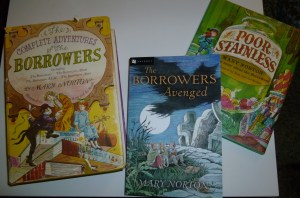
Have you ever lost your keys? Or a safety pin or a paperclip or maybe a spoon or a roll of thread? Maybe they were borrowed. Not by a houseguest–at least, not a human one. The Borrowers series by Mary Norton tells the story of tiny people who live among us, hidden from sight. Only a few inches tall, they live inside walls and under floorboards, and survive by “borrowing” odds and ends from the human world.
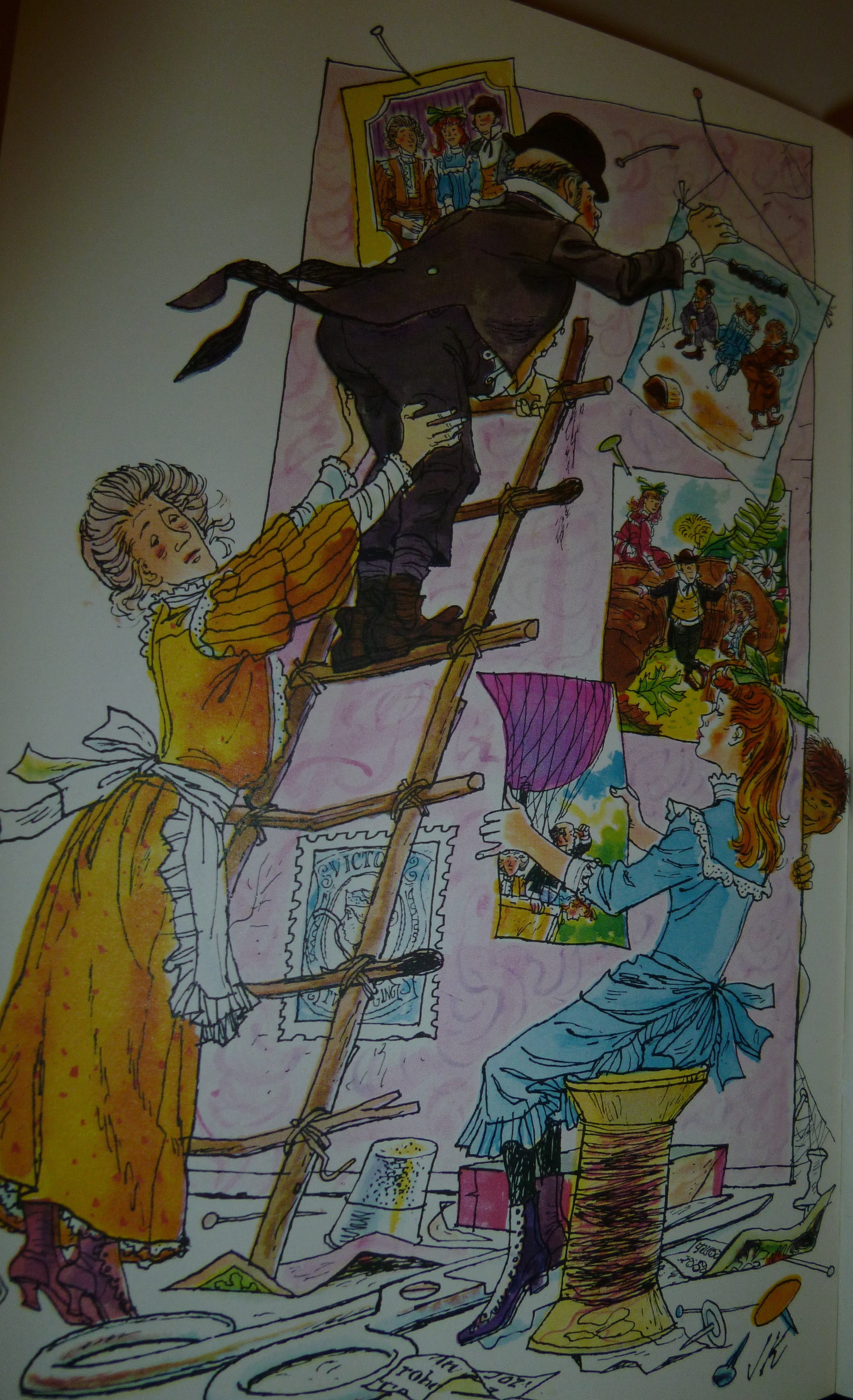
One of my favorite parts of the whole idea is the details on how the Borrowers live. The stories are set in England, I think in the early 1900s (though it’s a bit vague) and despite being so much smaller than everyone else, the Borrowers have clothes and rooms and furniture that is all quite proper to the time. Except, of course, that the walls of the rooms are made of stacked books, the table was originally a pill box, and the chest of drawers is made out of match boxes. I love the ways ordinary objects are cleverly and creatively repurposed. And it’s fun to imagine the adventures of a family who can (and do) live inside of a boot in one book, and float down a stream in a tea kettle in another.
The Borrowers series focuses on Arrietty, who I think is about fourteen (although I’ve been paging through the first few chapters and can’t actually find an age!) and her parents, Pod and Homily. It’s the greatest crisis in the world for a Borrower to be seen by a human–but Arrietty has a fascination with humans, which leads to any amount of trouble.
There are five books in the series (plus a very short prequel named Poor Stainless), starting with The Borrowers. They’re all good, but I think they get better from the second one on. It’s in the second one that they leave their home in the old manor house and go out into the wider world for adventures–as mentioned, living in a boot for a while, and ending up in a tea kettle floating down a stream, among others. Norton keeps the suspense up through the Borrowers’ need to evade humans who want to capture and exploit them, and through the ongoing hazards of surviving in the world when you’re much smaller than everyone else.
One aspect to the book that’s interesting and I think unusual, is that it’s actually a family having an adventure. In most children’s fantasy, the child in the story has the adventure–think of Dorothy, Alice, Jane and Michael, Wendy or any of the children in Edith Nesbit’s books. The parents are dead, or oblivious to any magic goings-on, or can be conveniently left behind for the length of the adventure. In The Borrowers, however, we see a family unit of father, mother and daughter launch into the world. It’s slightly more Arrietty’s story than anyone else’s, but Pod and Homily are the next two lead characters.
One note if you pick this up and find the first few pages slow going–there is a frame story to this, something about humans who saw the Borrowers telling the story to others. I can tell you intimate details about the Borrowers’ adventures, but I’m extremely hazy on the frame story because I’ve never actually read it. I probably should someday, but it’s never seemed as interesting, and at some point (probably by the time I’d read the first book or two) I discovered that it’s very easy to just flip ahead a few pages until I found the first chapter that was from Arrietty’s point of view. So I could be missing a few details of the story, but I’ve never felt their loss if I am.
As it is, the books are a wonderful adventure with excellent characters and a completely different perspective on the world, from the vantage point of a few inches off the ground.
 Tales of the Marvelous
I loved these books as a child and recently read the first one to my daughter. The frame story almost lost her attention, but once the actual Borrower’s story started, she really enjoyed it (I should have done as you suggest and just skipped to that point to begin with!).
That’s fascinating–so it’s NOT just me that finds the frame story so much less interesting than the rest. Glad to hear you kept reading and your daughter enjoyed the main story!
I like the idea, too, of a family having adventures instead of just the child doing so, without the parents’ knowledge. Maybe these books appeal to children also because they chronicle “the ongoing hazards of surviving in the world when you’re much smaller than everyone else.” That can be said about children themselves and their view of the world when they are young. Good recommendation!
Interesting point about children being smaller too! I hadn’t thought so much about children being able to relate to being the wrong size for the world around them–but you may be on to something there.
I’ve been meaning to read this series for so long! Good to hear you enjoyed it so much.
I hope you pick it up and give it a try! It won’t take you very long to read. 🙂