Month: August 2012
– Brenda Ueland, in her excellent book, If You Want to Write

The Wisdom of History
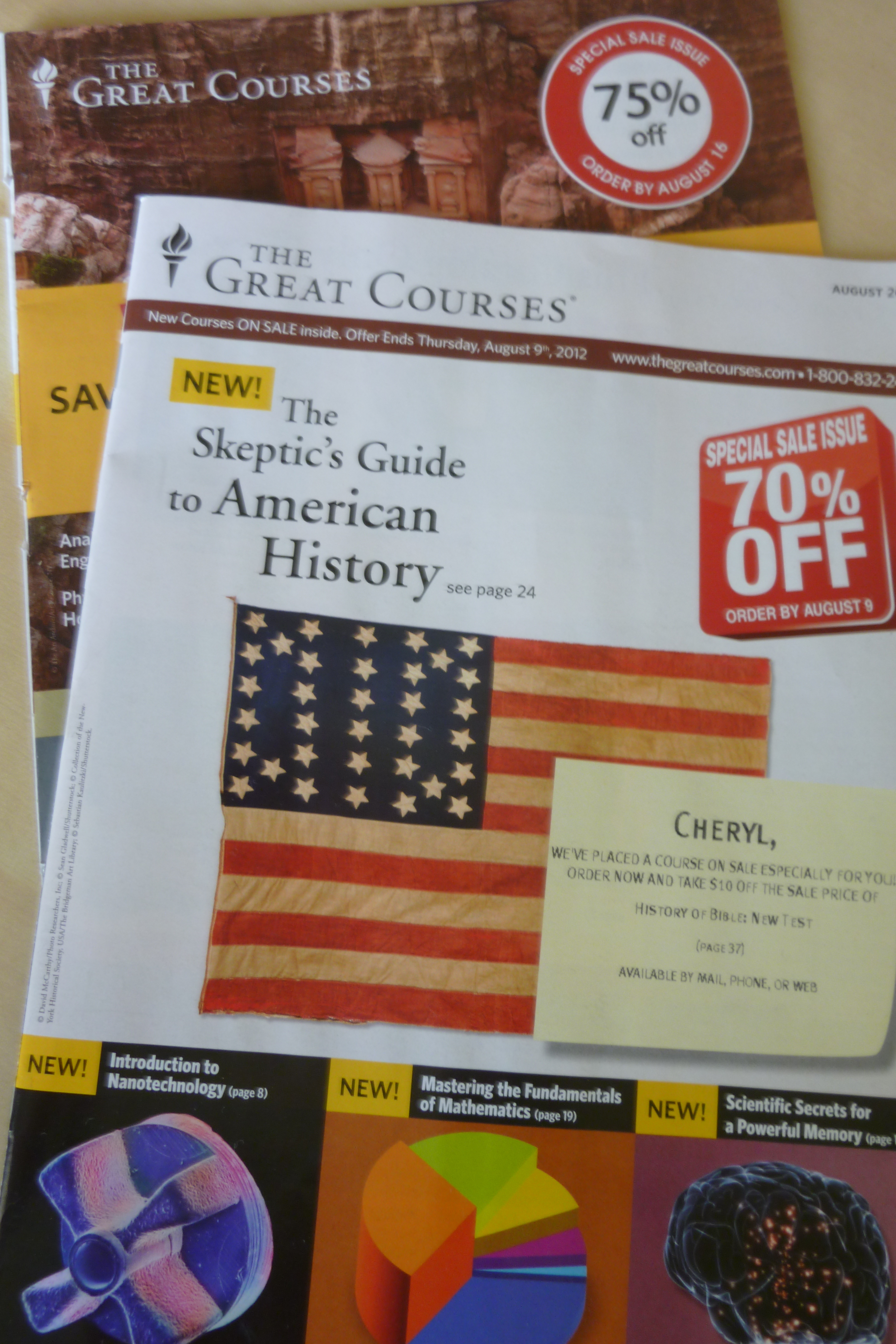 Something a bit different today–I rarely listen to audiobooks, but lately I’ve been listening to Great Courses. They’re like the best parts of college classes, without the hard parts. No papers, no exams, you’re never called on unprepared, and you get to study anything you want, whenever you want. In essence, the Great Courses find really excellent college professors, and have them put lectures on CDs in thirty minute sets. They have a huge variety available, so you can probably find whatever interests you.
I’m a fan of Professor J. Rufus Fears. I admit I haven’t listened to a large number of Great Courses professors, but that’s in part because I keep listening to Professor Fears’ different courses. He teaches history, as you might guess from my blog title. You can listen to The Wisdom of History

Professor Fears has certain lessons of history which he reiterates throughout his courses (one of which is, we never learn the lessons of history). My favorite is the idea that history is made by individuals, not sweeping anonymous trends (this is quite at odds with Hari Seldon’s psycho-history, incidentally). I think this is the key to why I so enjoy these courses. Professor Fears is always talking about individuals and their stories–and he’s a wonderful storyteller. He gives you the quirky details, the comedy and the tragedy, and brings ancient figures to life as real, complex people, not stern marble statues.
The Roman course has some wonderful pieces, especially about Hannibal, the Caesars, and the early emperors. Did you know Hannibal had terrible Latin pronunciation? It messed up his campaign when his native guide took him to the wrong place by mistake. Or did you know Nero believed that he was really meant to be an opera singer? Professor Fears also has a knack for bringing battles to life–sometimes in more detail than I really needed! And he makes some alarming comparisons between the fall of the Roman Republic and the present day.
I’ve always loved Winston Churchill, and Professor Fears does too. He brought out so many stories and anecdotes about Churchill. You end up feeling like you know him, and everyone else in his life too.
If you want a sweeping coverage of human history, The Wisdom of History is for you. Even with such a broad focus, Professor Fears picks moments and individuals within it to share. This is not by any means dry and intellectual history. The funny thing is, by looking at the individuals you also learn about the broader trends and larger shape of history.
It’s probably good that I mostly listen to these courses alone in my car, as I frequently find myself talking back. It’s not exactly a class discussion, but sort of! They’re immensely engaging.
So if there’s something you’d like to learn more about (some history, maybe?), you can explore the Great Courses catalog online. Don’t be put off by the prices–they have near-constant 75% off sales, or even more. And anyway, it’s a lot less than most actual college classes–and no exam at the end!
Following the Foundation into Book Two
 Another partly-read series I’m working on is the original Foundation trilogy by Isaac Asimov (which also fits my goal last year to read more classic sci fi). I just read the second Foundation novel, Foundation and Empire
The Foundation books are set in a distant future where humans live on planets across the galaxy, under the rule of a Galactic Empire. The impetus for the whole series is Hari Seldon, a master of psycho-history. Not the history of crazy people 🙂 it’s a discipline of applying psychology to entire societies, to look at sweeping trends and predict the future with startling accuracy. Seldon predicts the fall of the Galactic Empire and a period of 30,000 years of barbarism before a new Empire will rise. He calculates that the solution is to gather the great minds of the time together into two Foundations at opposite ends of the galaxy. This will set in motion necessary events to shorten the period of chaos to only 1,000 years.
Throughout the 1,000 years, there are certain crisis points, known as Seldon crises, which must develop and resolve a certain way for history to continue as Seldon predicted. The novels primarily deal with these crisis points. Foundation deals with the founding and first two hundred years of the Foundation. Foundation and Empire picks up at the next crisis point, as the last vestiges of the Empire make an attack on the Foundation.
That’s Book One. In typical classic sci fi fashion, the book is really two novellas, and though both good, I found the second one the more interesting one. In the second section, a shadowy figure called the Mule has begun conquering worlds, heading towards the Foundation itself. Seldon’s predictions deal with trends, not individuals, and the Mule is poised to set awry all of Seldon’s calculations.
I find that I tend to enjoy Asimov on a cerebral level. He has interesting plots, and he deals with intriguing theories of societal trends and human nature and big macro-level things (like Seldon). He tends not to be as satisfying on a micro-level, by which I really mean that his individual characters rarely make an impact on me. Part of it is that there are often a lot of them, and they’re mostly intellectual men having serious conversations all the time.
That being said, Foundation and Empire was a pleasant surprise for having more relatable characters! The first section features a well-developed character in the general attacking the Foundation, and there was also a former revolutionary and a merchant trader who had my interest. I feel like those two should have been a little more than they were, but I still liked them.
The second section had two very solidly engaging characters. There’s Magnifico, the Mule’s court jester who is cringing and slightly pathetic and yet comical as well. And there’s Bayta. And she’s a girl! After a book and a half, I was beginning to think that Asimov was writing about a future society consisting only of men. There’s a complete absence of female characters until Bayta comes on the scene, and it’s nice that when she does arrive she’s intelligent, warm-hearted, and even has a bit of a sense of humor.
These are not comedic books, and they’re mostly not emotional books either. They’re not exactly light, although I wouldn’t say they’re heavy in a depressing way either. They’re interesting and they’re intellectual, and I’m pleased about the improving trend in this one, and hopeful for the next!
Other reviews:
Kinda Silly Books
Reviews and Ramblings
Sci-Fi Book Review
Anyone else?
Saturday Snapshot: Bumper Stickers
My current car is the first one I haven’t shared (well, borrowed from parents, really), so when it became mine I decided to personalize! Then I spent a few months not able to commit to any bumper stickers I saw in shops. Is any random joke really that clever to stick on my car for years? Finally I went online, and here’s what I ended up with…
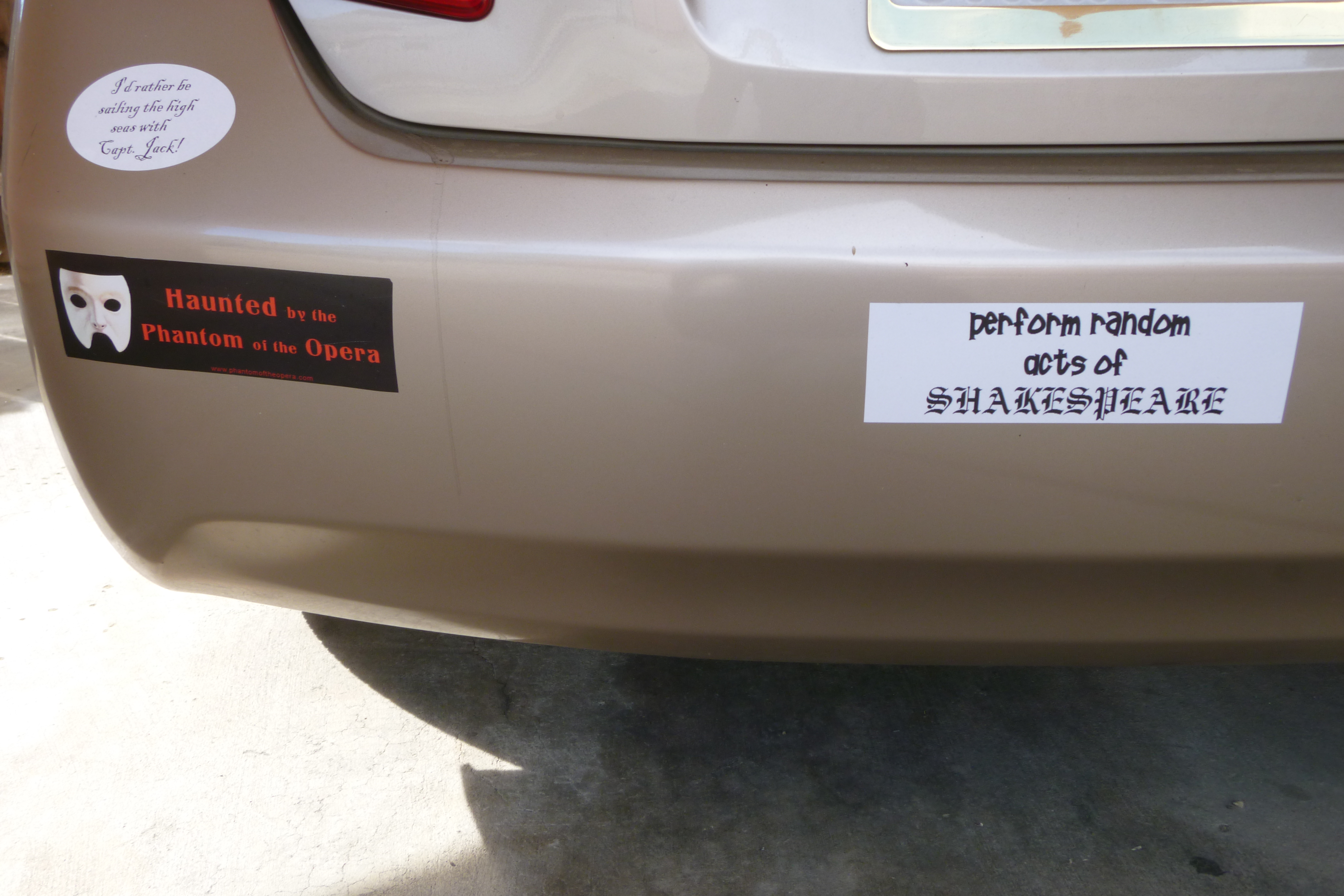
When I bought “I’d rather be sailing the high seas with Captain Jack,” I of course meant Captain Jack Sparrow–and mostly I do still mean him, because he’s one of my favorite characters ever. But if Captain Jack Harkness from Doctor Who invited me on a voyage, I’d go with him too!
As to being haunted by the Phantom of the Opera…that seems to say it so well. He’s lived in my head for years.
The “Perform Random Acts of Shakespeare” one has prompted people to ask me if I’m in theatre. I’m not–but I like Shakespeare. And I quote him frequently.

The Starfleet emblem should be pretty self-explanatory. And as to “Coexist” I do believe in coexisting, on a lot of levels; I wanted something different than the blue sticker everyone else has. And space–it’s pretty amazing.
I felt like I could commit to all of these, because the most recent interest represented here is the Phantom–and that’s going on eight years. So I’m pretty sure I’m not going to wind up turning away from any of these and regretting the sticker!
Anyone else have a cool bumper sticker? Or do you remember seeing a fun one?
Check out At Home with Books for more Saturday Snapshots!
Books to Travel with
When I travel somewhere, I try to bring books set in the place I’m going, or at least reflective of the place. I’m heading to London and Paris in September, so I’m looking for some good British and French novels! I have a few ideas, but I thought I’d put the question out there for ideas.
A Tale of Two Cities occurred to me as an obviously appropriate choice, except that reading Dickens requires a bit too much effort for a vacation read.
I know I want to read some Sherlock Holmes. I have a volume of the Complete Stories, but I haven’t actually read all of them. I won’t be bringing that particular volume (much too heavy for travel!) but I plan to pick up a book of stories from the library.
I want to read something by Agatha Christie, but I’m not sure what yet. I’ve never read her and I’ve been meaning to for ages. She’s one of those authors you hear about, and L. M. Montgomery enjoyed reading her, and she shows up in an episode of Doctor Who!
I plan to re-read The Little White Bird by J. M. Barrie, because it’s set in Kensington Gardens and I’m staying two blocks from the Gardens–deliberately, because I’ve read The Little White Bird before. It’s all rather circular, really.
But that still leaves me woefully short of books for a two-week trip! Any suggestions?
 Tales of the Marvelous