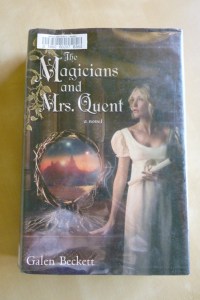
 My next book for the R. I. P. Challenge is The Magicians and Mrs. Quent
 by Galen Beckett, which mostly comes into the category in the book’s second part. I became interested because this was described as a blending of Austen and Bronte, in a fantasy world–and that’s exactly what it is!
The book is divided into three sections. Book One is told by three narrators in rotating chapters. We meet Ivy first, a young woman fascinated by magick [sic]. Her beloved father was a magician who has gone out of his mind; Ivy comes to realize that magick may relate to the cause, and also that he left her a riddle to solve, relating to vital work she must do. Rafferdy is another narrator, a bored and cynical nobleman interested only in amusement and determined to do no harm by having no meaningful effect on the world at all. Our third narrator is Eldyn, who is striving to create a better life for himself and his sister, but in the process falls into the power of a ruthless highwayman and revolutionary.
The personal stories of all three characters roll out against a backdrop of brewing revolution and a growing magical threat, which Ivy in particular must find a way to combat.
Book One has us very much in Austenland. Book Two takes a dramatic shift towards Bronte, when Ivy accepts a position as governess at Heathcrest Hall, a gloomy manor out on the moors. There’s a not too subtle resemblance in the premise to Jane Eyre, and Heathcrest Hall is presided over by Mr. Quent, who bears a not too subtle resemblance to Mr. Rochester. Book Two is strictly about Ivy, and told by her in first person. The book takes on a gothic feel, out on the misty moor where strange magick is afoot.
Book Three takes us back to the setting and narrative structure of Book One, as all the characters’ plotlines come to a head.
This book started slow for me, but I ended up really enjoying it. In the first section, I was mostly only drawn into Ivy’s chapters. Rafferdy and Eldyn are interesting, but they weren’t engaging me that much. The book picked up in the second section, when the plot gets more focused, and we get much more magick. (And I have no idea why it’s spelled with a K, but it is.)
The book is set in Invarel, which is a very obvious parallel to England. All the names are changed, but there are frequently details that are clear analogs; for instance, the brewing revolution centers around an obvious Bonny Prince Charlie equivalent. There is the difference, of course, of the presence of magical forces, which exist in a few different varieties. There are magicians who can work certain complex spells. There are illusionists, who mostly work their marvels in theatres. And there are witches, who have an affinity for the Wyrdwood, an ancient forest spread throughout the country and which, legends say, will fight back against its enemies.
All the magick is intriguing, although in a way what grabbed me the most was scientific (sort of). The other biggest difference between Invarel and England is that Invarel’s planet is in a solar system which operates very differently from ours. The crucial result is that they don’t have days and nights of set length. People have to constantly check their almanacs to see how long the day will be–maybe four hours of daylight, maybe twenty-eight. I was fascinated by the concept, and by all the details about how society can function under those circumstances. I kind of wish there had been more of that! I’ve seen at least one reviewer complain that it didn’t make sense and that’s probably true–but that didn’t worry me. It was just so interesting!
The world of The Magicians and Mrs. Quent is an intriguing one, and I was also drawn into the characters. As mentioned, it started slow for me, but Rafferdy eventually gains some depth and Eldyn’s plotline gets more intense. I enjoyed Ivy from the beginning; her family circumstances and her character are both reminiscent of Elizabeth Bennet. She’s a capable, intelligent, well-read young woman who is nevertheless constrained by her position in society.
I was essentially playing “spot the Austen character” all through Book One. Ivy’s parents and two younger sisters all seem drawn from the Bennet household, and you can also find Lady Catherine de Burgh, Mr. Collins, and even Mr. Palmer from Sense and Sensibility. There may be more–I’ve only read three Austen books.
I suspect this book is more fun if you’re familiar with both Pride and Prejudice and Jane Eyre, although I don’t think it’s essential. It draws from them for the characters, and the circumstances those characters find themselves in (Ivy especially), but the plot goes in a different direction from either book. If you don’t have the background knowledge, you could probably just take this as-is and be interested.
The style of the writing is also drawn from Austen and Bronte, although rarely in a heavy-handed way. You can see it right in the first sentence: “It was generally held knowledge among the people who lived on Whitward Street that the eldest of the three Miss Lockwells had a peculiar habit of reading while walking.” A few times I thought Beckett was trying too hard to make the dialogue sound Austenish and it came out stilted, but most of the time it’s a nice flavor in a very readable book. Except, that is, when Beckett picked up Austen’s teeth-gnashing habit of skipping lightly past romantic declarations without any dialogue! I always want to know what they said, not just the narrative fact that they said it! Sigh. On the plus side, near the very end of the book we get a little more Bronte-style adorable romantic teasing dialogue, so I was somewhat mollified.
All in all, I’d say, be warned that this may take some effort at the beginning, but it really is worth continuing. I recommend this if you like fantasy, and highly recommend it if you like Austen and Bronte. I know I’ll be going on to read the next two books! This one gives us resolution, but there are still mysteries to be explored. I may also be rereading Jane Eyre soon…
Author’s Site: http://wyrdwood.net
Other reviews:
Fyrefly’s Book Blog
Kid Lit Geek
Stewartry
Things Mean a Lot
Stella Matutina
Anyone else?
 As regular readers know, I tend to bounce between different features on Fridays. This week, I’m trying something new–the Book Blogger Hop, inviting book bloggers to answer a book-related question each week, and “hop” amongst the other blogs that are participating. Normally hosted at Crazy for Books, this week it’s traveling to Soon Remembered Tales. Today’s question is:

 by Andrew Motion is told by a different Jim Hawkins, the son of the original. This Jim is eighteen years old and thoroughly sick of his father’s stories about his glory days on Treasure Island. Nevertheless, he can’t resist following when he’s approached by Natty, the daughter of Long John Silver. Natty’s dying father has prepared a new expedition to Treasure Island. Jim steals his father’s map, and he and Natty set off, hoping to find a cache of silver that the last expedition left behind.
 Tales of the Marvelous