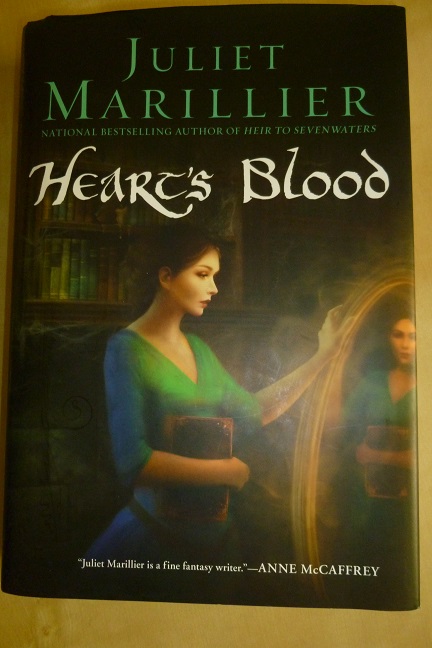
Heart’s Blood by Juliet Marillier

Heart's BloodI’d just like to say, when Juliet Marillier is good, she’s really good, and I’ve been having a nice run with her books lately.  After recently reading Heir to Sevenwaters, I jumped into a reread of Heart‘s Blood, in part so that I could try to actually notice sooner this time that it’s a “Beauty and the Beast” retelling…  It took me far too long to figure that out on the first go-around.

The heroine of the story is Caitrin, who flees an abusive situation and, in desperation, seeks refuge and work as a scribe at Whistling Tor.  There are strange rumors about monstrous spectres in the woods around the Tor, and about Anluan, the chieftain.  Anluan proves to be bad-tempered and unfriendly; he was stricken by illness as a child and it left him semi-paralyzed on his right side.  He nearly runs Caitrin off at once, but instead she stays, becoming part of his very unusual household and delving into the myserious curse afflicting the Tor.

You probably already see some “Beauty and the Beast” parallels, and there are also enchanted mirrors scattered throughout.  It’s really only “Beauty and the Beast” in the broad strokes, though, and most of the story focuses on deducing the origin of the curse, as well as on an outside threat from foreign invasion.

I was also struck by Jane Eyre parallels, particularly in the second half of the book, so I don’t want to get into details too much.  Even at the beginning, though: a talented young woman sets off from a difficult situation, and finds work with a gruff employer at a big house on a misty moor (or Tor…)  He’s unfriendly but secretly attracted to her, while she comes to see the value behind his unattractive exterior.  (Although no, there’s no first wife locked in a tower.)

This was an interesting one to read right after Heir to Sevenwaters, because it was once again two of my favorite archetype characters: a heroine who has to find her own strength and worth, and a dark hero with a heart of gold.  That’s not to say, however, that Caitrin and Anluan are the same characters as Clodagh and Cathal.  They have their own unique characteristics and paths to walk.

Caitrin has a particularly difficult journey, overcoming abuse in her past.  Marillier focuses less on the bruises and more on the psychological damage, which is deeper and far more complex.  I ultimately found Caitrin’s path to be immensely satisfying.  Anluan has different internal demons to overcome, and though we get less of his internal thoughts (Caitrin narrates, but we do get into Anluan’s journal) his development is intriguing too.

The magic is spooky at times, creepy at others, and delves into questions of good and evil and the hazard of judging too quickly whether someone is one or the other.  There’s a nice balance of character growth with unraveling mysteries and, as is usual for Marillier, the last hundred pages are breathless and hard to put down.

Highly recommended. 🙂

Author’s Site: http://www.julietmarillier.com/

Other reviews:
Ivy Book Bindings
Academics Go Clunk
The Book Rat
Anyone else?

Buy it here: Heart’s Blood

Star Trek: Into Darkness

StarTrekIntoDarknessEnterprisePosterI went to see Star Trek: Into Darkness on opening night, and can happily report that I thoroughly enjoyed myself…although in the end, I feel mixed about the movie.  It was a very good time–and yet there are issues.  I feel rather that way about the previous movie too, although the particular issues are different ones.  The first (eleventh) movie had rather a mess of a plot but excellent characters and some fantastic moments.  This one had an engaging plot, made rather a mess of the characters…and had some fantastic moments.

The movie opens with the Enterprise on a routine survey mission that is on the brink of going horribly awry.  This felt a lot like an old-style Trek adventure, and was a very fun way to start the movie.  Kirk breaks regulations to pull a victory out of chaos, but is still smacked-down by Starfleet for breaking the rules.  This is quickly set aside, however, when Starfleet comes under attack from the mysterious John Harrison (Benedict Cumberbatch) and the Enterprise sets out to round up the fugitive.  Beyond that, it’s hard to discuss plot without serious spoilers.

Suffice to say, the plot was at times implausible or convoluted, but also exciting and engaging.  There are some good twists and very good chase sequences, although some of the action parts went on longer than necessary.  And there were far too many flashing lights!
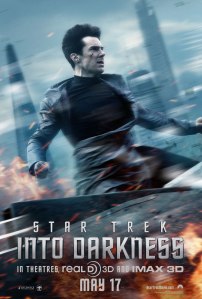
Cumberbatch2But  there was also Benedict Cumberbatch.  Pardon while I gush.  I don’t think I would have enjoyed this movie half as much without Cumberbatch.  Whatever was wrong with the characters (I’ll get to that), the problem was not the villain.  He was completely awesomely amazing  every time he was on screen.  He was one of those villains who is just so damn cool that you want to root for him–while realizing fully that he’s a horrible person who must be stopped.  I’ve only ever seen Cumberbatch before in Sherlock, and this was like the evil Sherlock.  Sherlock if he really was a pyschopath, and not nearly as funny.  So.  Brilliant.

They hold back the reveal on his, shall we say, secret identity for quite a while and I won’t reveal it either.  But I heard a definite exhale go through the audience when it finally came out.  If you’re on the fence about seeing this movie, it’s worth it for Cumberbatch alone.

But he isn’t the only good thing in the movie.  Scotty, McCoy and Chekov are all really delightful every time they’re on screen–which, in the case of McCoy especially, was not often enough.  There are some very funny moments, which was good and bad–and I think that brings me up to why I feel mixed.  Some of the lines made me laugh…except that the characters shouldn’t have been saying them.

I had problems with the portrayal of the characters, and when I say “the characters” I think I mostly mean Kirk, though not exclusively.  Part of the trouble is the whole “prequel” concept that they set up in the last movie.  At the end of that movie, a group of (essentially) college students were put in charge of the top-of-the-line, pride of the fleet Starship Enterprise.  In this movie, the college students are running things–but they’re still behaving like college students.  They flirt, they argue, they have relationship discussions in the middle of a battle sequence, they disregard regulations and blithely expect to get away with it.

Now I’ll grant you, the original series characters always had their moments.  But there was also always a baseline of professionalism.  There was rank, there was protocol, there were regulations and procedures and a rational chain of command.  And they behaved (mostly) like professionals.  They felt like mature adults.  The dynamic and the interactions in this new movie just didn’t feel right to me for Starfleet officers, or for these characters.

I know this sounds like a nitpick, but the continued unprofessionalism was threaded throughout the movie, and when something is just a little bit wrong every third line of dialogue, that’s not a little thing anymore.  It was everything from Kirk making pointed-ear references (which is McCoy’s sole prerogative) to Sulu or Chekov saying things like, “I don’t know if I can do that but I’ll see what I can manage,” when the only appropriate response is “Yes, Captain.”  And then there was Scotty calling Kirk “Jim,” repeatedly.  Only Bones calls him Jim regularly, that’s what makes him special (or maybe I should say, his specialness lets him do it–not that anyone writing this seemed to understand that McCoy is important.  A different issue).  The worst was when Uhura and Spock had a relationship spat mid-landing party.  People: professionalism!  (The fact that they even have a relationship to have a spat about–that’s so wrong I can’t even touch it.)

The lack of maturity was especially a problem for Kirk, because they apparently decided to give him a character arc about needing to grow up into the role of captain.  And yeah, I know, prequel–except that he’s already captain, with the same crew he had on the original series, and the idea in that context that he doesn’t know what he’s doing yet and that, I don’t know, his pre-frontal lobe is still developing or whatever…no, it just felt wrong.  I love Kirk because he is every bit as awesome as he thinks he is, he always knows what he’s doing, and he always bends the rules in exactly the right way to get a victory and stay out of trouble.  Always.  If they want to tell a story about how he became that person, it should have happened before he was sitting in the Chair.

So much for my rant.  Just when I was getting thoroughly frustrated with things, though, we got into the last half-hour or so…which will be a spoiler to discuss.  So I’m putting it in white, highlight the next paragraph if you want to read it.

Loved the last portion of the movie.  I thought the role reversal of Kirk and Spock was mind-bendingly brilliant.  This is by far and away the best example so far of taking the altered timeline and doing something really clever with it.  Loved the chase sequence with Spock and Khan.  Loved that a tribble was part of the key to saving Kirk.  Loved that Khan was shown still alive–and smiling–at the end.  That man’s not going away (I hope).  Loved that Leonard Nimoy had a cameo.  It was a pretty much unnecessary cameo–except that he’s Nimoy, and therefore is necessary unto himself, it doesn’t have to do anything for the plot.

And though it is about the end, it’s not a spoiler to say that using the original music for the end credits gave me the warm fuzzies.  🙂  Suffice to say as a non-spoiler, the last half-hour was brilliant, and while I stand by my issues with the other portions of the movie, it brought me around to a positive on the movie overall.

Next time–because I trust there will be a next time–I’m hoping for more McCoy (please, more McCoy!), less flashing lights and weird reflections, more maturity from the crew and especially Kirk, and with any luck, more Benedict Cumberbatch!

Movie site: http://www.startrekmovie.com/
Favorites Friday: Disney Women

You may have been seeing the buzz lately over Disney’s induction of Merida into their pantheon of Princesses–and even more buzz about the make-over that went with that.  It’s a fascinating and disturbing discussion (read more here).

It has me thinking about Disney women.  And I think it’s doubly unfortunate that Disney has a tendency to focus on the pretty, sparkly princesses, and not on the girls’ other qualities and abilities–because there are awesome Disney women.  Disney gets a fair amount of criticism in general for weak heroines, but there were already amazing Disney women before Merida–princesses and otherwise.  Here are my favorites:

Belle from Beauty and the Beast – Sure, she’s a princess, but only in the last minute of the movie.  Mostly, she’s an ordinary girl who loves to read and has big dreams.  She doesn’t let society dictate what she should be interested in (since they think she’s strange for reading) or who she should be dating (refusing to marry the immensely popular Gaston).  She sacrifices her freedom to rescue her father and stands up to the Beast when he bellows at her.  She’s brave, intelligent, inquisitive and yes, she has a pretty yellow dress…but there’s a lot more going on than that.

Katie from Darby O’Gill and the Little People – Lest you think Disney has no positive female characters before recent years, I point you to a live-action example, Katie O’Gill, whose movie came out in 1959.  She has immense force of will, there’s a clear sense that she’s running things in her family, and she’s not going to brook any nonsense from anyone, be it the local bully, her father, or the handsome Michael McBride (a very young Sean Connery, by the way).  She’s not waiting around for a prince–when Michael asks her once if she gets lonely, she remarks that she keeps busy, and seems to be sincere.  It’s not a perfect example because she doesn’t get to do much in her movie, but she has a strong personality and is a very long way from a sparkly, useless princess.

Chicha from The Emperor’s New Groove – Chicha, Pacha’s wife, is an absolute delight.  For one thing, she’s a pregnant animated character (how often do you see that?) and more importantly, she’s clearly as smart and as capable as her husband (probably more so).  To a certain extent, she’s stuck at home with the kids–but the villains come to call and Chicha swings into action.  She doesn’t wind up kidnapped or need to be rescued.  Instead, she becomes a participant in the efforts to foil the villains.  Love it.

Dejah Thoris from John Carter – I’m not denying there’s some issues with this one…like how she gets kidnapped, or her distinctly scanty attire.  But having read the original book, A Princess of Mars, I can assure you that they really tried to make her a stronger, more capable character.  I mean, she gets to use a sword–and she’s a scientist!  Big leap forward from the original source material.

Ellie from Up – Merida isn’t Pixar’s first amazing woman.  We also have Ellie, who is adventurous, daring and immensely confident in herself.  Even better, she marries a man who obviously loves those qualities in her.  It’s true she was only in the movie for ten minutes, but it seems to be a near-universal opinion that those were the most powerful ten minutes of the movie.  That’s a girl who’s having an impact.

It would be amazing if the debate around Merida sparks off some larger realizations for Disney.  Enough with the Princesses marketing campaign.  Yes, little girls like sparkles and pretty dresses and that’s fine, but Merida already has a sisterhood of Disney women who have qualities beyond their prettiness.

I think the problem is less the stories that are being told than the way the marketing campaign is handling them.  I mean, besides the women above, there’s Mulan, who rode off to war and found confidence in herself; Pocahontas, who saved John Smith from execution; and Jasmine, who inspired her father to change the law in a way that gave women more rights.  So I think it’s fair to give Disney credit for having some amazing women characters–and to hope that they’ll notice that fact!

The Two Towers by J. R. R. Tolkien

Two TowersThe quest continues–I finished reading The Two Towers by J. R. R. Tolkien this weekend, continuing my journey through the very-intimidating Lord of the Rings.  I enjoyed Fellowship pretty well (review here), and I think I liked Towers better.  Tolkien is still not exactly a high-speed car chase of a book, but there is more of a sense of things happening in the second book.  I’m not sure why I think that, when the entire second half is Frodo, Sam and Gollum wandering about…but still, it felt like at least they were going somewhere.  And I actually really liked that half!

The big surprise for me here (after seeing the movie) was how divided the book is.  It’s really two separate novels–the first half focuses on Merry and Pippin with the Ents (tree shepherds) and Legolas, Gimli, Aragorn and Gandalf fighting against Saruman’s forces, most notably in the Battle of Helm’s Deep.  The other surprise was that Helm’s Deep was Chapter Seven of Twenty-one, instead of the big, final, epic battle!

It was still pretty epic, though.  I’m not one for war novels, and I can’t say that I normally enjoy a major battle (swordfighting is different).  However, Tolkien (and Peter Jackson) pulls it off very nicely.  He sounds some interesting notes here.  Helm’s Deep emphasizes the bravery and glory of the defenders, fighting off mindlessly evil Orcs.  But then we get a different side in the second half, in a battle between Men.  Sam sees an enemy soldier killed, and wonders who he is and what his story is and whether he believed in his cause too.  It brings much more humanity and realism to the warfare.  I’ve heard Tolkien was a soldier in World War I, so I imagine he knew of what he wrote.

After that somewhat heavy observation, the other big surprise for me was that Legolas and Gimli actually have a competition in the book over how many Orcs each can kill at Helm’s Deep.  By this point, I was assuming that anything funny in the movie would not be in the book…

This first section of the book also introduced us to Eowyn, and I was happy to see another female character.  She didn’t have much more screen time (page time?) then Arwen, but slightly more, and I thought Tolkien did a better job of painting her character even in a short time.  From Tolkien, that’s about all I can  hope for with a female character…

I loved Merry and Pippin and the Ents.  That was much funnier in the movie (of course) but was pretty fascinating in the book too.  In typical Tolkien-fashion, we got the whole history of the Ents, these incredibly long-lived creatures.  It was (of course) a divergence from the main plot, but I found their history very interesting too.

The second half of the book brings us over to Frodo and Sam, on their quest to get into Mordor to destroy the One Ring.  They’re guided for much of the book by Gollum, and he is such a wonderful character.  He’s so distinct, so weird and strange, so interesting to read.  Maybe it was the focus on a smaller number of characters, but I felt like Frodo, Sam and Gollum all emerged much more strongly in this second book.  I was especially happy to see a lot of it from Sam’s point of view.

With the exception of Boromir, I like all the characters from the original Fellowship (although that may be more Jackson’s influence than Tolkien’s), but if I had to choose a favorite, I think it’s Sam.  It was Frodo when I watched the movies back when they came out, and I still like him a lot, but on this go-around, I think it’s Sam.

I think it’s Sam because he’s not the strongest or the smartest or the heroic type who ought to be on a quest.  But he’s so loyal and he’s so plucky and he’s going to stick by Frodo right into the depths of Hell–literally.  He’s not a saint;  he doesn’t like Gollum and he makes mistakes.  He’s a Hobbit, but he’s very human.  And because he’s in many ways the most ill-fitted for the adventure, I think he may be the bravest too.

The fact is, I (and probably most people reading the book) am much more the “sit at home and garden” type, rather than the “stride through the wilderness seeking evil” type.  I’m never going to be an Aragorn, but if life thrusts challenges at me, I would hope to be a Sam.

I also love that Sam is so aware of stories.  He keeps thinking about the epic tales, and how their adventure is just like one…but feels so different when you’re actually in it!

My favorite moment of both books so far…is a spoiler, because it’s near the end, but you’ve been warned…is when Sam believes that Frodo is dead, and resolves that he will take the Ring into Mordor himself.  He doesn’t want to do it, he’s afraid to do it, it’s not what he ever signed up to do, but it’s what needs to be done, so he’s going to do it.  Tolkien makes a U-turn about two pages later and it turns out it’s not the path Sam needs to take, but still.  In isolation, taken as itself, that one moment is just so beautiful.

Yeah.  So I kinda love Sam.

In fact, I’m glad I’m writing this review, because the more I think about the book, the more I think I liked it.  I mean, I knew that–I didn’t love it, but I enjoyed reading it and didn’t have any big complaints (just still a little bit slow…) but as I think about parts of the book more, the more I think I really quite liked it!

And I have Return of the King sitting on my DVD player, and the book on top of my reading stack, so we’re good to go for the final installment…

Author’s Site: http://www.tolkiensociety.org/

Other reviews:
Rawr Reader
Snuggly Oranges
Books, Tea & Me
Anyone else?

Buy it here: The Two Towers

Stonehenge Post: Revising Writing Goals

Stonehenge 2New post up today for my writing group blog, Stonehenge Writers!  You may remember at the beginning of the year, I wrote a post about setting writing goals.  Well, we’re almost five months along, and it’s a good time to take a look at goals and make some reassessments…  Come read the post: “Revising My Revising Goals.”