Reading Milestone: Completing the Newberys

This is a semi-challenge update…not a proper one going through all the challenge books I’ve read, though I know I missed June’s usual update (I’ll aim for getting September’s up…)  I couldn’t pass up sharing a milestone more than two and a half years in the making: I finished reading the Newbery Medal winners this week.

When I started this goal at the beginning of 2016, I had already read (some time over my lifetime) 32 of the then-94 total Newbery Medal winners.  I read 22 in 2016, 20 in 2017, and 22 in 2018, including the two new winners added since I started.

The first one I read for the challenge was the surprisingly upbeat Number the Stars by the very reliable Lois Lowry (1990), and the last was the rather dated Daniel Boone by James Daughtery (1939).

The most intimidating (but unexpectedly engaging on audio) was The Story of Mankind by Hendrik Willem van Loon (1922), the very first winner.

There’s a stereotype that Newbery Medal winners are tragic, which I can’t agree with.  Some yes, but not most.  There were even some animal ones where the animal survived, and not every wise mentor died by the end.  Still, the saddest was Kira-Kira by Cynthia Kadohata (2005) and the grimmest (not quite the same thing) was Sounder by William H. Armstrong (1970), although Avery Brooks (Captain Sisko) reading the audiobook helped.

On the other hand, I can’t say that any stand out as particularly funny (though some are more light-hearted), which seems unfortunate.

The book that took the most effort was The High King by Lloyd Alexander (1969), because it’s Book Five in a series and I read all the others first.

A lot of the books were good–and a lot were not, at least to my taste!  I can’t seem to pick a least favorite, because there were probably a dozen that were about equally so-so.  My favorite is The Girl Who Drank the Moon by Kelly Barnhill (2017), which wasn’t even on the list when I started.

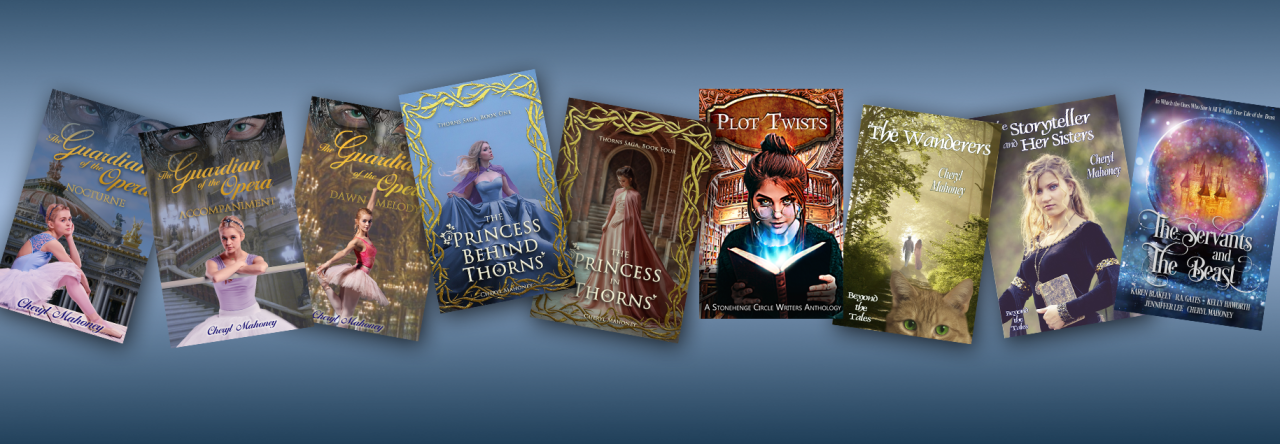
Since beginning this challenge, I met my now-husband, got married and moved.  The world went through some upheavals, I published one novel, completed NanoWriMo twice and finished a draft of my Phantom of the Opera trilogy.  So in many ways, this challenge began in a different lifetime entirely…

I don’t exactly feel, now that I’ve finished, that I took a trip through the best contributions to children’s literature since 1922.  It wasn’t a (not very) secret gold mine of excellent children’s fiction.  However, there is something very satisfying about completing a survey through…well, what has at least been considered the best contributions to children’s literature.  Many of them are famous ones, and it’s satisfying too to be able to look at titles I’ve heard for twenty years and feel that I finally have an acquaintanceship with the book behind it.

I’m curious about other people multi-year reading challenges.  Does it feel strange to finish something so lengthy?  Were you satisfied with the reading in the end?
Writing Wednesday: Class Divides in 1880s France

Earlier this week I did some editing on a scene in my Phantom retelling that gets at a thematic point (and plot obstacle) that I think has been largely ignored in other versions of the Phantom’s story: namely, the class divide between Raoul, Vicomte de Chagny, and Christine Daae, opera singer.

Mainly, Raoul could never marry Christine, and everyone involved would know that.  She could be his mistress, sure, but it would be a scandal to marry her.  In the original novel, Raoul is sad at one point early on because he knows he can’t marry her–and that obstacle is never referenced again.  (Spoiler: they get married eventually.)  Webber ignores the issue entirely.

In my ongoing effort to distinguish my retelling, and to provide a (reasonably) historically accurate version, I wanted to take that issue on directly.  The excerpt below comes just after Meg asks Raoul what his feelings are about marrying Christine.  It’s not the only place the class issue comes up (it becomes a major part of Meg’s plot in the third book too), but I like how this bit captures it.

*******

Raoul looked at the ceiling, the programs, the far end of the corridor.  “You must understand—my options are very limited—it’s all nonsense about the aristocracy having more freedom, we’re really very constrained in many ways—”

“I understand perfectly, Monsieur,” I said in my politest tones, because why waste any more time on this nonsense?

“Oh good,” he said, shoulders visibly relaxing, which just went to show that he had no idea what I meant.

I understood that he genuinely cared about Christine, that he thought well of her and, maybe, wanted to do the right thing by her.  I also understood that none of that weighed as heavily as the pressure of Philippe, or of societal opinion.  Nothing was surprising in that.  Everyone knew that men like Raoul didn’t marry girls like Christine.  Or like me.  Though with a sudden, uncomfortable feeling, I realized I wasn’t sure that Christine knew it.  But did I dare try to point it out to her?

I felt a surprising pang of disappointment too.  I didn’t even like Raoul, it wasn’t exactly that.  But it didn’t seem fair, that even Christine, beautiful, talented, magnetic Christine, wasn’t good enough for a silly vicomte.

Writing Wednesday: A Dragon Poem

I recently took a break from my revisions to play with a sudden idea for something very different.  I was having conversation with a writing friend about her new kitten, named Dragon, and his dragonish qualities, like his dragon heart.  I asked if he had a dragon’s voice though, and it turns out he’s quite squeaky!  With leaps and bounds, this led us both into separate ideas for a children’s story about a dragon seeking his roar.

Because it all looked rather Dr. Seuss-ish in my head, I ended up spending a week writing a rhyming tale of baby dragon Squeak and his search, in all the wrong places, for his very own roar.  I’ll offer the initial qualifier that I am not a poet, and offer a few verses just for fun.

And so the days passed, and the baby dragons grew,
Named for the sounds of their first cry and hue,
Gree and Fwoof and their fine brother Squeak,
Who hated his name, sounding so soft and so meek.

He was a brave dragon, he knew this was true,
He knew that his roar should be brave and strong too.
He tried and he tried, and then he tried even more,
Opened his mouth and produced a shocking squeak.

“Don’t worry, my child,” his kind mother soothed,
A serene dragon she was, not easily moved.
“You’ll find your own roar, just like all your kin.
Just remember your roar must come from within.”

Mini-Monday: Hello, Universe and Invincible Louisa

I’m getting down to the end of my Newbery Medal reading challenge, with just two more to go!  Today I thought I’d say a few words on the most recent two I read, from very different time periods but both pretty good.

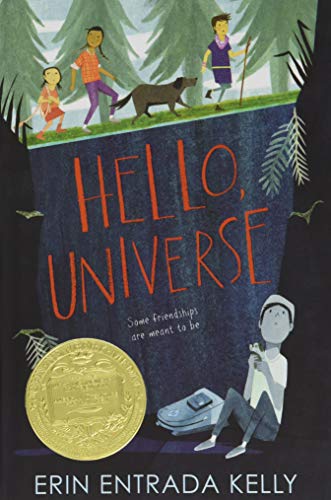
Hello Universe by Erin Entrada Kelly (2017)
The most recent Newbery winner, this tells the story of a handful of kids who share a neighborhood: Virgil, whose family calls him “Turtle” because they think he needs to come out of his shell; Valencia, brave, nature-loving and deaf; Kaori, who believes emphatically in her own psychic abilities, and Chet, neighborhood bully.  Their paths intersect one afternoon when Virgil goes missing.

This is a great one for my diversity challenge, as Virgil is Filipino and Kaori is Japanese, and both cultures are very much present and important for the characters.  All three of our heroic characters are different from the norm in their own ways, and they grow through the book to appreciate both themselves and each other.  There’s some tragedy at the center of the book, but a mostly light-hearted tone, especially around Kaori and her younger sister. Continue reading “Mini-Monday: Hello, Universe and Invincible Louisa”

Book Review: Persuasion by Jane Austen

I recently reread the Austenland duology, which put me in the spirit for some of the real thing.  I’ve reread a fair amount of Jane Austen in the not too distant past, but it had been a long time for Persuasion, so I decided to listen to the audiobook.

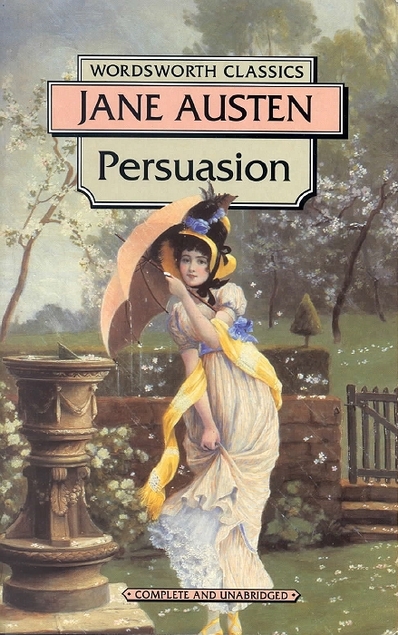
Persuasion follows the story of Anne Elliot, who is seven-and-twenty and unmarried (horror!)  In her youth, she loved a sailor, Captain Wentworth, but was persuaded it was an unwise match.  She gave him up, but misses him still.  Now he’s back in England, a wealthy and successful man, but seems quite cold to her when they begin to move in the same social circles.

This is the main plot thread, but Persuasion is full of family dramas involving Anne’s two rather unlikable sisters, foolish father, and host of in-laws.  This book is so very Austen, in that for whole stretches not a great deal happens besides going for walks and having intensive debates about relative ranks in social circles.  It’s an interesting social study, and the soothing kind of book where you know nothing very bad is going to happen–despite a life-threatening injury to one character, and financial crises of others.

Anne is a bit of a puzzle to me.  She’s unfailingly kind and sensible, with a genius for putting up with other people’s foibles and still liking them (in the case of her sisters, for example).  She’s not as witty as Elizabeth Bennet, but also not quite so self-effacing as Fanny Price (who I actually like, though I believe I’m a minority!)  I got frustrated with her at times though, I think because I brought modern sensibilities to a very different social setting.  Anne encounters Captain Wentworth–misses him–wonders how he feels about her–and does nothing!  But I imagine there was nothing much for a well-bred young lady of the time to do, and perhaps Austen’s original readers would have taken that for granted. Continue reading “Book Review: Persuasion by Jane Austen”