Book Review: Mansfield Park

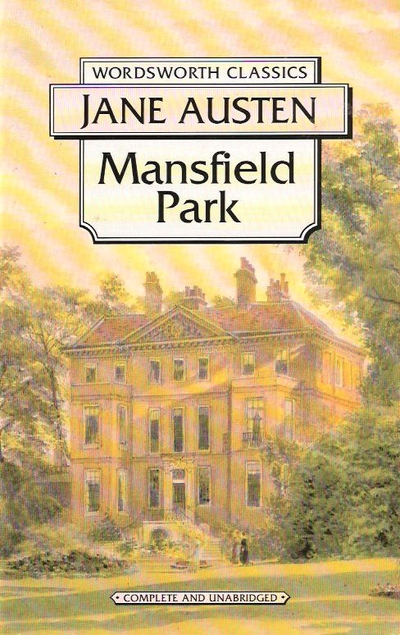
I recently reread (via audiobook) Mansfield Park by Jane Austen, one of my favorite Austen novels–although it rather surprises me that it is a favorite!  As sometimes happens, rereading gave me a few more insights.

Our heroine is Fanny Price, a penniless child taken in by her wealthy aunt and uncle, Sir and Lady Bertram at Mansfield Park.  She grows up beside her cousins, becoming particularly close with Edmund.  As all the young people reach adulthood, Austen takes us through courtships and scandals of the Bertram family and their possibly questionable friends Mr. and Miss Crawford.

It’s a bit difficult to summarize Austen, because it’s not really a plot-driven book.  I freely admit that Mansfield Park meanders–or perhaps I should say it strolls along a country lane.  The book is a long series of incidents of family life, all of which last longer than they would in a modern novel and often only vaguely build upon each other.  And yet–it’s just such a pleasant read!  I like an exciting story too, but sometimes a country stroll is very appealing. Continue reading “Book Review: Mansfield Park”
Blog Hop: Incomplete Reading

book-blogger-hop-finalToday’s Book Blogger Hop question is: How many books have you started, but just couldn’t finish?

I’ve no idea about the number, but it isn’t very many…  I’m a completist, so I will usually stick with a book.  I did somewhat famously quit Awaken halfway through because it  made me so angry; it was either quit or throw it across the room.  Alcatraz vs. the Evil Librarians, on the other hand, I finished so that I could hate it more comprehensively (and so I’d know what I was talking about at my book club when I criticized it).  I sometimes finish a particularly dark book because if I get to the end I can close it in life and in my head, and if I stop halfway it feels more likely to linger.

Lately I’ve been trying to drop books if I just don’t care about them.  There have been probably four or five in the past year that I got several chapters into and, while I didn’t hate them, I had no real interest either.  I have to remind myself that there are too many books in the world to waste time on ones that I don’t care about, even if I can’t point to any reason I don’t care–sometimes a book (or, frequently, its characters) just won’t grab me.  So I’m trying to quit on those.

This new resolve did cause a problem when I was at work, with lunch and a second break ahead of me, and continuing to read the book I had brought felt like it would be nothing but a waste of time.  I’ve since started keeping a collection of O. Henry short stories (my go-to for random snatches of reading time) at my office, just in case.

Do you frequently drop books midway, or do you feel compelled to give them a chance?

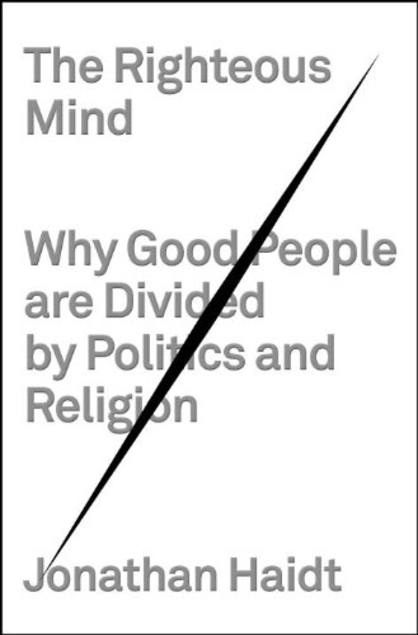
Book Review: The Righteous Mind: Why Good People Are Divided By Politics and Religion

Most of the books I read now I pick up on reserve at the library, but I love it when I just stumble on a really good book.  I was at the library a few weeks ago and had nothing to fill the nonfiction slot in my regular reading.  So I looked up Gretchen Rubin’s Better Than Before (a favorite) in the online card catalog, then went to that shelf to see what else I could find there.  And so I found Jonathan Haidt’s The Righteous Mind: Why Good People Are Divided By Politics and Religion.  A book exploring why we end up on opposite sides of the political spectrum?  Yes, please!
And it was fascinating.  Haidt brings together psychology and sociology to look at how morality works, and how different people and groups can have very different concepts of what is right and wrong.  He expands on a few major premises:

A) Different groups around the world have strikingly different moral systems.  Much of this comes down to whether morality is based purely on whether an action causes harm or not (it’s almost never just that).  Everyone agrees it’s wrong to hurt others, but after that there’s divergences in whether something can be wrong, and for everyone, even if it causes no direct harm. Continue reading “Book Review: The Righteous Mind: Why Good People Are Divided By Politics and Religion”

Blog Hop: Page vs. Screen

book-blogger-hop-finalToday’s Book Blogger Hop question is: What was the one time you thought the movie was better than the book?

There are actually a number of movies that were better than the book…although I do think the trend is usually the other way!

One of the big ones is Horatio Hornblower.  I watched the miniseries, went to the books, and found out all my favorite bits of the miniseries weren’t in the books.  What’s especially odd is that the miniseries had much, much better development of the characters and their relationships than the book did–not the usual situation.  Oddly enough (or not), the same author wrote The African Queen.  Exact same problem with regard to best bits and character portrayal compared to the Hepburn/Bogart movie.

More likely to raise some controversy…I also feel that the movie Stardust was better than Neil Gaiman’s book.  Two reasons: he summarizes a major journey that sounds like the most interesting part into only a few pages; the movie portrays this portion much better.  Second, he subverts expectations at the end with a kind of non-climax…and there’s a reason people like climaxes.  I preferred the movie’s admittedly more conventional ending.

Have you encountered times when the movie was better than the book?  What made the difference for you?

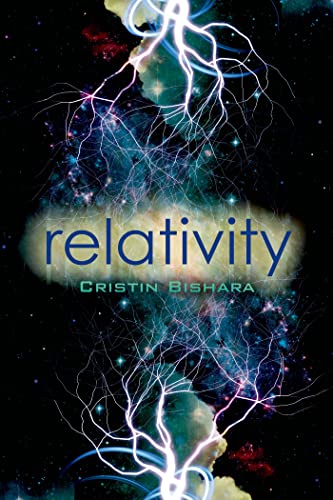
Book Review: Relativity

Still catching up on some of my unreviewed challenge reading from late last year…  My last parallel universe book was Relativity by Cristin Bishara.  Another YA one, it explored how a family and a town can change in different universes.

Ruby’s mother died when she was four; now sixteen, her father recently moved them from California to a tiny town across the country, with a new stepmother and horrible stepsister.  But then Ruby finds a mysterious old oak with a door in the trunk—and going inside takes her to alternate worlds.  What if her mother didn’t die?  What if she had an older brother?  What if the town was a haven for art and science instead of, well, not one?  What if her best friend from California lived in this town instead?  How is Ruby different—and can she find the perfect life?

This was a great one for exploring my favorite parallel universe question—how does one event in the past change everything that follows?  I really enjoyed the exploration of Ruby’s different lives and how different she herself is.  Her desire to find the “perfect” life is very relatable—and heartbreaking, because it’s so clearly a doomed quest. Continue reading “Book Review: Relativity”