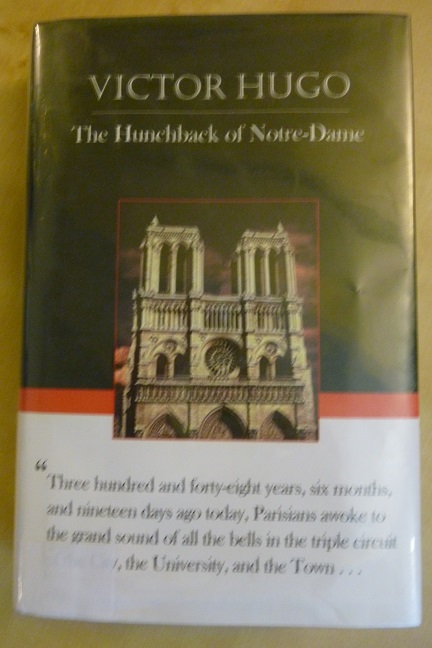
I’ve been working on intimidating books this year…and diving into shadowy mysteries and Gothic literature for RIP…so September was clearly the month for The Hunchback of Notre Dame by Victor Hugo. I enjoyed it quite a lot–I had been thinking I might take a break and read something else in the middle. Instead, I ended up being so engaged that I didn’t stop after all–even though I had the new Jacky Faber book arrive while I was reading (but that’s a topic for another review).
The copy I read mentions on the jacket flap that Hugo despised the title The Hunchback of Notre Dame, which only arrived for the English translation. Hugo called it Notre Dame de Paris–1482. Not so catchy, but more accurate. The Hunchback is just one member of an ensemble cast, and if I was going to pick one character as the lead, it would have to be the gypsy Esmeralda–hence the title of this post! Because it really is centered around Esmeralda…and the men around her.
After my experience with Les Mis, I felt comfortable skipping or skimming when Hugo seemed to be off-plot, which happened a lot in the first hundred or so pages. In fact, the main character of the first section of the book (if there even is one), is Pierre Gringoire, a destitute poet, and the story didn’t really pick up for me until he reached the Court of Miracles, where live the gypsies and vagabonds of Paris.
This is one of those books that’s worth sticking with, though, as it really does improve as it goes (with a few side diversions into history or cultural background…but that’s Hugo). Gringoire has an interesting adventure or two, then disappears for most of the book as we finally focus on beautiful Esmeralda, terrifyingly sinister Frollo, sad hunchback Quasimodo, and surprisingly awful Phoebus. For all the cultural weight and the number of pages, it’s essentially a story of unrequited love: Frollo wants Esmeralda who wants Phoebus who doesn’t value her–and no one wants Quasimodo, who was struck to his core by one act of kindness Esmeralda showed him.
Esmeralda is the center of the story, in that all the other characters circle around her and the plot is mostly driven by how they feel about her. I couldn’t get much sense of Esmeralda herself, though. She’s something of a will o’ the wisp, always flitting about but we don’t get into her head much. She almost irritatingly enamored of Phoebus, and it’s a shame that that becomes such a driving part of her character. She could be fascinating, as an independent woman who makes her own way in the world, on her own terms. In a sense Fantine of Les Mis is independent, but her life fell apart; Esmeralda is actually getting along fine. We don’t get much of that, though.
I was also rather disappointed by the lack of relationship between Esmeralda and Quasimodo. She does show him kindness once in an extreme situation, but later on she’s still deeply uncomfortable around him. Oh well, I should have known Disney would make it all rosier!
And on that subject–for a man named after the Sungod, Phoebus was horrible! I deeply missed Disney’s courageous, noble captain, when Hugo gives us instead a philandering cad who can’t actually remember Esmeralda’s name…
This may be weird, but I think I was most fascinated here by Frollo. Hugo’s heroine may have left a bit to be desired, but you can trust him to provide a complex villain. It shouldn’t be surprising that we descend into the depths of his sordid obsession and twisted desire for Esmeralda. I mean, even Disney didn’t manage to clean that up entirely! I was more surprised by how openly sordid and at times sensual the book was, considering the time of the writing…maybe I’m just used to restrained British Classics, and it’s different when the French were writing them? 🙂
So how about the not-actually-title-character? Quasimodo reminded me SO much of Leroux’s Phantom. And I think that was just me and my particular, um, interests. Hugo’s Quasimodo is dark, at times hostile, but also coming from a place of deep sadness. His hostility towards the world is founded on the world’s rejection of him and that makes me feel so very bad for him. I love his love for the cathedral, and I was thrilled to see a line where he’s talking to his favorite gargoyle statue…and it’s heartbreaking that that line is, “Why can’t I too be made of stone?” Sad sad sad.
And he’s also like Leroux’s Phantom in that I think they both had authors who didn’t realize what they’d created. Leroux spent far more pages on Raoul than he did on the much more interesting Phantom, and Hugo could have given us more of Quasimodo and less of some others…but what we got was very good.
This is only about half as long as Les Mis (so, 500 pages…) and some parts require a bit of wading, but on the whole I thought it was an excellent, very readable story with extremely engaging characters–even if some were less likable than I had hoped! Once the book gets into its stride, it’s also hugely exciting. I read the last hundred pages straight-through. And, of course, the ending is deeply tragic.
I’ll probably still watch the Disney movie more often than I’ll read Hugo 🙂 …but I did thoroughly enjoy reading the original.
Other reviews:
My Turn to Talk
The Yellow-Haired Reviewer
A Good Stopping Point
Anyone else?
Buy it here: The Hunchback of Notre-Dame


 I’ve been reading the Jacky Faber series by L. A. Meyer since high school. I think there were only two or three books when I started. Last month, I was very excited to read the latest installment–Book Eleven, Boston Jacky.