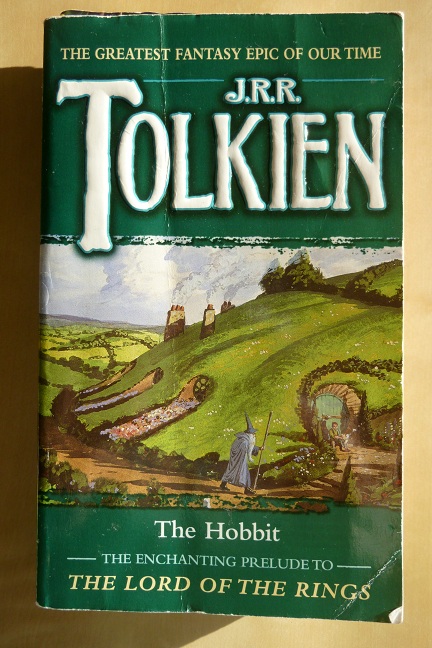
The Hobbit by J.R.R. Tolkien

HobbitIn another read for the Once Upon a Time Challenge, I reread The Hobbit by J. R. R. Tolkien.  This is one I read so long ago (twelve years?  Fifteen?) that it mostly felt like a new read by now.  I kept meaning to read it before the movie (review here)…and then wanted to read it after…and mostly read it now because I plan to read the Lord of the Rings trilogy this spring, and it seemed like a good place to start!

The story, as most of you probably know, follows Bilbo Baggins, a Hobbit who only wants a tidy life and regular meals.  He is enticed into an adventure by Gandalf the Grey Wizard, who recruits him to join thirteen dwarves on their quest to reclaim their lost home and treasure from Smaug the dragon.  Adventures along the way involve elves, trolls, goblins, a truly creepy forest and, now and then, even a few humans.

I love Bilbo’s growth as a character throughout the book.  He begins by feeling that adventures are unpleasant things which make one late for dinner (one of my favorite lines!), and comes to find his own strength and ability–and a taste for adventure.  He learns how to use a sword, devise a daring plan, and make a hard decision about loyalties and sacrifice.  There’s a thread that runs through the novel about the state of Bilbo’s pocket handkerchiefs, and it’s just a delightful illustration of how he progresses.

I also love (spoiler?) that Bilbo ultimately does return home.  So often stories like this end up with the character in a new place, or deciding that they don’t really want to go home after all, or realizing that “you can never go home again” as the cliche goes.  (Or there’s Dorothy, who does go home, apparently only learning that home is really wonderful.)  The Hobbit takes a different and more complex path by sending Bilbo back home in the end, meaning that the real exploration is not ultimately how Bilbo’s life changes, but how he himself changes.

The world of Middle Earth is also great fun to explore–and I suspect that was a major part of Tolkien’s inspiration to write the story at all!  It’s a story about a character, but it’s just as much about the wild places he’s wandering through, with so many interesting creatures along the way.  Humans come across as a small minority, present in a few communities but no more dominant than any other species (at least in this installment).

My two favorite scenes are the very funny opening sequence of the dwarves descending unexpectedly on Bilbo, and the quite creepy Riddle contest with Gollum.  I very much look forward to more Gollum in the trilogy to come.

There are aspects to the book that didn’t work as well for me–and at times it’s abundantly obvious this was written in a different time, because a modern writer would make a different choice (or editors would insist on it).  The most obvious, perhaps, is when a character we’ve never seen before ends up killing Smaug.  It’s a rather disappointing way to finish off the dragon…though at least it leads into further excitement.  I’m very curious to see how Peter Jackson, as a modern filmmaker, is going to handle that part.

I also wish the dwarves had been better developed.  Rather like the discussion we’ve been having around the Twelve Dancing Princesses, it’s tough going when you have so many characters to juggle.  There were thirteen dwarves and most were completely undeveloped.  Even the five or so that had some personality were pretty slight.

Last critique–I don’t think there was a single female character with a name or a line of dialogue in the entire book.  For all I know, hobbits, goblins and elves are only men!  The dwarves reference a female relative or two in explaining family connections between men (Fili and Kili are the sons of Thorin’s sister, for instance), and some human women get into boats when Smaug attacks the town…but otherwise, Middle Earth seems to be entirely male.  Frustrating…though, if I can go by the movies, there are at least a few actual female characters in the LOTR trilogy!

Whatever its flaws, this is a still a very fun, very interesting adventure.  And, as I hoped, it’s great gateway-Tolkien, because it has me looking forward to exploring the world more and delving into new characters for the LOTR trilogy.  I’ll let you know how that goes. 😉

Other reviews:
Books Please
The Bookworm Chronicles
Pocketful of Books
There must be many, but I was struggling to find other good reviews…tell me about yours!

Buy it here: The Hobbit

Stonehenge Post: Building a Fantasy World

Stonehenge 2New post today for my writing group blog, Stonehenge Writers!  You may have noticed a bit of a focus on fantasy around here recently…so in keeping with that theme, my post today shares a great resource for building a fantasy world.  Might be interesting even for non-writers, to think about all the elements that go into these fantasy novels we enjoy so much!  Come by to read the post: Building a Fantasy World.

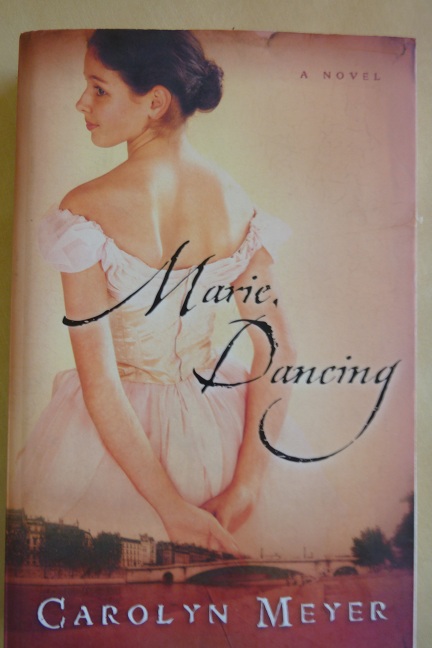
Marie, Dancing

Marie, DancingI think we all know I’m a fan of the Phantom of the Opera…and I’d be lying if I said that wasn’t the primary reason I wanted to read Marie, Dancing by Carolyn Meyer.  It just happens to be set in the Paris Opera House around 1880, the same time as the Phantom.  But besides that, the book also plays to my interest in Impressionist art, and in Paris in general, and in stories about strong young women.  The book only shares a setting with Leroux and there are no Phantom references at all…but there is a good story and a lot of information about the Company of the Paris Opera.

Marie and her two sisters are ballet dancers at the Palais Garnier.  The story opens when the painter, Monsieur Degas, selects Marie to be his model for a sculpture he has in mind–the sculpture that will become The Little Dancer, Aged Fourteen.  Degas and his art are just one part of Marie’s story, as she struggles with her family’s poverty and tries to make choices about her future.

Marie lives in a very, very different world than Christine Daae.  Unlike Leroux’s spooky thriller, this is a gritty, realistic book.  Marie’s problems are real and serious, with never enough food, a mother who drinks too much absinthe to forget her pain, and an older sister who aspires to become a rich man’s mistress and thinks Marie should do the same.  The book is not depressing exactly, but it is a glimpse at the harsh reality behind the elegant forms of the dancers.

Marie does love to dance, and she has dreams of becoming a great dancer.  The book is not really about dancing though–that recedes more and more as it goes on, and becomes more about Marie’s family, her struggles, and a romance–lest you think it’s all grim!

From the point of view of a Phantom fan, this definitely gave me some different angles on things.  It gave me more basic information about life at the Opera House than anything else I’ve read, and was utterly eye-opening on the subject of money.  I never appreciated just how much money 20,000 francs a month (the Phantom’s salary) really is, until Marie sighed with envy over the salary of the higher-level dancers–6,800 francs a year.

The sections with Degas were particularly interesting.  There are occasional references to specific sketches or paintings, and I think I recognized some famous ones!  Mary Cassatt is also present as a supporting character, and I loved the glimpses of the history of Impressionism.

I would have liked more description of the setting–the Opera House is gorgeous, and yet other than a few bits here and there, I didn’t get much sense of it.  But even if appearances were somewhat lacking, Marie’s world came vividly to life.

If you’re interested in dancing, and particularly the Paris Opera, this is a very good slice of historical fiction, unflinching but not unremittingly grim either, and the characters and plot are both engaging.  And you’ll look at Degas’ Little Dancer in a whole new way!

Author’s Site: http://www.readcarolyn.com/

Other reviews:
The Estella Collective
That’s all I found!  Anyone else?

Buy it here: Marie, Dancing

Jesus On Screen

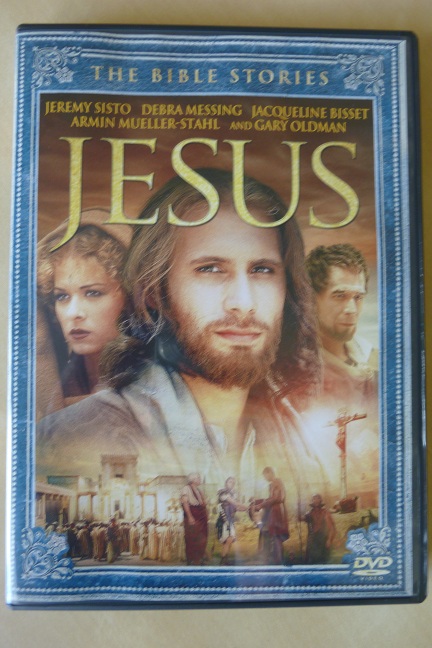
JesusI don’t usually do reviews on Friday, but today is Good Friday, leading up towards Easter Sunday, and I just watched a movie that is immensely appropriate to the day.  It has the very simple title of Jesus and was originally a TV miniseries from 1999, though it plays like a three-hour movie (and there were only a few obvious commercial breaks!)

I watched at least part of this when it first aired, but all I remembered was Jesus having a conversation with the devil, and a vague image of Jesus walking down the road and joking around with his disciples.  Not a lot to go on trying to find the movie again–but obviously it worked out.  And it turned out to be a fantastic movie–I ordered the DVD from Amazon before I even sent back my Netflix disc, and I searched IMDB to see if the director has done any other Biblical movies (he has!)

So what blew me away so much?  Oddly enough, it really may be encapsulated by that moment of Jesus joking around with his disciples.  This is the most joyful Jesus I can remember seeing in…maybe any movie.  The church teaching is that Jesus is fully human and fully divine, but the divinity seems to get more play in movies.  Usually it’s all very serious, every word he says is a solemn and profound pronouncement.  Most often, the humanity gets expressed in suffering.  I’m not saying any of that isn’t important, and this movie gives those moments too–but there are also a lot of moments where you get the feeling that it’s a good time hanging out with Jesus.  Or just that he knows how to live a normal human life, and goes through periods of learning, uncertainty and change.

The movie opens slightly before Jesus (Jeremy Sisto) begins his public ministry.  We don’t often see Jesus with Joseph, and I really liked this movie’s exploration of Jesus’ relationship with his adoptive father.  Mary figures in quite a bit too, and while there isn’t a full scene of the Nativity, Mary and Jesus do have a conversation or two reminiscing over family stories.

Jesus begins his ministry with the baptism by John, and then goes into the desert for a very interesting Temptation sequence.  This was a particularly clever Satan, who is clearly evil but convincingly persuasive.  Although, while the desert sequence was mostly good, I could have lived without the image of Jesus with a severely blistered sunburn…

Jesus then starts collecting disciples, and I love that not only is Jesus very human, real and alive, everyone else is too.  There are about six of the Apostles who get some development, and without spending a lot of time on most of them, I still got a sense of all of them as people, not just distant figures in Bible stories.

As one representative example, I’ll take the calling of Simon Peter.  Peter and his friends have been fishing and caught nothing.  Jesus tells them to take the boat out and he’ll tell them where to drop the nets to catch fish.  Peter scoffs at the whole thing (because what does this guy know about fishing anyway?), but says he’ll do it to prove a point about this supposed Messiah.  When the nets come in miraculously full of fish, Peter is completely flummoxed–and Jesus starts laughing.  There’s nothing remotely mean about it, but it’s so clear that Jesus is having fun teasing Peter.  I love that.

There are lots of moments like that.  The movie walks a nice line, because while it is fun, at the same time, Jesus is also a profound teacher who takes his mission seriously, and has an important message about love and compassion.  It’s not all just larks, there’s a spiritual depth as well.  And there are serious moments–as when Jesus cries over a Roman soldier killed by Zealots (not Biblical, I don’t think, but I like it).

One of the other major characters in the story is Mary Magdalene (Debra Messing).  Overall I thought her portrayal was wonderful, although (rather like the blisters in the desert) I could have lived without two very brief, gratuitous scenes of Mary Magdalene, um, at work.  The movie conveyed everything needed in another scene of her watching Jesus forgive the woman caught in adultery.  We didn’t need the more sensationalist moments.  The tradition of Mary Magdalene as a prostitute isn’t Biblical, but I don’t object to it generally, and the movie used it for the most part in a very profound way to convey a message about forgiveness and releasing judgment.  Another nice touch was the relationship between Mary Magdalene and Mary, Jesus’ mother.  They’re next to each other in paintings of the Crucifixion a lot, but I’m not sure I’ve ever seen it really explored.

On the villain side of the story, Pontius Pilate (Gary Oldman) and King Herod are threaded throughout the movie, rather than only coming in at the very end.  Herod has his own issues, particularly around John the Baptist, and Pilate is working political manuevers to make sure he stays in good with Rome.  By the time we reach the Passion, we know Pilate very well, and I like seeing Pilate as a human too.  Not a very nice one, but human.

The movie successfully makes the bridge from a largely light-hearted ministry to the intense end of Jesus’ life.  The Raising of Lazarus is something of a turn in the tone, I think, as it’s handled in a more solemn way, and that leads into the last week of Jesus’ life.  Satan returns in the Garden of Gethsemane, which I thought was an excellent touch.  The Passion is intense and bloody (as is probably inevitable), but it is mercifully brief.

And after the Crucifixion, there are a couple of lovely scenes with Resurrection appearances.  I don’t know why exactly, but the Passion seems to get far more focus in movies than the Resurrection (more dramatic?), which is too bad because there are wonderful Resurrection stories in the Bible.  Another ten minutes in this part would have been even better, but at least there were some wonderful moments.

I have a tradition of watching Jesus Christ Superstar leading up to Easter, but I may have to expand that tradition a bit.  Jesus is a wonderful movie, and I have to love a Bible-retelling that frequently made me smile.  And not only because it led Netflix to send me an email with the subject line, “Has Jesus arrived yet?”  🙂

Other reviews:
Charles Tatum’s Review Archive
Canadian Christianity
Anyone else?

Buy it here: Jesus

Chalice by Robin McKinley

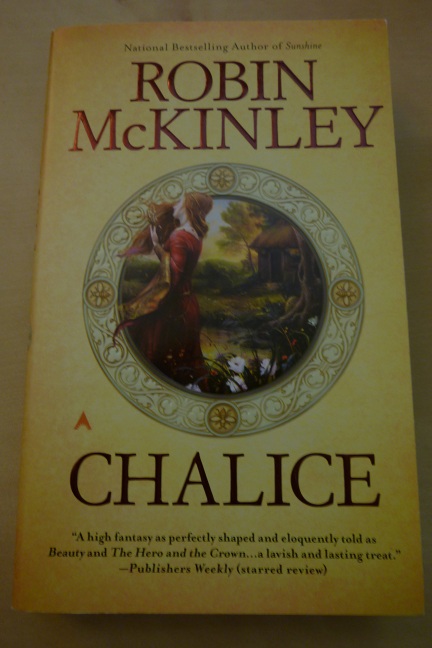
ChaliceFor the second year in a row, I began the Once Upon a Time Challenge with a Robin McKinley re-read.  Last year it was Rose Daughter, a surreal “Beauty and the Beast” retelling.  This year it was Chalice, about a beekeeper trying to take on a very difficult magical role.

Chalice is set in a fascinating magical realm that I so wish we could spend more time in.  The land is divided into demesnes (rather like Fiefdoms) each of them ruled over by a Circle, twelve individuals with specific roles, bonded together by magic.  The first member of the Circle is the Master, the hereditary Lord of the demesne.  The second member is the Chalice, who binds the demesne together, tending to everything from magically encouraging fellowship among the Circle to quieting restless earthlines.

In Mirasol’s demesne, an unstable Master and his Chalice died suddenly together, sending the land into disarray.  In desperation, the Circle summons the Master’s brother, now a Fire Priest, the last blood heir who can assume the duties of Master.  Meanwhile, Mirasol finds the powers of a Chalice suddenly erupting within her, and she must find a way to learn and manage her new role.

This is a fairly slim book, but hard to summarize, because the world and the magic system is so integral and so complex–and not quickly explained in the book!  McKinley has a tendency to throw the reader into a novel without a lot of explanation, and then drop dribs and drabs of information as we go.  I often find that frustrating in books, but McKinley is generally quite good at making it work.  All the same, I think I did enjoy this book more on a reread because I had a clearer context at the beginning.

It’s a truly fascinating world and magic system, and it all ties together into the larger conflict.  The demesne is threatened both from within and without, from political manuevering and from the land literally fighting the instability brought on by human actions.  Mirasol and the new Master have to work together to hold the demesne together, while dealing with their personal internal struggles, and with conflict among the people around them, who have serious reservations about a Fire Priest Master.

Mirasol is an excellent heroine, one who is clearly strong, intelligent and good-hearted, but doesn’t entirely believe she has any of those qualities.  She’s a beekeeper who is suddenly dealing in things so much bigger than her former realm, and she’s struggling to learn the role and duties of Chalice.  Even more, her struggle is how to stay Mirasol within the Chalice, and carve her own unique path.

I pretty much can’t avoid liking the Master as a hero.  He’s dark and terrifying and mysterious (it’s that Fire Priest thing), while kind and caring underneath the intimidating exterior.  I love dark, brooding heroes with hearts of gold, and this is one of the most clearly good heroes of that type.  His magic is also just so intriguing.  As a Fire Priest, he’s been physically transformed so that he’s not quite human anymore, and he’s struggling to adapt to this return home.

Arguably, this is McKinley’s third “Beauty and the Beast” retelling, though unlike the first two, which lift direct elements from the fairy tale, this is only the tale in its themes.  It is a story about a girl who finds herself, while helping a man who lost his humanity learn to be human again…but all the surrounding details are different.  Still, I’m sure the themes are deliberately there.  Somewhere I heard McKinley say that “Beauty and the Beast” is THE story for her, the one she’s really telling, to a greater or lesser extent, in all of her novels.  That is certainly abundantly clear here.

If there’s a flaw in the book, it’s that the ending is too fast.  It’s completely right.  I love the way things work out, all the earlier hints and clues are there to set up the conclusion, and the details are all immensely satisfying.  But it happens so quickly!  The first time I read Chalice, I read the ending twice, because I just couldn’t get the emotional resolution so fast.  This time, I found myself rereading individual paragraphs, trying to linger on key moments.  The point here is that I love the whole thing…I just wish there was more of it.

This is among my favorite McKinley books, and I highly recommend it.  I also recommend having honey on hand while you read…remember, Mirasol is a beekeeper, and honey figures prominently!

Author’s Site: http://www.robinmckinley.com/

Other reviews:
Starlight Book Reviews
Bookshelves of Doom
Beauty Is a Sleeping Cat
Anyone else?

Buy it here: Chalice