Princess of the Midnight Ball

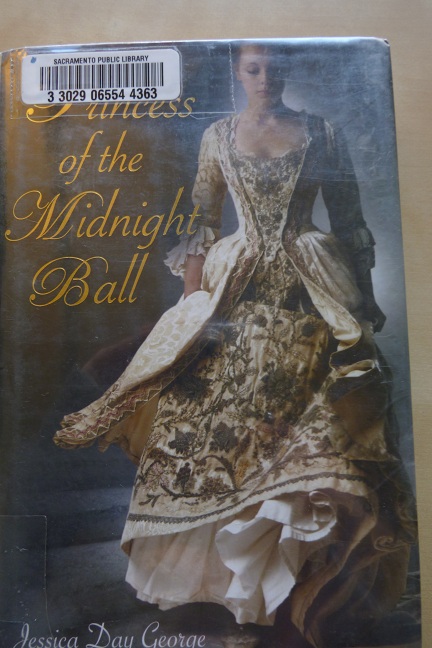
Princess of the Midnight BallSomewhere in the last couple of years, “The Twelve Dancing Princesses” (or, “The Shoes That Were Danced to Pieces”) became one of my favorite fairy tales.  I’ve read many retellings, and even wrote one for NaNoWriMo 2011.  For the Once Upon a Time reading experience this year, I decided to go back and re-read one of the first retellings I encountered, Princess of the Midnight Ball by Jessica Day George.

This is a lovely, magical retelling that evades the typical pitfalls of the story, while shining mostly for its two lead characters.  The point of view is split between Galen, a young soldier just returning from a long war and taking up a job as under-gardener at the palace; and Rose, the oldest princess, trying to hold her sisters together as they suffer through a curse, evading questions about their mysteriously worn-out slippers.

Rose and Galen both have a way of looking harmless, with unexpected depth and strength beneath.  Rose is a pale, beautiful princess–but that doesn’t mean she doesn’t have intelligence and strength of will.  Galen is a gardener who spends his spare time knitting–which proves to be a surprisingly valuable skill.  When I think about it, the two of them don’t spend much time together.  But I don’t really think about it when I’m reading the book, and this is a rare occasion when I find myself completely buying into a very cute romance, even when the characters don’t really have much opportunity to get to know each other.

The other eleven princesses largely run together, which tends to happen quite a bit in these retellings.  It actually worked rather well in this one, though, I think because George hit a very nice balance of giving me just enough information, while not making me feel like I should be knowing/remembering more.  I’m not sure that makes sense…but for example, on the princesses’ ages: Rose and Lily are the two oldest, at eighteen and seventeen.  Petunia and Pansy are the youngest, seven and six.  The other eight exist in some vague space in between, and while I don’t know precisely how old they are, I also never felt like I needed to know.

Similarly, I had a slight sense of the personalities of roughly half the princesses, and that seemed to be enough.  George has a nice way of never asking the reader to remember the princesses’ personalities, because it’s self-evident whenever that particular princess is referenced.  Poppy is the boisterous one, and it was no effort to remember that because she’s always being boisterous whenever we see her.

For the most part this is a very light retelling, though there are a few moments of genuine creepiness.  It follows pretty close to the original fairy tale, and comes up with some very nice explanations and backstories, filling in the empty spaces in the Brothers Grimm’s much shorter tale.  Some retellings move farther away from the original and it works…but others have completely floundered in the process.  This one didn’t try to go too far, and succeeded very well within its own scope.

I remembered this as one of the best of the retellings I’ve read, though it was hard to judge since I read it before most of the others.  Happily, I was right!

Author’s Site: http://jessicadaygeorge.com/

Other reviews:
Lili’s Reflections
The Dead Authors’ Club and More
Bird on a Pencil
Anyone else?

Buy it here: Princess of the Midnight Ball

Saturday Snapshots: Come Away to Fairyland

Come away, O human child: To the waters and the wild with a fairy…” – William Butler Yeats

Spring has begun this month, and with it, the Once Upon a Time Challenge on Stainless Steel Droppings (my launch post here)…and so I have fairyland on my mind.  I’ve never climbed through a wardrobe, been abducted by the Green Wind, or fallen through a rabbit hole, so I can’t share photos from the various places those routes would take you 🙂 and cameras probably wouldn’t work anyway.  But as regular readers know, I have gone rambling about Kensington Gardens, where Peter Pan flew to when he “ran away from home and lived a long, long time with the fairies.”

Part of the fun of the Gardens is that there are no plaques or ceramic fairies or touristy things to point out the different sites of interest.  You have to take a quest, with J. M. Barrie’s The Little White Bird as your guide, and find the magic spots yourself.

Fortunately, the fairies seem not to object to cameras!

P1010296If you look closely, you can see one of the “paths which make themselves”–at night, of course, which is when everything really magical happens in the Gardens.

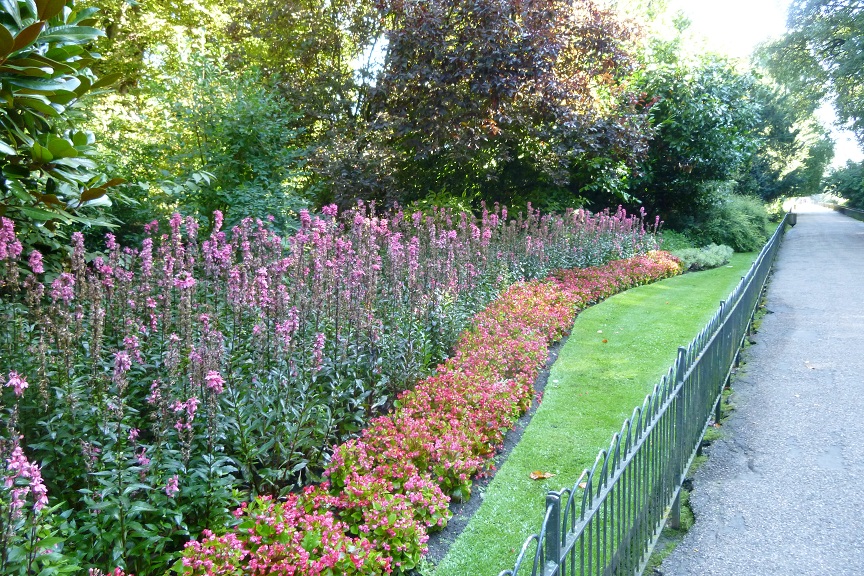
P1010608These are flowers along the aptly-named Flower Walk.  Barrie tells us that fairies caught abroad by humans will pretend to be flowers.  His advice on the best way to spot a fairy is to stare at a “flower” until it can’t help winking at you.  (I don’t know what that would look like either!)

18 Branch of BeechThis is the branch of the Weeping Beech in the Flower Walk, where Peter Pan spent the night immediately after running away from home.

P1010308If you can’t find some fairy dust, and reliable directions on how to fly past the second star to the right, you can at least go see the island in the middle of the Serpentine.  Peter spent some time living there too, until he built a boat and (eventually) learned how to fly.

The Gardens are not the most exotic or showy of fairylands, but they’re certainly the most accessible–and they are every bit as charming as J. M. Barrie.

If you feel like visiting fairylands, even in books, why not join up with the Once Upon a Time Challenge?  And of course, you can also find more Saturday Snapshots on At Home with Books!

Blog Hop: Five Books to Grab

I’m joining in with the Book Blogger Hop again today, when bloggers discuss bookish topics!

book blogger hop

This week’s question is: What are the top 5 books you would grab in an emergency?

I’m not entirely sure what this question means…I mean, the five books I would read during a personal crisis are not necessarily the same five books I would choose if I was only going to have access to five books for an extended period…  But let’s assume the point here is, which five books would you choose if you could only have five books.  Say, on an extended spaceflight to Mars.  I like that better than the idea of being stuck on a desert island, where I’d need books about survival on a desert island!

So if I was on a long spaceflight and could only bring five books…

1) The Bible, although that’s so obvious it almost feels like cheating.

2) The Complete Works of William Shakespeare (unabridged), because I read so quickly, I’d need something that would last.  Which is an argument in favor of the Bible too, apart from spiritual inspiration.

3) Susan Kay’s Phantom because, I mean, it’s Susan Kay’s Phantom and I just madly love it.

4) The Little White Bird by J. M. Barrie because it’s a wonderful, lovely, magical book.  Plus, even a spaceflight to Mars would probably have its alarming and homesick moments, and this would make a perfect comfort read.  George Davies, the boy who inspired David in the book, brought a copy with him to the trenches in World War I.

5) And finally, The Blue Castle by L. M. Montgomery, because I couldn’t possibly get by without any Montgomery, and this is my favorite of her novels.  Though I’d be tempted to bring Volume I of her journals instead.

And if, as I know I surely would, I decided to toss a pair of shoes out of my luggage and squeeze in two more books…

6) The Song of the Lioness quartet by Tamora Pierce–there is an omnibus edition, so it could be counted as one.  Alanna is the most inspiring of heroines, and every so often, everyone needs to believe that they can do anything.

7) Something Terry Pratchett…possibly Night Watch.  Because of course I’d need something funny too.

And then I’d probably have to discard some more clothes so that I could bring something by Edgar Rice Burroughs, and also If You Want to Write by Brenda Ueland, and a spaceflight to Mars really would be a good moment to read some favorite Star Trek books, and so we begin to see why I have three enormous bookcases in my small apartment!

So if you had to grab five books, for a spaceflight to Mars or maybe if you were on a desert island, what would you snatch up?

Springing Into Fantasy

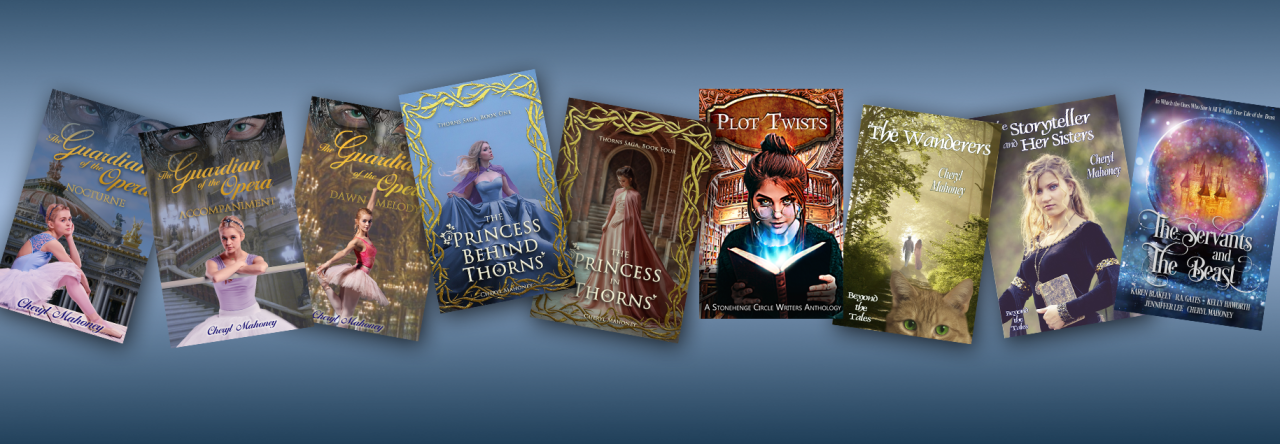
Today marks the launch of spring–and of the Once Upon a Time Reading Experience, hosted by Carl at Stainless Steel Droppings.  This will be my third year participating, and I’ve been looking forward to joining in again.  If someone was going to design a reading challenge around my favorite kinds of books…it would look a lot like this one.  I mean, fantasy with an emphasis on fairy tales!  That’s what I read (and what I write too).
I’ve been telling myself that I’ll make progress on my To Be Read list over the next three months, since so many of the books on it are fantasy.  This, of course, ignores that fact that I’ll probably add tons of wonderful new books too…but shhh, let’s not talk about that right now!

I have far too many books that fall into this Experience to list them all here, but I’ll give you a few initial ideas…

~ Stardust by Neil Gaiman, for the group read-along

~ Chalice by Robin McKinley, which I started yesterday…but close enough

~ Princess of the Midnight Ball by Jessica Day George (a reread) and its once-removed sequel, Princess of the Silver Woods (because I already read the immediate sequel, Princess of Glass)

~ The Hobbit by J. R. R. Tolkien, to get me set up for the real challenge…

~ The Lord of the Rings trilogy–or at least a good attempt at them

~ Good Omens by Neil Gaiman and Terry Pratchett, because…Pratchett and Gaiman!  How have I not already read this?

~ The House on Durrow Street and The Master of Heathcrest Hall by Galen Beckett, as I thoroughly enjoyed the first book in the trilogy, The Magicians and Mrs. Quent

~ The Blue Sword and The Hero and the Crown by Robin McKinley, which I read SO long ago that I’ve completely forgotten them, and now I feel like they’re a gap in my McKinley reading

~ More installments of the Sevenwaters Series by Juliet Marillier, part of my goal to complete series

And, oh, so many, many random fantasy novels…really, the list above barely scratches the surface!  Well, scratches it, maybe, but not so far as a dent.  So, I’m not worrying too much about which books I read, or how many, or which Quests they fit into.  I’ll just toss lots of books into the air (metaphorically) and let them fall where they will.  I hope you’ll come along for the fun!

Imagined Lives: Portraits of Unknown People

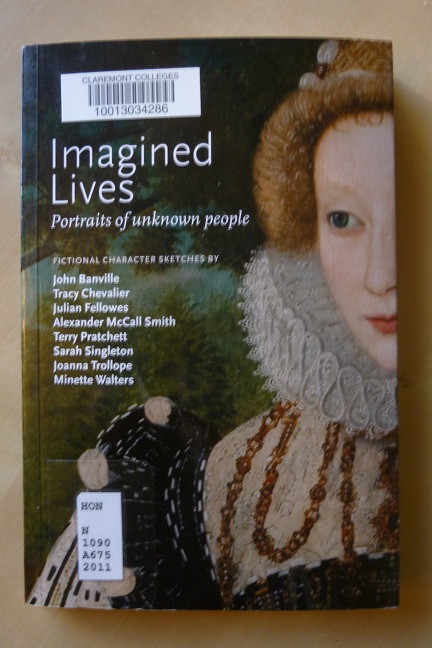
Imagined LivesI’ve been deeply intrigued by the concept of Imagined Lives: Portraits of Unknown People ever since I first heard about it.  Eight authors wrote fictional character sketches, based off portraits whose original identities have been lost.  Many were at some point thought to be someone famous from history, which is how the portraits ended up at the National Portrait Gallery in London.  Later scholarship has overturned their supposed identities, and now the Portrait Gallery (which, by the way, is my favorite museum, ever) has put together a collection of stories around these anonymous portraits.

I almost bought a copy in the gift shop when I was at the museum…but I have trouble buying books I haven’t read, so I resisted.  I hit the library instead, and I think that was the right decision.  I enjoyed the book, but I’m glad I didn’t spend however many pounds they would have charged me.

There are eight authors and fourteen character sketches, and while I liked the book overall, the quality does vary.  The style also varies, which contributes to the changing quality.  I liked best the ones that were more like stories.  There’s a mix of letters, personal reflections, and fictional encyclopedia entries, all of them only two to three pages long.

The encyclopedia entries read like, well, encyclopedia entries.  Some of the more elaborate ones have some intriguing elements to them, but ultimately…well, how fascinating is an encyclopedia entry, really?  Especially a very brief, overview biography of someone.  Some of these would be wonderful as novels, but in such a compressed format, they fall a little flat.  Not all–but some.

For the letters and the reflections, I liked the shortness.  Because of their style, they’re much more intimate, much more detailed, and give us this tiny, very personal glimpse into the individual’s life.  I especially liked it when the glimpse is very closely tied into the portrait–as in a woman writing to her sister about her husband’s rash investment in commissioning a portrait they can’t afford, or a young noblewoman whose painting has been done with the interest of attracting a suitor, and she fears a husband who would choose his wife in such a way.  That was one of my favorites.  We also get the other side of a similar story, a woman writing to her mother about her indecision on whether she should accept a suitor who has sent her his portrait.

My favorite, though, is actually one of the encyclopedia entries, which will make more sense when I tell you that it was written by the delightful Terry Pratchett.  It tells the tale of the very unfortunate Joshua Easement, who dreamed of being a great explorer but whose “navigational method mainly consisted of variations on the theme of bumping into things.”

The portraits all seem to be from loosely around the time of Queen Elizabeth I, and many are tied very closely into history.  As is frequently true with much longer works of historical fiction, some of the fun of the stories is weaving the fictional characters into the lives of real people.

The book concludes with an essay on how scholars identify portraits, and how portraits like the ones in the book can lose their original identities.  It’s a very accessible essay, and an interesting look at the stories behind the portraits in museums.

If you have an interest in portraits or British history, I recommend this intriguing (and very quick) read.  I didn’t enjoy all the character sketches, but in the midst are several gems.

Museum Site: http://www.npg.org.uk/

Other reviews:
Vulpes Libris
Patrick T. Reardon
Anyone else?

Buy it here: Imagined Lives: Portraits of Unknown People