Victor Hugo’s Les Miserables – Volume III

Les Mis (2)This week I’m doing a multipart review of the excellent but very long Les Miserables by Victor Hugo.  Read about Volumes I and II here.  Volume III focuses (though not immediately) on Marius, leaving Jean Valjean and Cosette out of the story for quite a while.  This is where I think it helped the most that I knew the musical, or I would have been feeling very adrift!

Marius was raised in wealth, but fell out with his grandfather over his estranged father’s politics.  Turning his back on his grandfather and his money, Marius lives in Paris in relative poverty, scraping along on some minimal scholarly work–but contented with that.  And then one day at the Luxembourg Gardens he sees a beautiful young woman out with her father and is hopelessly smitten.  They carry on a lengthy courtship of glances, until one day she ceases to come and Marius is plunged into the depths of despair.

I’m not entirely sure how I feel about Marius.  He’s such a nice young man.  I can’t dislike him–he’s so nice–but there’s not a whole lot I like about him either.  I both accept and respect his dedication to his principles (a dedication I don’t quite believe in the musical), but at the same time, he follows that dedication with such utter lack of common sense that I shake my head a bit too.  His most praiseworthy attribute in the musical is his revolutionary fervor, which just doesn’t exist in the book.  On the other hand, his most blameworthy attribute, his blindness regarding Eponine, doesn’t really exist in the book either.  But that brings me to two other plot threads…

Marius’ crowd of revolutionary friends do turn up in this book and I enjoyed getting more depth on them.  At the same time, I was surprised by how shallow Marius’ connection to them was.  He knows them, but he’s really not one of them.  It gets more complicated with the barricade, but that’s Part IV.  I was happy to see Enjolras, though, the leader of the group and one of my favorites from the musical.

Marius’ path also intersects with the Thenardiers, who have come to Paris and fallen on even worse times.  Take away the humor from the Thenardiers, and you have instead examples of just how low people can sink, both in poverty and in moral character.

Two members of the Thenardier family particularly fascinate me.  First, Eponine, the older daughter.  I actually found her a more interesting character in the musical.  There’s a spark of something in her, this sense that she could be so much more than her life has so far let her be.  Oddly enough, I get less of that feeling from the book.  I think it’s there, but she’s far more disreputable too.  There also seems to be less of a relationship between her and Marius than the musical suggested, to the point that I can’t blame him for not returning her unrequited crush.  It redeems him a bit, though I felt less for her.

I was just a little disappointed regarding Eponine, but I was thrilled with Gavroche.  I can see why the musical never got into the fact that he’s the Thenardiers’ son–he has only the most tenuous of relationships.  He emerges in the book just as I had hoped, a plucky, cheeky street urchin, keeping his head up and his confidence intact no matter what life hands him.  I love Gavroche’s spirit, and I also love that even in his own poverty, he’s still generous.  He gives to others even if it means he won’t eat that night himself, and he seems to do it instinctively.  Love, love Gavroche!

You may be wondering at this point what ever became of Valjean, and you’d be justified in that wondering!  I don’t think he’s mentioned by name in this entire Volume…although it doesn’t take much insight to match up Valjean and Cosette with another set of characters who do appear here…

I’m definitely not invested in Marius the way I was in Valjean, but that didn’t really interfere with my enjoyment of this section.  The story was engaging even if I had mixed feelings about the main character.

Come back tomorrow for a review of the last section…one day more ’til the barricades arise. 🙂

Victor Hugo’s Les Miserables – Volumes I and II

Compare the thickness here...
Compare the thickness here…

I have a fear of long books, a fear I have been attempting to confront this year by reading some of the big thick books I’ve put off (usually because there are so many other books to read!)  I’m trying to get in one a month, and in February I tackled what’s probably the thickest of them all, Les Miserables by Victor Hugo.  My copy had 920 pages of very small font, and with that much text to get through, it’s a good thing I enjoyed the story so much!

I’ve seen the musical, both as a play and the recent movie, and I think that was beneficial reading the original.  The musical felt (to me) like it was predominantly accurate to the book–not in every particular, but in most ways.  Knowing the soundtrack so well, I frequently had relevant lines running about in my mind as I read the corresponding scene.  That was fun, but more importantly, knowing the musical meant I had a pretty good idea where Hugo was going–which is not always obvious!

Before I go further, I should confess something.  I didn’t actually read all of the book.  I’m guesstimating I read a solid 750 pages.  You see, Hugo has this habit of going off into history or social commentary for twenty pages at a stretch.  And…I started skipping those chapters.  In a way, it’s actually a compliment to the rest of the book–I was far too eager to get back to Jean Valjean and the rest, and couldn’t stomach the amount of reading time it would take to wade through the other bits.  I never found that I was having any trouble following subsequent chapters after skipping sections, so it seemed to work out.

The book is subdivided into five volumes, but I think really reads like three clear sections.  Volume I and II focus on Jean Valjean and, more briefly, Fantine.  Volume III is Marius’ story.  Volume IV and V are about the revolution, in the middle of which all the earlier plot threads intersect.  I could give you a very, very long review…but as you likely surmised from the title, I’m going to break this into three parts instead.  So today, we’ll start with the first two volumes.

Set in France in the early 1800s, Volume I begins the story of Jean Valjean, an ex-convict on parole who finds himself at a crossroads when he meets a particularly sainted bishop (Hugo drives the point home rather).  Valjean struggles with whether or not to steal from the bishop…and I won’t give the details away, but he ends up resolving to shed his former identity and go forward to lead an honest life.

Jump ahead several years and we meet Fantine, a woman left alone with a child born out of wedlock.  She falls on worse and worse times, eventually turning to prostitution to provide for her daughter, Cosette, who has been left in the care of two innkeepers, the Thenardiers.

The first observation I have to make is that Hugo likes backstory.  The first 35 pages are the backstory for the sainted bishop; I was still feeling dedicated at that point and read them.  They’re not bad, but the story picked up a lot for me at the beginning of Book Second, when Valjean arrives in the story.  I loved learning more about Valjean’s backstory, and about Fantine’s as well, when we come to her.  I loved getting the details that the musical only hints at, and I loved the depth of the character exploration.

Valjean is a wonderful character.  It was fascinating to find out his history, and also how he developed (or perhaps I should say, regressed) during his time as a convict.  We then watch his struggle at the turning point to reclaim his humanity and his faith…and then his struggle for the rest of the book to keep them.  More on that later, though.  These first two volumes demonstrate Hugo’s ability to make mental struggle fascinating.  I think I recall that “man vs. himself” is one of the standard conflicts of literature, but I’ve rarely seen it explored to such an extent.

We meet several other principle characters in the first two volumes, particularly the Thenardiers and Inspector Javert.  I was actually a bit disappointed that we didn’t meet Javert sooner.  He turns up fairly far along, and there’s just a few references to establish that Javert knew Valjean while he was a convict.  So many other things are so much more elaborated upon, I hoped for more here.  What was here was good, though, and we delve into Javert’s mind some too.  I know people who just love Javert; I can’t say I’m one of them, but I do find him an intriguing character.

The Thenardiers probably diverged farthest from the musical version of the characters.  In the musical, they are nasty individuals, but they’re played for humor.  In the book, they’re not even remotely funny.  They’re just nasty, horrible, awful people.  Cosette’s situation living with them is incredibly heartrending.  Imagine whatever other “poor orphan waif” story you’ve read, multiply it a few times, and you’ll probably have it.  I think that was one of the most gripping sections of the book.

Volume II ends on what’s essentially a happy note, and we’ll leave it there for today.  Come back tomorrow to meet Monsieur Marius in Volume III!

Other reviews:
Compulsive Overreader
Teacups in the Garden
One More Page
Anyone else…?  I know I have readers who are Les Mis fans–send me links to your reviews and I’ll add them!

Buy it here: Les Miserables

Saturday Snapshot: Home and Abroad

I was poking through my photos looking for inspiration for this week…and thought I’d do a couple of fun pairings of photos.

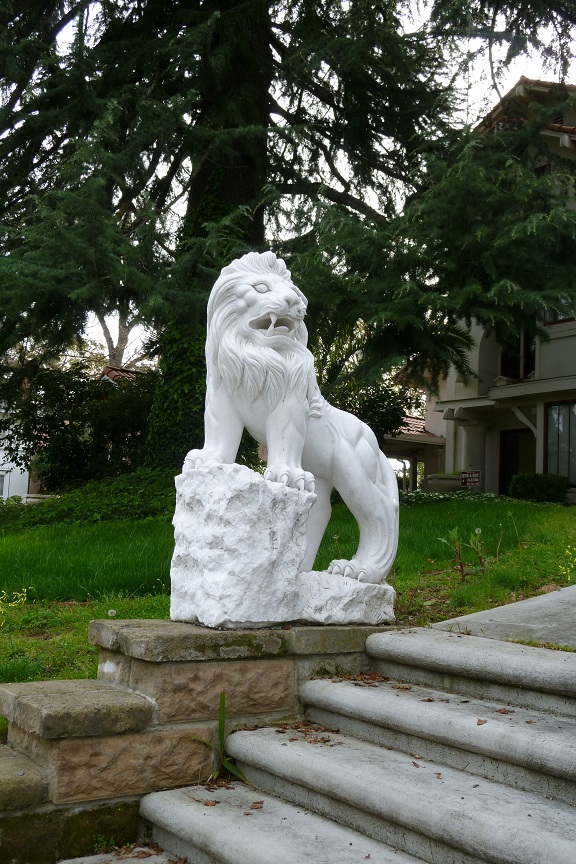
Stone LionThis stone lion lives a few blocks from me…

British Museum Lion…while this one lives at the British Museum in London.

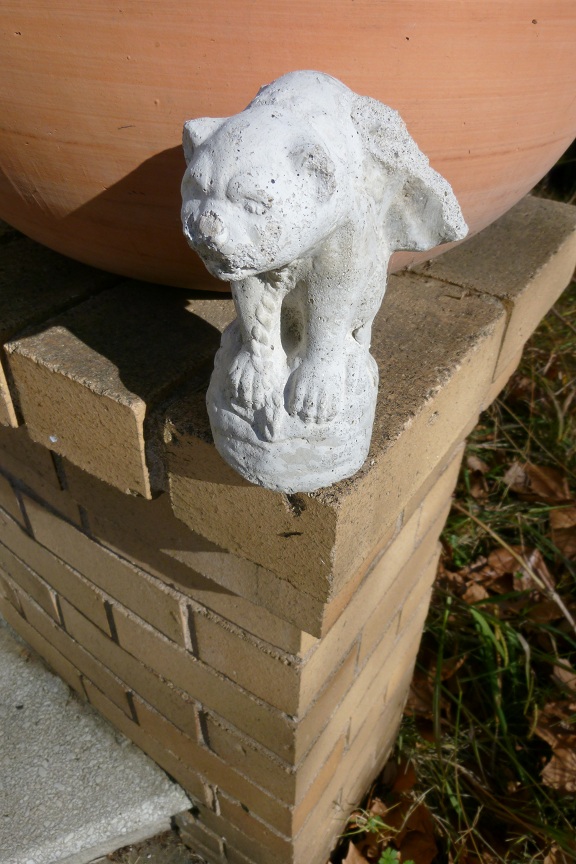
GargoyleThis is a random little gargoyle statue on a porch in my neighborhood…

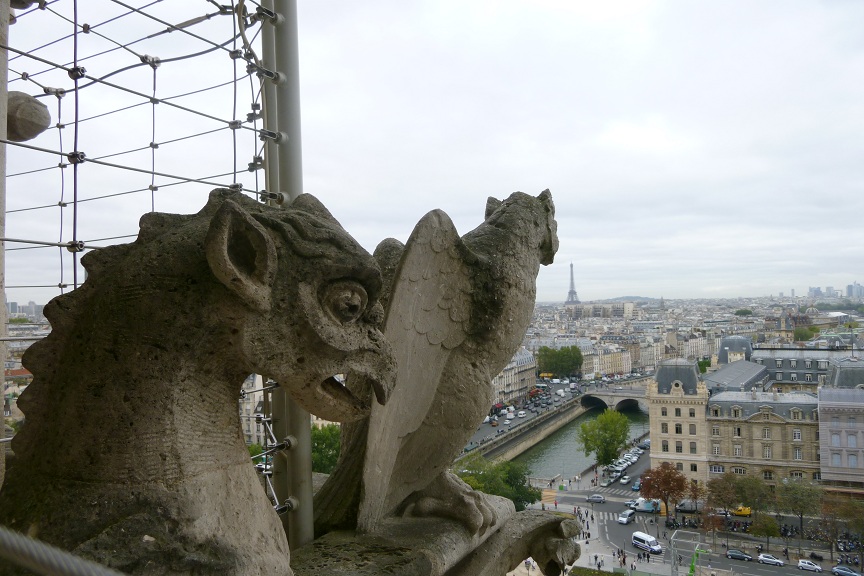
Notre Dame Gargoyles…and here are his more famous cousins.

Visit At Home with Books for more Saturday Snapshots. 🙂

A Man and a Cat Walk Into a Bar…

I’m always sharing my reading news around here…  Meanwhile in writing news, I’m currently working on three novels–which is making my head spin a little!  Two are at different points in the revision stage, and one is still being planned.  In the midst of all that, naturally the logical thing to do is work on a short story.  Though at least it’s a short story related to one of the novels!

It uses characters from the novel, but the story is meant to exist independently.  I wrote most of it, only to get a bit stuck maybe 75% of the way through.  So I thought I’d toss the first page up here and see if sharing it inspires me to write that last stretch…

**********

When Jasper and Tom walked into the tavern, they attracted no immediate attention.  It may have looked a little odd when Jasper opened the door for the orange cat and let him walk in first, and even odder when Tom made an efficient line between the tables, chairs and boots directly to the bar, springing up to sit on top of it.  But the tavern’s inhabitants were intent on their drinks and their conversation, and didn’t pay any mind to the newcomers.

Jasper followed Tom to the bar, where the tavernkeeper looked them both over, didn’t comment on the cat on his counter, and just said, “What’ll it be?”

“One ale and a bowl of milk,” Jasper answered, prompting a snicker from his nearest neighbor.

But it wasn’t until Tom said, “And have you got any fish?” that heads starting turning.

Jasper hid his grin behind the mug of ale the tavernkeeper had handed him.  Eventually the fun of shocking people with a talking cat was going to wear off, but after a month of traveling with Tom, it was still amusing him.

“I, uh, yeah, I think we do,” the tavernkeeper managed, staring at the tabby.

“Excellent.”  Tom sat down, sticking his nose in the air with his most regal attitude, plainly aware that the entire room was looking at him.  “One order of fish, please.  Any kind will do, only not too spicy.  Spicy food makes me sneeze.”

“Right,” the tavernkeeper said.  “So…d’you want it raw?”

Tom bristled, tail lashing.  “No, cooked!  What do you think I am, a savage?”

“He thinks you’re a cat,” Jasper pointed out.

“That doesn’t mean I can’t have refined taste.”

Welcome to the Land of Oz

Welcome to OzI’ve lately been slowly rereading the Oz series by L. Frank Baum.  This is at least my third or fourth time through, over the span of…maybe 18 years.  Everyone knows the first one: The Wonderful Wizard of Oz.  It’s less well-known that there are another thirteen books in the series–and even more if you count the non-Baum ones, which I don’t.

Fourteen would be a bit many to tackle in one review 🙂 but I’ve been discovering that it’s surprisingly easy to divide the series into sections, mostly trilogies.  So today let’s look at the first three–I’d like to call them the “Welcome to Oz” Trilogy.  Though new characters are introduced throughout, these first few introduce the principle players, not to mention the setting, which is frequently a character in itself.

***********

The Wonderful Wizard of Oz bears some resemblance to the movie…and some differences.  Kansas farmgirl Dorothy is picked up by a tornado and carried away to the magical land of Oz with her little dog Toto.  There, her house lands on a wicked witch, she acquires a pair of magic slippers (silver, not ruby), and sets off through Oz with a Scarecrow, a Tin Woodman, and a Cowardly Lion.  Eventually she meets the Wonderful Wizard, kills the Wicked Witch of the West, and goes home by slipper power.

That all sounds like the same plot as the movie…but the difference is focus.  While the movie ties neatly together with both Glinda and the Wicked Witch appearing early on, and the Witch providing an ongoing threat, they come in later on in the book.  Dorothy spends more time simply wandering about on adventures, without the drive and the urgency of the movie.  Growing up, I actually never liked this book–and I think the problem was that I was comparing it to the movie.  This most recent read-through, I was finally able to look at it more separately, and it is a rather charming (if unfocused) fairy story.

We’re introduced to a lot that’s fun here, and the characters are delightful.  At the same time, there were some things that Baum hadn’t quite figured out yet.  For instance, he all but directly says that the emeralds in the Emerald City are illusion, and that the Wizard didn’t really give Dorothy’s companions their various rewards, but just humbugged it.  This takes a turn in later books–in the later volumes, the Emerald City really is covered by gem stones, and the brain, heart and courage bestowed by the Wizard really are magical.  While I like the message that Dorothy’s friends had all they needed all along…I do also like the more magical version of events.  Though at least Baum maintained the magic in this book to the extent that the story didn’t all become a dream sequence at the end!

The ramblingness of the book is the most serious problem, and while this is good, I don’t actually think it’s one of the strongest volumes–strangely, when it’s the best-known!

***********

In the second book, The Marvelous Land of Oz introduces new characters.  Dorothy isn’t in the story at all, and the hero instead is Tip, a boy being raised by Mombi, an evil witch.  Tip runs away with Jack Pumpkinhead, a stick-man with a Jack O’Lantern head, which Tip made and Mombi brought to life.  Their adventures eventually lead them to an alliance with the Scarecrow and the Tin Woodman against an army of girls who have conquered the Emerald City.

Between the threat of Mombi and the possibility of war, this is one of the more exciting installments.  The characters are also particularly entertaining, the ones mentioned above as well as a giant, highly-educationed Woggle-Bug, a strange flying contraption called the Gump, and a return appearance by Glinda the Good Witch.  The army of beautiful girls armed with knitting needles (really) sets off my feminist instincts a bit, but they’re counterbalanced by Glinda’s far more capable female army.  The ending of the book is bizarre to say the least–I won’t give it away, but I’ll say that sometimes you have to just go along with Baum and not ask too many questions…

***********

Ozma of Oz is Book Three, and one of my favorites of the series.  Despite the title, which refers to the new Queen of Oz, this is largely a Dorothy book.  She gets lost at sea and washes ashore in a magical country near Oz, swiftly reuniting with old Oz friends who are on a journey to the Nome King to rescue the Royal Family of Ev.

This one is full of images and moments that have stuck with me all out of proportion to their importance–though maybe I should just say it has memorable moments.  There’s a wonderful bit early on when Dorothy finds trees laden with lunch boxes and dinner pails.  She picks ripe ones, opens them up and finds entire meals growing inside.  It’s not an important scene, and yet it’s so delightful and whimsical.  It encapsulates the magical things that can happen in Baum’s world.

Later on, Dorothy encounters Princess Langwidere, who has a collection of different heads and interchanges them at whim, the way people normally change hats or jewelry.  It’s weird and wonderful and just a bit creepy!

When the party from Oz reaches the Nome King’s cavern, he explains that he’s turned the Royal Family of Ev into knick-knacks, and invites each rescuer to search among his collection and try to choose the correct ones–at the peril of being turned into knick-knacks themselves.  That story element of having to choose the right enchanted object from a collection has definitely threaded itself into my mind, and is directly responsible for a chapter in my novel–though my heroine had to select the right enchanted fish.

***********

Baum’s books are whimsical and magical and full of funny, fascinating characters.  There are very few rules and anything is possible.  The first one has some flaws, but on the whole these first three in the series are excellent.  They’re rarely highly dramatic or very deep, but they’re entertaining and bright.  These are wonderful pieces of classic fantasy I highly recommend.

Other reviews:
Story Carnivores
Sarah Reads Too Much
Booksessed
Dark Chest of Wonders
Anyone else?

Buy it here:
The Wonderful Wizard of Oz
The Marvelous Land of Oz
Ozma Of Oz

…or the movie version 🙂