Author: cherylmahoney
I'm a book review blogger and writer. I have published four novels, The Wanderers; The Storyteller and Her Sisters; and The People the Fairies Forget; and The Lioness and the Spellspinners. All can be found on Amazon as an ebook and paperback. In my day job, I'm a Marketing Specialist. Find me on Twitter (@MarvelousTales) and GoodReads (MarvelousTales).
When Redshirts Fight Back
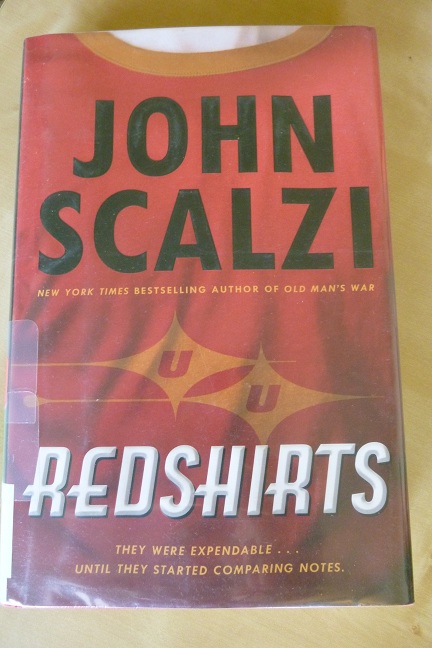 Redshirts
Ensign Andrew Dahl and his friends are newly arrived on the starship Intrepid, and swiftly realize that there are strange things going on. There seems to be a strangely high number of casualties among the crew, events frequently defy the laws of physics or logic, and everyone gets awfully nervous about the subject of landing parties. Dahl eventually connects with Jenkins, a crewmember who became unhinged after his wife was killed aboard the ship, and has taken to hiding in the crawlspaces–but who seems to have a firmer grasp on what’s really going on than anyone else. Jenkins has figured out that their lives are dictated by the scripts of a TV show–a bad one–and Dahl and his friends conclude that the only way to escape a meaningless death is to go back in time and find their writers.
Two brilliant things here: this book takes all the weird absurdities of the original Star Trek and sci fi shows like it, drags them out to be even more extreme, and then has characters actually realize how irrational it all is. Second, this is so meta–characters inside of a story have to deal with what it means to be characters. I’m not sure if it’s applicable philosophy, but it’s certainly intriguing philosophy.
Two criticisms: this will sound nitpicky, but Scalzi has a speech tag problem. For non-editors, those are he said, she replied, he asked, etc. Generally authors drop them when they can without losing clarity. Scalzi keeps them, particularly in ‘s a scene near the beginning with two characters swapping dialogue back and forth and a speech tag at the end of every line. It may be a deliberate stylistic choice, but it still made me twitch. Second, and this is very ironic–I couldn’t keep Dahl’s friends straight. They’re all redshirts, all with carefully crafted paragraph-long backstories, and I struggled to remember who was who, or see any depth in most of them. Again, maybe deliberate–or Scalzi fell into the same trap he’s parodying. We’ll say it was deliberate…
I did really enjoy Dahl as a character, as well as Jenkins. In some ways I think I felt for him the most. And then there was Kerensky, one of the TV show regulars. He’s the regular character who gets injured or threatened but pulls through–again and again and again. He’s also incredibly arrogant and very entertaining.
The main story comes to a close with a strange number of pages left in the book, because it’s followed by three codas. The first is supposed to be the blog of one of the TV show writers. I had trouble with this story. The writer is very argumentative, and I’ve never liked narrators who come across as hostile to the reader. The second is…harder to explain, but suffice to say it’s in second person (so the main character is “you”) and I couldn’t get into that somehow.
The third story, though, is about the actress who played Jenkins’ deceased wife, and I really liked her story. She’s trying to grapple with this revelation about the characters of the Intrepid, and with larger life questions and…really fascinating.
All in all, for whatever its quirks and misfires, this book is still worth reading for that so fantastically amazing premise. If you’re a Star Trek fan, at least. I mean–the redshirts figure out what’s going on and try to save themselves. And it’s fast-paced and funny and–well, how could that not be fantastic? 🙂
Author’s Site: http://scalzi.com/
Other reviews:
Stainless Steel Droppings
Little Red Reviewer
Tia’s Book Musings
Anyone else?
Saturday Snapshot: Notre Dame Cathedral
During the week, I reviewed Disney’s The Hunchback of Notre Dame–a wonderful and surprisingly complex Disney cartoon. Naturally, for Saturday Snapshot, I thought I’d share some pictures from my visit to the cathedral last September!
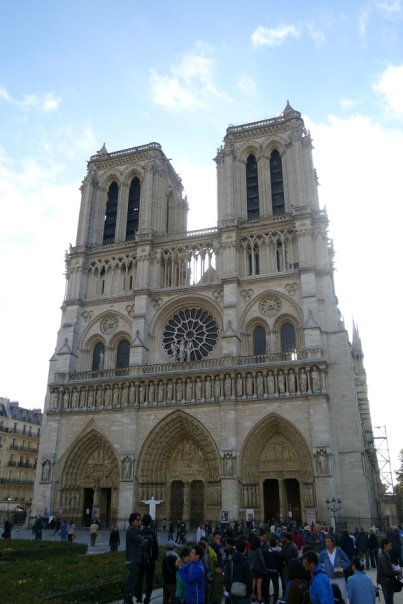
I went in the morning, on the theory that it would be less crowded. Contrary to what this picture suggests, this actually worked–it was even busier by the time I left.
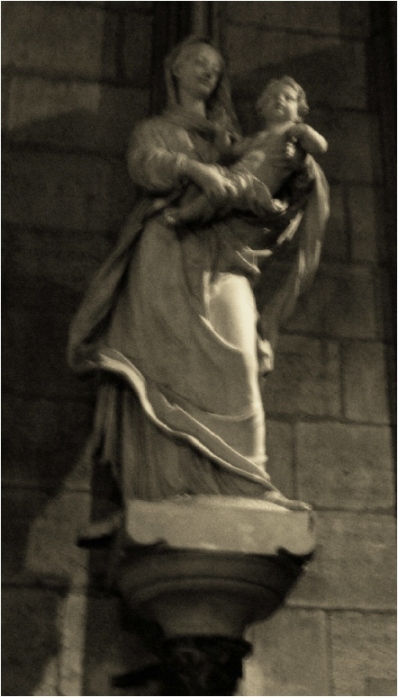 The lighting is very bad for photos inside the cathedral, so apologies for the fuzziness–but I managed to get a shot of this lovely statue of Mary and Jesus. And after I got home and rewatched Hunchback, I realized this is the statue Esmeralda addresses her beautiful song to, “God Help the Outcasts.”
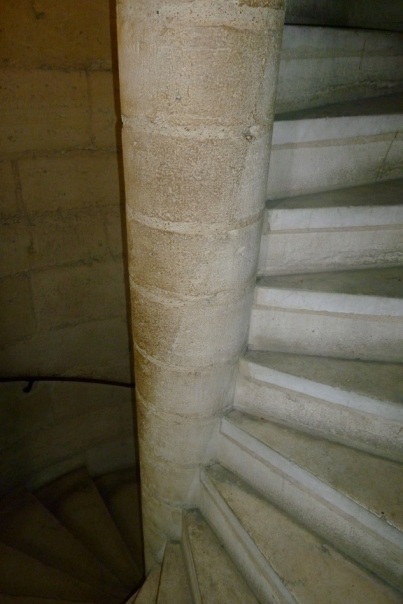 After seeing the inside of the cathedral, I went around the corner and got in a long line to go up in Quasi’s towers–and up many, many narrow winding steps. Google brings back differing numbers on how many steps it is, but the majority opinion seems to be 387. I believe it! If you watch Hunchback, look for a scene of Quasi and Phoebus on steps that look a lot like these.
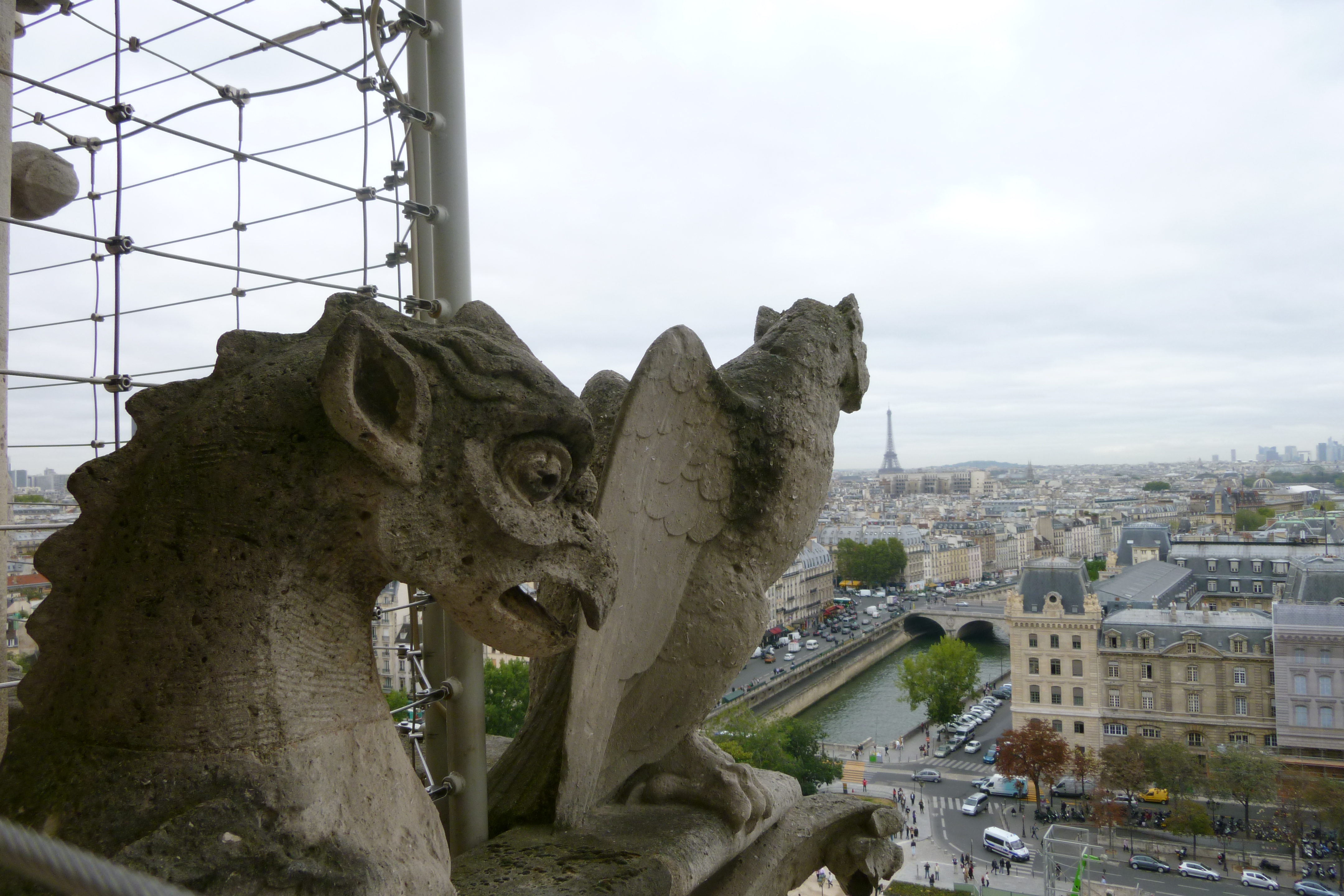
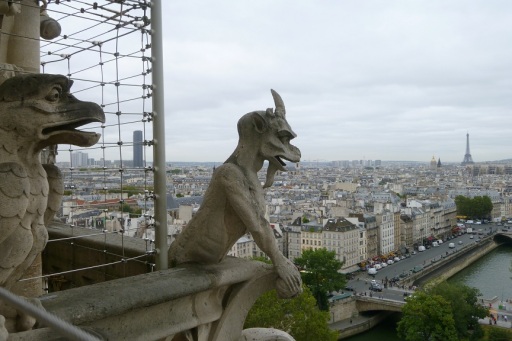 It’s worth all the steps for the views from the top! And definitely worth it for the gargoyles. After all, I had to go up and see Quasi’s gargoyles. 🙂
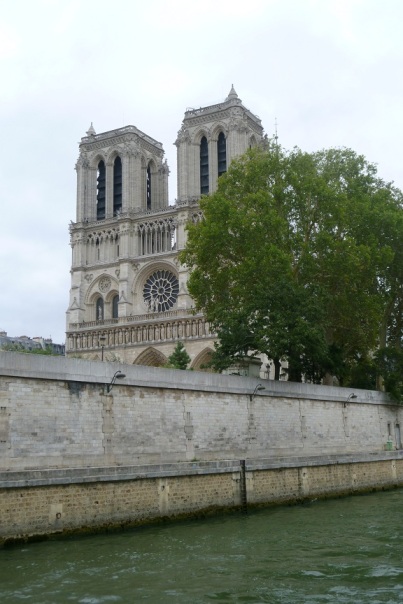 After I came down from the towers, I went in search of another literary/movie reference–also by Victor Hugo. Apologies, as it’s somewhat grim…but I remembered that in the 1998 film of Les Miserables, when Javert went into the Seine there was a beautiful view of Notre Dame behind him. So I went down to the walkway beside the Seine, and I’m pretty sure this is the spot…
Not to mention, from down there you can’t see all the crowds!
All in all, Notre Dame was wonderful to visit–a beautiful place, and then there’s all the literary references too.
Visit At Home with Books for more Saturday Snapshots!
Favorites Friday: Short Story Collections
I haven’t done a Favorites Friday for a while, what with NaNo and other features, so I thought I’d come back to that for this week. Today, let’s look at a different-than-usual medium, and talk about short stories. I don’t read a LOT of short stories, but there are a few collections near to my heart.
To start with an author I’m pretty sure I’ve never mentioned–I love O. Henry’s short stories. I had a habit in high school: if I finished my book during school, I’d run to the library between classes and pick up an O. Henry book for the rest of the day. Because I couldn’t be bookless for three hours! I have no particular favorite collection, but O. Henry in general is excellent. I always enjoy his twist endings–even when you’re expecting them, he still surprises.
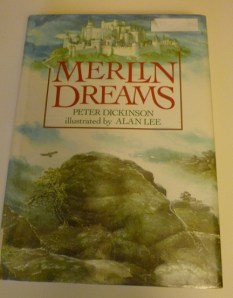 Merlin Dreams by Peter Dickinson is a book I’ve reviewed before. It was a beloved favorite at the library through my childhood, and I finally bought it myself last year. He tells semi-Arthurian stories about love and loss and honor and falling prey to your own tricks, all in a frame story about Merlin sleeping through the centuries somewhere below the moor. The stories are haunting, with characters and ideas that have woven themselves into my mind. And I about fell off my chair when I realized that Robin McKinley was married to Peter Dickinson–the Dickinson of Merlin Dreams! And that’s definitely how I thought of him… 🙂
An author I often talk about 🙂 is L. M. Montgomery, so you must have expected she’d be here too! She’s best known now for her novels, but she also wrote hundreds of short stories. I’ve read 199, all of the ones presently available. My favorite collection is The Road to Yesterday, with three of my favorite Montgomery short stories. “Fancy’s Fool” is about dreamy Esme, who long ago went into a secret part of a garden and met a ghost boy she can’t forget. “The Cheated Child” is about Pat Brewster, who must choose which of an awful assortment of relatives he’s going to live with…until one day he breaks free and finds himself at beautiful Sometyme Farm. “Fool’s Errand” is about Lincoln Brewster, who reckons he’d better get married but dreads the thought–and ends up going in search of a girl he met on a beach one long ago day in his childhood. With the possible exception of Esme’s story, these aren’t fantasies–but they’re magical.
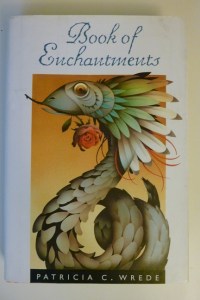 More directly magical, I so enjoy Patricia C. Wrede’s Book of Enchantments (my review here), with fantasy stories that are funny or sad, traditional or modern, silly or profound. And yet somehow, they all fit together too. There are even two excellent short stories connected to her truly excellent Enchanted Forest quartet–which is such a treat for fans!
I’m open to reading more short stories, so…any recommendations?
Climbing Notre Dame with Quasimodo
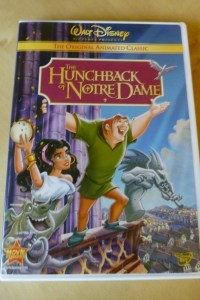 One of my top places to see in Paris last September was Notre Dame Cathedral–for the architecture and because I like big old churches and because it’s an icon. But also very much because of The Hunchback of Notre Dame. I’ve never actually read Victor Hugo’s novel (though I have put it on my list since visiting the cathedral) so when I say that Hunchback influenced my Parisian sight-seeing…I mostly mean the Disney movie.
I can’t remember being particularly attached to this one as a kid, but in recent years it’s been emerging as one of my favorite Disney cartoons. That makes sense, because this is not at all a typical Disney cartoon, and has a much more adult feel. I love typical Disney and I don’t mean to criticize it in the review that follows, but I do feel this one is on a different level.
I’d really like to know how the first person looked at the book and said, hey, let’s make a cartoon! Instead of a star-crossed princess and her prince, we have Quasimodo, the hunchbacked bellringer of Notre Dame. His only friends are three gargoyles (two of whom are named Victor and Hugo–love that) and though he dreams of entering the world he’s watched, this has always been forbidden by his master, the stern magistrate Frollo. Quasi finds a little daring, the beautiful and bewitching gypsy Esmeralda comes on the scene, and everything changes.
I love Quasi and his growth as a character, as he overcomes his fears and realizes his own value. Sure, it’s not quite the complexity of Susan Kay’s Phantom, but there’s still a depth here that goes beyond perfect-princess-meets-perfect-prince. Likewise Esmeralda is a strong, intelligent character, very aware of larger societal issues of class and prejudice. I even like the prince figure, the handsome Phoebus, who I find more likable than, say, Raoul from Phantom. Phoebus has his own depth, as a soldier who struggles with a new position and orders he doesn’t like–and he has a sense of humor. Disney heroes who have funny scenes with horses to seem to work well with me… And how do you go wrong when he says to his horse, “Achilles–heel.”
Frollo is also a villain with fascinating depth, and he’s a very mature villain for a Disney movie. His interest in Esmeralda is on a totally different level than Jafar’s decision to marry Jasmine in Aladdin. I really don’t know how the scene “Hellfire” got into a Disney cartoon. Frollo is singing about lust and temptation and damnation, while there are flames and demons and hooded figures chanting “mea culpa.” It’s fantastic and wonderful, but–in a Disney movie? Really?
I love the songs, especially “Out There” which is one of my favorite songs ever. It’s just so beautiful and heartfelt, and is one of the main reasons I felt I had to spend time in Paris “strolling by the Seine.” The only time I got out my iPod while walking around was to listen to “Out There,” sitting on a wall next to the Seine. I also love “God Help the Outcasts”–again, there’s a depth to it, and to Esmeralda’s character. From the opening lines, “I don’t know if you can hear me, or if you’re even there–or if you would listen to a gypsy’s prayer,” she’s having a complex religious experience. It’s deep, it’s emotional, leading up to the end, “please help my people, the poor and downtrod–I thought we all were children of God.”
My only significant reservation on the movie is the last two minutes. After such a beautifully nuanced movie, it tied up with more of a simple Disney happy ending. Quasi gives his blessing to Esmeralda and Phoebus, and then is embraced by the crowd. And…I don’t buy either idea. He may accept how Esmeralda feels about Phoebus, but I’d find it much more believable if he was less pleased about it. A little wistfulness, maybe? And after all the times that crowd has made an about-face, I wouldn’t trust it to stay welcoming for the span of five minutes.
I’m not sure what ending I want. I don’t want Quasi to die, or even to retreat back into his belltowers (because then what was the point of the character growth?) But after all the rest of the movie, I feel like they could have managed a more subtle, less conventional ending. Maybe he retreats to the towers but it’s implied he’ll come out again in the future? A little wistfulness on the romance question but also make it clear that Esmeralda and Phoebus will be his friends into the future, opening up the possibility that he could venture out farther someday? There had to be some kind of bittersweet or lightly hopeful ending they could have managed.
I still love the movie–and I loved watching it shortly after visiting Notre Dame. Someone animating this really knew what Notre Dame looked like, and when I watched it again I kept reacting to things I recognized. If you go to Notre Dame, you can easily go into the church, which is very beautiful. I recommend also going around the corner to the left and getting in line to visit the belltowers. There are a lot of stairs (a LOT of stairs), but it’s worth it to see the gargoyles and the view. You don’t really get to see Quasi’s bells (just one) or the space where he lives in the cartoon, but it’s still neat–and you can see the whole of Paris below.
 I’m planning a Notre Dame Saturday Snapshot for this weekend, so come by for more pictures then!

