In my ongoing quest for more fairy tales, I recently watched the French film, La Belle et la Bête. This is another one for Once Upon a Time‘s Quest on Screen. The movie was…odd. I’ve heard this one touted so much as a landmark film in the realm of fairy tale retellings, but sadly, I just wasn’t impressed. I’d actually seen it years ago, in a mythology class in high school. I was hoping that I was wrong back then–because I disliked it the first time through. I liked it better this time, but I’m still not really a fan.
The movie is based on the story by Jean-Marie Leprince de Beaumont, as all Beauty and the Beast retellings seem to be. Beauty’s father is a wealthy merchant who loses all of his money, forcing his family to live in poverty in the country. This particular version involved poverty that still featured footmen and a big house, but they were supposedly fallen from greater means. Beauty has two sisters who are greedy and horrible, while Beauty is kind and sweet and devoted to her father. This movie does get points from me for including Beauty’s brother (the original had three brothers), the only version I’ve seen do that–and the brother was my favorite character. Beauty’s father gets lost in the woods one dark night, and is sheltered at a magical castle. When he makes the fatal error in the morning of picking a rose from the garden, a terrible Beast appears, and demands that the merchant send one of his daughters to live with the Beast. Beauty, of course, volunteers, to save her father’s life. And so it goes from there…
The movie was made in 1946, but felt more like it was from the era of The Thief of Bagdad than Casablanca. I had trouble with the acting, especially Beauty. She had the big limpid eyes of the silent film stars (which was fine) and she did a lot of strange head tilts and hands waving about (which was not). There are a few scenes of her walking around the Beast’s castle, and nobody actually walks like that. On the plus side, like the silent films, I was impressed by…I don’t know whether to call them sets or special effects. Everything in the Beast’s castle is alive–the statues, the arms holding candelabras, and so on. Those were well-done, and often achieved a very good, slightly creepy effect. I also very much liked the music, which I think did a lot to set the tone.

The Beast I found hard to take seriously when he first steps out in the garden. He’s, well, furry. He’s just really obviously a man in a Beast-suit. Which he would have to be, it’s live-action, but…he’s not that ominous when he’s just standing there. However, he actually was creepy at later moments. The camera pans in and he kind of looms and it’s much more effective. He also seems to lose control at times; from a plot standpoint this wasn’t very good because I’m still not clear exactly what happened, but a couple times he wanders around the corridors looking lost and dishevelled with magical smoke coming off of him and blood on his clothes. In a strange way, he’s much scarier when he seems scared and confused.
I never got very attached to the characters, though. I don’t think the problem was that it was in French, with subtitles. There are long stretches without dialogue at all, so I don’t think the language mattered that much. It was more the style of acting and storytelling that got me. I mentioned Beauty seemed to be coming from the silent film school of acting, and the Beast and her father also seemed somehow distant. All three of them felt like fairy tale characters–more archetypes than people. That’s why I liked her brother best–Ludovic is the only one who seemed liked a real person. He’s something of a scoundrel but I think good at heart, and the only one with any sign of a sense of humor.
There’s a subplot here involving Ludovic’s friend Avenant, who is also a suitor for Beauty. When the Beast turns into a Prince (sorry if that was a spoiler…) he turns out to be the same actor as Avenant. I’m sure this was intended to say something symbolic, but it still felt disconcerting, especially because Beauty noticed it. She comments that he looks like her brother’s friend, and I feel like that fractures some version of the fourth wall, or something. A more serious issue (and more of a spoiler so I’m trying to dance around it)…let’s just say something is happening to Avenant at the same moment the Beast is turning into a man, and while they’re related events, I feel like it distracts from what should be the pivotal moment of the story.
So all in all, I’m glad I saw La Belle et la Bête, but it’s never going to be a favorite, and I don’t quite understand the excitement over it. After we watched it in my class, I went home and watched Disney’s Beauty and the Beast. The French film may be a landmark in cinematography and certainly is much closer to the original…but I enjoy Disney more, especially the characters.
I did very much like the opening of La Belle et la Bête, a written message from the director. Translated, it reads in part: “Children believe what we tell them. They have complete faith in us…They believe in a thousand simple things. I ask of you a little of this childlike simplicity, and to bring us luck let me speak four truly magic words, childhood’s Open Sesame: Once upon a time…”
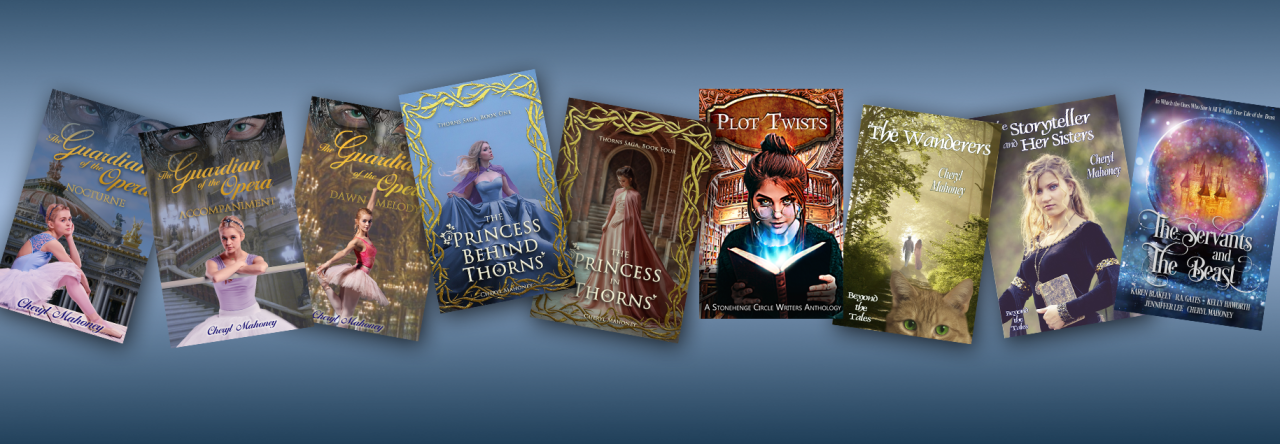
 A fun announcement today–Cathy from Kittling Books invited me to be part of her weekly feature, “Scene of the Blog.” She invites bloggers to share photos and some thoughts on the places where they write their blogs–desks, mostly, although not in my case. If you’d like to see where I’m doing my writing, check out the post on her blog.