Quotable L. M. Montgomery

I’ve been neglecting my “Quotable” category for months.  So let’s revive it with a quote from a favorite author…

“I’d like to add some beauty to life…I don’t exactly want to make people know more…but I’d love to make them have a pleasanter time because of me…to have some little joy or happy thought that would never have existed if I hadn’t been born.”

– Anne Shirley, in Anne of Avonlea by L. M. Montgomery


Twelve More Dancing Princesses

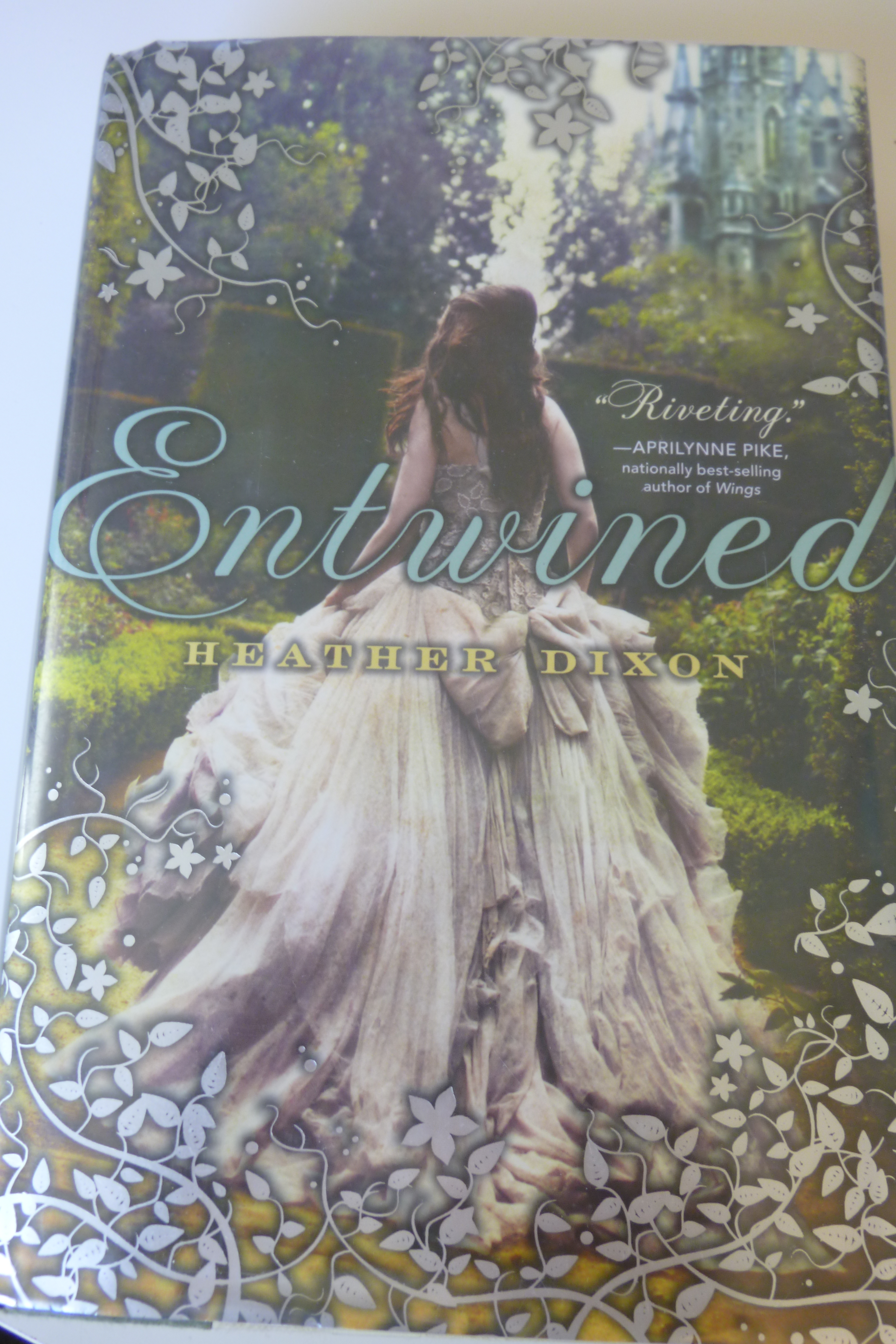
Entwined by Heather Dixon is one of those books I saw make the rounds of several blogs I follow.  And of course I was intrigued–it’s another retelling of “The Twelve Dancing Princesses.”  I reserved this at the library months ago, but the hold list was so long, it finally looked like it was about to come in during November.  Since I was spending November writing my own retelling of the same story, I didn’t want to read this then–I was sure I’d end up subconciously plagiarizing something!  So I put my request on hold, and finally read it in January, after finishing my own novel.

Entwined centers on Azalea and her eleven sisters, all named for flowers or plants and helpfully in alphabetical order: Azalea, Bramble, Clover, Delphinium and so on.  I frequently had to run through the alphabet to figure out the approximate age of, say, Jessamine or Kale.  The princesses’ mother dies early in the book, and the official rules of mourning restrict them from dancing for a year (among other things).  The girls discover a hidden passage leading off their room, relic of a magician-king from two hundred years ago.  They find an enchanted silver forest and a pavilion, whose guardian, the Keeper, tells them they are welcome to come and dance every night.

This book started slow for me.  The first half was only so-so, but it did pick up in the second half.  The turning point for me was when Keeper started threatening the soul of Azalea’s mother, to force Azalea to free him from captivity in the magic pavilion.  It was the first time Azalea seemed to have any significant motivation, and also when she finally figured out how creepy Keeper was–which had been pretty obvious to me from the beginning.  Prior to that, really wanting to dance just didn’t seem like adequate motivation to defy their father and go dancing every night in a pavilion owned by a very sinister stranger.

The romances also pick up in the second half of the book, for Azalea as well as Bramble and Clover.  This actually did a lot for Bramble and Clover as characters.  Prior to that, Clover was very quiet and Bramble was very immature.

That leads me to another point–this book made me think about what is perhaps the first fundamental question of retelling this story.  Namely, which sister to focus on?  The oldest?  The youngest?  Someone in between?  This is a larger question than it might seem, because there seems to be an unwritten rule that the heroine has to be around sixteen or seventeen.  If you give your seventeen-year-old heroine eleven younger sisters, simple math tells you that most have to be children.  Making her one of the younger ones means she can have adult sisters.  In a way, it’s a choice between giving your heroine a circle of peers, or making her a baby-sitter.  The fact that I put it that way probably tells you already that my heroine is at the younger end, #9, with sisters ranging between the ages of 15 and 25 (with a couple sets of twins).

Azalea is the oldest princess, and she spends a lot of time looking after younger siblings.  Most of them completely run together for me.  Even though Bramble should be about 15, she spends the first half of the book seeming very young.  It gets better when she and Clover get a little more screen time, a little more maturity, and can serve more as equals for Azalea.

Another major arc of the book was the relationship between the princesses and their father.  The King starts out as very cold and apparently aloof, but ultimately develops into a caring father (who simply doesn’t always know how to relate to his daughters).  Sometimes that transition is jarring, but it does come together in the end.

There are things I liked about Entwined too.  Some of the description was good, and I liked the treatment of the dancing.  Dixon clearly knows something about dancing, and there’s plenty of discussion about what kind of dance the princesses are dancing, and how they feel.  I do feel convinced about the importance of dancing to Azalea, and there’s good description of what it means to her–for one thing, it’s a connection to her mother, and it also gives her a sense of freedom and of magic.  I believe dancing is important to her–it just doesn’t seem quite important enough for some of the choices she’s making.

This was a good book, with a great climax, and nothing really wrong with it (other than some bland sisters, but with twelve there’s only so much you can do).  It didn’t quite spark for me, though.  Good–but not fantastic, and not particularly distinctive compared to other versions of the story I’ve read.  Aside, that is, from the cover–definitely one of the most beautiful books I’ve read in a while!

Author’s Site: http://www.harperteen.com/authors/37209/Heather_Dixon/index.aspx

Other reviews:
Between the Stacks
Charlotte’s Library
While We’re Paused
Yours?

Revisiting a Galaxy Far, Far Away

This sci fi kick I’ve been on lately has led me back around to Star Wars, which I must admit I haven’t paid much attention to for about ten years–and it had probably been that long since I watched the original trilogy.

First, a little history.  The trilogy was re-released in theaters when I was in elementary school, and me and everyone around me became Star Wars fans.  I read probably 10 or 12 Star Wars books too, but lost interest when it began to feel like every book was basically “let’s mop up the last traces of the Empire…and then the last last traces…and then this last one…”  More significantly, I also found Star Trek.  For me, the fandoms co-existed for a while, but in the end, the traveling turned out to be more interesting than the fighting (I’m convinced the difference really is all in that second word of the names).

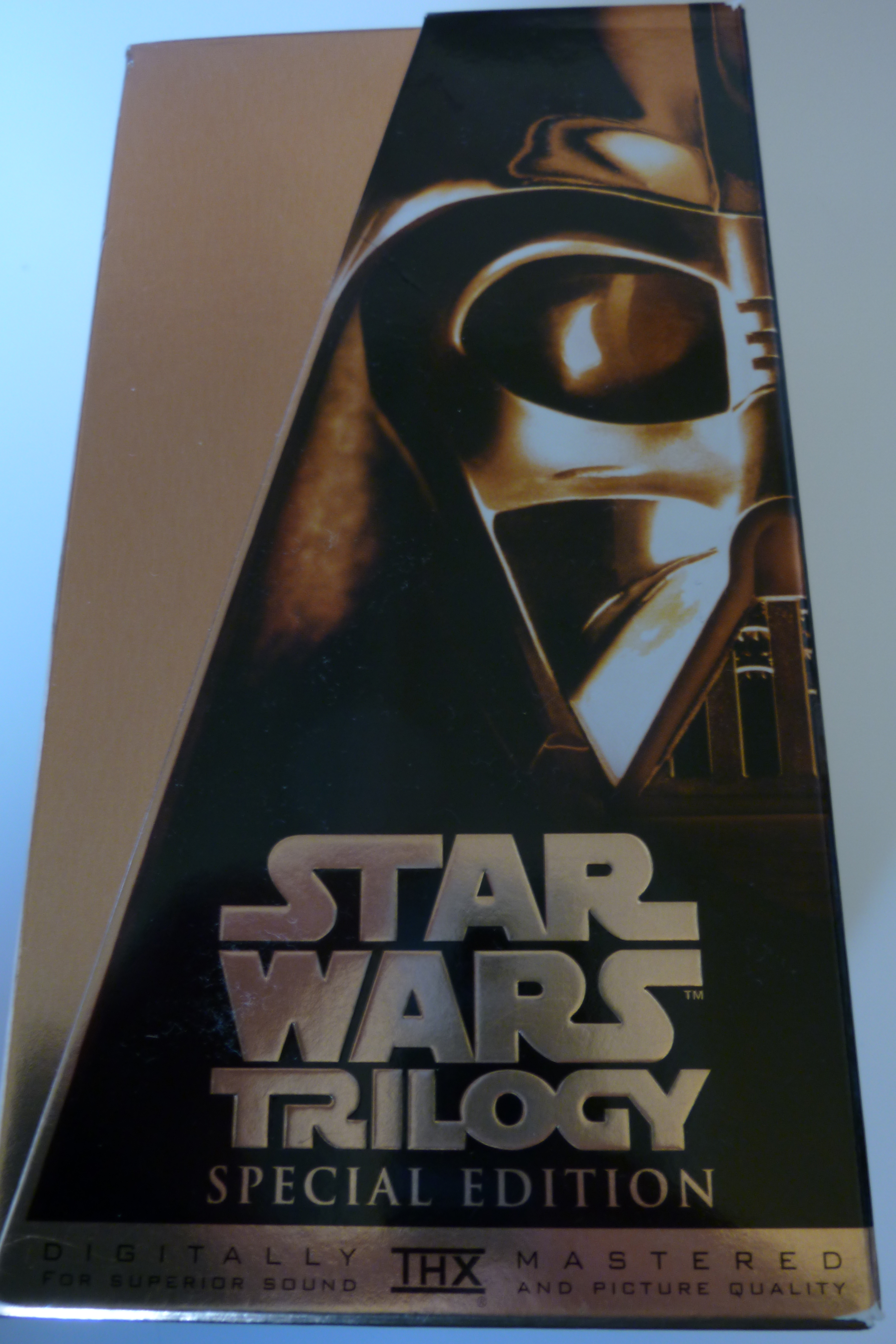
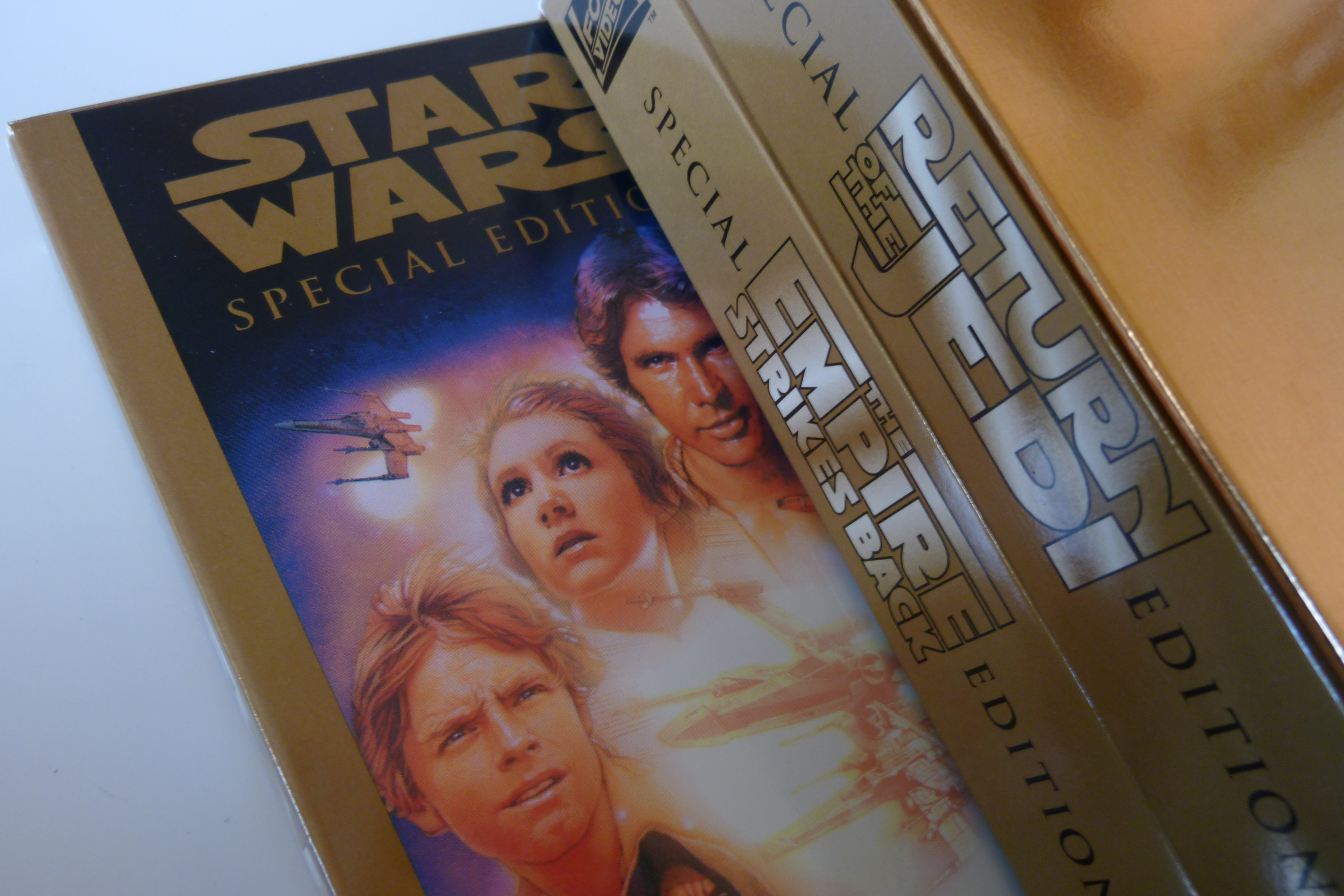
All of this is to say that I identify as a Star Trek fan, but I like Star Wars too, and there was a time when I really liked Star Wars.  And lately I’ve been thinking I’d like to revisit the galaxy far, far away.  So, over a recent weekend, I dug out my very old, shiny gold Special Edition VHS tapes of the original trilogy (a very big deal purchase when I was much younger!) and rewatched all three movies over three days.
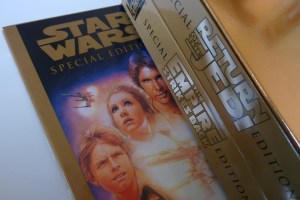
And you know, they really are wonderful.  The characters, the strange landscapes, the magic of the Force…even the battles.  It’s often the characters that count most for me, so let’s start there.  Remember it had been ten years (or thereabouts) since I saw these movies.  The biggest “change” was Luke.  Han is right when he’s calling him a kid at the beginning!  You can’t see him the same way when you’re a kid yourself.  I think you have to be older to properly see Luke’s character arc, from a whiny kid on Tatooine (he really is whiny in spots) to the serene and confident Jedi Knight.  It’s the classic growth of a hero story, and it’s very well-done.  I enjoyed Han’s growth too, from refusing to stick his neck out for anybody, to General Solo of the Rebel Alliance–but still with some of that scoundrel edge.  The one who grows less is Leia–she’s awesome from the first moment and stays that way, whether it’s blasting Stormtroopers or making acid comments to Han.  I remembered she was great, but I think I forgot just how much so.

I thought other characters were excellent too–Threepio, with his constant worried commentary, gets some of the funniest lines.  And at the opposite end of the spectrum, you have the looming and menacing Darth Vader.  I don’t think I ever noticed before–his entrance gets more impressive with each successive movie.  I wonder if they didn’t quite know what they had in the first one.

I thought the plot rockets forward at a nice pace, and each time I finished one movie it made me want to watch the next one.  It’s fun to revisit all the iconic lines and moments, and my memory of the later two movies may have been part of why I wanted to go on to watch them.  The trilogy is also a great example of a story which is complete unto itself, despite previous events which influence the present.

Which leads me around to the newer trilogy.  I watched that as it came out, and I don’t think I had seen the original trilogy since watching Episodes 1-3.  Rewatching Episodes 4-6 largely brought home to me how irrelevant the first three episodes really are.  I don’t feel like they added anything to my viewing of the original trilogy.  It was a bit interesting to see the references in the original to the past, and to know how they expanded those references, except that mostly I don’t much like the way they expanded them.

If anything, the new episodes hamper viewing of the original; now when Leia talks about her mother, I’m stuck thinking about Padme’s really stupid death; when anyone talks about Anakin Skywalker, it’s now harder to think of him as a heroic Jedi when I’ve seen him as a sulky teenager who, after the age of nine, was never all that likable.  And even though I like Padme, seeing Leia again makes Padme look like a poor imitation.  It’s sad, really–the original trilogy points up how far the new ones fell short, and how we really already knew anything we needed to know about the backstory.

If I was going to get more backstory, I think I’d rather have it about the galaxy, not the individuals.  Star Wars has good character development, but not so much when it comes to races.  The Wookies, the Ewoks and the Jawas are the only ones I can think of who have their species name even mentioned in the original trilogy (maybe Jabba–is Hutt a species or a title?)  There are endless bizarre-looking creatures, but most of them we know pretty much nothing about.  We don’t need to know about all of them–but it would be nice to know about some of them.  I suppose that’s another reason I ended up as a bigger fan of Star Trek; there’s much more scope in exploring different alien cultures than there is in mopping up the last traces of the Empire.

But there’s plenty that’s good in Star Wars too, and I think I’m going to do a bit more revisiting.  The new trilogy added nothing to the old one for me, but what I remember of the books did.  I remember Wedge got to be a much bigger character, that Leia became a political leader, that Luke continued that character arc to found a new Jedi Academy, that Han kept trying to balance the general and the scoundrel.  I lost interest eventually in reading new Star Wars books, but I remember I liked several of the ones I did read.  So I think I’m going to track some of them down and see if they’re worth revisiting too!
The Girl Who Followed the Birds

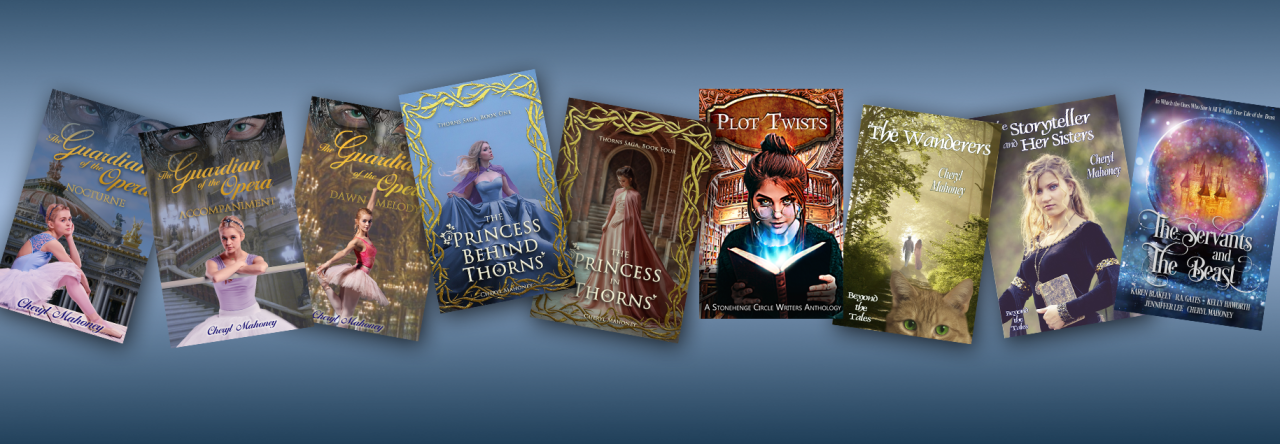
For Fiction Friday this week, I have another story-within-a-story from my NaNoWriMo novel.  Within the novel, this story reveals quite a bit about how my lead character is currently feeling about her life and especially her love interest.  Outside of the novel, it is, I hope 🙂 an entertaining Brothers Grimm-esque fairy tale.

**********************************

The Girl Who Followed the Birds

This is a story about once upon a time in a mountain village.  It was a small village where there lived simple people.  They knew their mountains, they knew their business of goatherding and farming, and they knew each other.  They knew very little else.  In this village there lived a girl, who all her life had known how the rest of her life was likely to be.  Her parents raised goats and a few crops like everyone else, and she did her part to help.  Someday she would marry the boy who lived next door, and they would have their own cottage and their own goats and plot of farmland, and so would their children after them.  It wasn’t that she had to marry the boy next door, but they had lived and played and grown together all their lives; she had always expected she would marry him one day, in an abstract sort of way.  One spring morning when they were both sixteen, he offered her a cluster of blue mountain flowers and she looked into his blue eyes and the abstract became the very real and she knew that she didn’t only expect to marry him, she very much wanted to—someday.

It was a fall day when her sweetheart asked her to marry him, and he would have said that it was a perfect and beautiful day.  It was also a day when the birds were in the village. Continue reading “The Girl Who Followed the Birds”

Caught Between a Great Brain and a Money-Loving Heart

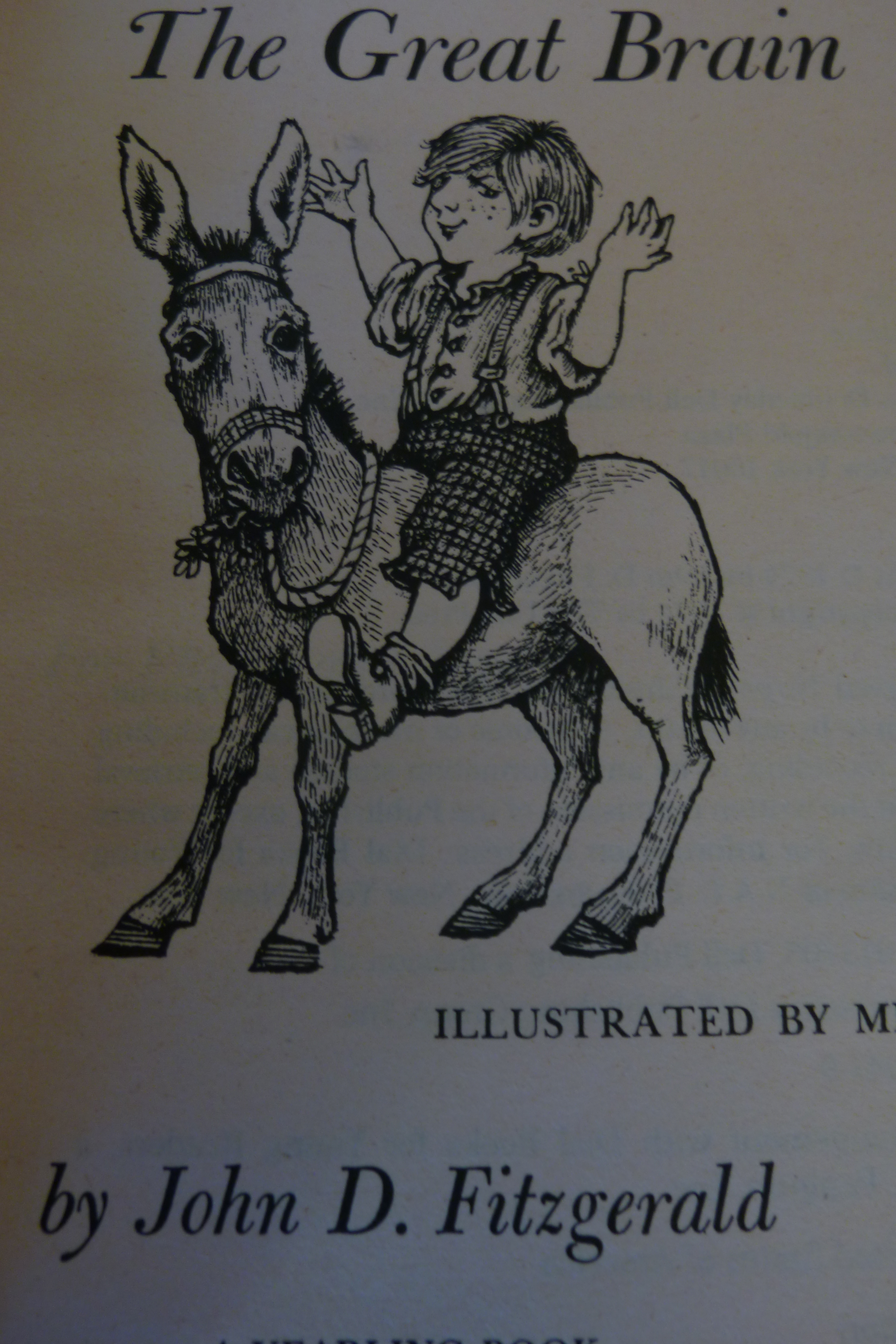
On the subject of funny kids books about boys, another favorite besides Gordon Korman is The Great Brain series by John D. Fitzgerald.  Based loosely on Fitzgerald’s childhood, the books are set in a small town in Utah in the 1890s.  The Great Brain of the title is John’s older brother Tom, who has a brilliant intellect and a “money-loving heart.”

There are seven books in the series, each a string of vignettes.  John narrates in first-person about the adventures of his brother Tom, who always has a scheme going to swindle someone–including John, who never seems to learn that it’s impossible to win a wager against Tom.

Tom is very clever, and it’s always fun to see what scheme he’ll come up with next.  I’ve never been a big reader of mysteries but I like figuring things out, and guessing at what plot Tom is devising, or how he’ll solve some problem, always makes for good puzzles.  Tom is a great character in that he never becomes TOO unlikable.  He’s immensely proud of his Great Brain, and he loves to get money out of people.  He doesn’t cheat, though–he finds ways to trick them, usually exploiting their own gullibility or greed.  He also uses his Great Brain to help people, sometimes saving lives or dramatically changing lives for the better.  He usually gets something for it too…but that’s always the question, of whether he’s acting from compassion or from greed!  Usually I get the sense it’s a little of both.  He’s also not above being humbled at times when greed or pride leads him into a serious mistake.

John is a good character, sweet-natured and modest.  He often refers to his “little brain” in comparison to his brother’s Great Brain.  John is rather eclipsed by Tom, but that aspect of the books seems to work–it’s John’s story about his brother, so it makes sense that he’s giving Tom the center stage.  John’s obvious admiration and love for his brother (no matter how many times Tom swindles him!) also goes a long way to setting Tom up as a likable character.

The stories are mostly light and funny.  They’re not the hilarity of Gordon Korman, but they are very entertaining.  There are some serious ones mixed in too.  Sometimes the situations kids get into have real peril, as when two boys get lost in a network of caves, or when one boy loses his leg to an infection and contemplates killing himself.  The Great Brain series is another example of how deep children’s books can be, addressing very serious issues and subject matter, while being child-appropriate.

And fun, of course.  Even though the stories are sometimes serious and Tom is out to swindle others to satisfy his money-loving heart, these still come across as sweet stories about family, set in a small town in a quieter time.  Well-worth the read.

Other reviews:
The Five Borough Book Review
Books 4 Your Kids
There must be more…tell me about yours?