Oh the Horror! Maybe.

I was recently reading a book that got me thinking when it used a particular narrative device.  I’ve noticed this before, but I don’t know if there’s a name for it.  Maybe I’ll coin one.  Let’s call it the Hidden Horror.  And since I’ve been posting about spooky books for Halloween, it seems like the appropriate time to talk about this!

The Hidden Horror is when SOMETHING happens (or has happened).  A character knows about it and reacts, saying, “Oh, the horror!”  Sometimes that’s literally what they say 🙂 but the point is that somehow it’s conveyed to the reader that the character feels SOMETHING really awful and horrible and excruciatingly bad has happened.  But we don’t know what it is yet.  The narrator holds onto the secret, and makes us keep reading to find out what the SOMETHING is.  Sooner or later, of course, it’s revealed, and of course we’re supposed to echo, “Oh, the horror!  Now I see what was so awful!”

The trouble is, usually I don’t.  Most of the time, if a writer makes me wait to find out what the Hidden Horror is, I get a complete anticlimax.  My reaction is usually, “Really?  That’s not that bad.”

I think the problem is that as soon as the character reacts, I start imagining what horrible thing it could be.  Horror is in a way a strangely personal thing.  One scenario may feel far more horrible to me than it would to you–and something that would seriously disturb you wouldn’t really bother me.  Maybe you can’t stand spiders, while I’m much more upset by snakes.  So when I start imagining the horrible thing, I imagine whatever would be most horrible to me.  And after I’ve had time to imagine that, how can the horrible imagining of the author–distant, third-party, impersonal–compare to whatever I conjured up?  While if I hadn’t had time to imagine it, I probably would have appreciated the author’s horrible event.

I love plot twists (even when I guess them), and I love knowing there’s some secret in the narrative that I have to keep reading to learn.  I love suspense–when you know the story is building up towards something, which will probably be horrible when it arrives.  Perhaps the key difference is that, if it hasn’t happened yet, it’s not being hidden.  It’s just approaching, and I’m not trying to imagine it in the same way because I’m still waiting for it to arrive.

It may also be a problem of over-emphasis.  When the characters go on and on about the awfulness, when the author goes to great lengths to convince me it’s horrible, almost anything would be an anticlimax.

I think reading helps writing in so many ways–it helps build a feel for language, sparks ideas, and lets us see clever things other writers have done.  And sometimes, it’s just as helpful to see what doesn’t work.

Oh, and despite the recent discussion on suspense in The Hound of the Baskervilles, that wasn’t the book that inspired this post.  Doyle knows how to do suspense.
Out on the Moor with Mr. Holmes

Don't you love battered, yellowed old books?

I’ve heard The Hound of the Baskervilles described as a horror novel.  I don’t think I’d go quite that far, but there definitely are some horror elements to it.

The Hound of the Baskervilles by Sir Arthur Conan Doyle is my favorite Sherlock Holmes novel, maybe my favorite of any of the stories.  Holmes and Watson leave their usual stomping grounds of London to venture out onto the moor.  This is the biggest horror-story element.  I loved the setting: the spooky, eerie, mist-covered moor, full of strange croppings of rock, treacherous bogs and mysterious noises.  I felt rather like I had followed Holmes into a Bronte novel.  There’s even a big, gloomy pile of an old manor house: Baskerville Hall plainly belongs in the same neighborhood with Wuthering Heights and Thornfield Hall.

Holmes and Watson are out on the moor investigating the recent death of Charles Baskerville, which seems to be tied in some way to the legend of a monster hound stalking the Baskervilles through the centuries.  Something is stalking Sir Henry Baskerville, Charles’ heir and the new lord of the Hall, and Holmes and Watson launch into an investigation.

Sir Henry is a poor substitute for Mr. Rochester, with a mostly place-holder role in the story, but it doesn’t much matter.  Holmes and Watson are always the significant characters, and there’s a fairly good cast of strange secondary characters surrounding them.

This felt the most like a horror novel when Watson and Sir Henry first arrive at Baskerville Hall (Holmes coming later) and explore the dark rooms.  It seems like just the sort of place to have Frankenstein’s monster on a slab in the basement.  The Hall even comes with an ancient butler and his wife, who have their own secrets.

Quite apart from the horror setting (and, of course, the possibility of a spectral hound), this is a good Sherlock Holmes mystery.  There are strange happenings, unsuccessful inquiries, and odd clues that all come together in the end.  I always love books that end up with all the random bits pulling together to explain everything.  Since Doyle follows a pattern of having Holmes lay it all out for Watson at the end, his stories are uniquely suited to managing this trick.

It causes an interesting problem for Doyle, I would imagine–Holmes always solves everything long before Doyle wants to reveal the answers to the reader.  He creates an extra layer between us and the answer by having Watson narrate, and Watson always stays as much in the dark as the rest of us.  The flaw there is that this means Holmes can’t tell Watson anything either, which sometimes seems a little forced.  Mostly Doyle justifies it by making Holmes, by temperament, an extremely laconic and uncommunicative man.  It stretches a bit, but I’ll take it.  I’ll suspend disbelief a touch for the sake of the story.

It is necessary for Holmes to play it close to the vest, because there wouldn’t be any tension otherwise–and Doyle is very good at tension.  I love the way he plays the story out bit by bit, drawing the reader along through the maze, heightening the danger as he goes.  There’s not actually that much action–it’s mostly people talking–but it’s somehow a very tense and exciting story.

My favorite moment in probably any Holmes story (and I’ve read a lot of them) is midway through Baskervilles.  I don’t want to ruin it for anyone–but Watson is out on the moor, and he’s anticipating a confrontation.  Nothing is happening.  He’s just waiting.  And yet Doyle keeps building the tension higher and higher, and then all of a sudden it snaps…and it’s brilliant.  It’s fairly predictable, but it’s still brilliant.

I love Sherlock Holmes stories, and Hound of the Baskervilles is an excellent one.  I don’t think it’s a horror novel, but it is perhaps a Gothic Sherlock Holmes story, and well-worth the read.

An Exploration on Being Dead

Halloween is coming up, and I’ve been thinking about appropriate books to review.  Halloween is one of my favorite holidays (Costumes!  And candy!), but not the easiest for me to get into thematically with book reviews, since I don’t like horror (movies are even worse than books).  But…occasionally I like something that drifts towards the spookier side, so I’ll try to give you a few reviews of books that are Halloweenish but won’t make you (by which I mean me) afraid of the dark.

Starting us off, Being Dead by Vivian Vande Velde.  What could be more Halloween-appropriate than a collection of short stories about ghosts?  In typical ghost fashion, most have unfinished business of some sort, but what and how they go about it varies widely.

The first story, “Drop by Drop,” is probably the creepiest, though it also felt a bit unfocused.  The conclusion in some way makes a lot of the rest feel irrelevant, although I don’t want to explain beyond that as it’ll give a lot away.

“Dancing with Marjorie’s Ghost” is a wonderfully traditional-feeling ghost story, the kind someone would tell around a campfire, while “Shadow Brother” takes a very different angle–the narrator’s brother died in Vietnam, and may or may not be haunting their father.

I found “October Chill” the saddest, about a teenage girl with a terminal illness who meets a ghost from the distant past.  The title story, “Being Dead” is the funniest–while having some pathos too.  It’s about a news boy who dies suddenly, and tries his hand at haunting to set a few things right before he goes on.  I think it was my second favorite.

My favorite story (and I don’t want to give you the title because there’s no way to talk about it without spoilers, if you knew which one I was talking about) started out feeling rather flat, but then had a final twist ending that was so clever I had to go back and reread the whole thing so I could see how brilliantly it was actually put together.

I enjoyed the variety of stories and the variety of takes on ghosts.  Many had a good undercurrent of creepiness or a clever twist of some kind.  None have been haunting me, and that’s a good thing!  It’s just a good collection of interesting and engaging ghost stories.

Author’s Site: http://www.vivianvandevelde.com/

Favorites Friday: Stories in Paintings

Since I seem to have fallen into a theme about pictures this week, I thought it was a good time for a Favorites Friday about art.  I love wandering through art museums, and I’m lucky that I’ve been to some really good ones.  The paintings that most appeal to me tend to be ones that feel like they have a story.

Some, of course, are very specific stories, like a scene from the Bible or mythology, or something with a clear narrative.  But I often find paintings that have a setting or a person that feels as though there must be a wonderful story behind them.

I try to make notes of paintings I like while wandering a museum, so that I can find them online later.  Here are a few of my favorites.

The Goose Girl, by William Adolphe Bouguereau

I just love her smile.  There’s so much character in it.  She may be a goose girl, but she’s confident, maybe a little saucy, and I bet she knows a good joke too.

Bouguereau is one of my favorite painters.  The most expensive book I own is an enormous one about his life and work.  I’ve never read it, but I’ve spent plenty of time pouring over the reproductions of his paintings.  He does wonderful things with light and detail, and if you look at enough paintings you recognize his regular models, so they feel even more like characters!
.

Dent du Midi Castle of Chillon, Lake Geneva, by Edwin Deakin

Wouldn’t this be a wonderful setting for a story?  Who lives in the castle, and what brings so many boats onto the lake, and does anyone ever go up and explore those mountains looming in the background?


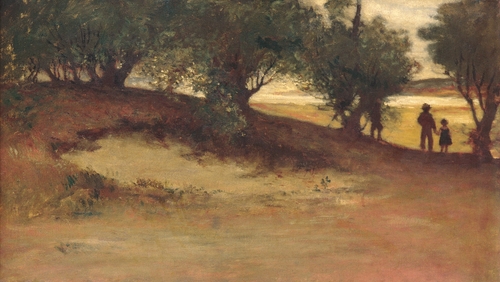
The Sandbank with Willows, Magnolia by William Morris Hunt

I love that we only get a glimpse of the two people in this picture.  And I’d love to know where they’re going.


The Lake for Miniature Yachts by William Merrit Chase

This story I’m pretty sure I’ve read.  It’s in The Little White Bird by J. M. Barrie, with a lovely comparison between the fun to be had with a fancy yacht vs. a simple stick-boat and some imagination.


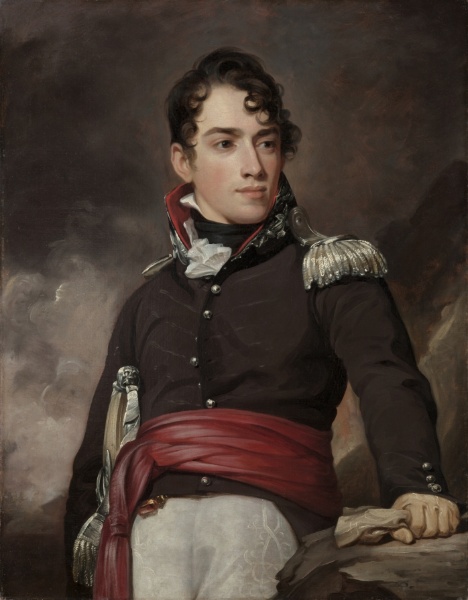
Portrait of Jean Terford David by Thomas Sully

This man clearly needs to be the hero of a good naval epic.  In fact, he bears an astonishing resemblance to Ioan Gruffudd’s Horatio Hornblower!

Anyone else with favorite art to share?  🙂

Picturing the Twelve Dancing Princesses

Have you ever stumbled on something and wondered why you didn’t know about it twenty years ago?  That’s how I feel about Kinuko Craft.  She did the cover for Wildwood Dancing, and since seeing that, a friend and I have both become a little obsessed with her art.  And apparently she’s been doing covers and illustrations for years!  How did I not discover this sooner?

Most recently, I tracked down a beautiful picture book, The Twelve Dancing Princesses by Marianna Meyer and illustrated by Kinuko Craft.  I’ve talked about the dancing princesses a lot in various other retellings, and this one doesn’t offer a lot that’s new in the story itself.  A slight twist on a few elements, but mostly a straight-forward retelling.  But the pictures are lovely.  Apparently this is just my week for talking about illustrations!

Almost every alternate page is a full-page illustration, with illustrated sidebars on the text pages.  The detail and intricacy of the art is wonderful.  Some pictures are relatively simple, such as a man working in a field (although even that has an entire sweeping landscape behind him).  Others are a swirl of faces and dresses, showing all twelve princesses.  One dark picture shows the mysterious castle on the far side of the magic lake; another is riot of color in a flower garden.

The hero is drawn a little cherubic for my taste, but the princesses and their dresses are beautiful.  I think my two favorite pictures are when the hero is approaching the castle, showing the stretch of mountains and water before him, and a picture showing dozens of couples dancing in a vast hall lit by chandeliers.

But why take my word on what they look like?  Better to just put up a few pictures!


Illustrator’s Site: http://www.kycraft.com/