
No Goddesses–Have a Child Genius Instead

Artemis Fowl by Eoin Colfer was one of those books I’d heard of, but knew nothing about.  I knew it was a popular series and…that was about it.  If I had had to guess, I would have assumed it had some relation to Greek mythology, maybe something about warriors and hunting.  I mean, toss together the Greek goddess of the hunt and a bird, what are you likely to get?
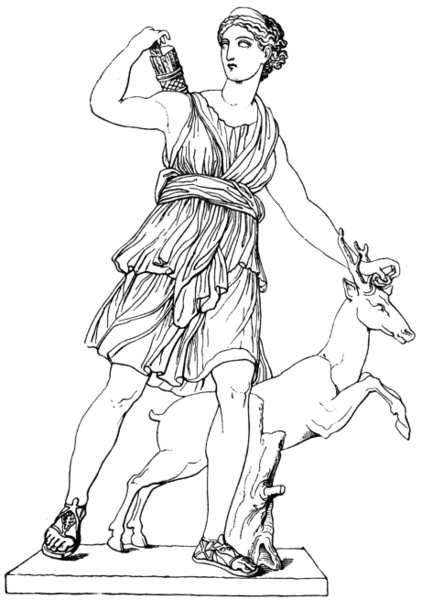
Not Appearing in This Book

An evil child genius, as it turns out.  I never did find a connection to Greek mythology (or figure out why the main character, especially a male one, is named after a Greek goddess), and no birds.  Artemis Fowl is a very wealthy twelve-year-old bent on conquering the world–or at least making even more money off of it–and isn’t scrupulous about how he does it.  His new scheme is to exploit fairies–a whole new market!

I really enjoy the concept of the fairies.  There’s a whole community, mostly living underground, hiding their existence from humans.  They have plenty of the magical and mystical powers that fairies traditionally have, but in other ways they’re treated as simply another intelligent species that sprang up on the Earth the same as humans.  I suppose that makes sense–why should fairies consider themselves myserious and otherworldly, after all?  I think you can consider this a fantasy, but in some ways it feels more like science fiction.

So I liked the idea of the fairies…but somehow I couldn’t build up much interest in the fairies as individuals.  I don’t know why, and this may be totally my thing and not relevant to someone else.  Artemis’ scheme is to kidnap a fairy, and he does–Holly Short, a member of the fairy police force.  I feel as though I should like her more than I do–she’s a tough female character trying to prove her worth in a male profession.  Put that way, she has plenty in common with Tamora Pierce’s Alanna, who has to be in my top ten favorite characters ever.  But maybe Holly felt too much like a stereotype–fine for her type, but too much a type and not an individual.

Holly’s boss (whose name I can’t remember or find!) feels even more like a stereotype: the crusty old chief with a gruff exterior and a secret heart of gold.  He’s like Perry White, minus the “Great Caesar’s ghost!”  I did enjoy Mulch, a rather creative criminal, and Foaly, a technical genius centaur with a paranoia that humans are spying on him.  But even they seemed like they should be more interesting than they were.

I liked the human characters better, although they were probably types too.  Artemis is pretty interesting.  Evil child geniuses are fun, and Colfer played a bit with the bizarre combination of a brilliant intellect in someone who really is still twelve.  There was also some nice ambiguity about how evil Artemis actually is.  Ruthless, definitely, but it wasn’t always clear whether his motivation truly was profit, or something more noble.  I like the grayness.

I also liked Butler, Artemis’ faithful sidekick and the muscle of the team.  The Butler family has been serving the Fowl family for centuries, and may be the origin of the term “butler.”  That’s fun.  Butler is enormously proficient at fighting, fiercely loyal to Artemis…but once in a while we get a glimpse that he can think for himself too.  Again, I like the grayness.

So I was up and down about the characters.  The plot was pretty good, although since it hinged on Holly’s kidnapping, it probably would have worked better if I had cared about her more.  But it was an enjoyable book, and I can see how someone else who connected better with the characters would really like it.  For myself, I’m glad that now I know what it’s about (no Greek goddesses–check) and I might pick up the next book eventually, though I haven’t rushed to get it.  But maybe some time, especially to see if the characters develop more as the series goes on.

Anyone else care to share an opinion?  🙂  I’d love to hear it!

Author’s site: http://www.artemisfowl.com/

New Feature: Favorites Friday – Opening Lines

I’ve been thinking about Fridays.  As regular readers know, on Fridays I normally post my own writing.  Which is fun, but I think I want to mix it up with a new feature.  Book reviews are normally a drill-down focus on one book (or series or author).  But sometimes I want to do a round-up of several favorites of something…favorite characters, favorite opening lines, favorite paintings that plainly have a story in them (most of my favorite paintings are like that!)  Because I have a thing for alliteration, I’m going to start doing Favorites Friday.  I’ll still do Fiction Friday too, but I want to do a mix of both.  And by all means, let me know your preferences too!

To start us off, why not begin at the beginning?  Favorite opening lines.

“All children, except one, grow up.”
Peter Pan, by J. M. Barrie

Six words, yet it’s all there.  The tragic thread throughout, especially at the end, of children growing up and changing and leaving (“tragic” seems to be Barrie’s feeling on it).  The magic of one child who defies this most basic convention.  And the poetry and charm of Barrie’s writing.

“I have been in love with Titus Oates for quite a while now–which is ridiculous, since he’s been dead for ninety years.  But look at it this way.  In ninety years I’ll be dead, too, and the age difference won’t matter.”
The White Darkness by Geraldine McCaughrean

Brilliant, funny, and I love the way she talks about him simultaneously as both a distant historical figure, and as someone immediately present in her life–which is how Titus is throughout the book.

“If it had not rained on a certain May morning Valancy Stirling’s whole life would have been entirely different.”
-The Blue Castle by L. M. Montgomery

And now you have to keep reading to find out why, right?

“Last night I dreamt I went to Manderley again.”
Rebecca by Daphne du Maurier

I can’t analyze for you why I like this so much–but somehow it’s got into my head and when I read it I want to sigh and say, oh yes, Manderley…

And speaking of sighing:

“Sam Vimes sighed when he heard the scream, but he finished shaving before he did anything about it.”
Night Watch by Terry Pratchett

Which is Discworld in a nutshell.  And Sam too, for that matter.  Rather world-weary but still going about his business as head of the Night Watch.  In this case, tending to a would-be assassin who has fallen into his booby trap.  I don’t think anyone handles “oh bother, another assassin” quite like Pratchett–and makes it funny!

What are some other great opening lines?  I’d love to hear your favorites!

Why Does All the Food Have to Be Sad?

Every so often, one book seems to make its way through several of the blogs I read.  One of these books, a few months ago, was The Particular Sadness of Lemon Cake by Aimee Bender.  Since I’d already read the jacket description in Green Apple Booksellers in San Francisco when I was visiting over New Year’s and been intrigued, I decided to request it at the library.

Six months later, I finally read it.  When I joined the hold list, I was around #130 in line.  Good thing I wasn’t in any particular hurry!

It was a good book and I’m not sorry I let it sit in my hold list long enough to get all the way though the LONG line…but I’m also not sorry I didn’t buy it six months ago, despite my great fondness for Green Apple.

The book is about Rosie, who, whenever she eats, can taste the emotions of the people who cooked the food.  She discovers this talent/curse when she eats the lemon cake her mother made for her ninth birthday, and realizes that her happy-seeming mother is…well, depressed is simplifying–empty, unfulfilled, desperately seeking something else in her life and probably wanting someone else to provide it.

The book follows Rosie into adulthood, as she grapples with eating and with the hidden tensions in her family–revealed only in their food.

I love the premise–I was so intrigued by it at Green Apple.  I do feel it lived up to the promise of that premise, at least in how that part of the book was handled.  Rosie develops a complex palette for food–she can tell where the ingredients came from, has insights about every stage of the process, sees into the hidden emotions of the people who touched it all along the way, often seeing the things that they don’t know themselves.  I didn’t understand why she couldn’t cook her own food–where’s the harm in feeling your own emotions?–but when she does finally try that, it reveals hidden feelings in herself that are even more terrifying than other people’s.

I did have some problems with parts of the book, though.  People seem to only ever transmit negative emotions into food.  Maybe I’m just a hopeless idealist, but I refuse to believe that the vast majority of people are leading desperately unhappy lives, secretly or otherwise.  In all the food she eats throughout the book, I can think of only one example where the people making the food seem to be truly happy.  Rosie also finds one restaurant where she loves the food, but it’s not so much that the cook is happy as that she really loves food, and puts that into the dishes.

So I had trouble with that part.  I also don’t see why it was necessary.  Being overwhelmed by other people’s emotions every time you eat is compelling enough–being hit by other people’s positive emotions would be difficult too, and maybe even more interesting.

The second part I bumped into some problems with was Rosie’s brother, Joseph.  He possesses his own strange talents which, if you take it all at face-value, make tasting emotion in food seem comparatively tame.  At the risk of a slight spoiler, I’ll mention that he disappears most of the way through the book.  I won’t spoil how, except to say that it’s part of that strange talent.

This, odd though it may sound, is where I found the book implausible.  Not the way Joseph disappears–I was willing to accept that as the universe of the book–but the way other people react.  I’ve read other books about family members who disappear, probably kidnapped or run away, and the reaction here just didn’t feel right.  He was twenty or so when it happened, but there still should have been quite a lot of police calls, a lot of trying to hunt down anyone he had talked to or knew who might have an insight, a lot more searching.  Deciding to live in a fantasy where he’s off skiing the Alps and might come back any time just didn’t ring true to me, even for these rather odd characters.

I am probably over-exaggerating the issues of the book.  Do you ever find it’s sometimes easier to explain the parts that didn’t work than the parts that did?  Well, let me wind up by saying I did enjoy the book, and if you’re intrigued by the premise it’s worth a try.  You might want to lay in a Terry Pratchett book or two, though, in case you find yourself needing a laugh by the end.

Author’s site: http://www.flammableskirt.com/ (I don’t know what it means either…)

An American Girl for an American Holiday

Happy Fourth of July!  I’ve been hunting my shelves for a good book to review that’s appropriate to the day.  I usually celebrate with movies–either 1776 or Mr. Smith Goes to Washington.  But I do have one favorite book series set around the Revolutionary War.

I loved American Girl when I was a kid.  I subscribed to the magazine for many years, and read several of the book series.  My favorite was always Felicity.  One of the best Christmas gifts I ever got was a Felicity doll, with her wardrobe of clothes and her four-poster bed, from rather indulgent grandparents.  🙂

Felicity lives in Williamsburg, Pennsylvania, at a time when tensions are beginning to rise between the British and the colonists.  Felicity loves adventure and has trouble being a proper young lady–which is probably what makes her beloved of young girl readers.  The main focus of her story is usually on school or family or friends, but the political situation furnishes a backdrop, and sometimes becomes part of the story.  At one point, Felicity is separated from her best friend, Elisabeth, because Felicity’s family is pro-revolution, while Elisabeth’s father is a Loyalist.  At another point, Felicity’s father’s apprentice considers running away to join the revolutionary army.

The books strike a balance, bringing in history without making it feel dragged in, and without distracting too much from Felicity’s adventures as a girl living her ordinary life in the 1770s.  Not every book achieves such a good balance!

The most appealing part of the Felicity stories, for me, was Penny.  Penny is a horse who Felicity tames and learns to ride, rescuing her from a cruel master.  This was directly responsible for my going through the horse phase that probably every little girl has at some point!

These are sweet books, and a lot of fun–and quite short!  Rereading them many years later, I find it takes about twenty minutes to read one book.  But Felicity and her world are nice to visit–however briefly!

2011 Reading Challenges – Halfway Point

I’m suspending Fiction Friday today because it’s July 1st, halfway through the year, and I want to update on my reading challenges.  So far, I’m having success–I’ve found some fun new series, enjoyed a variety of fairy tale retellings, and have knocked off some classics that I’ve been meaning to read for years.  Things slowed down for almost every challenge this quarter, but I’m still on track for halfway through the year.

The one I’m just barely keeping up with is the library challenge.  I’m still at the library weekly, but I’ve also been borrowing stacks of books from friends…which is great fun, but not helpful for the challenge!

Linked titles go to my review of the book.  If you see something you’re curious about that doesn’t have a review, let me know!  If I don’t feel like I have enough to say for a full post, I’ll at least let you know what I thought in a reply-comment.

Here’s what I’ve read so far Continue reading “2011 Reading Challenges – Halfway Point”