Story in Song

I love to read, but what I really love are stories–which of course aren’t confined just to books.  It was fun to review a couple of movies for the Once Upon a Time Challenge, and I think I may mix it up a bit in the future, occasionally reviewing something that isn’t a book–but still a marvelous tale.

Lately, I’ve been enjoying stories in music.  I may be among the few people my age willing to admit this, but I’m a Barry Manilow fan.  (No one laugh!  I’m in good company–Elton John, Victoria Beckham and Slash from Guns ‘n’ Roses are all fans too.)  If you somehow don’t know Barry Manilow, he’s an oft-maligned singer/songwriter since the seventies, singing heartfelt and soaring ballads.  I ask you–what’s not to love?

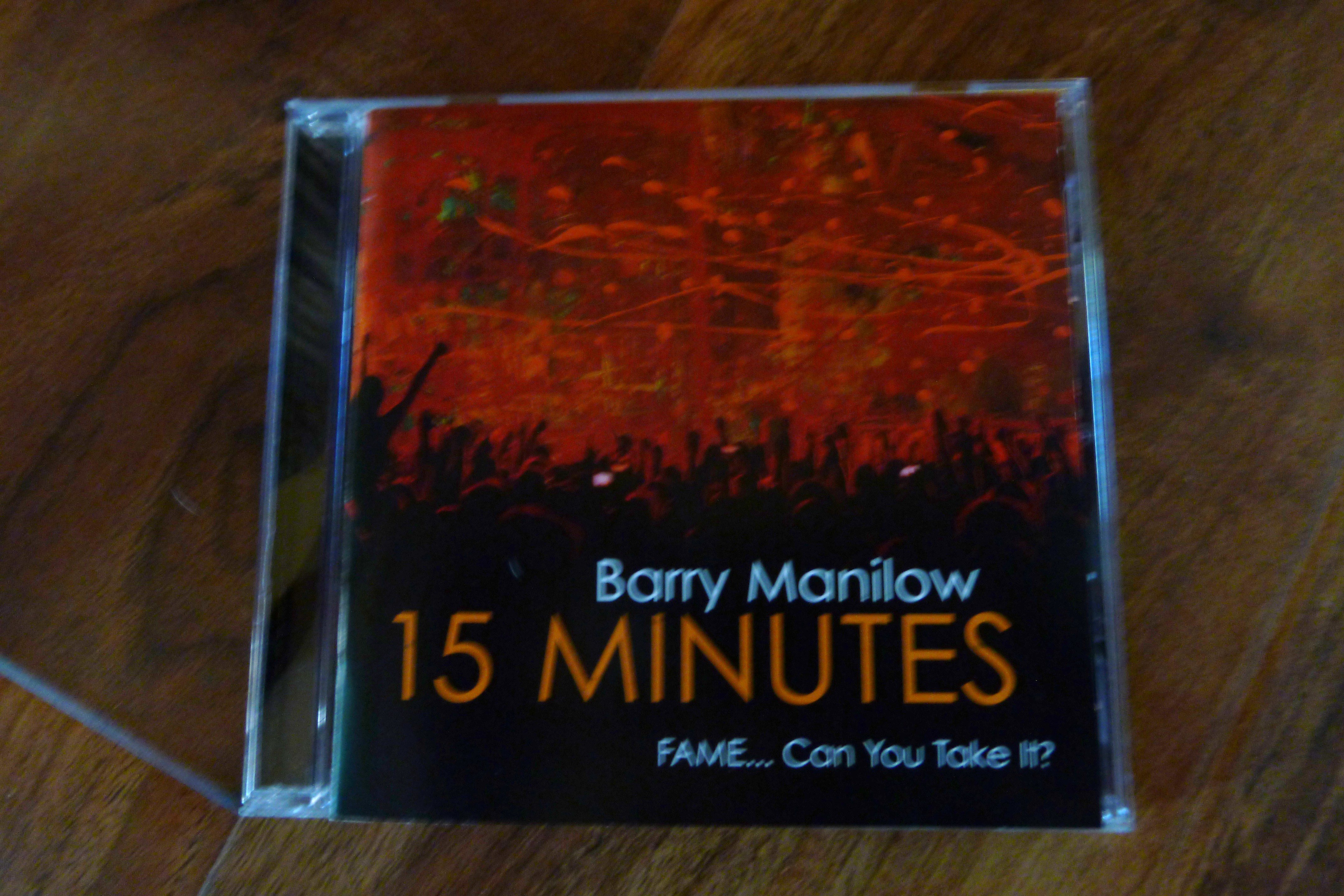
Barry’s latest CD came out just a few weeks ago: 15 Minutes, a story about a singer’s rise to fame and subsequent self-destruction.  And it really is a story.  It’s not just a series of songs around a theme–it’s a clear, continuous, building story, from track to track.  It’s like a soundtrack, only without the play.

For those who are familiar with Barry Manilow, this one is different.  It’s still heartfelt and soaring at times, but it has more of a rock quality to it.  He’s also delving into different emotions: anger, bitterness–darker feelings.  He’s always had sad songs; you can pretty much take your pick of songs that follow the theme “I loved her, I lost her, I miss her.”  But there’s something more raw and edgy about this CD.

(If it’s possible to give a spoiler for a CD, fair warning that I’m about to.)

It opens with “15 Minutes,” setting the stage of the singer’s dreams of fame and glory.  He gets the job in “Work the Room” (which has an astonishingly rapper-like quality to it!) and rushes home to tell his girl in “Bring on Tomorrow.”

“Bring on Tomorrow” is my favorite song on the CD.  It’s a beautiful piece about reaching your dreams and seeing this amazing future spread out ahead of you.  Chasing dreams are another frequent theme in Barry’s songs, which may be one reason I like him.

Bring on tomorrow for me and for you,
We hung on through dark hours, dawn’s overdue.
Bring on tomorrow, and show me the sun,
We’ll live it together, ’cause you’re the one.

Without you it’s nothing, why else would I climb?
Together forever, hearts beating in time.

He gets to enjoy his rise for a few songs, but then it starts to disintegrate: “He’s left with no companions, only enemies and slaves” in “He’s a Star.”  From there, everything falls to pieces, including his relationship–which gives “Bring on Tomorrow” this wonderful added poignancy.  The songs trace a spiral into increasing destruction, including the truly creepy “Letter from a Fan,” who turns out to be disturbingly obsessed.  (I have never used the word “creepy” to describe Barry Manilow music before!)  Everything comes to a head in “Winner Go Down,” followed by a few songs reflecting on how it all went wrong.

And here, despite how much I do love this CD, is where Barry ends up losing me.  I’m right with him through “Trainwreck,” the third-to-last song, about how it all went off the rails and now the singer is trying to get back on the track again.  But then, right when I’m looking for a classic “loved her, lost her, need her” song…we get a reprise of “15 Minutes.”  The singer’s heading back into the spotlight.  Which I could accept as well, if there was a sense of “I learned something, I’ll get it right now and it’ll be different this time.”  There is a sense of “I’ll prove to them I’m not done yet,” but…not much of “it’ll be different.”  So when the last track is “Everything’s Gonna Be All Right,” I’m left saying, how and why and what are you going to do to make it all right?

There’s a brilliant melodic touch in here–a couple times, at key emotional moments, we hear the melody from “Bring on Tomorrow” again.  It’s there in the song when the couple falls apart, and again at the end of “Trainwreck”–which is my one (extremely slim!) hope that maybe he went and found the girl again.  (He should–didn’t he listen to all of Barry’s other songs about devastated loss?)

If they were going to turn this into a play, it would be easy to do.  It’s got the complete story already, and if they needed to expand it, they could just bring in some of Barry’s other songs–I’ve been listening to my other Barry Manilow music, and there are several that would weave in very nicely.  Including adding a “loved her, lost her” song at the key moment.  All you have to do is name the girl Mandy and you’re set.

“Mandy” is Barry’s signature song (along with “Copacabana”) and one of his first big hits.  Thematically,  it fits into this story perfectly, even in the details.

Standing on the edge of time,
I walked away when love was mine,
Caught up in a world of uphill climbing, the tears are in my eyes,
And nothing is rhyming, oh Mandy.

You came and you gave without taking,
But I sent you away, oh Mandy.
You kissed me and stopped me from shaking,
And I need you today, oh Mandy.

If they need someone to turn this into a play, I’m ready!  🙂  And barring that unlikely event, I’ll just enjoy listening to it.  If you like Barry Manilow, or even if you don’t, check it out–you might be surprised in either case.

Thank you for indulging me on my musical ramblings about a marvelous tale in music…I promise to write about a book next time!

Artist’s Site: http://www.manilow.com/ (including samples of the songs from 15 Minutes right on the homepage)
A Book by a Family Friend–Distantly

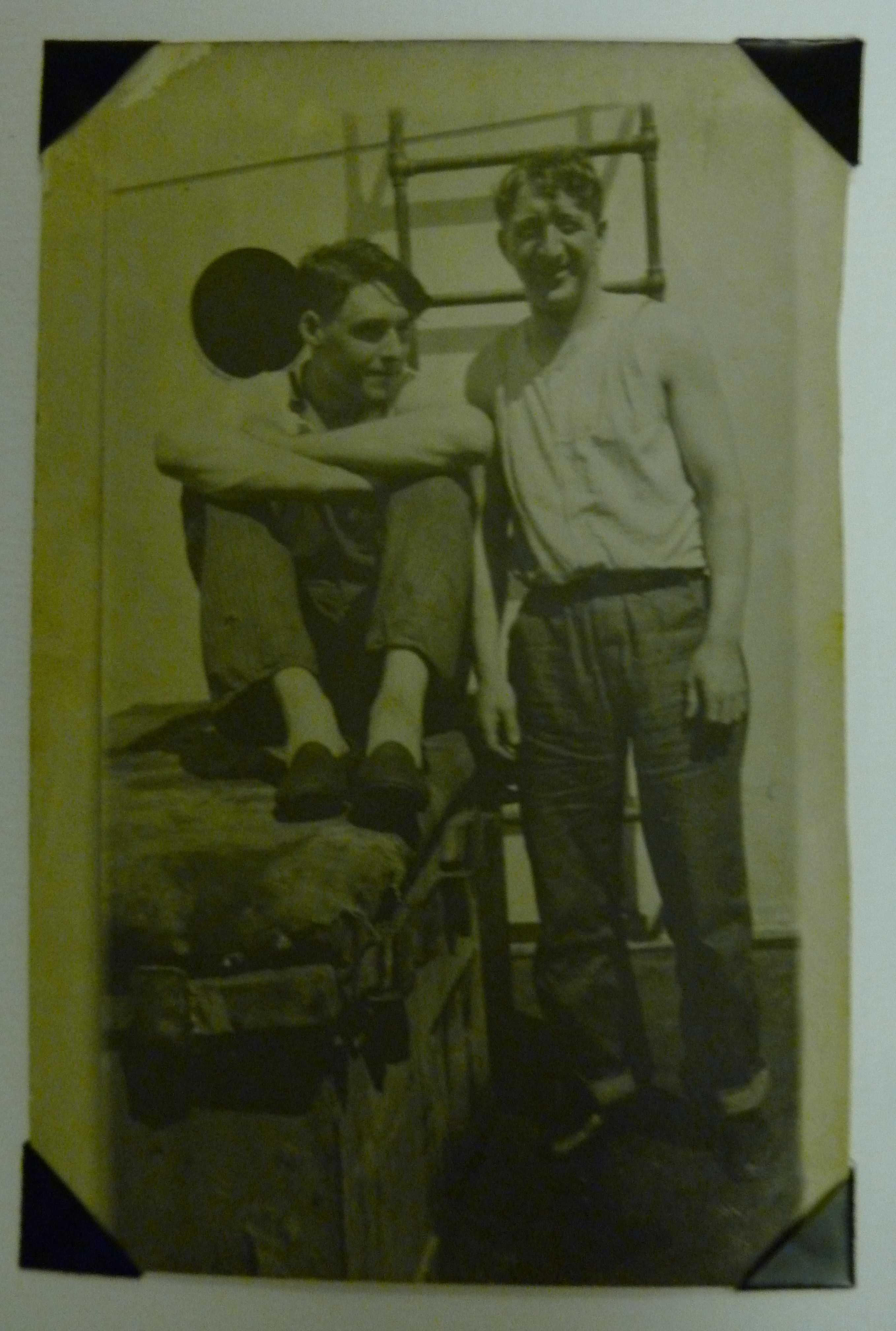
My great-grandfather is on the right. At left...anything's possible!

We have a family legend that my great-grandfather, who was in the Merchant Marines in the early part of the 1900s, was a friend of Jack London’s.  The embroidered version is that they were drinking buddies; the verified version is, well, non-existent.  But we do have several old pictures of my great-grandfather traveling the world, often with unidentified companions.  So who knows–one of them could be Jack London…

Despite the family connection, I’d only read one novel by Jack London (The Sea-Wolf), until recently when I delved into The Call of the Wild.  Ol’ Jack may have been great fun to visit a bar with, but I’m sorry to say he’s never going to be a favorite author of mine.

It was an interesting story, and the point of view of the dog brought a lot to it.  The picture of life up in the Klondike during the mining time was engaging (not that I’d want to visit, but it was fine to read about) and there were exciting moments.  But the nearly unrelenting harshness of it all was too much for me.

The story follows Buck, a family pet who is stolen and sold to become a sled dog.  Buck gradually sheds civilization, adjusts to life as a sled dog, and eventually finds his inner wolf, responding to the “call of the wild.”

As Buck passes from one owner to another, meets and (usually) fights with other dogs, and gets pushed through one test of endurance to another, the story is so bleak, and so harsh.  For most of the book, rarely is there an act of kindness or a pleasant word.  Buck does finally find a loving master who he worships in return.  If he hadn’t, I might have completely despaired of the book (or at least London’s opinion of humanity).  But, while I don’t want to give away spoilers, let’s just say it doesn’t end up happily with that master either.

I should have known what I was getting into, of course.  The Sea-Wolf  was not exactly cheerful, and, more significantly, I had read “To Build a Fire,” an incredibly bleak story about a man who managed to get wet in the Arctic and struggles, strains and strives to build a fire so that he won’t freeze to death.

Incidentally, you can also find a story by Mark Twain, I think part of Roughing It, called “Lost in the Snow.”  A group of men get lost in the snow and try to build a fire so that they won’t freeze.  Because it’s Twain and not London, it’s a very funny story.

I respect London’s knowledge and worldview…but it’s not a world I’d want to visit too often.  The Call of the Wild is a good book as a book, but not my style.  I’d rather hang out in Twain’s world.

A Visit to a Good Fairy

I thought it would be fun to pull out another excerpt from my novel The People the Fairies Forget–it’s been a few weeks!  Click the category at right (or the page at the top) for more extensive background.  The brief background is that Cinderella’s slipper has fit the wrong girl, who is now having difficulty getting out of an engagement to a not at all charming prince.  My fairy narrator, Tarragon, has gone in search of his very traditionally-Good-Fairy colleague, Marjoram, who he suspects was involved in Cinderella’s arrival at the ball.

I don’t know if I’m supposed to say I enjoy my own writing 🙂 but I do enjoy that this scene shows Marj at her most Marjish–and at her most aggravating!

*********************

            Marj was at home.  Marj’s home involves endless piles of flowers and pillows and silk curtains and pink furry things.  And sparkles, of course.

I popped in, moved a pink kitten off of a chair—wondering as I did if it had been something else before becoming a pink kitten, and if so, had it been a sentient something else—and sat down.  “Hello, Marj.  I need a word.”

Marj was sitting in front of an immense, extremely ornate mirror, with powder puffs and lipstick and I don’t pretend to know what else hovering in the air around her head.  “I really don’t have time right now, Tarry, there is so much going on.”

“Speaking of things going on, about Prince Roderick’s ball.  Did you help a girl go?

“I did.  Aren’t you pleased?  I helped a commoner.”

“I might be pleased.  I’m not sure yet.  Does any of that so much going on involve the girl you helped?”

Her eyes shifted to the side and I knew she was checking something magically.  After a moment she shook her head.  “No, nothing happening with her.  No one’s brought the shoe around yet.”

Continue reading “A Visit to a Good Fairy”

Making Music for Dragons

I’ve been thinking about favorite books I haven’t yet reviewed to see if I’m missing anyone important–and I thought of Pern.  The Pern books are Anne McCaffrey’s epic dragon series, and if you’re a fan of science fiction or fantasy, you probably know them.

Pern is a distant planet where survival is complicated by Threads, strange burning filaments that fall from the skies at intervals, consuming anything they touch.  Pern is protected by dragons and their riders, who burn Threads from the skies before they can touch the ground.

There are a large number of books within the Pern series, some more or less connected to each other, spanning a couple thousand years of Pern history.  My particular favorites are the Harper Hall Trilogy–and don’t worry, you don’t have to know the entire complex history of Pern to read them!  The Harper Hall Trilogy focuses mainly on Menolly, a girl living in a small fishing village.  She dreams of making music, but in her conservative village, girls aren’t supposed to become harpers.

Harpers are the musicians, teachers and historians of Pern.  The society relies mainly on oral history, and harpers write and teach the music that records Pern’s history and stories.  Every village (or hold) has a harper to teach the children and provide musical entertainment.  The harpers train at the Harper Hall, a sort of musical boarding school and university.

Menolly, forbidden to write music but unable to resist, runs away–and discovers fire lizards.  Fire lizards are like miniature dragons, and wouldn’t it be incredible to have a miniature dragon for a pet?  Menolly’s adventures with music, dragons and surviving are exciting for the first volume.  The second volume takes Menolly to the Harper Hall, to meet a new cast of excellent characters and to see more of Pern.  The third book focuses on Menolly’s friend Piemur, who has his own adventures.  I have to admit I found them less engaging than the first two books, but still good.

One of my favorite parts of the Pern books is the complex society McCaffrey has created.  Dragons and Harpers are just one part of it.  Everyone has their own place, as Lord Holders or craftsman or runners.  Pern has fairly minimal technology, perhaps on a level with the Middle Ages, but they have skilled craftsmen and their own methods of keeping society functioning–and it all seems to work!

The other books in the series are mostly targeting an older audience, so while the Harper Hall Trilogy could be in the kids’ section, the others are at least YA.  I like a lot of the chronologically-early Pern books.  In the later books in the series, Pern rediscovers its history as a very far-flung Earth colony, and begins to rediscover their lost technology.  Frankly, I think it was a mistake, because complex, fascinating Pern begins to increasingly resemble Earth–which is just not as interesting to read about.

But the Harper Hall Trilogy is wonderful.  And if you don’t want a pet dragon now, you will by the end!

Update on the Once Upon a Time Challenge

It’s the beginning of summer, which means…a lot of things, actually, but among them is that the Once Upon a Time Challenge concluded yesterday.

I had a lot of fun finding some books to fit the categories.  Here’s how the reading went (links go to my reviews):

Quest the First: Read five books that are fantasy, fable, fairy tale or mythology.
Quest the Second: Read four books, one from each category.

It seems easiest to combine the lists for these two:

Fantasy

The Lies of Locke Lamora by Scott Lynch

Among Others by Jo Walton

The Colour of Magic by Terry Pratchett

The Seven Towers by Patricia C. Wrede

Johannes Cabal the Necromancer by Jonathan L. Howard

Artemis Fowl by Eoin Colfer

The Particular Sadness of Lemon Cake by Aimee Bender

Son of the Shadows by Juliet Marillier

The Light Fantastic by Terry Pratchett

Mythology

The Last Olympian by Rick Riordan (Greek)

The Red Pyramid by Rick Riordan (Egyptian)

Abandon by Meg Cabot (Greek)

Fairy Tale-Inspired

Fire and Hemlock by Diana Wynne Jones (Tam Lin)

The Stepsister Scheme by Jim C. Hines (mostly Cinderella)

Sleeping Helena by Erzebot Yellowboy (Sleeping Beauty)

Fables

Aesop’s Fables

Fables: Volume 15: Rose Red

Quest the Third: Quest one or two, plus reading or watching A Midsummer’s Night’s Dream in June.

I watched a BBC version from 1968 last week.  I’ve seen a number of versions, but this was a new one.  It was truly bizarre on several levels.  For one thing, the fairies were all painted green.  For another, it was full of actors who I know really well in much later roles, so it was a trip to see them forty years younger.  Most notably, a very young Helen Mirren plays Hermia, and a nearly nude (and green) Judi Dench plays Titania.  It was an…interesting version.  Worth watching, but probably not going to be my new favorite telling of the story.

Quest on Film: Watch any movies or TV that also tell stories fitting the categories.

Fairy Tale: Disney’s Beauty and the Beast

Mythology: Hercules and the Underworld, Hercules and the Amazon Women

Fantasy: Dragonheart, The Page Master, Disney’s Peter Pan, Pete’s Dragon

By the end of this challenge, I can only conclude that if someone was going to design a challenge which required reading everything I normally read…it would look a lot like this one!

We’re coming up on the end of June, so stay tuned for an update on other challenges next week!