Cursed by Christening Gifts

My quest for retold fairy tales most recently brought me to Sleeping Helena by Erzebet Yellowboy. As you can probably guess from the title, it was a retelling of Sleeping Beauty.  And it was…an odd one.
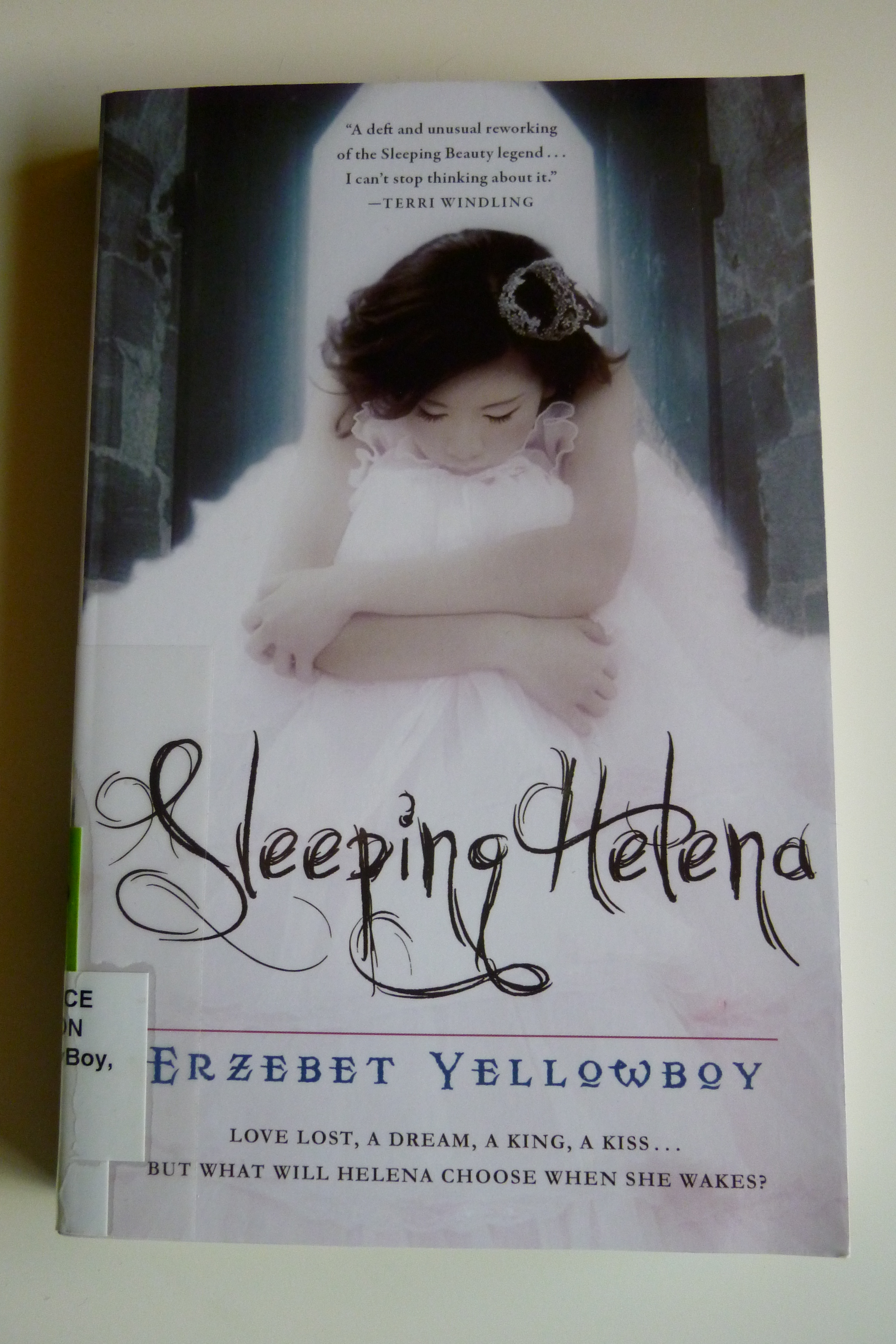
Helena has eight aunts, who all give her special gifts at her christening.  Six offer her well-meaning things like beauty and dancing ability.  One issues a complicated prophecy that seems to predict death.  And the eighth uses her gift to try to undo the curse.  Seven of the aunts raise Helena together, while desperately trying to protect her from the curse.  As the book goes on, we realize that the aunt who issued the curse, Katza, has more complicated motives than it seemed.  It’s all tied into the tragic death of their brother, a century before.

Yes, they have a brother who died a hundred years ago.  Everyone in the family is blessed (or cursed) with extraordinarily long life, which is the first place this starts to get odd.  It’s a little disconcerting when most of the characters are 105 or thereabouts.  Especially when they haven’t been given youth–they really are 105, and apparently feel that way.  I have nothing against elderly characters, but it makes it kind of hard to relate to.

It’s also rather depressing to think about seven sisters living together from childhood into old age, and if any of them ever got married or formed any meaningful attachments outside of their family group, we don’t hear about them.

The purpose of it is so that Helena’s sixteenth birthday can be exactly 100 years after Katza’s sixteenth birthday, which is also when their brother died tragically.  So you get Sleeping Beauty’s hundred years–but going back from the day the curse strikes, instead of forward.

Helena is the most interesting character, although more as a concept than as a person.  I love the way this examines what it would be like to have eight christening gifts.  Helena is so filled with her gifts, there’s no room in her personality for anything else (and they forgot to give her compassion or sympathy or kindness…)  She is utterly absorbed in herself and her gifts, which are constantly clamoring at her to be used–she wants always to dance, to sing, to admire her beauty, and so on.  In some ways, they seem more like curses than the curse.

This does take some interesting turns, and I particularly liked the flashbacks to Katza and her brother, Louis, when they were young.  I ended up disappointed by the ending, though.  I won’t give away the details, but essentially just when it was getting to something really interesting–it ended.

I have to come down somewhere in the middle on this one.  It wasn’t so bad that I’ll talk a friend out of buying it (The Frog Princessactually, she was going to buy one of the sequels and I convinced her it was a terrible idea) or so good that I’ll push it on friends (Robin McKinley–anything by her, really).  It was okay.  So if you have a particular fondness for Sleeping Beauty or some of the elements sound especially interesting, you could give it a try.

Author’s Site: http://www.erzebet.com/
The Man with the Dark Brown Eyes

Considering the mythology theme of this week, I thought it would be a good time to share a mythology retelling of my own.  In high school I took a mythology class, and for our final we had an in-class essay, retelling one of the myths we’d studied.  I can’t remember anymore if the teacher was expecting two paragraphs or two pages, but either way, I probably went overboard.  And then I spent the next several months stalking my teacher to get the copy of my writing back.  🙂  Once I did, I revised a little to end up with the story I’m sharing today.

I decided to retell the story of Jason and the Argonauts, from Medea’s point of view.  All my reading up until that point convinced me that Medea didn’t get nearly enough credit in that story.  Later mythology studies led me to realize that Medea’s point of view is better represented than I knew.  But it’s still true that she isn’t represented in the retellings for children, since I’d read a lot and been left with the impression that Medea was pretty well ignored.

But I won’t wax on about that.  There’s enough of that in the story.

*************************

            Maybe you’re familiar with the story of the Golden Fleece.  Maybe you know about the golden ram who carried off a boy and a girl to save them from their stepmother’s wrath, about how the girl slipped off and drowned and was never heard nor thought of again, about how the boy survived to land in far off Colchis.  Maybe you know that the ram was killed and its beautiful golden fleece hung up on display.  Maybe you know about Jason, who came to take over his rightful kingdom and was sent by the usurper king to obtain the Golden Fleece.  Maybe you know that Argos built the Argo and that Jason filled it with any number of great heroes—Heracles, Orpheus, Castor, Pollux, the list goes on—and calling themselves the Argonauts they set off over the sea, dealing with storms and sirens and sea monsters to finally land in Colchis.  And maybe you know that he did steal the Golden Fleece and go back home again.

But I bet you don’t know my side of the story.  And I bet you don’t know that Jason was a lazy, good-for-nothing, ungrateful lout who couldn’t steal sheep’s wool to save his life.

I am Medea, princess of Colchis, and this is how I tell the story.

Continue reading “The Man with the Dark Brown Eyes”

Persephone Today

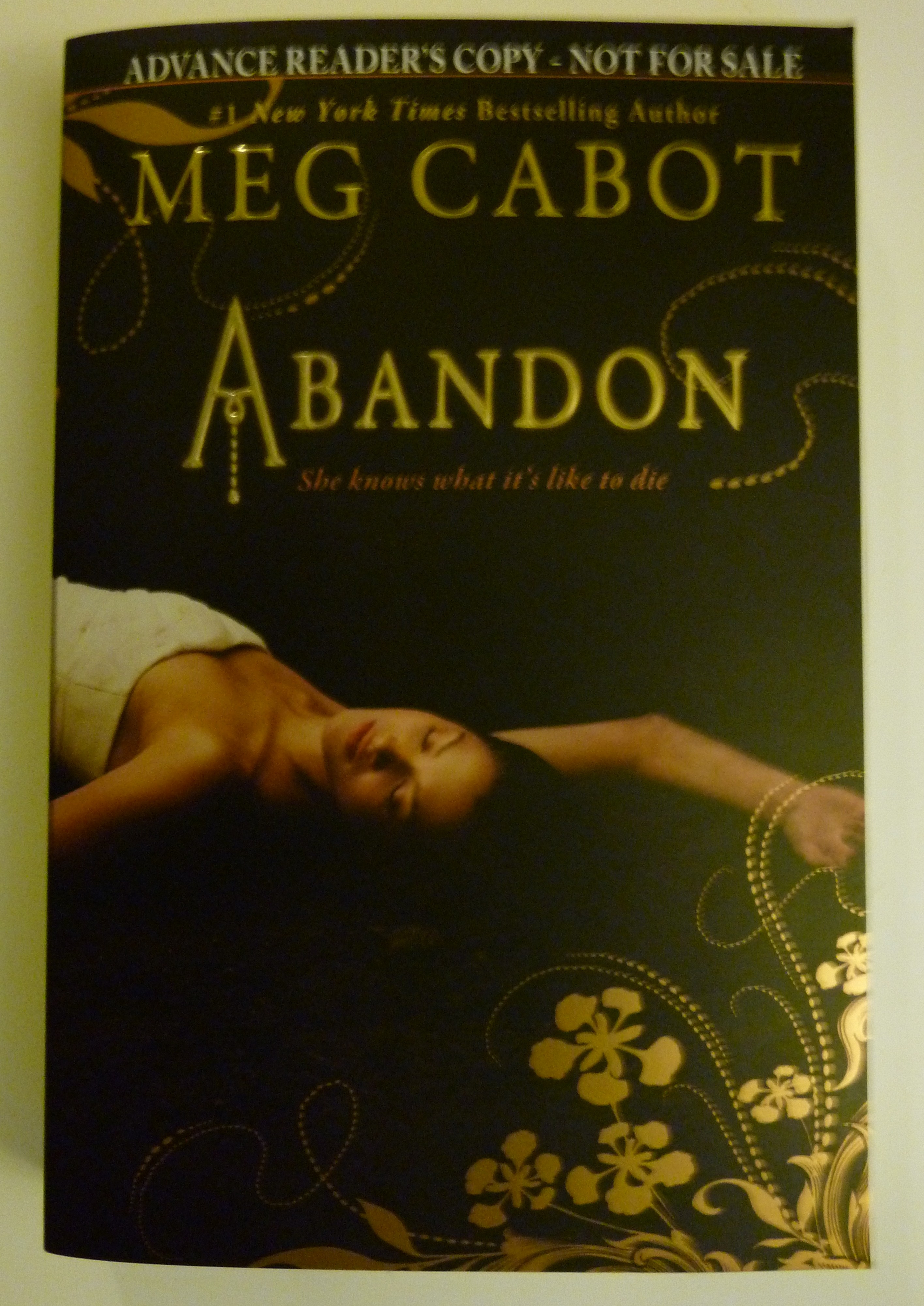
I seem to be on a mythology theme this week.  Heading back towards the Greek isles, in a way, after The Red Pyramid I read Abandon by Meg Cabot.

I’ve read a fair bit of Meg Cabot; she’s a good option when I feel like something light, fluffy and bubbly that I can read in a day or so.  Abandon turned out to be a very different Meg Cabot book.

Abandon is a retelling of the Hades and Persephone myth.  In case you don’t know it, Hades, the god of the dead and Lord of the Underworld, kidnapped Persephone, who if she isn’t the goddess of flowers (I can’t remember for sure) nevertheless gives that distinct impression.  Depending on the version, Persephone and Hades may or may not fall in love.  Ultimately, Persephone ends up dividing her time between the Underworld with Hades and being with her mother, the goddess of harvest, up on Earth.

Abandon retells this, loosely, in the present day.  The lead character, Pierce, is a teenager who had a near-death experience.  While she was dead, she met the Lord of the Underworld (who conveniently looks like an attractive 19-year-old man).  He isn’t Hades, but he has the same job.  He chooses Pierce to be his consort, but Pierce flees, the EMTs bring her back, and she tries to get on with her life.  Except that she’s convinced he is following her, hoping to bring her back to the Underworld.

The funny thing is, I very much enjoyed this while I was reading it.  Then afterwards I started thinking about all the flaws–well, the one big overarching flaw, really.  So I’m not sure where I come down on this one, except that I do feel sufficiently positive that I’ll probably try the sequel when it comes out.

I really like the concept of this, and the plot, though far-fetched in spots, is reasonably good.  It’s the characters that bring me to that big overarching flaw.

One character thing I do love–I love that the dark, brooding, fearsome and mysterious Lord of the Underworld is named John.  Not a dark, mysterious name–just John.  That’s fun.  And John is actually a decent character.  I like dark, brooding heroes with good hearts, so he at least has potential.  Although the more I think about it, the more I think I’m just assuming he has a good heart in there somewhere because it’s the only way this will work at all, not because there’s actually much evidence for it.

But John is all right.  The real problem, the big problem, is Pierce.  She’s one of those bland, underdeveloped heroines.  Other than an understandable obsession with death since her accident, and a concern for animals and other people, Pierce has almost no personality.

I made a possibly unfortunate comparison, and realized there’s a lot of similarity to Twilight–brooding, handsome, not-human hero falls obsessively in love with ordinary, undistinguished girl for no particularly compelling reason.  Edward thought Bella’s blood smelled good.  And John was totally blown away when Pierce asked how he was.

No, really!  She accidentally spooked his horse, he fell off, and she asked if he was all right.  Granted, he’s a death deity, who mostly deals with people who are dealing with the fact of their own recent demise, so he doesn’t get this sort of thing very often–but it doesn’t make her Mother Teresa!  Nor does it seem a reasonable basis for deciding that this is the person you want to–literally–spend eternity with.

Pierce does demonstrate caring for others at other times, but Cabot must have a poor opinion of humanity if she thinks it’s enough to mark Pierce out as an extraordinarily kind and giving person.  The times when Pierce does go over the top trying to help people, it’s either meddling, or totally stupid and ill-advised.

I think one reason this didn’t strike me much as I was reading is that the book went by so fast, I felt like I was still just starting when I was halfway through.  So it didn’t occur to me how undeveloped a character Pierce is until I got to the end–and she was still undeveloped.  It is part of a proposed series, so maybe she’ll get more depth in the next book…but she had an entire book, she could have gotten deeper here.

I do recommend Abandon–I enjoyed reading it–but don’t expect to find a new favorite character in the heroine.  Despite the similarity in how they met their heroes, Pierce is no Jane Eyre.

Author’s Site: http://www.megcabot.com/

Egyptian Mythology in the Present Day

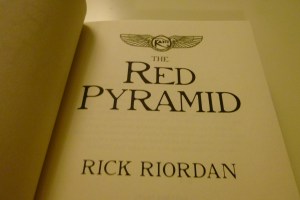
After enjoying the Percy Jackson books, I decided to try another Rick Riordan series, and read The Red Pyramid.  It’s basically the Egyptian Percy Jackson.  Which in a way is a good thing–I mean, I liked the Percy Jackson series.  And Riordan’s given us another book where ancient mythologies turn out to be true, the pantheon of gods is still hanging out in the current day, and ordinary-seeming kids have to discover their hidden powers to fight an ancient evil threatening to destroy the world.

All right, so it’s a formula.  But it’s a fairly unique and specific formula, at least the ancient mythologies part.  And, the most important thing for a formula–it works.

The Red Pyramid is about Carter Kane (who rather resembles Percy) and his sister Sadie (who really resembles hot-tempered and strong-willed Annabelle).  I may be oversimplifying in my character comparisons, and there are distinctions…but not broad sweeping ones.  Things go rather awry for Carter and Sadie when their father blows up the Rosetta Stone using Egyptian magic, and unleashes ancient gods into the world.  Carter and Sadie come to realize that they have magical powers they have to learn how to use, in order to fight the evil god Set, who has captured their father and is also planning to destroy all of North America.  Mostly because he can, I think–it’s all part of an ancient feud among the gods, and an even more ancient conflict between order and chaos.

It’s a good thing, by the way, that all these kids are around to deal with ancient evils, because apparently they’re all in the same fantasy world.  At one point Carter and Sadie are in Brooklyn, and a comment comes up about Manhattan.  The Egyptian magicians don’t get involved there, because Manhattan has other gods to deal with.  Love the reference, as the Percy Jackson books tell us that Mount Olympus is floating above the Empire State Building.

The mythology is the biggest way this differs from the Percy Jackson books, not only the gods themselves but the way the gods relate to the world.  The Greek gods are, to large extent, sort of like very ancient and very powerful humans, who interact with the world more or less like humans do–just in larger than life ways, and in ways that may involve monsters and destruction.

The Egyptian gods seem to lead a more metaphysically-complicated existence.  They mostly exist in a sort of dream world, and primarily access the physical world by possessing humans or objects, but preferably humans with the blood of the pharoahs.  Timelines and chains of events are also a little confused, as the gods apparently act out the same patterns and stories again and again over millenia.

The Egyptian way of engaging the world is certainly more complex, and fascinating in some ways.  But on the other hand–I like that Hermes uses a cell phone, that Poseidon hangs out on the beach, and that Aphrodite and Ares use the Tunnel of Love at the theme park.  The Egyptian gods are, mostly, less relatable, and I can’t decide if I like that or not.  I suppose it’s just different, and both ways have merits.

In the end I think I have to come down saying that I did prefer the Percy Jackson books, but that’s mostly for two reasons that I should elaborate on, because they may not be relevant for other people.

For one thing, I’ve always been a Greek and Roman mythology buff.  Maybe it’s a product of watching Hercules: The Legendary Journeys as a kid (a truly brilliant TV show, by the way).  When I was around twelve, I had run out of new Greek mythology books to read at my library.  The Egyptian gods, on the other hand, I’ve mostly had brief encounters with through friends who love Egypt, or in an occasional historical fiction book.  So when a Greek god shows up, my reaction is usually “oh, them, I know them, they had this story and that story and were the god of this, and it’s so cool how they’ve been portrayed!”  When an Egyptian god shows up, my reaction is more along the lines of “yeah, I guess I recognize your name…”  That skews my impression of the book, I’m sure.

Second thing: my favorite character in the Percy Jackson series is Grover, and there was no Grover equivalent here.  The funny baboon is, well, funny, and Bast as a supporting character is pretty great, especially when she exhibits cat-like tendencies.  But they’re still not as much fun as the ecology-obsessed satyr who loves eating burritos and tin cans.

So if you enjoyed Percy Jackson, and especially if you like Egyptian mythology, give The Red Pyramid a go.  It’s maybe a little darker and a little more complex, but pretty much…it’s an adventure about ordinary (except not) kids on a quest through ancient mythology to save the world.

To Talk Like a Pirate

Today is a very special day.  🙂  Today, Pirates of the Caribbean 4 premieres, so you can imagine where I’ll be tonight!

If someone had told me eight years ago that I’d one day be going to see the fourth adventure of Captain Jack Sparrow…I might have believed them!  Especially since Johnny Depp said, way back when, that he’d be in for Pirates 6 or 7.  And I’m right there with him.  In some ways, I’m an easy fan–put Johnny on the screen as Captain Jack, and I’m there.  Throw in mermaids and zombies and Blackbeard, and that just makes it better.

Considering the occasion, I naturally have to give you a POTC story for Fiction Friday.  I decided to go with a short story I wrote, almost eight years ago.  This is set midway through the first movie.  Jack and Will are on their way to Tortuga, to pick up a crew before going to rescue Will’s kidnapped ladylove, Elizabeth.  And along the way, they have a language lesson.

**************************

            Will realized, as he turned away from the railing of the ship, that Jack was staring at him.  He frowned.  “Something wrong, Jack?”

“Well…I’ve been thinkin’,” the pirate captain admitted.

Will felt a qualm of worry.  He hadn’t known Jack for long, but it had been long enough to know that when Jack started thinking, things started happening.  “What about?” he asked warily.

Continue reading “To Talk Like a Pirate”