The Other Side of the Wall

There’s something fascinating about the far side of walls.  Mandy by Julie Edwards (who’s also the actress Julie Andrews) is about what one girl finds on the other side of a wall.

Mandy is a ten-year-old orphan, who one day discovers a way through the wall at the back of the orphanage garden.  There’s a forested area on the other side of the wall, part of a large estate, and in the forest Mandy finds an abandoned cottage.  Mandy keeps the cottage a secret, and over the next several months sneaks out to it whenever she can.  She cleans the inside, plants the garden, and creates a special place for herself.  Eventually, because of the cottage, Mandy’s life is changed completely.

Mandy is a sweet character, and her story is a good one.  I think what always appealed to me most about this book, though, is the idea of the secret cottage in the woods.  I like cottages (although I read this book when I was very young, so I may like them in part because of it), and I so love the idea of the wonderful secret beyond the wall.

There’s something fascinating about doors in walls, about a valley hidden behind a hill, about open land on the other side of a creek or the country just beyond the next bend in the road.  It’s the hope that over there there will be a place that’s magical and wonderful and altogether different from over here.

One of Paul Simon’s songs has the line, “Everyone loves the sound of a train in the distance; everybody thinks it’s true.”  I don’t really know what he meant 🙂 but to me I think it’s talking about the same thing.  The train in the distance is going towards those magical lands over there, somewhere distant and exotic.

Of course, intellectually I know that if you actually go through the door or get on the train, 99 times out of 100 you won’t find anything very exciting, and over there will turn out a lot like over here.  But the feeling of the possibility persists.

And Mandy actually found something wonderful over there, and it’s wonderful to read about.

Chasing Ducklings

I’ve been getting very little writing done at the park lately.  I try to go over there every Saturday morning; on nice days I write by the pond, on nasty days I go into the library to write (there’s actually a library in the park–how cool is that?)  Lately, the weather has been nice–but the pond has been distracting.  You see, it’s duckling season.

I’ve been spending a fair amount of my writing time watching little fuzzy balls of fluff float around the pond.  I’ve identified two families with babies.  There’s a single mother duck who was chasing six children around on a recent Saturday, and two-parent family with a mere two off-spring.

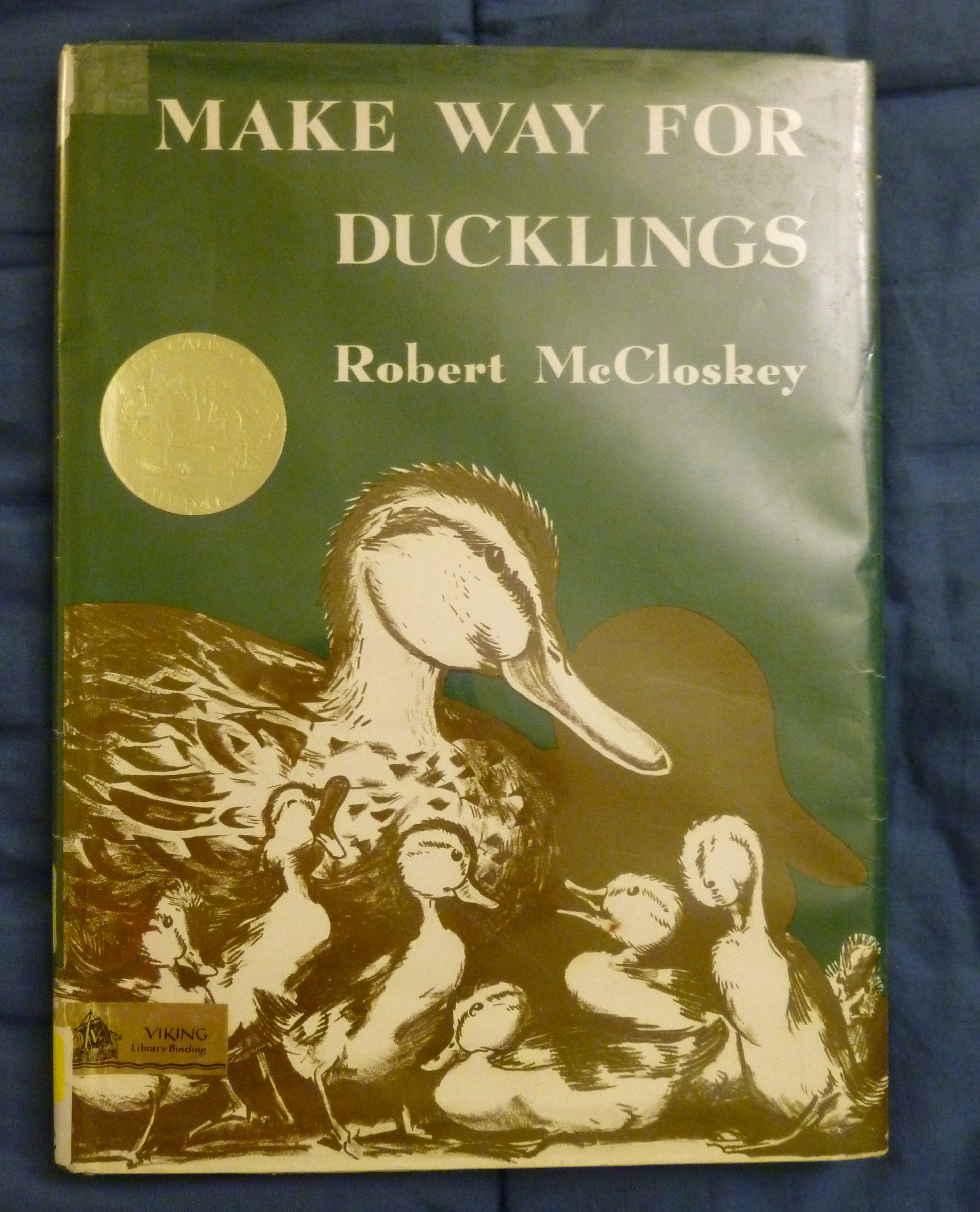
All of this duck-watching does in fact lead to a book review!  Because the duck-watching very naturally led me back to Make Way for Ducklings by Robert McCloskey.

I love the artwork of this book.  I think that’s really why I wanted to reread it, to look at the cute duckling drawings.  McCloskey’s ducklings have longer necks than mine (maybe they’re older?) but they’re just right for fuzziness.

Although I’ve yet to see the ducklings at my pond walk in a neat line like McCloskey’s.  Mama Duck seems to spend most of her time herding ducklings around.  They stray off in all directions, and every so often one realizes it’s gone too far away, panics, and has to be rescued.  They start cheeping, and sometimes they go shooting over the water back to the rest, while other times I’ve seen Mama Duck go after a strayed duckling.  It’s adorable to watch, but I think it would be exhausting to be a duck mother.

Back to Make Way for Ducklings.  I admit I was a little disappointed by the plotline.  I remembered the ducklings’ journey as a bit more epic.  Then I went back to the story to find it’s only a couple of blocks.

But it may be silly to discuss whether the plot of a picture book is sufficiently epic.  It was cute, and well-worth a visit just for the drawings.  If you know any ponds with ducks near you, you might want to visit them too–there could be ducklings to distract you too!

A Day for Bad Luck

Today happens to be Friday the Thirteenth.  So I can’t resist sharing a story I wrote several years ago about how my recurring character, Sam Jones, spent Friday the Thirteenth.  This is a scene from a long Star Trek serial I wrote.  The only context you need, aside from a slight knowledge of major characters from the original Star Trek, is that in a previous chapter Dr. McCoy adopted a black cat and named him Surak, after the Vulcan philosopher (on the theory that they both had black hair and pointed ears).

And, of course, it also helps to know that traditionally, terrible things always happen to the red-shirted security guards aboard Kirk’s Enterprise.

For more backstory on Jones in particular, check out the Richard Samuel Jones category of Fiction Friday posts.

One other note: Jones was always my red-shirt when I was writing Star Trek stories.  For this scene I also borrowed a friend’s red-shirt, Lt. Simmons.  Thanks to the wonders of the internet, I can send you over to her blog as a years-later thank-you for the loan.  🙂 So I don’t own Lt. Simmons, or Star Trek, or any other copyrighted material involved.  On to the story…

******************************

Simmons, deputy chief of security, had a problem.  He often had problems, to tell the truth.  Problems happened when your department lost a man or two every week or so.  But this was rather a different sort of problem.  And whenever someone had a different sort of problem, they tended to call up the captain.  No particular reason, simply because.  So Simmons contacted the bridge.

“Captain Kirk?  I have a slight problem,” Simmons said over the comm.

“Oh.”  Kirk considered.  On the emergency scale, ‘slight problems’ could rate anywhere from one to ten.  From Scotty, ‘slight problems’ could mean imminent warp core ejection.  Definitely a ten.  Tens rarely came from security though.  “What slight problem is that?”

“Well…one of our security guards, Ensign Jones, is refusing to report for duty.”

Continue reading “A Day for Bad Luck”

Stealing Words

After two people, unrelated to each other, both recommended The Book Thief by Markus Zusak, I decided I ought to give it a go.  I’m not sure what I expected.  Possibly Fahrenheit 451 meets The Sting, with a little Diary of Anne Frank.  And maybe even a touch of Terry Pratchett, considering Death is the narrator.

It really wasn’t any of those.  It was the story of Liesel Meminger, a German girl living outside of Munich during World War II.  The book opens with her younger brother’s death, and Liesel being passed over to foster parents by her mother.  The story follows Liesel’s bonding with her foster family, and with Rudy, a neighbor boy and her best friend.  It also follows as she learns to read.  She does steal books, but it’s not really the organized crime or defiance of Nazi book-burning that some of the plot summaries of this book suggest.  It is about the power of words, though, and how certain books come to define Liesel’s life.

I liked the The Book Thief, but it is an overwhelmingly bleak book.  The single word that most comes to mind is grim, especially in the later sections.  There are happy moments, sweet moments…maybe even one or two funny ones (though this is emphatically not Terry Pratchett, despite Death narrating).  And yet there’s such bleakness.  Poverty is set against a backdrop of oppression, with a lot of Heil Hitler-ing for good measure.

I thought of a funny moment–Death reflects at one point that if everybody starts in on “Heil Hitler” in a crowd, it would be really easy to cause injuries from the arm movements, if you happen to be standing in the wrong place.  He’s not sure if it’s happened–all he can say for certain is that it’s never killed anyone.

But despite that,  it’s a bleak book.  If this was a movie, I think it would have to be in black and white.  Or else use a trick Tim Burton likes, of making color movies that are gray and washed-out, as though the world is perpetually overcast.  Think of Sweeney Todd or Sleepy Hollow.

I enjoyed the characters, especially Liesel’s adoptive father; Rudy, the neighbor boy who becomes her best friend; and Max, the Jewish man who hides in Liesel’s family’s basement.  I was also impressed by the portrayal of Liesel’s adoptive mother, who grows a lot as a character.  I don’t think it’s that she grows as a person–I think it’s that we see new sides and depths to her as the book progresses, so that even though she started out seeming completely horrible, by the end I was kind of fond of her.

The Book Thief has apparently been classified as Young Adult sometimes and for adults at others.  I think it could be YA, but older YA.  It’s not so much for any particular moment as for all that bleakness, and some of the darker plot turns.  It has “adult themes,” I suppose.

But it is a very good and complex book.  Just be careful that you don’t read it when you’re already feeling down about the world!

Author’s site: http://www.randomhouse.com/features/markuszusak/

Revisiting Diana Wynne Jones

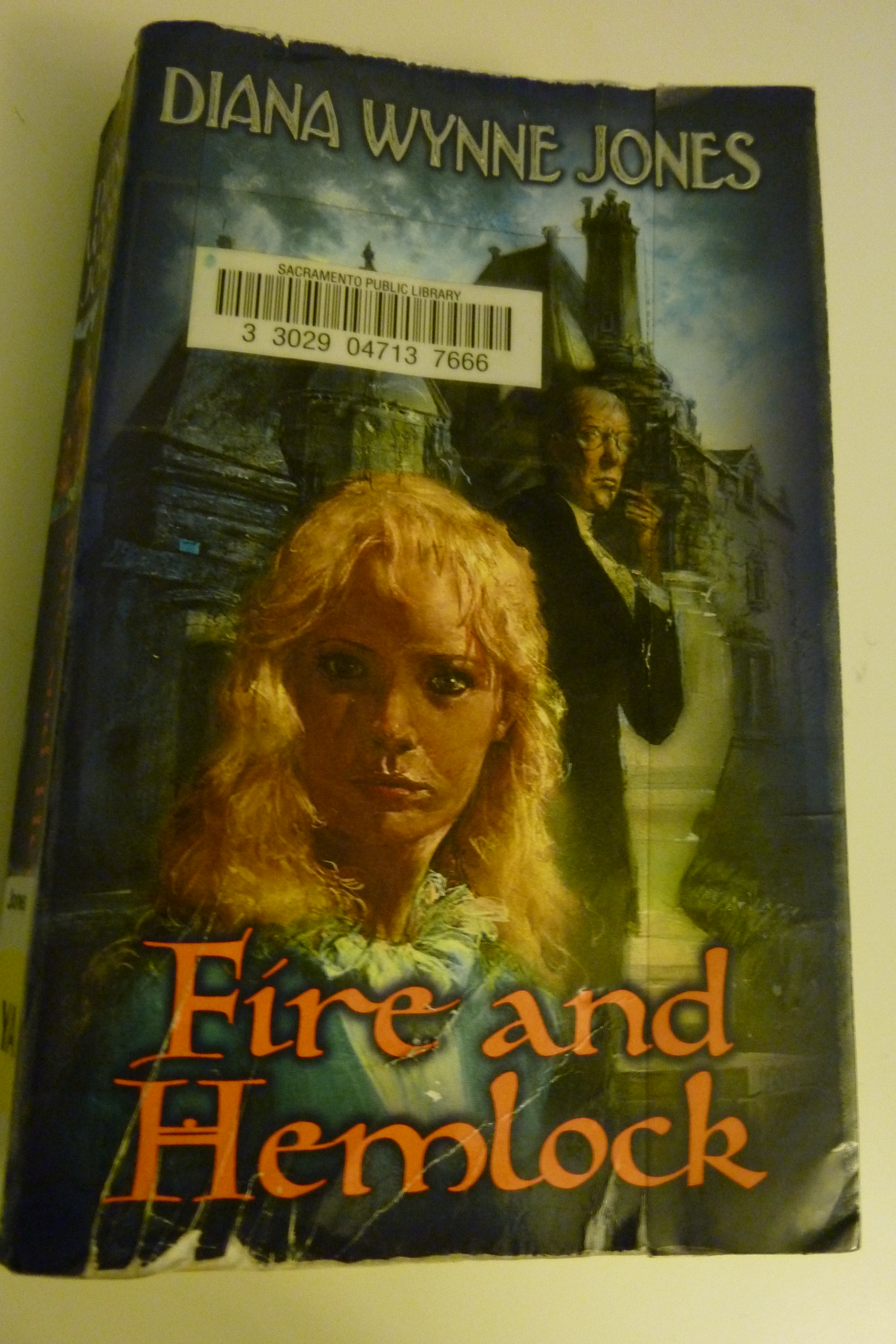
After Diana Wynne Jones’ death a few weeks ago, I–like many people–wanted to go back and read some of her work.  I decided to revisit Fire and Hemlock.  This was a reread, and I selected it in part because I had some trouble with it the first time around–but thought at the time that I might like it better on a second read.

This book is a bit difficult to describe without giving things away.  It begins with Polly, who is 19 and looking at a book of fantasy stories.  One of them, a story about a man with two sets of memories, triggers a series of hidden memories for her.  The book jumps back to when Polly was ten, and moves forward exploring these hidden memories.  They start when Polly gate-crashed a funeral at the mysterious Hunsdon House next door to her grandmother’s, and met Tom Lynn.

At this point I ought to describe Tom; this is also where I had trouble the first read-through.  Ten-year-old Polly views Tom as much, much older than her, and Diana aids and abets this impression for the reader.  I think he’s described as “stooped” at some point, he definitely is described as having an “elderly hairstyle,” and he’s a recently-divorced cello player.  None of this says “young man” to me.  The divorce alone would probably make me assume thirties at least, and everything else had me putting him as minimum mid-forties, and only the relatively young-sounding ex-wife would keep me from assuming he was much older.

I’m about to reveal what was probably supposed to be a twist–so I’m sorry for a spoiler, but it was a twist that thoroughly derailed me, and I would’ve done better had it been spoiled.  Hundreds of pages in, we find out that Polly as a child was a very poor judge of age, and Tom was much younger than she led us to believe.  This becomes important to the ending, which is why I had such trouble the first time.  This time I really tried to implant in my mental image the idea that he was young, to the point that I was mentally chanting “he’s twenty, he’s twenty” on occasion.  Later evidence in the book suggests he was probably early twenties.  So if you read this, keep that in mind–it might help.  And pay no attention to the cover, it has a horrible depiction of Tom.

Back to the plot.  Tom and Polly, despite their not-quite-as-big-as-I-thought age difference, become fast friends, making up stories about their alter ego selves who are heroes in training.  It all becomes more fantastical when the stories they make up begin to come true.  Meanwhile, the Leroys, who own Hunsdon House and include Tom’s ex-wife, have some kind of sinister hold on Tom, and continually warn Polly away.  Nineteen-year-old Polly has to solve the mystery, and determine what happened four years previously that changed, not only her memory, but apparently actual events.

I’m not really sure what kind of review this is.  Because I really enjoyed the book.  There’s so much in here that’s wonderful–characters, mystery, fantastic adventures, humor.  And yet…the end doesn’t quite pull together for me.  The basic mystery is cleared up, there’s essential resolution, but I feel like an extra twenty pages explaining what just happened would be very helpful.  I love Diana Wynne Jones’ books–love, love, love them–but every so often one of them is more convoluted and confusing than the others.

So I guess it’s a mixed review.  I recommend it…but if you try reading it, remember–he’s young!

Author’s Site: http://www.dianawynnejones.com/dwjflash.htm

And official fansite: http://www.leemac.freeserve.co.uk/