Writing Wednesday: French Influence by Way of Mr. Dickens

I didn’t read A Tale of Two Cities with the intention of researching for my Phantom novel, but it has turned out that way anyway.  Not a lot has been directly relevant, but it has added some definite shadings through reading the history.  The book is set about ninety years before my novel, but considering the French spent the intervening time having repeated revolutions and changes of government, it feels like it still has a lot of bearing for my characters’ experiences.

And there was one direct edit I made as a consequence of reading about the howling mobs depicted by Dickens.  The Phantom, you see, has a terror of falling into the hands of a mob, something mentioned in the very first scene told from his point of view.  After reading this book, I made some key edits.  Here’s the paragraph as it was before:

Any attack would be more complicated than a simple mob with pitchforks; France was a civilized country, but the result would be the same.  The end of a noose or even worse—a cage.  He was guilty of the crime of being different, the world had convicted him at birth, and he had ample precedent to suggest how they would sentence him.

And with edits:

Any attack would be more complicated than a raging mob with pikes; France was a civilized country, outside of her sporadic revolutions.  The result would be the same.  The guillotine or even worse—a cage.  He was guilty of the crime of being different, the world had convicted him at birth, and he had ample precedent to suggest how they would sentence him.

Small changes, but I feel good about them.  Also, weird historical note: I looked up the history of the guillotine to make sure it was still in use in 1881.  Turns out, it was France’s standard method of execution until 1981, when they ended capital punishment.  !!!  But maybe if I was French, that wouldn’t seem weird after all…
Mini-Monday: A Tale of Two Cities

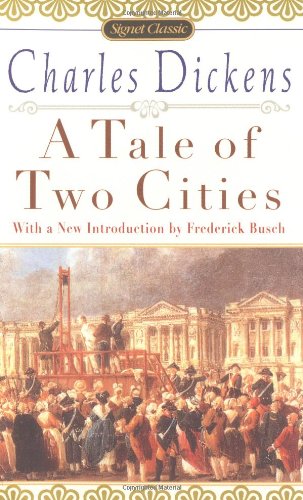
I am happy to report that I seem to have cracked the secret to a more satisfying relationship with Mr. Charles Dickens—audiobooks.  I’ve always wanted to like Mr. Dickens, the quintessential British author, but he’s always felt so slow.  I don’t exactly mean the pacing is slow, but somehow it has always taken me far longer to read one of his books than it seems like it should.  But due to a recent move my commute has expanded, and it seemed like the perfect time to make another attempt on Mr. Dickens.  And so far, a successful one!
At the time of writing this, I am almost done with A Tale of Two Cities, and feel confident enough to make a positive report.  I can still tell sometimes that Dickens was (or at least feels like he was) paid by the word—I knew “It was the best of times.  It was the worst of times” and heard it with a minor thrill, but no one ever told me he followed it with a dozen or so “it was this and it was that,” probably six more than needed!!  But an audiobook just keeps rolling along, and whatever was slowing me doesn’t seem to be in effect.

Two Cities does begin a bit slowly, but it picks up its speed, particularly once the French Revolution breaks, and becomes much more dramatic and exciting than I might have expected—but then, it is the French revolution.  This book really feels like a kind of melding of Charles Dickens and Victor Hugo, as so much reminds me of Les Miserables.  And there’s a scene of the mob sharpening their weapons to kill the prisoners that is stunningly vivid and terrifying.  I genuinely did not know Dickens had that in him!

I’m not quite to the famous last lines yet, and it adds some suspense to see if my guess on who says them is correct—so no spoilers, please!

So far, so good on the Dickens experiment.  It may be this book, but I hope it’s the audio, as I plan to try another one soon!

Blog Hop: A Blogger By Any Other Name

book-blogger-hop-finalToday’s Book Blogger Hop question is: Do you agree or disagree with this statement: A blogger’s first name should be in a prominent place on his/her blog.

I guess I must disagree, since my name is not particularly easy to find on my blog.  (It’s Cheryl, by the way.)  I guess I don’t see why it’s inherently important!  Some bloggers choose to blog anonymously for various reasons, which seems like a valid choice.  Some bloggers are building a brand, and in that case having your name, or easy links to the rest of the work you’re building/promoting is good marketing.  (This will become much better on my blog, once I do the redesign I’ve had in mind for, oh, two years or so…)

On one level it’s nice to know the person behind the review, but on another level, their name doesn’t matter that much.  There are a lot of people I know through the internet alone, who I think of by their username or blog name, even when I learned their “real” name somewhere.  I put “real” in quotation marks because…what we choose to call ourselves online is real, in a way, for the realm we’re blogging in.  So if you think of me as “Marvelous Tales” rather than Cheryl, that’s totally valid.  I probably think of you as “Bookish Reads” or whatever your blog or username is!

Do you like to know the “real” name of a blogger?  Do you think it should be prominently displayed?

Mini-Monday: Interpreting God and Translating the Bible

Another new feature I thought I’d explore–since I haven’t had time for long-form reviews, how about some brief updates on recent reads?  I’m still doing spiritual reading, and read a couple interesting ones in the last few weeks.

The God We Never Knew by Marcus Borg – I actually wanted to read Meeting Jesus Again for the First Time, recommended by Nadia Bolz-Weber, but this was the Borg book my library had.  And it was interesting!  The fundamental premise, as I took it, was that there are two ways to think about God: as a supernatural being out there somewhere, or as a transcendent spirit who is all around us.  The first concept has dominated to large extent, while Borg makes a compelling case for both the spiritual power and the Biblical basis of the second.
I found Borg to have a lot of interesting ideas, though he could get academic at times in his language.  He was less revelatory and more validating for me, but I come from a Franciscan tradition within Catholicism, and I feel like I’d already been exposed to a lot of these ideas.  He’s right that they’re not always mainstream, though, and I appreciated an eloquent exploration of them that, as I said, was validating.

**********

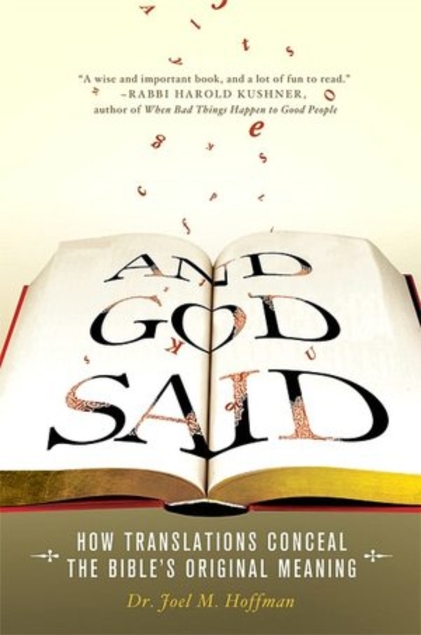
And God Said: How Translations Conceal the Bible’s Original Meaning by Dr. Joel M. Hoffman – I found this one on my library’s bookshelf and picked up on a whim, curious about that slightly provocative title.  Plus it was blurbed by Rabbi Harold Kushner.  Well, after reading, the good news seems to be that the title was an exaggeration.

Hoffman goes into extensive (sometimes too extensive) detail about how to achieve an accurate translation, with a lot of emphasis on looking at specific words as they’re used in context, and comparing multiple uses to build a full picture.  He spends the second half of the book looking at specific examples, most of which he says are dramatic mistranslations but…I don’t know, I didn’t think so!

I’ve always known (in the time I was thinking about Biblical interpretation, anyway), that the English Bible I’m reading is a translation of Ancient Hebrew or Greek, and (in the case of New Testament dialogue), the original writing was a translation of spoken Ancient Aramaic.  And it all contains cultural references of a people who lived a minimum of two-thousand years ago, in a different kind of society.  So yes, of course some nuances are going to be lost or unclear, and trying to uncover those original concepts is fascinating and enriches the interpretation.  But concluding that ancient Israelites thought shepherds were more heroic than we do today doesn’t really make “The Lord is my shepherd” a poor translation.

Most of his other points were similar, and some mattered a lot less.  So I walked away from it concluding that, based on the half-dozen examples from a scholar trying to find mistranslations, the Bible is actually translated pretty accurately!

******

Because I’m wordy, this was not all that mini after all…so I’ll call it done here! 🙂

Blog Hop: Congratulations?

book-blogger-hop-finalToday’s Book Blogger Hop question is: What’s your proudest blogging milestone or achievement?

Huh.  So I had to really, really think about this one.  Because I did not (do not) find it easy to point to something.  I don’t think (that I can recall) that I ever got into blogging with number goals (however many comments, readers, page views, etc).  I have been and am proud of some numbers I’ve hit in that regard.  They went on my resume, in fact, but putting them on my blog feels…sort of like sharing my salary?  It’s that kind of weirdness, because I don’t know how other blogs are “performing” and it feels weird to talk about it in numbers.  And those aren’t my proudest accomplishments anyway.

I started blogging to connect with other bloggers, have a place to share about the books I read, and promote my writing.  And I do all of those things, so success!  But they’re ongoing, hard to point to as accomplishments.

I think I’ve worked it out though.  Two accomplishments, sort of.  I’m proud that, when my first book was first out, I contacted a number of bloggers I knew online to ask if they’d help me promote my book.  That was nerve-wracking.  Was I pushy, or asking too much?  And of course they were all lovely, and I got to be on a number of other blogs.  But I’m proud that I asked, and proud that I had built the relationships where asking made sense.

The biggest accomplishment though, that I’m most proud of?  Just that this blog is here.  And it’s still here.  Even in the last few months, at my lowest posting frequency over the entire eight years I’ve been blogging, I feel like I’m still here.  And that’s what I’m proudest of.  That I started a blog to begin with, and that I have stayed on it all this time.

A long while back I read this New York Times article that said 95% of blogs are abandoned.  (That was in 2009, but it probably hasn’t changed.  I somehow must have found it a few years later, because I was blogging when I read it.)  I found this extremely validating.  Staying with a blog, that’s far and away not the norm.  It’s a real thing to do it.

So my proudest blogging accomplishment?  It’s blogging.