The Two Princesses of Bamarre

Two Princesses of BamarreMy (unintentional) theme for Once Upon a Time this year seems to be rereads of long-ago books I’ve largely forgotten…and today is another one, The Two Princesses of Bamarre by Gail Carson Levine.  Levine wrote the particularly excellent Ella Enchanted (review), and also has a wonderful blog with writing advice.

The two princesses of this title are Addie, who is afraid of everything, and Meryl, who dreams of adventure.  When Meryl falls fatally ill, Addie has to find her courage to set out adventuring in search of a cure.  Fighting ogres, spectres and a quite alarming dragon, and with some help from a very nice magician named Rhys, Addie learns more about her kingdom, and about herself.

The plot is somewhat episodic, and on the whole a pretty straight-forward quest.  The strengths of the book are more in the characters and the depiction of magic.  Bamarre is largely over-run by different magical threats, and there are some very interesting ways that magic is created.  Spectres might be the creepiest, as they can appear in anyone’s form.  Dragons are creepy in their own way, though, at least the one Addie meets–she genuinely loves her victims, keeping them around for company, and mourns them once they’re dead…but all the time considers it inevitable that at some point she’ll become angry and kill them.  Very odd!

Magicians are quite odd too, as they’re “born” when lightning strikes marble.  They seem to be mostly human though (and can even intermarry), except they have a tendency to float.  One of my favorite details may be when Rhys admits that he has trouble keeping his feet firmly planted, so he usually hovers a hairsbreadth above the ground.

Addie’s physical journey is pretty straight-forward (and occasionally a bit implausible) but her internal journey is more profound.  I think Levine portrays very nicely her growth and finding of her own strength, without losing who she was.

This was a fun and pretty quick reread.  If you haven’t read Ella Enchanted, read it–not because there’s any connection to this book but just because I think it’s Levine’s best.  But if you’ve already read Ella (seeing the movie does not count) and liked it, then Two Princesses is another good one as well.

Author’s site: http://gailcarsonlevine.com/

Other reviews:
Leaf’s Reviews
Escaping Reality (One Book at a Time)
Brightdreamer’s Book Reviews
The Book Vortex
Anyone else?

Buy it here: The Two Princesses of Bamarre

The House on Durrow Street

House on Durrow StreetIn another read for Once Upon a Time and my continuing efforts to finish series, I read The House on Durrow Street by Galen Beckett.  (Read my review of the first book, The Magicians and Mrs. Quent)  I loved revisiting the world of Invarel, and I feel like I’m fonder than ever of the characters.

This book kept up some of the style of Austen and Bronte, without adhering to their plotlines (as in the first book).  In fact, I didn’t feel like plot was a strong point of the book–but that was okay!  Rather than strong plot elements, it felt like we were just reading about the continuing lives of the characters, and though I feel like I should object, in actual fact I found it entirely satisfying.

Picking up not long after we saw them in the last book, we continue with the same three major characters, Ivy Quent, Mr. Rafferdy (who must have a first name, but I don’t remember it), and Eldyn Garrett.  Ivy is overseeing the refurbishment of her father’s house (on Durrow Street…) and enjoying whatever time she can snatch with her husband, when he isn’t busy with his work as an Inquirer.  Mr. Rafferdy is being dragged into responsibility by his father’s poor health, which has forced his son to take his place in Assembly (rather like the House of Lords), despite his best efforts to have no impact at all.  Eldyn is working as a clerk for the church, but finds himself continually drawn by the illusion plays–and by one of the actors.

Swirling around these more ordinary affairs are continuing magical mysteries, and hints of much bigger troubles afoot.  There’s political upheaval, growing revolts, and even the heavens are falling out of line, as the ever-reliable almanacs can no longer predict the length of day and night with accuracy.  The funny thing is, most of this seems to be going on in the background somewhere–the characters observe it or touch on it peripherally (and a little more directly, near the end) but usually it’s not the focus.

I felt like that should annoy me–but actually, I kind of enjoyed watching ordinary people carry on their relatively ordinary lives.  It felt wonderfully realistic somehow.  All that said, I probably will be bothered if some of these elements don’t become more central in the third book!

This book followed the same pattern as the first one, switching between viewpoints of the three major characters, with a slight variation.  This time Ivy alternated chapters with either of the two men, instead of cycling evenly through all three (most of the time).  I approved–I always liked Ivy’s chapters best.  I think it’s that Ivy is interesting whatever she’s doing, while Eldyn and Mr. Rafferdy are only interesting when they’re doing something interesting–which they did for most of the book.  That distinction was true in the first book, but may be less so now, as I think I grew increasingly attached to both of the men throughout this second book.

But I continue loving Ivy as a character, and enjoyed her relationship with Mr. Quent.  I wish he’d been more central!  They have moments together, but he spends a lot of the book off doing something else (which could make a great companion book…)  Considering the third book is titled The Master of Heathcrest Hall, I hope he’ll be more directly involved.  When they are together, it’s wonderful how much they obviously love and trust each other.  In fact, he’s so trusting that there are moments when I just have to wonder…is he really sure that he’s really that glad that she’s getting on so well with Mr. Rafferdy?  Really?

Mr. Rafferdy undergoes some very nice character growth here–he was already starting to find himself a bit in the last book, and he continues that process here.  Since he also continues to be in love with Ivy, I’m really wondering how that’s going to turn out for him…

Eldyn went through quite a bit of self-revelation as well, and I thought he was posed with some very interesting conflicting pulls.  It was a little disappointing in that I thought it ultimately worked out too neatly, by having circumstances make his choice much more clear than it had been (or might have continued to be).

I know I’ve come to this trilogy a bit late, but here’s where it pays off–because now I can go swiftly on to the next book instead of waiting for it!  I have several others I very much want to read too, so I won’t get to Book Three immediately…but it’s definitely on the short-list to be read soon.  I’ll let you know how it goes!

Author’s Site: http://wyrdwood.net/

Other reviews:
Fyrefly’s Book Blog
Stella Matutina
Fantasy Book Critic
Anyone else?

Buy it here: The House on Durrow Street

Princess of the Silver Woods

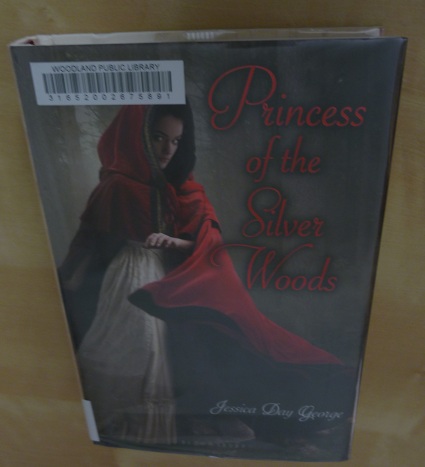
Princess of the Silver WoodsI recently reread Princess of the Midnight Ball by Jessica Day George (review), which turned out to be great preparation for reading the third book in the series, Princess of the Silver Woods.  Thank you, Lark, for letting me know it existed!

The first book retells the story of the Twelve Dancing Princesses.  There’s a second book, loosely retelling Cinderella, Princess of Glass (review).  As the cover makes clear, the third one draws from Little Red Riding Hood—if very loosely!  Fairy tale or not, this is definitely another good one for Once Upon a Time.

The third book focuses on Petunia, the youngest of the princesses, who starts the book traveling through the woods to visit an old friend from a neighboring royal court, the Grand Duchess Volenskaya.  Along the way, she runs afoul of bandits wearing wolf masks–particularly their leader, Oliver, who abducts Petunia more or less by accident.  She makes it eventually to the Grand Duchess’ and all should be well—except that she and her sisters have recently been plagued by particularly vivid nightmares, shadowy forms are lurking in the garden, and the Grand Duchess may have ties to their old enemy, the King Under Stone.

There are elements of Red Riding Hood here and there, but mostly this novel is a second confrontation with the King Under Stone and his macabre court.  This felt like a much more closely connected sequel than the second book, which was primarily a separate adventure.

I really enjoyed seeing the twelve sisters again.  George managed her deft juggling of many characters once again, and I didn’t feel troubled trying to sort out which princess was which.  As in the first book, it’s always self-evidently obvious—Jonquil must be the hysterical one, because she’s always collapsing whenever we see her.  Poppy (the lead of the second book) is obviously the bold one, because she’s always being bold.  It was nice seeing Galen again (who really is lovely), and I liked that we got a little more of Heinrich, who just barely shows up in the first one.  And I love that all the princesses’ have taken up knitting!

Petunia didn’t blow me away as a heroine, but she’s scrappy and likable, and I do enjoy when she starts ordering her demon-suitor around.  Oliver is a bit of a Robin Hood figure, a displaced earl who turned to banditry to feed his people.  Again, likable, if a little typical-hero-type.

The romance didn’t do much for me.  There was nothing wrong with it—it just didn’t feel like it added much to the adventure.  Petunia and Oliver have very few opportunities to interact, and while that was true for Rose and Galen too (Galen even makes a comparison at one point), somehow I felt the romance in the first one much more than I did here.  And I was a bit annoyed with Oliver when both Petunia (a girl he had barely met) and his men (who he had lived with and fought with all his life) were in mortal peril, and he seemed to find these concerns equally troubling, with a possible slight edge to Petunia.  Really?

But while the romance may have been a bit of a non-thing, the adventure was excellent.  The King Under Stone and his brothers are thoroughly creepy, and the fact that they were defeated once already doesn’t at all seem to lessen the threat.  George did a nice job of re-exploring familiar territory, while convincingly raising the stakes and the tension.

Overall, I’d say that Princess of the Midnight Ball was the stronger book, but this third one was good fun to read as well—and I enjoyed spending more time with the twelve princesses, and getting a little more of their story.  The first one can stand alone, but I’d recommend the next two as well.

Author’s Site: http://jessicadaygeorge.com/

Other reviews:
The Bookwyrm’s Hoard
Escaping Reality (One Book at a Time)
Tressa’s Wishful Endings
The Book Smugglers
Anyone else?

Buy it here: Princess of the Silver Woods

The Fantastic Mr. Fox, Written and Read by Roald Dahl

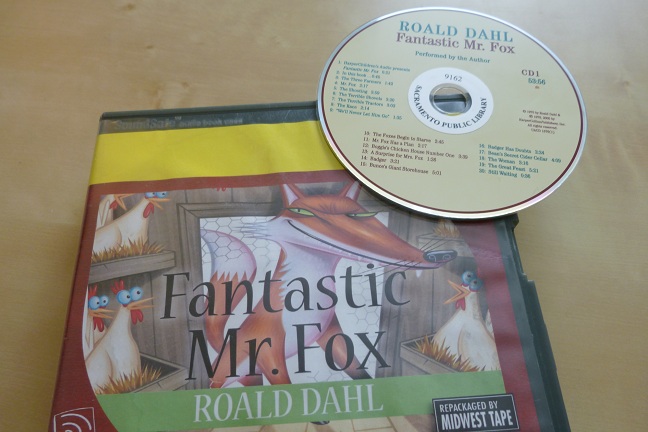
Fantastic Mr. FoxLast week, I found myself with a long drive coming up and no audiobooks on hand!  So I dropped by my library and impulsively picked up The Fantastic Mr. Fox, without realizing that it was actually read by Roald Dahl himself.  I’m calling a talking fox appropriate for Once Upon a Time too.  I had a good time listening–but also came to the conclusion that I’m just too old for this story.

I had seen the movie already (and by the way, great choice of casting with George Clooney as the voice of Mr. Fox) and found the book to be more or less the same storyline.  Boggis, Bunce and Bean are poultry farmers, and rather an unpleasant bunch.  Mr. Fox routinely steals from the three of them to feed his family, until Boggis, Bunce and Bean strike back, first with guns and then trying to dig or starve the Fox family out of their hole.

It’s an enjoyable, exciting story, with lots of Dahl’s flair for language and rhyme.  There are tense moments and humorous moments and a few gross moments, of the kind aimed at kids.  All in all, it is fun.  And I might have quite liked it if I had read it when I was younger and more willing to take matters at face-value.

But.  The trouble is, I can’t get behind Mr. Fox as a hero.  Because he is stealing from Boggis, Bunce and Bean.  Dahl tells us that they’re terrible people, but I don’t see much actual evidence of that.  Yes, they’re rather rude, unhygenic, and ruthless in hunting down the Fox family…but you can’t steal from someone just because they’re rude and don’t bathe often enough.  This isn’t Robin Hood stealing from the oppressive Sheriff of Nottingham.

Even the villains’ ruthlessness towards the foxes is an uncertain indicator, because it’s not quite clear what they understand about the foxes’ intelligence and level of civilization.  Using lethal force to defend property is going too far, but that’s when applied to humans.  Shepherds and farmers have defended crops and livestock from predators since time immemorial.  As an animal lover, I’d rather they let the animals live, but I can’t say they’re evil if they take extreme measures.

So while I’m supposed to be cheering on crafty Mr. Fox, I never could quite avoid seeing Boggis, Bunce and Bean as honest (if unpleasant) businessmen taking necessary steps to defend their livelihoods from a persistent and unrepentant thief.

The situation is made worse because at one point Badger asks Mr. Fox if the stealing bothers him.  Mr. Fox jumps on something of a soapbox about how he’s only trying to keep his family from starving (because they’re under seige at this point) and after all, Boggis, Bunce and Bean want to kill him and he doesn’t want to do any such thing to them, so stealing is comparatively minor.  Which is all well and good except he’s ignoring the larger cause and effect.  He didn’t start stealing because they were hunting him.  They started hunting him because he was stealing.

I should note that I do like the occasional roguish hero–Captain Jack Sparrow is one of my all-time favorite characters.  But Mr. Fox does not have the charm of a Captain Jack, or the noble ideals of a Robin Hood, and at the end of the day…he was just not that fantastic.

But the audiobook only took an hour of my life (while driving), and it was well worth the time just to satisfy my curiosity about the book.  And I did enjoy listening–even if it had some issues!

The best part, though, was that the book was read by Roald Dahl.  And somehow, he just sounded the way I would expect Roald Dahl to sound. 🙂

Author’s Site: http://www.roalddahl.com/

Other reviews:
Tor.com
Reading to Know
Strange and Random Happenstance
Anyone else?

Buy it here: Fantastic Mr. Fox (CD)

Good Omens from Terry Pratchett and Neil Gaiman

Good OmensTerry Pratchett is the funniest of authors and Neil Gaiman seems to be one of the coolest of people, so I’ve no idea why I didn’t read their co-authored Good Omens long ago…but I finally have, and it was wonderful!  And right on time for Once Upon a Time.

I realized after I opened the first page that I had almost no idea what this one was actually about.  Because, I mean, Pratchett and Gaiman–who cares what the plot is?  But in case you’re curious (and to add coherence to the rest of this review), I’ll give you an overview.

The book centers in large part around Crowley and Aziraphale, a demon and an angel, respectively, though the two have more in common than you might think.  Both have been on Earth for the past 6,000 years and have developed a solid working relationship in the process.  When the Antichrist is born, heralding the end of the world in eleven years, Crowley and Aziraphale both realize that they find Earth far more interesting than either Heaven or Hell, and set about to prevent the end of the world.

Meanwhile, the Four Horsemen of the Apocalypse are gathering, the last of the Army of Witchhunters is vigorously and ineptly pursuing his calling, and Anathema Device (witch) is following dictates set down by her ancestor in the Book, The Nice and Accurate Prophecies of Agnes Nutter, Witch.  And the Antichrist turns out to be a very nice young man.

The plot doesn’t even begin to do justice to the madness and hilarity of this book.  I don’t think there’s any way to discuss it very coherently, so perhaps a few representative examples…  Every cassette tape left in Crowley’s car for more than a week or so turns into something by Queen.  The Four Horsemen ride to the Apocalypse on motor bikes, accompanied by four more conventional Hell’s Angels, arguing about what horrible thing they want to be (including “People Covered in Fish,” for instance).  When the Antichrist (whose name, by the way, is Adam) starts latching onto some wild, part New Age, part urban legend concepts that he doesn’t quite understand, Atlantis rises and Tibetan monks start popping up out of holes everywhere.

The book is incredibly clever too.  Take the Four Horsemen–Famine goes around spreading his particular evil through fad diets and nutritionless fast food.  Pollution has replaced Pestilence, after penicillin was invented and Pestilence retired in a huff.  War makes a living first as an arms dealer and then as a war correspondent–who always gets to places just before war breaks out.  And Death, well…he’s not quite as funny as the Discworld Death, but he does speak in ALL CAPITAL LETTERS.

This book is all the more remarkable for being about a battle between angels and demons, drawing heavily from the Book of Revelations and occasionally Genesis, and pulls it off without being proselytizing or judgmental.  I wouldn’t recommend this as a source for theology, but it’s never offensive either–and I’m a practicing Catholic who found The Da Vinci Code deeply bothersome (for a number of reasons, scholarship as much as anything).

I could keep rambling on about this, but just take my word for it–it’s hilarious.  If you like either of these authors or think you might, then read it.  I mean, there’s a book-loving angel, a demon who “did not so much fall as saunter vaguely downwards,” a whole lot of footnotes, and Death.  And according to Wikipedia, once upon a time someone thought about casting Johnny Depp as Crowley, and now I so want to see that movie made!

Authors’ Sites: http://terrypratchettbooks.com/ and http://neilgaiman.com/

Other reviews:
Charley R’s Leaning Tower of Plot
Amidst the Meadow of Mind
Books, Writing, Tea
Death, Books and Tea (trend?)
Anyone else?

Buy it here: Good Omens: The Nice and Accurate Prophecies of Agnes Nutter, Witch