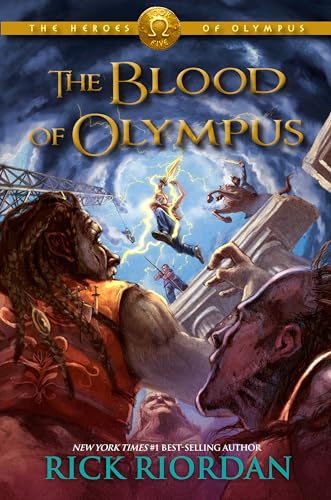
Book Review: The Blood of Olympus (Heroes of Olympus series)

I finished out my read of Rick Riordan’s Heroes of Olympus series just before the end of the year with The Blood of Olympus, fifth and final book. It was dramatic and exciting and a good conclusion to the series…if not quite everything I might have hoped for.

The waking of Gaea, the terrifying Mother Earth, has been drawing closer and closer throughout the series and now is only days away. Most of our (several) heroes are aboard the flying Argo II, heading towards the Parthenon, site of Gaea’s waking, fighting monsters and questing for the ingredients of the Physician’s Cure along the way. Meanwhile, the motley band of Reyna (Roman praetor), Nico (antisocial son of Hades) and Coach Hedge (war-mongering satyr) are trying to deliver a giant, ancient statue of Athena to Camp Half-Blood in time to prevent a war between the Greek and Roman demigods.

Everything that was here was good, and my biggest disappointment was what wasn’t here. Namely, anything from Percy or Annabeth’s point of view, because they’re my favorites. I actually flipped through when I was somewhere near the beginning to see what the POVs were going to be—and it turns out to be Jason, Piper, Nico, Reyna and Leo. To be fair, Percy and Annabeth got a lot of play in the last three books, especially 2 and 4, and there is a certain appropriateness to returning to Jason, Piper and Leo in the final book, when they were the focus of book 1…but I like Percy and Annabeth. And don’t get me wrong, they are here…but not the primary focus this time around. Continue reading “Book Review: The Blood of Olympus (Heroes of Olympus series)”

Classic Review: Enchantress from the Stars

Since I’m branching out from my usual fantasy into science fiction for NaNoWriMo this year, it seems appropriate to revisit one of my favorite books that exist at the perfect intersection between the two genres…

*******
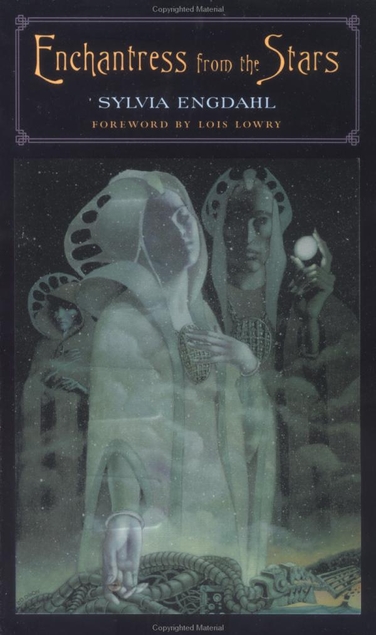
Science Fiction and Fantasy get lumped together all the time, in discussions, in “Best of” lists, in the bookstore.  But you rarely see them together in a single novel.  Enchantress from the Stars by Sylvia Engdahl is a brilliantly-devised story that could be in Earth’s distant past–or even more distant future.

The story is told by Elana, who belongs to a society far advanced beyond present-day Earth.  She is part of a Federation of many planets, joined together in peaceful cooperation.  They study less advanced worlds, but have a strict non-interference policy, believing that it’s best for cultures to develop without knowing about more advanced races.

(For the Star Trek fans–I know, I know.  All I can tell you is that this was written in 1971, but feels less like Star Trek when you’re actually reading it.)

Elana is training to be one of the scientists who studies Youngling worlds when she stows away on a mission to Andrecia.  Andrecia’s native people are at roughly a Middle Ages level of development.  Their future is threatened by colonists from another world–the Imperials have developed space travel, but have not yet achieved the level of Elana’s people, either technologically or culturally.  The Federation team’s mission is to induce the Imperials to leave, without harming either race’s culture.

Elana ends up taking on the role of Enchantress, to relate to the Andrecians in a way they can comprehend–she especially connects with one, Georyn.  She teaches him magic spells (combinations of technology and telekinesis), so that he can go fight the dragon (the Imperials’ digging machine).  The hope is that if an Andrecian uses powers the Imperials can’t understand, they’ll be convinced to give up their colony.

The brilliance of the story is that it’s told from three very different points of view–Elana, from her advanced, enlightened perspective; Georyn, who tells a Brothers Grimm-style story about a beautiful Enchantress, a dragon served by terrifying demons, and magical spells; and Jarel, an Imperial who questions what his government is doing but doesn’t know how to act–and is probably the closest to all of us who are reading.

The three perspectives are intertwined and so different, yet work so well together.  It’s emphasized, in Elana’s sections, that Georyn’s perspective on events isn’t wrong either–he simply has a different understanding, a different way of viewing what’s happening.  In some ways, he proves to be the most intelligent and the most insightful of any of the characters.

Elana is very interesting too, because we see her as the uncertain, often naive girl she is on the mission; as the strong and wise enchantress Georyn sees her as; and as the more mature voice telling the story after it’s all over.  Her character growth, throughout the story and from the after-perspective, is very excellently done.

This is a good adventure with compelling characters, and it’s ultimately a very hopeful story.  Engdahl is careful to place Andrecia, Elana’s home world, and the Imperials’ home planet all in the position of third from their stars.  It notes in the introduction that any of them could be Earth–this could be a story about our past, or a story about our future.  Ultimately, I don’t think it matters.  We’re all of them.  The hopeful part is that the book makes it clear that Georyn’s people, and Jarel’s, and us, can all learn and grow and eventually reach the wisdom of Elana’s people.

In that way I guess it is like Star Trek, as a vision of a hopeful future.  But if you want to take this as science fiction, as fantasy, as philosophy, or even as something with some of the same elements as Star Trek, it’s worth reading–it’s a wonderful book.

Author’s Site: http://www.sylviaengdahl.com/index.htm

Other reviews:
Book Snatch
Jenna St. Hilaire
Yours?  Let me know!
Book Review: A String in the Harp

A String in the Harp by Nancy Bond was a rare case where I bought a book unread—unheard of, in fact, before finding it on the shelf. But it was at my library’s warehouse sale, and either I got it in a brown bag with a lot of other books, or I bought it for a dollar—I can’t remember anymore—so I was willing to risk it. The Newbery Honor medal and the Welsh setting seemed like good signs. And happily, it turned out to be well-worth the price!
The story is about an American family spending a year in Wales. Coping with their mother’s recent death, all three children—15 year old Jen, 10 year old Peter and 8 year old Becky—are all grieving in their own ways. Their father has retreated into his work, and Peter in particular is withdrawing from the family, angry and rebellious and fiercely hating this cold country his father took them to. Then Peter finds an ancient harp key, and through it begins to have visions of the ancient bard Taliesen, exploring Welsh history through his life. It’s not immediately clear whether this magic will draw Peter back towards his family, or only farther away.

This book had me engaged at the first glimpse of Wales—and the odd part is, I have no idea why! I’ve never been to Wales (apart from one train ride to and from the Doctor Who Experience, which doesn’t really count), I’ve never been especially interested in Wales, and the characters, initially, hate the place! And yet somehow, I immediately felt an incredible wistfulness for Wales. Continue reading “Book Review: A String in the Harp”

Book Review: Tom’s Midnight Garden

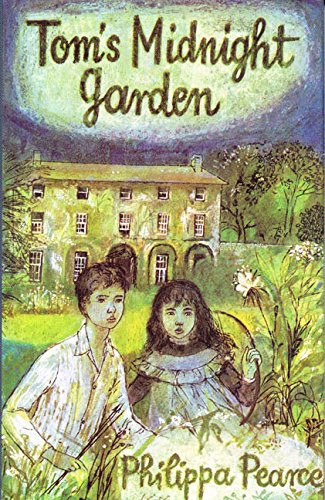
After reading the time-travel Four Seasons of Lucy McKenzie, it made me want to go back to reread a very similar, classic time-travel story, Tom’s Midnight Garden by Philippa Pierce.  And maybe it’s just because I read it when I was a kid, or maybe it’s the style, but I found it to be delightful.
The story begins when Tom is sent away for the summer to his aunt and uncle’s house because his brother has the measles.  Tom misses his brother and hates his exile…until one night he hears the old grandfather clock downstairs striking thirteen.  Venturing downstairs and out the back door, Tom finds a wonderful garden, not at all like the dingy yard and crowded subdivision he knows surrounds his relatives’ house.  He visits the garden every night, where time seems to run differently and it’s always summer.  There he makes friends with a little girl named Hatty, and they explore the garden together.

This is in some ways a quiet book–there’s no big conflict, no huge obstacles to overcome, and no particular plot even.  It’s just a story about a boy who finds–and then fears losing–a magical place, and makes a dear friend along the way.  But the whole book is so whimsical and light and charming that I didn’t mind at all that there was nothing bigger at stake. Continue reading “Book Review: Tom’s Midnight Garden”

Book Reviews: My Unfair Godmother and The Four Seasons of Lucy McKenzie

Every so often I read a book that I don’t have quite enough to say about for a review…so today you’re getting a twofer with two mini-reviews!

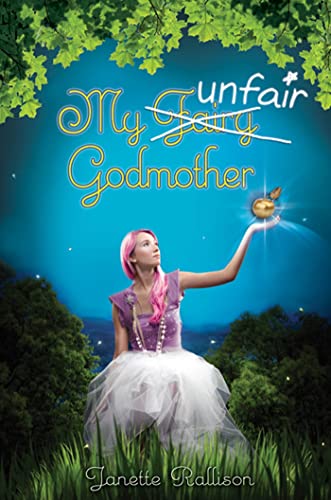
My Unfair Godmother by Janette Rallison

This is a decent book that I would have liked better if I hadn’t been expecting something completely different from what I actually got. I saw the cover and title, read the plot description and thought: story about an inept (and sparkly) fairy godmother? I’m so in!

Turned out the fairy godmother was really more of a supporting character…part of her ineptness is that she’s never around to help, leaving Tansy to deal with the fallout of her wishes on her own. So really the story here is about a teenage girl coping with accidentally bringing Robin Hood and his Merry Men (more bandits than heroes) into her small town, and then with accidentally transporting herself and her family into a medieval-era Rumpelstiltskin tale. While fighting with her father, and crushing on her brother’s attractive but disapproving friend.

All of that is reasonably entertaining, but not what I was expecting! And this turned out not to be as much my type of book as I was hoping. Even though this is a fantasy, Tansy is very much a modern, real-world teenager. I have nothing against actual real-world teenagers, but there’s a certain type of book-teenager…shallow, self-absorbed, fighting with her parents and having trouble balancing priorities (say, a fight with her boyfriend vs. stopping a government conspiracy…though that’s a different book). Tansy is not by any means the worst of this type I’ve seen—she’s fairly likable on the whole—but there was still a flavor of that type in here.

There was a fair bit of whimsy and humor here too, and the inevitable romance had some nice moments. It was all a rather light froth of a book, which can be fun…although I did wish there was a bit more depth on at least one point. Tansy has some very real issues with her father, which is explored in the first few pages and made me feel sympathetic towards her…but then that never really got resolved. Storming a castle together as a family is not the same thing as having a serious heart-to-heart about how it felt when Tansy’s parents got divorced and her father moved out of the state. A demonstration of love doesn’t simply erase emotional damage.

So don’t look for a lot of depth here, and don’t look for a story about a fairy godmother (all indications to the contrary), but it’s not a bad frothy modern fantasy…with a side-trip into medieval England.  And incidentally, this turned out to be a sequel (to My Fair Godmother) which I haven’t read, but it didn’t seem to matter for following the story.

Author’s Site: http://janetterallison.com/

Other reviews:
Story Snoops
Literature Purgatory
These Paper Hearts
Anyone else?

Buy it here: My Unfair Godmother

Lucy McKenzieThe Four Seasons of Lucy McKenzie by Kirsty Murray

This was another book I liked, but not as much as I hoped too—which may be a product of reading too many time-travel books, or just of liking a different kind of time-travel.

Lucy has to spend the Christmas holiday (in Australia, so it’s summer) with her Great-Aunt Big, in a ramshackle farmhouse in a secluded valley. The dining room has gorgeous murals of the valley—one season on each wall. And at night, Lucy finds that she can walk into the paintings, to meet April and her family living in the valley.

This is a sweet story about family, and Lucy grows in confidence throughout the book in a nice way. It’s fun to read the Australian setting too, with the blistering hot January Lucy travels into for summer.

So my reservations? It was abundantly obvious to me on paragraph one who April was…but I’ve read a lot of time travel stories, so I tried to be cool with that. And Lucy figures it out (relatively) quickly. My other issue is that I like dynamic time travel (actions in the past can change the present) and this was distinctly fixed time travel (the present can’t change and everything done in the past only creates the present as it already was). Fixed time travel just feels a little pointless to me because…nothing can be changed! Especially when Aunt Big’s life is a bit sad in the present. Lucy ends up understanding more by the end, but not enough for the understanding alone to be entirely satisfying to me as a reason for the time travel.

However. All of that is pretty darn subjective, so you might not be bothered by those things at all. And even with those issues, this was a nice book, a very fast read, and ultimately there was an upbeat ending too.  And I do love the idea of walking through paintings…such a cool concept.

Author’s Site: http://kirstymurray.com/

Other reviews (from people who loved this!):
Charlotte’s Library
The Bookbag
First Impressions
Anyone else?

Buy it here: The Four Seasons of Lucy McKenzie