Cinderella, As Told By the Kitchen Boy

File:Happilyneverafter1 large.gifDo you remember that Last Unicorn review a while back?  Well, when I watched the movie, the DVD also featured a trailer for Happily N’ever After—and for a rarity, a DVD trailer actually inspired me to watch something!  HNA had actually been in my Netflix queue for quite a long while, but finally seeing the trailer convinced me to actually order the disk…and it was as fun as the trailer promised.

An animated movie from Lionsgate, it reminds me a bit of Once Upon a Time mashed up with Tangled.  In a magic land where every fairy tale is playing out, Cinderella’s wicked stepmother gets control of the magic, and of the scales that control the happy or sad endings.  Pretty soon everything is going awry for Ella, who hopes that the Prince can save the day for her.  Unfortunately, what she doesn’t realize is that the Prince is unbelievably dense (and constantly consults a book to tell him the proper action to take).  Fortunately, Ella also has a friend named Rick, dishwasher and all-around flunky at the palace—and quite reminiscent of Eugene in Tangled.

This is not a deep movie, but it’s a lot of fun, from the cute Rick to the incredibly funny prince.  There are also representatives from several fairy tales, like the seven dwarfs.  I always enjoy twists on fairy tales, especially when ordinary people get to be heroic.  Rick is a great every-man hero, and the prince is hysterically funny in his earnest efforts (and failures) to do the heroic thing.

I also love that Rick is a long-time friend of Ella, who has been harboring a long-time crush–rather than having her love interest be a guy she danced with once.  The romance on Ella’s side comes together rather neatly, but I’m willing to assume she always had feelings for Rick, and she just hadn’t quite put it together.

One piece of advice, if you get the DVD, watch the alternate ending–it ties things up a bit more, and I think I liked it better than the actual ending.

https://i0.wp.com/upload.wikimedia.org/wikipedia/en/0/03/Happily_N%27Ever_After_2_-_Snow_White_Another_Bite_at_the_Apple_Coverart.pngAfter enjoying Happily N’Ever After, I went on to the sequel.  Unfortunately, as often happens with direct-to-video animated sequels, it doesn’t live up to the original–both in depth and in how downhill the animation goes.  Almost entirely new characters, this one focuses on Snow White, an irresponsible teenager who has to learn about kindness and true beauty when her father’s horrible fiancee starts creating trouble.  This has a nice message, which comes across as simplistic in the extreme.  It probably would be fine for a younger audience, but it didn’t strike me as likely to transcend and be fun for adults too.

Part of the issue is that the movie takes on a different tone, trying to bring in more modernity to the fairy tale world.  I was enjoying the idea of Snow White as a party-loving, make-up-using teenager for about two minutes…until she uses a magic cell phone to call her girlfriends, who answer with “Holla!”  And then continue saying it every third sentence…

On the plus side, there’s one really nice moment with Snow’s love interest, Sir Peter, who seems to be a genuinely compassionate, intelligent, interesting character (except that he looks disconcertingly like Rick!)  He actually rejects Snow White at a party when he realizes how shallow she is, and asks a different girl to dance.  Cartoons talk about beauty-within all the time, while making sure their kind-hearted heroines are also beautiful and have gorgeous dresses.  It was good to see a hero who really took a stand on the subject.

If you’re a fairy tale fan, the first Happily N’Ever After is a fun and clever movie.  The second one, you can probably give a pass!

Classic Review: The Bagthorpe Saga

I’ve been looking back at old favorites in rereads lately.  Today I thought I’d share an early review of one of my favorite series, The Bagthorpe Saga by Helen Cresswell.  These are among the zaniest, most hilarious of books…

***************

Some of my favorite characters live inside of Ordinary Jack by Helen Cresswell.  Ordinary Jack is Book One of the Bagthorpe Saga.  The Bagthorpes are a family of geniuses, each with a precise number of “strings to their bows.”  That is, a number of talents (and each one can quote how many he/she has).  That’s true for all except Jack, who is ordinary, and politely disdained because of it.  Jack is complaining about the situation to his Uncle (by marriage) Parker one day, who hits on a scheme to convince the rest of the family that Jack is in fact a gifted psychic who can see visions and predict the future.  Chaos ensues.

Jack and Uncle Parker are a fairly rational pair, who will chart you through the madness of the rest of this cast of truly hilarious characters.  There’s Mr. Bagthorpe, a TV writer who loudly and frequently complains that everyone is disrupting the delicate vibrations he needs to write.  There’s Grandmother, who cheerfully starts an argument with everyone, and is in years-long mourning for her beloved pet cat Thomas, who everyone else remembers as the worst-tempered animal who ever lived.  There’s Uncle Parker’s daughter Daisy, who is four years old and likes to write on walls and set fire to things, often with literally explosive results.  There’s one scene involving a birthday party and a box of fireworks hidden beneath the table…  Daisy’s mother, Celia, is a poet and far too ephemeral and dreamy for this world, who feels Daisy’s spirit shouldn’t be restrained.  For reasons Jack never quite understands, Uncle Parker is madly in love with her.

That’s only a sampling.  They are all people I would never want to know in real life, and would definitely never want to let into my house (especially Daisy!) but they’re enormous fun to read about.

There are ten books in the series, taking the Bagthorpes through adventures including television fame, a haunted house, and more than a few explosions.  The later books do vary in quality somewhat–they’re all fun, but at some point Cresswell stops having plots and just starts throwing the characters together and letting them react off of each other, and some of the results are better than others.  But the first few are excellent and all are enjoyable.

And Ordinary Jack is worth the read if only for the scene about the birthday party and the fireworks!

Other reviews:
A Tapestry of Words
Letters from a Hill Farm
Anyone else?

Buy it here: Ordinary Jack: Being the First Part of The Bagthorpe Saga

The Ogre Downstairs by Diana Wynne Jones

Ogre DownstairsI’ve checked another one off my list of Diana Wynne Jones “to be read” – The Ogre Downstairs.  It’s a romp of a fantasy in the old style, about kids trying to cope with magical adventures gone awry.

Caspar, Johnny and Gwinny are not at all happy with their two new stepbrothers, Douglas and Malcolm, and even less happy with their new stepfather, invariably referred to as the Ogre.  The two sets of kids are forced to band together when two chemistry sets arrive, with rows of mysterious chemicals that cause unexpected results–from enabling flight to causing people to switch bodies to bringing inanimate objects (like toffee bars!) to life.

I feel like I’ve read many books (from Edward Eager to Edith Nesbit) about kids dealing with magical chaos, but it’s one of those tropes that doesn’t get old.  These kids felt like archetypal fantasy children, good kids with some flaws.  None emerged really strongly for me, but all five are distinct and effective within the story.  They go through some nice growth as well, particularly in their understanding towards each other.

The magic is highly amusing and entertaining, with a grand variety of mishaps.  The living, growing (and breeding) toffee bars are my favorite.

There’s a lot that’s good here, and the book is overall very fun.  But I did have a big problem–and that was with the Ogre.  (Spoilers here, you have been warned…)  Throughout the book, the Ogre is loud, angry, ominous and forbidding, apparently with no liking or understanding at all for children.  But then occasionally, for no clear reason, he’ll do something nice (like gifting them with the chemistry sets).  This made me suspect that DWJ intended to reform him by the end–and she does.  Although, it’s less about his change than about the kids changing their understanding of him.  Even with the hints along the way…it just didn’t work for me.

The trouble is, the hints felt less like signs of a complex character, and made him feel more inconsistent than layered.  The bigger trouble is that, though the kids ultimately decide he’s not really so bad–he is.  He doesn’t just yell–he’s nasty, mean and genuinely hurtful.  That would be bad enough, but at one point he gets angry enough to hit two of the boys.  The scene is off-stage, so it’s not clear if “hitting” means a mild clout, a serious beating or something in between.  All we do hear is “Johnny found out he had been right to postpone being hit by the Ogre.  It was an exceedingly unpleasant experience.”  And then Malcolm is ill for the next day.  After that, you can’t convince me that the Ogre’s “bark was so much worse than his bite” (a direct quote).

For the record, I really, really like characters with gruff exteriors and hearts of gold.  And I like happy endings, even improbably neat ones.  But this…just did not work for me.  I feel like the ultimate message was, “be understanding of the verbally and physically abusive stepfather and maybe he’s not really so bad.”  That may be putting it harshly, but I feel it’s a valid interpretation!

It’s really too bad, because 80% of this book is a delightful fantasy.  But then the conclusion of the last couple of chapters leaves me feeling rather troubled.  I tell myself it’s from a different time, and standards on child-rearing were different, and it’s true that if this was an Edith Nesbit book from the early 1900s I’d give it a pass…but was 1974 really that long ago?

I don’t know if I recommend this one or not.  It’s complicated.  But I know some of you are Diana Wynne Jones fans, so I’m very curious on whether you’ve read this one–and what you think!

Author’s Site: http://www.dianawynnejones.com/

Other reviews:
Dead Houseplants
Caroline Williams’ Blog
Readers By Night
Swan Tower
Forgotten Classics
Anyone else?

Buy it here: The Ogre Downstairs

Catherine, Called Birdy by Karen Cushman

Catherine Called BirdyIs Catherine, Called Birdy by Karen Cushman a classic, or did I just pick that impression up somewhere?  If it’s not a classic, it should be!

I read this as a kid, probably more than once, and recently revisited it again.  It’s the fictional journal of Catherine, the daughter of a minor lord in Medieval England, who, as she writes, utterly loathes her life.  More specifically, she hates the restrictions society places on her, and most especially hates the idea of being sold in marriage.

Catherine is a delightful, strong-minded character who brings her world vividly to life.  This isn’t pretty, clean historical fiction, more like the modern world in costumes.  Catherine’s world is Medieval, complete with strange food, ghastly hygiene, fleas, a privy and old-style curses (like “God’s thumbs!”)  Catherine visits a monastery, sees a hanging and attends a wedding, giving us a good tour of the time period without feeling like a history lesson.

Catherine is obviously the strongest character, but we meet many others.  There’s Catherine’s barbarian-like father and refined mother.  There’s Perkin, a goatherd who dreams of being a scholar; Aerin, Catherine’s independent-minded friend; and a crowd of successive suitors.  Catherine grows over the course of the book, and much of the growth has to do with realizing that the people around her are far more complex than she had supposed.

The depth of the book and the characters is especially impressive because the novel really is written like a journal.  Most of Catherine’s entries are only a paragraph or two long, and actually sound like something a person could sit down and write about her life.  Many “journals” end up having a level of detail, with extensive description and long exchanges of dialogue, that no one could ever remember and write about her life.  I usually suspend disbelief in that area, but it’s nice to read one that really feels like a journal, and tells a complex, engaging story at the same time.

If you enjoy realistic historical fiction and strong heroines, this book is a great one to explore.  It’s a fun story with a very memorable heroine, and it’s cured me forever of any desire to live in the Middle Ages!

Author’s Site: http://www.karencushman.com/

Other reviews:
Girl with Her Head in a Book
Scattered Pages
A Certain Slant of Light
Anyone else?

Buy it here: Catherine, Called Birdy

Journeys Through Oz

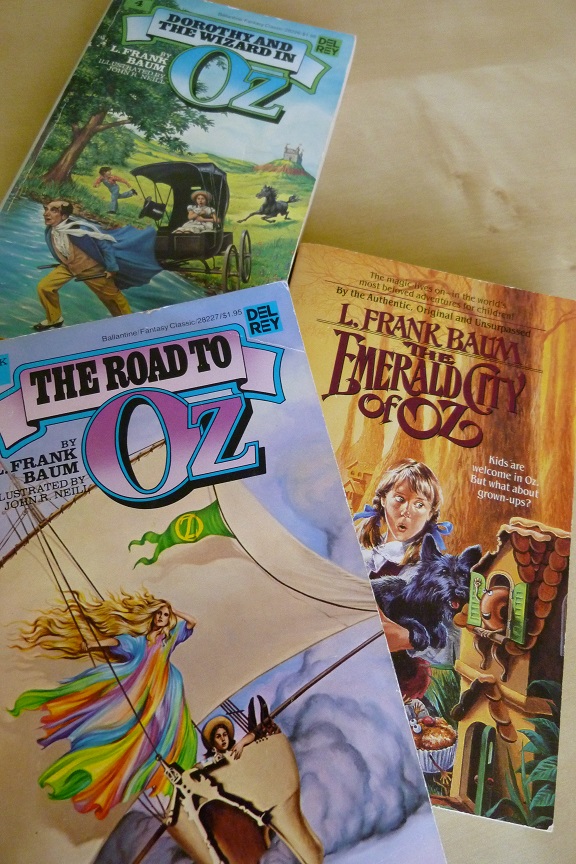
Oz Books 4-6I’ve been pursuing a slow reread of L. Frank Baum’s Oz series, and have found that they can be nicely divided into groups.  Earlier, I reviewed the first three books in the series, or as I like to call them, the Welcome to Oz Trilogy.  Today I’m looking at the next three, what I call the Aimless Journeys Trilogy.

*********

Dorothy and the Wizard in Oz is Book Four.  This one marks the return of the Wizard, who had been absent since he flew away in a balloon in Book One.  The story opens with an earthquake in California, which sends Dorothy plummeting down through a crack in the earth.  She arrives in an underground country, and is soon joined by the Wizard, who came falling down by the same method.  Dorothy, the Wizard and a few friends join together to travel through different countries underground, meeting strange and usually threatening people along the way, hoping to get back to the surface.  Spoiler: They eventually do, by a severe act of deus ex machina.

You probably already see why I’ve titled this trilogy as I have.  While there is loosely a quest to get back to the surface, the characters are basically wandering through magical countries with no particular purpose.  The things they encounter are charming and interesting, and I do love how absolutely anything can be possible, but the book overall suffers from a lack of plot to drive the events forward.

*********

Book Five is The Road to Oz, in which Dorothy and the Shaggy Man set out on a path in Kansas, and find themselves inexplicably on a road through a magical country instead.  Along the way they meet Polychrome, the daughter of the rainbow, and Button Bright, a little boy perpetually getting lost.  As you probably can guess, the rest of the book is devoted to traveling through interesting locales and meeting strange people.  The goal here is even less compelling than in the previous one–they’re hoping to get to Oz for Princess Ozma’s birthday party.

I don’t remember having any trouble with the idea as a kid, but as an adult, it’s hard not to feel that this is THE most meaningless of quests.

The positive side to this book is the characters, as both the Shaggy Man and Polychrome go on to be regulars, and Polychrome in particular is a delight.

*********

The Emerald City of Oz comes next, and is slightly more complicated.  It opens with a beautiful touch of realism and genuine threat.  Aunt Em and Uncle Henry are going to lose their Kansas farm; it was so expensive rebuilding after Dorothy’s tornado carried away the house that they had to get a mortgage and now can’t pay off the debts.  This problem is, of course, swiftly solved by the entire family decamping to Oz.  I do love that in the books, unlike the movie, not only was Oz NOT a dream, eventually Aunt Em and Uncle Henry move there to stay too.

After the family comes to the Emerald City, Ozma decides to send them off on a trip to explore some little-visited parts of Oz, bringing us back to the format of an aimless journey.  Meanwhile, in another narrative strand, the wicked Nome King is plotting to conquer Oz.  Unfortunately, this turns into a series of expeditions to recruit different fierce creatures to join his army.

Like the previous two books, the journey features lots of interesting sights and people (my favorite is a town inhabited by people made of puzzle pieces) but it also loses drive.

This is also not a good book for Ozma.  Again, I never noticed this as a kid–but as an adult, Ozma is troubling.  She has a tendency to direct everyone else’s lives for them (because she always knows best…) and she is good and pure and sweet to the point of insanity.  An army is marching on Oz intending to destroy everything and enslave everyone, and Ozma’s plan is, I quote “I will speak to them pleasantly, and perhaps they won’t be so very bad after all.”  Ahem.

The innocence of Oz is a good bit of its charm, but now and then Baum goes a little too far…

*********

These books have interesting characters and magic, but with the absence of a real plot or any notable character growth, these are not some of the stronger offerings in the series.  I think Baum was genuinely struggling at this point; he didn’t want to keep writing Oz (and he tries to do away with it forever at the end of Book Six) but the public demanded it.

Baum must have made some kind of peace with the situation, because he gets his stride back in the later Oz books.  Journeying through strange locales stays a common feature, but he manages to put it into better plotlines, and comes up with some particular vivid pieces of magic.  I’m still working my way through the series, but I remember some favorites in the later volumes!

I would recommend these three, with reservations.  A young reader might be less bothered by the lack of plot (and engaged by the magic).  More discerning readers (of any age) would probably enjoy any one of these…but I don’t recommend all three in a row!

Other reviews:
Bookmarked Pages (Book 4 and Book 5)
Story Carnivores (Book 4, Book 5 and Book 6)
The Fandom Post (Book 6)
Anyone else?

Buy them here: Dorothy and the Wizard in Oz, The Road to Oz, The Emerald City of Oz