Making Music for Dragons

I’ve been thinking about favorite books I haven’t yet reviewed to see if I’m missing anyone important–and I thought of Pern.  The Pern books are Anne McCaffrey’s epic dragon series, and if you’re a fan of science fiction or fantasy, you probably know them.

Pern is a distant planet where survival is complicated by Threads, strange burning filaments that fall from the skies at intervals, consuming anything they touch.  Pern is protected by dragons and their riders, who burn Threads from the skies before they can touch the ground.

There are a large number of books within the Pern series, some more or less connected to each other, spanning a couple thousand years of Pern history.  My particular favorites are the Harper Hall Trilogy–and don’t worry, you don’t have to know the entire complex history of Pern to read them!  The Harper Hall Trilogy focuses mainly on Menolly, a girl living in a small fishing village.  She dreams of making music, but in her conservative village, girls aren’t supposed to become harpers.

Harpers are the musicians, teachers and historians of Pern.  The society relies mainly on oral history, and harpers write and teach the music that records Pern’s history and stories.  Every village (or hold) has a harper to teach the children and provide musical entertainment.  The harpers train at the Harper Hall, a sort of musical boarding school and university.

Menolly, forbidden to write music but unable to resist, runs away–and discovers fire lizards.  Fire lizards are like miniature dragons, and wouldn’t it be incredible to have a miniature dragon for a pet?  Menolly’s adventures with music, dragons and surviving are exciting for the first volume.  The second volume takes Menolly to the Harper Hall, to meet a new cast of excellent characters and to see more of Pern.  The third book focuses on Menolly’s friend Piemur, who has his own adventures.  I have to admit I found them less engaging than the first two books, but still good.

One of my favorite parts of the Pern books is the complex society McCaffrey has created.  Dragons and Harpers are just one part of it.  Everyone has their own place, as Lord Holders or craftsman or runners.  Pern has fairly minimal technology, perhaps on a level with the Middle Ages, but they have skilled craftsmen and their own methods of keeping society functioning–and it all seems to work!

The other books in the series are mostly targeting an older audience, so while the Harper Hall Trilogy could be in the kids’ section, the others are at least YA.  I like a lot of the chronologically-early Pern books.  In the later books in the series, Pern rediscovers its history as a very far-flung Earth colony, and begins to rediscover their lost technology.  Frankly, I think it was a mistake, because complex, fascinating Pern begins to increasingly resemble Earth–which is just not as interesting to read about.

But the Harper Hall Trilogy is wonderful.  And if you don’t want a pet dragon now, you will by the end!
Fables and Fairy Tales

Quest #2 of the Once Upon a Time Challenge was the trickiest.  This one required reading at least one book in each of the four categories–fantasy, fairy tales, mythology and fables.  The first two more or less fell into my lap, because I read those all the time, Rick Riordan took care of mythology for me, and that just left fables.  Fables was a genuine challenge.

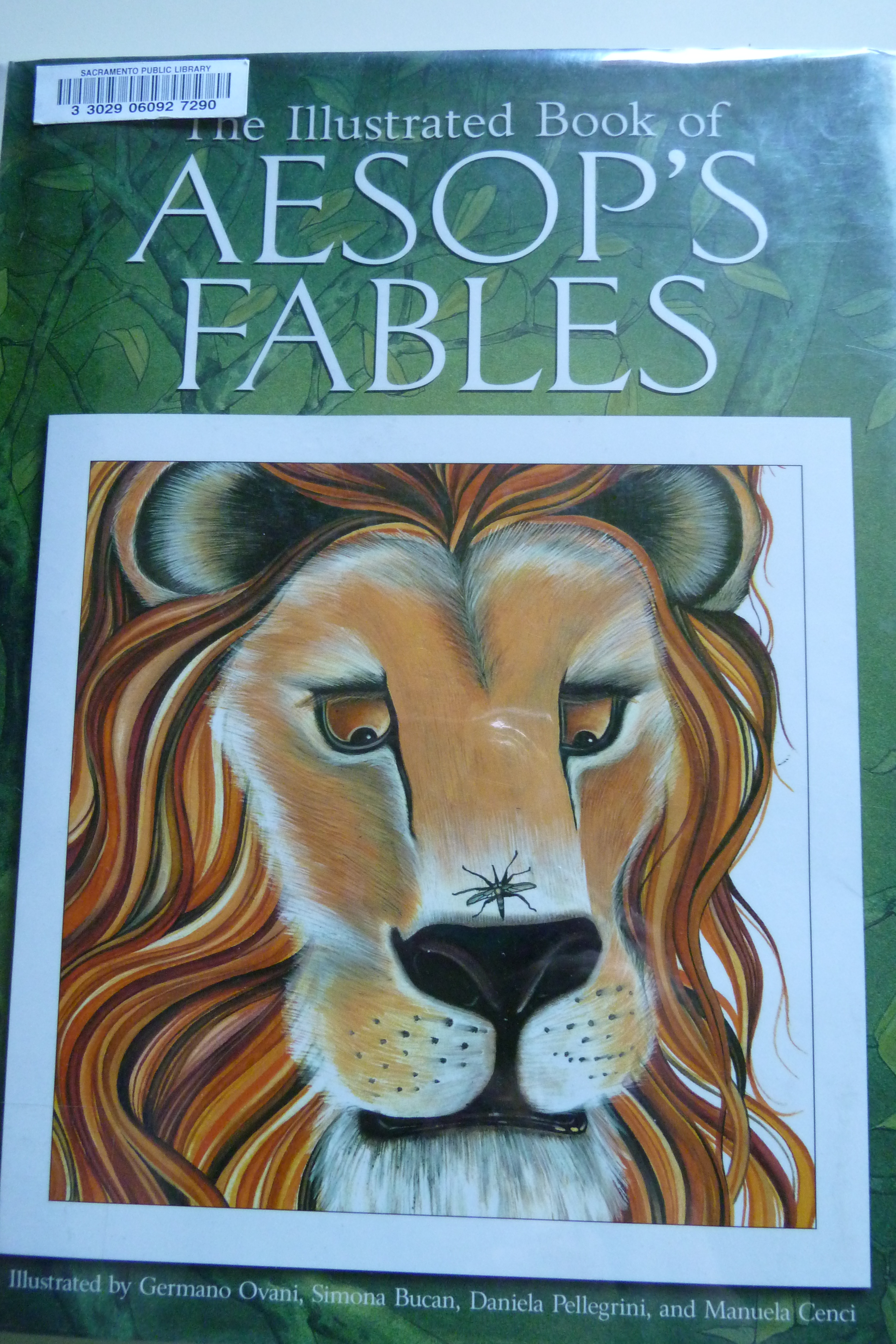
I don’t think I had a firm grasp on what would be defined as a fable, which left me somewhat at sea for finding a retelling or novelized version of one.  So I decided to simplify and pick up a book that had the category right there in the name–and read a collection of Aesop’s Fables.

I’m not nearly as familiar with Aesop as I am with Grimm or Perrault or Anderson.  And I don’t think I liked the stories as well either.  Maybe it was partially the particular collection I read, but Aesop seemed much more about teaching a moral–every story was focused on some lesson about what you should or shouldn’t do.  I like stories to have a moral, but I like it to be woven into an entertaining narrative, rather than becoming the primary focus.

Fairy tales sometimes have lessons too, but they’re usually more subtle, sometimes more complex–and sometimes more questionable too.  But then, I agreed with some of Aesop’s stories, and disagreed with others.

My sense now is that fables are more likely to be about animals or natural forces, focus on ordinary people, and have that aforementioned moral.  Fairy tales, on the other hand, often involve royalty, feature splashier magic like fairies and dragons, and are less obvious about teaching anything.  Which doesn’t explain at all why the graphic novel series Fables is called that, when they’re really more based on fairy tales, but oh well…

I suppose I could actually do some research and look up the difference between the two–but where’s the fun in that?  I’d kind of rather hunt my own conclusions based on what I’ve read.

In this collection, I only recognized one fable: the lion who spared a mouse, which later rescued him in turn.  Maybe there’s a reason that one has filtered into the culture more than others–it was my favorite!

The Once Upon a Time Challenge ends today, so I’ll be posting an update on what I read tomorrow!

Belle and the Beast

One of the “Once Upon a Time Challenge” Quests involves watching fantasy or fairy tale-based movies.  So today we’re going to take a side-trip into Cinema-land.

I decided to revisit a favorite fairy tale, and watched Disney’s Beauty and the Beast.  I haven’t watched it in a long time–not since I got serious about finding the originals of the fairy tales.  Disney’s Beauty and the Beast is pretty far distant from Jean-Marie LePrince de Beaumont’s version–but I like the way they tell it.  Disney’s was the first version I ever saw/read so I’m sure that slants my view, but I do think they manage some clever revisions of elements of the original.

I like the handling of the rose.  Threatening to kill someone because they picked your flowers is, um, unstable behavior.  But that’s pretty much how it goes in the original.  Having the Beast freak out because it’s a special, magical rose tied into his curse is far more reasonable.  I also like it that the Beast locks up Belle’s father for staring at him, rather than messing with the garden.  Sure, it’s a huge over-reaction either way, but if he has to over-react about something, it makes so much more sense that he’d be overly sensitive about people looking at him funny.

I can’t decide how I feel about Belle finding the castle and volunteering to stay, rather than the Beast demanding that Maurice send a daughter to take his place.  On the one hand, I’m sure the goal was to reduce the Beast’s villainy.  But on the other hand, at least in the original he was taking a proactive step towards breaking the spell.  He needs a girl, so he tries to get a girl.  Not in the best possible way, but at least he was making an effort instead of just moping around.

It’s kind of too bad that Belle lost all her siblings who were in the original, but my guess is that was to make space for other supporting characters, so it was probably worth it.  Lumiere and Cogsworth are really wonderful, and Gaston is a brilliant addition too.

Gaston, besides adding extra comic relief, is a great idea because it gives the story a villain.  In the original, Beauty’s sisters are pretty nasty, and I think a case could be made for the enchantress as the villain, but nothing is clear-cut.

Gaston’s main contribution, I think, is all in the last couple scenes.  First, bringing the mob adds great extra tension, as well as being a fantastic example of mob mentality.  It just needs one charismatic leader and everyone else is swept along (you see the same thing in Disney’s Hunchback, only more so; that crowd makes hairpin turns about three times).  I also love the way the mob demonstrates fear of the Other.  The line “we don’t like what we don’t understand; in fact, it scares us, and this monster is mysterious at least” says it all.

Gaston’s most important purpose, though, is that his presence means there’s someone to kill the Beast.  In the original we have this disturbing bit where the Beast tells Beauty she can leave if she wants to but it’ll kill him, and then when she goes, he tries to starve himself to death.  That’s seriously manipulative and unhealthy.  It’s so much better to have it play out with the Beast sad that she left but not dying–until he’s stabbed by Gaston.

There’s just one thing I don’t understand in this movie.  The spell has to be broken by the Beast’s 21st birthday?  Lumiere tells us, “ten years we’ve been rusting.”  So…this encounter with the enchantress happened when the Beast/Prince was eleven?  Isn’t turning a bratty kid into a monster kind of an over-reaction?  Okay, he was nasty to her, but show a little maturity!  And it doesn’t seem to me that the Beast learned anything much about seeing past appearances.  Belle did that (and as a reward, she gets to marry someone handsome…?) but the Beast went and fell for a beautiful girl, so what’s proved?

But aside from a few of the weirdnesses that often crop up in fairy tales, it’s a wonderful version.  And when I hunted down and read the original, I was so glad to find out that Belle’s love of books goes back to Beaumont.  That’s a favorite part of the movie–and I think everyone I know who loves to read wants the Beast’s library!

Egyptian Mythology in the Present Day

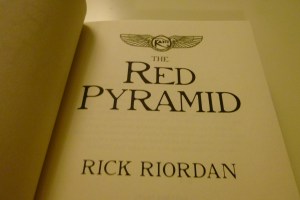
After enjoying the Percy Jackson books, I decided to try another Rick Riordan series, and read The Red Pyramid.  It’s basically the Egyptian Percy Jackson.  Which in a way is a good thing–I mean, I liked the Percy Jackson series.  And Riordan’s given us another book where ancient mythologies turn out to be true, the pantheon of gods is still hanging out in the current day, and ordinary-seeming kids have to discover their hidden powers to fight an ancient evil threatening to destroy the world.

All right, so it’s a formula.  But it’s a fairly unique and specific formula, at least the ancient mythologies part.  And, the most important thing for a formula–it works.

The Red Pyramid is about Carter Kane (who rather resembles Percy) and his sister Sadie (who really resembles hot-tempered and strong-willed Annabelle).  I may be oversimplifying in my character comparisons, and there are distinctions…but not broad sweeping ones.  Things go rather awry for Carter and Sadie when their father blows up the Rosetta Stone using Egyptian magic, and unleashes ancient gods into the world.  Carter and Sadie come to realize that they have magical powers they have to learn how to use, in order to fight the evil god Set, who has captured their father and is also planning to destroy all of North America.  Mostly because he can, I think–it’s all part of an ancient feud among the gods, and an even more ancient conflict between order and chaos.

It’s a good thing, by the way, that all these kids are around to deal with ancient evils, because apparently they’re all in the same fantasy world.  At one point Carter and Sadie are in Brooklyn, and a comment comes up about Manhattan.  The Egyptian magicians don’t get involved there, because Manhattan has other gods to deal with.  Love the reference, as the Percy Jackson books tell us that Mount Olympus is floating above the Empire State Building.

The mythology is the biggest way this differs from the Percy Jackson books, not only the gods themselves but the way the gods relate to the world.  The Greek gods are, to large extent, sort of like very ancient and very powerful humans, who interact with the world more or less like humans do–just in larger than life ways, and in ways that may involve monsters and destruction.

The Egyptian gods seem to lead a more metaphysically-complicated existence.  They mostly exist in a sort of dream world, and primarily access the physical world by possessing humans or objects, but preferably humans with the blood of the pharoahs.  Timelines and chains of events are also a little confused, as the gods apparently act out the same patterns and stories again and again over millenia.

The Egyptian way of engaging the world is certainly more complex, and fascinating in some ways.  But on the other hand–I like that Hermes uses a cell phone, that Poseidon hangs out on the beach, and that Aphrodite and Ares use the Tunnel of Love at the theme park.  The Egyptian gods are, mostly, less relatable, and I can’t decide if I like that or not.  I suppose it’s just different, and both ways have merits.

In the end I think I have to come down saying that I did prefer the Percy Jackson books, but that’s mostly for two reasons that I should elaborate on, because they may not be relevant for other people.

For one thing, I’ve always been a Greek and Roman mythology buff.  Maybe it’s a product of watching Hercules: The Legendary Journeys as a kid (a truly brilliant TV show, by the way).  When I was around twelve, I had run out of new Greek mythology books to read at my library.  The Egyptian gods, on the other hand, I’ve mostly had brief encounters with through friends who love Egypt, or in an occasional historical fiction book.  So when a Greek god shows up, my reaction is usually “oh, them, I know them, they had this story and that story and were the god of this, and it’s so cool how they’ve been portrayed!”  When an Egyptian god shows up, my reaction is more along the lines of “yeah, I guess I recognize your name…”  That skews my impression of the book, I’m sure.

Second thing: my favorite character in the Percy Jackson series is Grover, and there was no Grover equivalent here.  The funny baboon is, well, funny, and Bast as a supporting character is pretty great, especially when she exhibits cat-like tendencies.  But they’re still not as much fun as the ecology-obsessed satyr who loves eating burritos and tin cans.

So if you enjoyed Percy Jackson, and especially if you like Egyptian mythology, give The Red Pyramid a go.  It’s maybe a little darker and a little more complex, but pretty much…it’s an adventure about ordinary (except not) kids on a quest through ancient mythology to save the world.

The Other Side of the Wall

There’s something fascinating about the far side of walls.  Mandy by Julie Edwards (who’s also the actress Julie Andrews) is about what one girl finds on the other side of a wall.

Mandy is a ten-year-old orphan, who one day discovers a way through the wall at the back of the orphanage garden.  There’s a forested area on the other side of the wall, part of a large estate, and in the forest Mandy finds an abandoned cottage.  Mandy keeps the cottage a secret, and over the next several months sneaks out to it whenever she can.  She cleans the inside, plants the garden, and creates a special place for herself.  Eventually, because of the cottage, Mandy’s life is changed completely.

Mandy is a sweet character, and her story is a good one.  I think what always appealed to me most about this book, though, is the idea of the secret cottage in the woods.  I like cottages (although I read this book when I was very young, so I may like them in part because of it), and I so love the idea of the wonderful secret beyond the wall.

There’s something fascinating about doors in walls, about a valley hidden behind a hill, about open land on the other side of a creek or the country just beyond the next bend in the road.  It’s the hope that over there there will be a place that’s magical and wonderful and altogether different from over here.

One of Paul Simon’s songs has the line, “Everyone loves the sound of a train in the distance; everybody thinks it’s true.”  I don’t really know what he meant 🙂 but to me I think it’s talking about the same thing.  The train in the distance is going towards those magical lands over there, somewhere distant and exotic.

Of course, intellectually I know that if you actually go through the door or get on the train, 99 times out of 100 you won’t find anything very exciting, and over there will turn out a lot like over here.  But the feeling of the possibility persists.

And Mandy actually found something wonderful over there, and it’s wonderful to read about.