
A Whirlwind Webber Bible Story

The only previous encounter I can recall with Joseph and the Amazing Technicolor Dreamcoat was about eleven years ago in a high school religion class.  Watching the movie again really should have been like a new experience.  Instead, I found it was surprisingly familiar.

Joseph, of course, retells the Biblical story of Joseph and his eleven brothers, who sell him into slavery for the crime of being their father’s favorite.  With his ability to interpret dreams, Joseph rises to greatness in Egypt.  Because this is Webber, there’s a lot of music and production numbers along the way.

Possibly most striking about the play was the Andrew Lloyd Webber-ness of it all.  It’s impossible not to compare it to the 1970s film of Jesus Christ Superstar–the mix of ancient and modern, mostly minimalist sets, flashy lights, over-the-top costumes, and…well, forget breaking the fourth wall, there pretty much wasn’t one.

The movie somehow has a similar feel while being very different in tone.  I find JCS to be both insightful and dramatic.  Joseph didn’t bring much new insight to the story, and it was almost never serious (with the exception of when Joseph first lands in the Egyptian jail, and sings “Close Every Door”).

But if not dramatic, it is a fun production.  Twelve brothers means plenty of production numbers, with many songs played for humor.  Meanwhile, Pharoah and his court are channeling Elvis.  My favorite songs were “Any Dream Will Do” (which I already knew, thanks to a Michael Crawford CD) and the lovely “Close Every Door.”  Apparently the soundtrack has sticking power, as many songs felt remarkably familiar for something I haven’t heard in eleven years.  Funny how songs live at the back of your brain somewhere.

This musical seems to be targeting a younger audience than most Webber plays–after all, the frame is about telling the story to a group of school children.  At least, I would assume it was a younger target, except for all the scantily-clad dancers, and that Donny Osmond spends half the movie shirtless–which at least distracts from his very silly wig. 🙂  He rises above the wig, though, and does a very nice performance.

All in all, I don’t see it being a new favorite but it’s definitely another good light-hearted musical.  And I bought “Close Every Door” on iTunes.
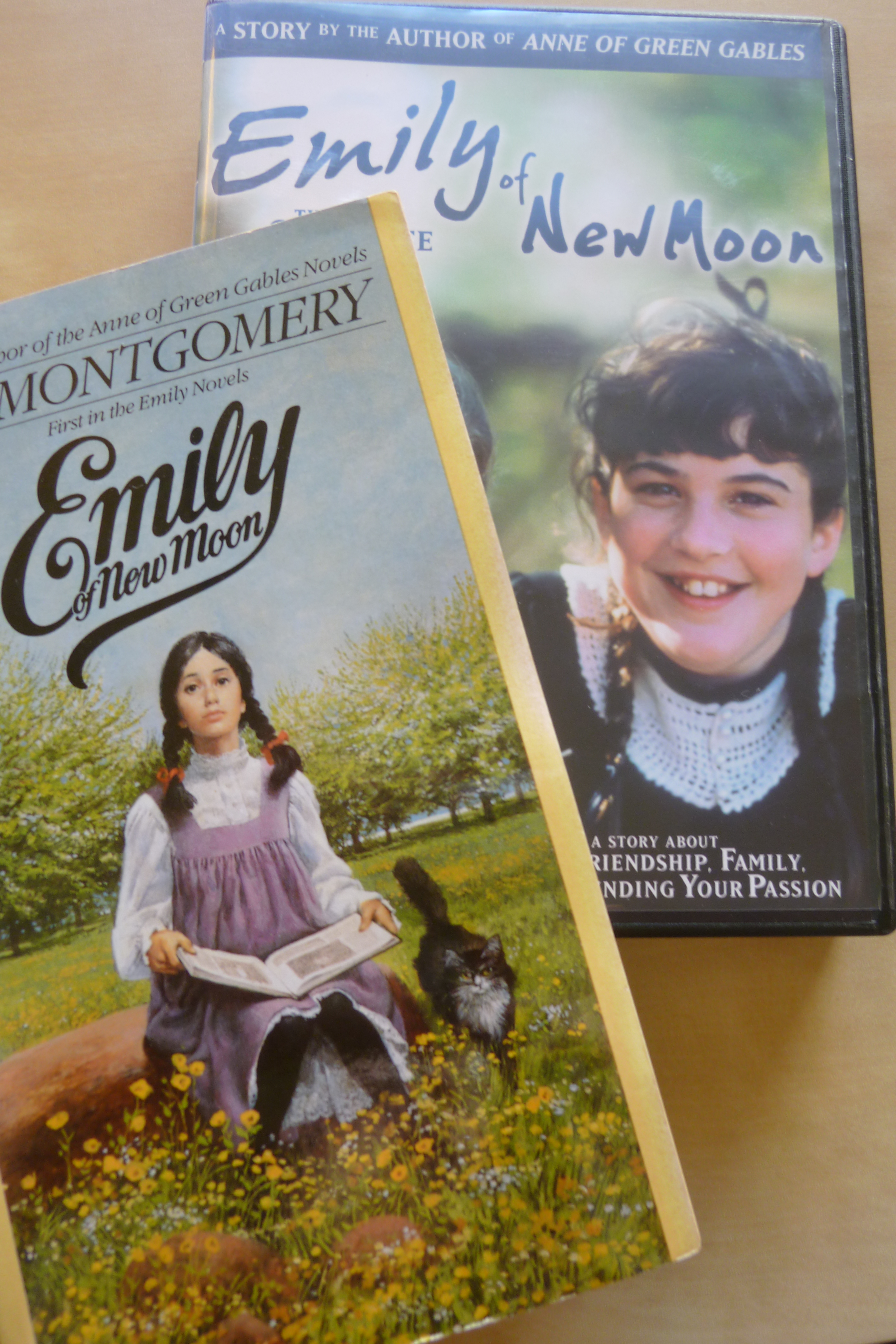
Emily of New Moon on Screen

I think you all know that I’m kind of an L. M. Montgomery fan.  She’s my favorite author and I’ve read every bit of her available prose.  So naturally I was intrigued when I encountered an Emily of New Moon television series.  It’s not new, but it was new to me.  Adaptations of beloved books can be wonderful or terrible, and fortunately this one was more good than bad.
Emily is an orphan who moves to New Moon farm after her aunts and uncle draw lots to see who’ll get stuck with raising her.  She ends up living with sweet Aunt Laura, domineering Aunt Elizabeth, and dreamy, slow Cousin Jimmy.  They don’t know quite how to handle stormy, emotional and impulsive Emily, who longs to be a famous writer.  But even Aunt Elizabeth warms up in the end.

I should probably note that it’s been some time since I read the books, but I think I remember them reasonably well.  It’s a funny balance here, in that the characters are very true to the book, while the plot isn’t.  I was okay with that, though.  I’m always more forgiving of plot changes than character changes–especially in a TV show where they obviously need more ideas than a book (even three books) will provice.

The premise, as described above, is correct, but the larger plot arc ends up diverging dramatically (though some of the early episodes draw directly from book vignettes).  It’s still fun to see Emily and everyone else brought to life, and even if the things they’re doing aren’t things that happened in the book, what they do fits with their characters (with the possible exception of Aunt Laura, who’s basically right but exaggerated in some ways).

Emily is a delightful heroine, in book and television, and of course I’ve always sympathized with her dreams of literary fame.  I also loved seeing her friends, wild-child Ilse, aspiring artist Teddy, and (my favorite in the adaptation) hired-boy Perry who plans to one day be governor.  They’re well-drawn characters and they’re enjoyable characters, having adventures large and small.

I think the feel of the show was also right to L. M. Montgomery, though it may not be what people would expect–and it probably actually helps that I’ve read so much of her writing.  The show does a lot with Emily’s second sight, especially in the first season.  Emily frequently sees spirits (most of them friendly).  The book was not that visual about it and it wasn’t that much of a focus, but Emily did have a few supernatural experiences–mostly visions or dreams of the past or the future.  It was part of the book, and it was also part of L. M. Montgomery’s beliefs, so I think she’d be all right with it here.  Ghosts also show up in some of the stories in Among the Shadows, one of my favorite collections of Montgomery’s short stories.

The series on a whole delves into some darker places and touchier social issues than most of L. M. Montgomery’s writing, but I never thought it went too far.  There’s a character who struggles with alcoholism, and another who has a baby out of wedlock.  It’s true you won’t see that in L. M. Montgomery’s novels, but I’ve read her journals too and she wasn’t blind to the world.  I think she might have gone deeper and darker in her books if her publishers had let her.  Although I don’t think she would have been as forgiving as the show towards people who broke society’s conventions!

I especially enjoyed the first two seasons.  The show takes a turn in the remaining two seasons.  It’s like they thought it had to be more exciting, because the plots get more dramatic and less plausible.  People fall in and out of love quickly, Queen Victoria comes to visit, and there’s a strange number of dream sequences.  Also, even though Emily is theoretically fifteen by the end, she still looks twelve to me, and far too young for the (reasonably innocent) romances they start her on.  I’m glad I watched to the end, to see how things turn out, but I do recommend the first two seasons as better.

I think this show can be watched and enjoyed whether you have or haven’t read the books.  Take it at face-value if you don’t know the source, and you have a great set of characters having interesting adventures.  If you know the books, you have familiar characters having adventures.  They weren’t all the right adventures, but for me at least, I liked the characters so much and enjoyed the adventures enough that it really wasn’t a problem.

Classic Review: The Little White Bird

A quick update today, to say that I just got back from my trip to London and Paris.  I scheduled posts ahead, but if you noticed a distinct silence in the comments, that was why.  The trip was amazing 🙂 and you will be hearing (and seeing) more about it soon!  While I’m getting back on top of things, I have another classic review today, very relevant to my recent trip.

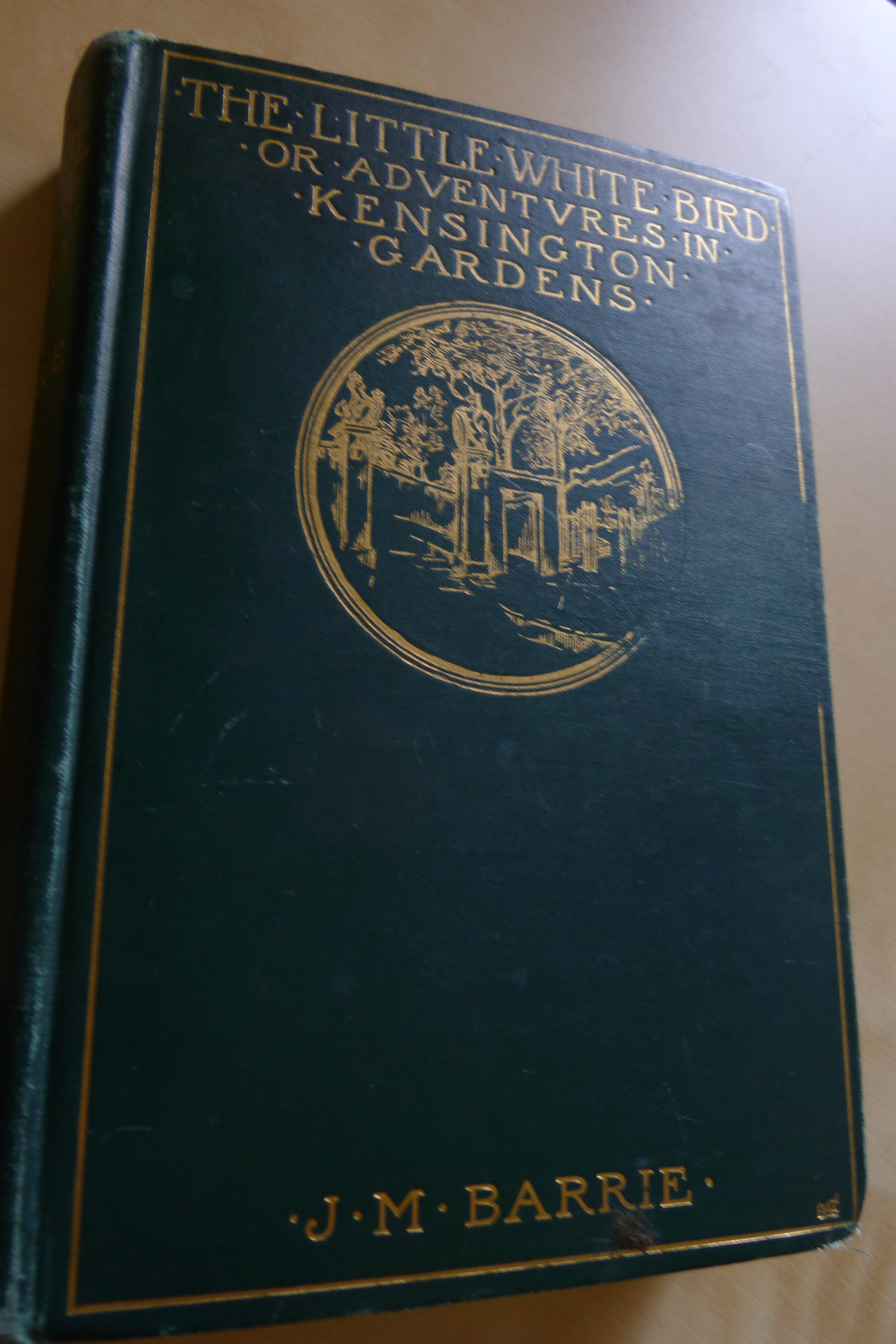
My hotel in London was near Kensington Gardens for a variety of reasons.  It really was a practical choice.  But I also stayed in that part of town because of J. M. Barrie.  The author of Peter Pan, he lived near Kensington Gardens, where he met the Davies boys, the real life inspirations for Peter.  He wrote another book inspired by the Davies, featuring Peter in a cameo.  It’s really that book, The Little White Bird, that’s given me my fascination with Kensington Gardens.

*********************************

It really all began in the The Little White Bird.  It’s very possibly my favorite J. M. Barrie book, even over and above Peter Pan.

The Little White Bird; or Adventures in Kensington Gardens is a tale about a man who befriends a little boy, and has adventures with him in London and Kensington Gardens.  If you’re not already suspecting the autobiographical nature of this novel, the little boy’s name is David.  Historically, J. M. Barrie befriended the Davies brothers in Kensington Gardens.  Not too subtle!  He also has a dog named Porthos, as did Mr. Barrie.  The man in the story is left unnamed.  He’s referred to as Captain W–.  I somehow picked up the habit of calling him the kindly old gentleman.

A review in The Times said of the book when it was first published, “The peculiar quality of The Little White Bird…is it’s J.-M.-Barrie-ness…whimsical, sentimental, profound, ridiculous Barrie-ness…Mr. Barrie has given us the best of himself, and we can think of no higher praise.”

I couldn’t put it better.  The Barrie-ness is often the best part of Mr. Barrie’s books.  The charm, the whimsy, the flights of fancy, the sweet sadness…the book is funny and tragic, absurd and heartbreaking, and sometimes all at the same time.  The tragedy, for the kindly old gentleman at least, is that David doesn’t really belong to him, and will one day grow up and leave him.

And there we come to the Peter Pan connection.  Besides thematic connections, there are also four chapters in the middle of the book that are about Peter.  They’re almost oddly unrelated to the rest, other than by geography, but I think they’re meant to be stories that the kindly old gentleman tells David.  In Peter Pan, Peter tells Wendy, “I want always to be a little boy and to have fun.  So I ran away to Kensington Gardens and lived a long, long time with the fairies.”  And this is that story.

We read about Peter’s running away from home, find out why he doesn’t grow up, see him meet the fairies, and also meet a girl he knew long before there was Wendy.  This is before Peter went to Neverland (although an island features) and the Lost Boys and Tinkerbell are yet to come on the scene, but there are other wonderful magical creatures and adventures.  The four chapters about Peter, along with one chapter giving a Grand Tour of the gardens, have been excerpted and published as Peter Pan in Kensington Gardens, with lovely illustrations by Arthur Rackham.

The Baby’s Walk

The Grand Tour (and map) is especially wonderful, because if you’re ever in London, I highly recommend spending an afternoon in Kensington Gardens with The Little White Bird in one hand.  It’s what I’ve done, and I spent a couple of hours going, “Oh, there’s Mabel Gray’s gate!  And the Round Pond!  And that must be the Baby Walk!  And this is probably the weeping beech where Peter sat!”  Even a century later, I was able to find almost everything J. M. Barrie described.  And it’s a little easier to get to Kensington Gardens than to figure out which star is the second one to the right.

One more note on The Little White Bird–George Davies, who was the chief inspiration for David, took a copy of the book with him to the trenches in World War I.  I think that’s one of the saddest and sweetest things I ever heard.

Even in much less dire reading circumstances, it’s a lovely and enjoyable book–and, of course, magical too.

Classic Review: A Semester in the Life of a Garbage Bag

One of my favorite funny authors growing up (and still, to some extent) was Gordon Korman.  Several of his books still make me laugh out loud, after repeated reading.  One of my favorites, for its humor and its philosophy, is A Semester in the Life of a Garbage Bag.  Gordon Korman understands stress.

He’s also an author who proved just how awesome he is–I emailed him after I posted this review, and got a very nice email back!

***********************************

Every high school student should read this book.  Actually, everyone should read it, if only for the metaphor of the title.  A Semester in the Life of a Garbage Bagby Gordon Korman sounds utterly ridiculous–and it is.  It is a hysterical, hilarious, wonderful book.
My slightly battered, much-loved copy

But the title is actually remarkably profound.  It’s based on a one-scene reference (like To Kill a Mockingbird‘s title) when the main character describes a commercial for garbage bags.  The garbage bag is hooked up to a machine that keeps pumping in more and more pounds of pressure, and the smiling spokesman talks about how much pressure the bag is taking.  He keeps on cranking it up, while the poor bag is struggling to hold together.  Sound like high school to anyone?  Or life, for that matter?

The main character in the book is Raymond Jardine.  He has no luck.  Zero, zip, zilch.  His overriding dream is to somehow make it Theamelpos, an island in Greece which he is convinced grants extraordinary luck to all visitors.  Six students will be selected (methodology unknown) for a school trip this summer, and Jardine is determined to lie, steal, cheat, scheme, and connive his way into one of those six slots.

And that’s just the beginning of the story.  We’re guided through the book by the comparatively normal Sean Delancey, who is paired with Jardine for an English assignment.  Korman often takes the wise tactic of giving us someone relatively sane as a lead character, who can navigate us through the wild and wacky world of the book, where anything is possible.

Where it’s perfectly normal, for instance, for students to surf on trays down tables in the cafeteria–the temperature in the cafeteria is typically around 90 degrees, because the school is powered by the experimental SACGEN, which all the students know doesn’t work but which the school board is determined to insist is a great triumph.  That’s just one example of the world we find ourselves in.

The English assignment Sean and Jardine have to do together is a 30 page report on a poet of their choice.  Jardine is determined to pick a poet no one else will do (reasoning that if they pick a famous poet, another group will too, the teacher can compare the two reports, and his is bound to be worse).  Literally minutes before the deadline to choose, Jardine selects Gavin Gunhold, the author of “Registration Day.”  They rave to their teacher about how much they love Gunhold’s work, and find out later that he never wrote anything else, having died in a freak accident shortly after writing his only poem.  Their solution is start writing their own poetry in Gunhold’s style, using for inspiration words they pick at random from the encyclopedia.

As to Gunhold’s one original poem:

On registration day at taxidermy school
I distinctly saw the eyes of the stuffed moose
Move.

I’m not usually a fan of poetry, and I have probably quoted Gavin Gunhold more often than almost any other poet.

A Semester in the Life of a Garbage Bag is packed with memorable characters, funny scenes, and even an explosion or two.  You will get your money’s worth in laughs out of this book.  And surely everyone can relate, at least a little, to how Jardine feels about that garbage bag?

Author’s website: www.gordonkorman.com

Becoming a Geek Celebrity

I seem to be meeting a lot of geeks lately.  That sounds a little odd, but it does make sense–I’ve connected into a few different social circles that seem to attract geeks (and by the way, they all defy the stereotype about socially awkward, reclusive geeks).

It’s great fun, because we all have some of the same touchpoints, and the important ones are not the same as the important general pop culture ones.  You know–Star Trek, Star Wars, Firefly, certain board games, certain authors.  There are certain people too.  Neil Gaiman is apparently The World’s Coolest Author; not just because of his books, but he personally seems to be amazing.  George Takei is the Geek King of Facebook (follow him if you want to be in on all the geek memes).

And lately, Wil Wheaton is emerging as the Geek Celebrity.  Not for anything in particular–just for being a geeky celebrity.  I mean, besides a recurring role as himself on The Big Bang Theory, he has an online show focused on playing board games.  Really.

All this made me curious.  How did Wesley Crusher become the Geek Celebrity?  So I read Just a Geek by Wil Wheaton.  It would probably make him happy that I read it more because I’m curious about who he’s become lately than because of Wesley.  I never actively disliked Wesley, but I was never much of a fan either, so that wasn’t that big a draw.

Just a Geek is a memoir, but one that covers a very narrow period.  It’s a couple of years from roughly 2001-2002, and charts how Wheaton went from a washed-up celebrity trying to escape Star Trek to coming to terms with Wesley Crusher and publishing his first book.  This was published in 2004 so it’s hardly the complete story of how he got to the present (obviously), but it does describe the turning point.

Some sections of the book are lifted directly from Wheaton’s blog, and the feel of the entire book is much like that.  You do get the sense of Wil Wheaton sitting down to tell you about his life and his experiences.  In some ways, what has stuck with me the most is the raw honesty of it all.  He talks about being depressed or angry or disliking something, in a way that people (at least in public forums) usually don’t.  He talks about deep positive emotions too, especially being incredibly moved by Star Trek: The Experience in Las Vegas, stepping back on the bridge of the EnterpriseD.

If his intent was to convince people that he’s a regular guy, that’s definitely how he comes across.  We usually see only a couple of visions of celebrities, and this is neither.  Wheaton is not the self-destructing celebrity on the cover of Us Weekly, or the serene dispenser of wisdom that shows up on Parade.  He’s just a normal guy who’s a bit geeky.  Despite the title, the geekiness didn’t feel like that big of a focus to me–it was mostly “life as a struggling actor.”  But he did get an introduction from Neil Gaiman, so there are obviously geek connections here.

In a way I’m sorry to say that the most memorable parts did turn out to be Star Trek related.  The journey and personal growth are interesting, but my favorite parts involved other Star Trek celebrities; it happens in a few places.  Unless you’re really interested in Wil Wheaton, I wouldn’t read this without a working knowledge of Star Trek: The Next Generation and the actors involved (which, if you’re really interested in Wil Wheaton, you probably have anyway).  It’s not a consuming focus but it is spread throughout the book, and there isn’t always much context provided.  In a way, Star Trek IS the context of the book.

Since Wheaton is honest, I suppose I’ll be strictly honest too on my assessment.  I enjoyed the book.  It gave me what I wanted, which was some idea of how Wil Wheaton became a geek touch point beyond the Starship Enterprise.  But I didn’t love it and I don’t think I’ll run out to read something else by him.  I’m just not enough of a fan of his writing or of him–and it’s a very personality-driven book.  I should note there’s no reason for that.  It’s just one of those things, what-does-and-doesn’t-speak-to-you.

But I will be hoping for another Big Bang Theory cameo, and I will recommend the book–if you’re a geek.

Author’s Site: http://wilwheaton.typepad.com/

Other reviews:
Stainless Steel Droppings
Just a Writer Geek
Reading by Candlelight
Anyone else?