Visiting Madrid with Bloody Jack

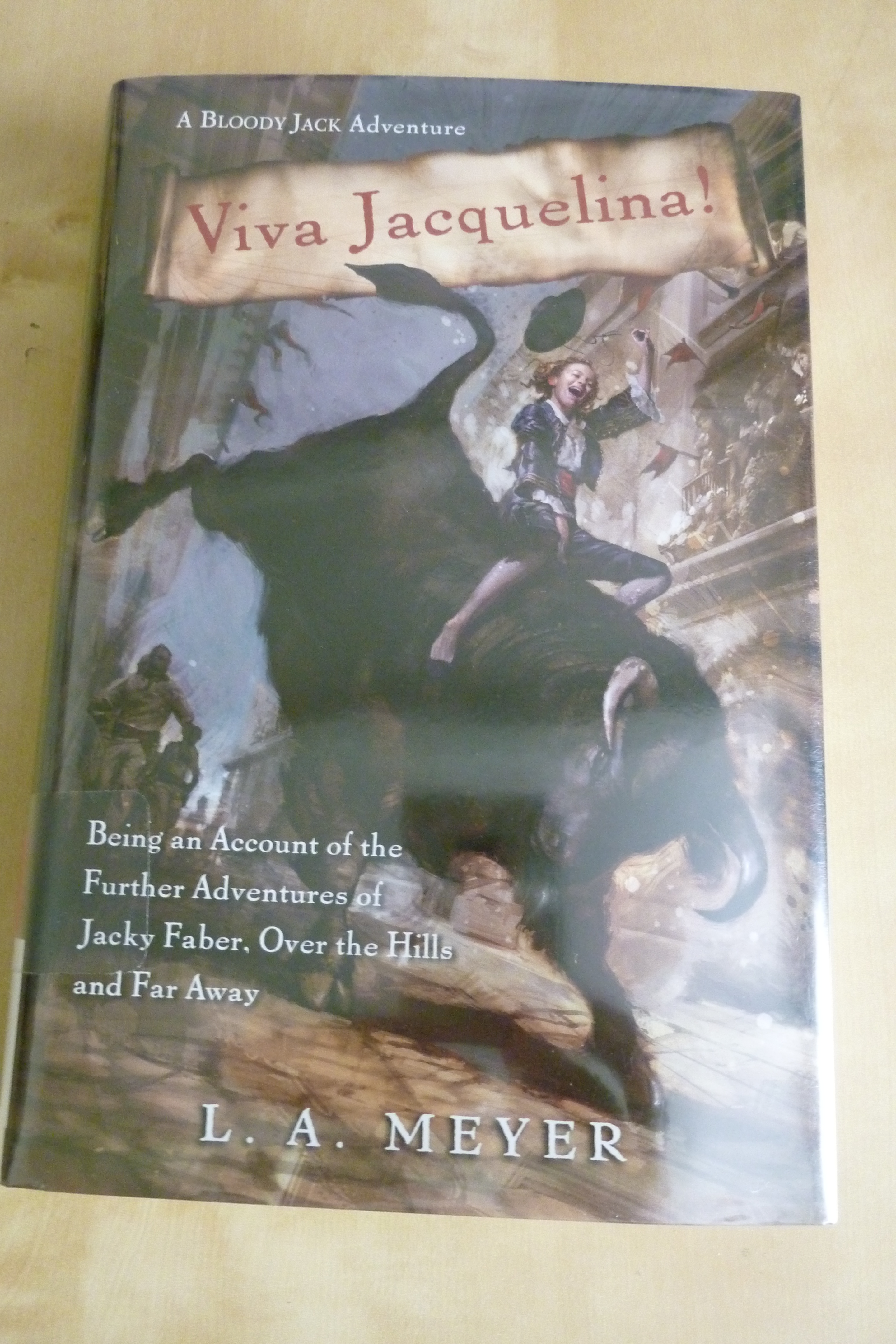
Every fall I look forward to the latest installment of the adventures of Bloody Jack.  This year, it was Viva Jacquelina!, L. A. Meyer’s tenth book about the irrepressible Jacky Faber.

Jacky has, in her various adventures, been a British Navy sailor, a merchant captain, a pirate, a member of the British intelligence, and sometimes even a fine lady.  As you might guess, this installment takes Jacky to Spain.  It begins on the battlefields of the Napoleonic wars, before Jacky is sent on a spy mission to Madrid.  Separated from her friends, she finds work at an artist’s studio, learning painting, posing as a model, and flirting with the local boys.  Jacky’s adventures go on to involve bull-riding, the Spanish Inquisition, and a band of gypsies.  In other words, it’s the usual Jacky Faber fare.

Jacky is still the charming, undaunted, ever-cheerful and ever-resourceful girl we’ve met in nine previous books.  She’s grown more confident but no more cautious or sensible.  The adventures come fast and furious here, which is good and bad.  The book keeps moving along at a quick clip and there’s never a dull moment–but sometimes I did wish it would slow down and give us more depth and more detail.

It strikes me that we’ve entered an interesting place with these later books in the series–they’re still enormous fun, I still love the characters, and I still can’t resist reading on to find out what happens next.  At the same time, the books are starting to lose the depth and the originality of the early ones in the series.  In some ways this book reminded me a bit of the second one, Under the Blue Tattoo, in that Jacky spends some months settling (relatively) quietly into a town and a household.  But this book racketed along at a much faster pace than the second book, and we never delved as deep into the characters or developed a plot that was as complex.

Jacky is also beginning to seriously grate on my nerves when it comes to her constant flirtations.  In the span of this one (relatively slim) book, she gets into pretty serious sparking with five men–all while her heart belongs to her one true love Jaimy, of course.  Jacky’s always been a bit free with her affections, but I feel like in this book she went farther faster and with greater numbers, and never seems to grasp that any of these men might take her seriously.  When her attitude starts to become, “ho-hum, another one swearing undying love,” it gets just a little annoying.

But I do still love Jacky–only I’m starting to feel like her best friend, Amy Trevelyne, who is frequently apt to sigh and wish Jacky would learn some restraint.  On the other hand, it is kind of fun that Jacky turns on its head the cliche of the roving man with a girl in every port.

All in all, I’d say this book isn’t up to the brilliance of the earliest ones in the series…but it’s still a very enjoyable read.  I wouldn’t suggest starting the series here, but if you haven’t read Bloody Jack, I do recommend picking it up!  This is a wonderful series to explore.

Author’s Site: http://www.jackyfaber.com

Other reviews:
Fyrefly’s Book Blog
In Bed with Books
Bookyurt
Anyone else?

The Graveyard Book Read-Along, Week One

This month, I’m participating in a read-along of Neil Gaiman’s The Graveyard Book, as part of R.I.P.  We’re looking at a few chapters a week, with no specific questions for each post.  This week, a discussion on the first three chapters.

I’ve read The Graveyard Book before, but it’s been a few years and some of the details have gone fuzzy.  I do remember the shadowy feel of the book, and that I enjoyed it!  So I’m looking forward to digging into in greater depth.  (I suspect there’s a pun somewhere in that “digging in” phrase…but we’ll just move along…)

For those not familiar with the book, it tells the story of Bod, a living orphan who is being raised by a community of ghosts.  The first chapter describes how this situation came about, and the next two share a couple of Bod’s childhood adventures.

The first thing that struck me on picking this up again was the pictures.  The first few pages of each chapter are illustrated with wonderful black and white drawings that set the shadowy tone of the book so well.

Gaiman makes a very interesting choice by starting us out in the point of view of a murderer, the man Jack who killed Bod’s family.  What’s particularly remarkable is that he manages such a deft balance of starting us in an unbelievably horrible situation–but I don’t feel inclined to slam the book and walk away.  It is horrible, and it’s certainly dark and creepy (just the phrase “the man Jack” is so creepy), but it never quite becomes grotesque or too twisted.  And if you’ve read the Sandman graphic novels, you know Gaiman is capable of going there!  As it is, this sets up a wonderful darkness without scaring squeamish me off of the book.

I also love that it’s the living man who’s frightening–the ghosts are quite homey and pleasant.  They have a close community in the graveyard, with each ghost living in his or her respective crypt, all going about much the same community relations that they had in life.  And why not?

In Chapter Two, Bod makes a human friend, a little girl named Scarlett whose mother thought it made sense to bring her to play in a graveyard (a nature reserve, technically).  The two of them venture into a dark depth of the graveyard and encounter very strange and sinister creatures.  I enjoyed some of the contrast between Bod and Scarlett, but wish Gaiman had done more with that.  Ultimately they both end up not being afraid of what appears to be a monster–and I totally get that Bod is used to the strange and the supernatural, but I don’t understand why Scarlett, as a normal little girl, calms down remarkably quickly.  Perhaps I’m just meant to take her as being special too.

My favorite thing about Scarlett, though, is probably that she thinks Bod is an imaginary friend.  What a wonderfully fuzzy margin between reality and imagination!

In Chapter Three, Bod gets a new tutor, Miss Lupescu (whose name makes her secret fairly obvious), and ends up captured by ghouls.  The best thing about the ghouls is their names.  They all receive new names when they become ghouls, names which properly reflect the high esteem ghouls hold themselves in: names like “the famous writer Victor Hugo” or “the Bishop of Bath and Wells” or “the 33rd President of the United States.”  And they’re never shortened.

So far, the book is quite episodic, with each chapter almost a self-contained short story.  I do seem to recall, however, that threads begun in one place will come back in another, and it’s going to be fun to watch that weaving.  And the short story nature makes this good for a read-along!

Austen and Bronte and Magicians

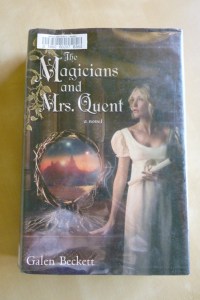
My next book for the R. I. P. Challenge is The Magicians and Mrs. Quent by Galen Beckett, which mostly comes into the category in the book’s second part.  I became interested because this was described as a blending of Austen and Bronte, in a fantasy world–and that’s exactly what it is!

The book is divided into three sections.  Book One is told by three narrators in rotating chapters.  We meet Ivy first, a young woman fascinated by magick [sic].  Her beloved father was a magician who has gone out of his mind; Ivy comes to realize that magick may relate to the cause, and also that he left her a riddle to solve, relating to vital work she must do.  Rafferdy is another narrator, a bored and cynical nobleman interested only in amusement and determined to do no harm by having no meaningful effect on the world at all.  Our third narrator is Eldyn, who is striving to create a better life for himself and his sister, but in the process falls into the power of a ruthless highwayman and revolutionary.

The personal stories of all three characters roll out against a backdrop of brewing revolution and a growing magical threat, which Ivy in particular must find a way to combat.

Book One has us very much in Austenland.  Book Two takes a dramatic shift towards Bronte, when Ivy accepts a position as governess at Heathcrest Hall, a gloomy manor out on the moors.  There’s a not too subtle resemblance in the premise to Jane Eyre, and Heathcrest Hall is presided over by Mr. Quent, who bears a not too subtle resemblance to Mr. Rochester.  Book Two is strictly about Ivy, and told by her in first person.  The book takes on a gothic feel, out on the misty moor where strange magick is afoot.

Book Three takes us back to the setting and narrative structure of Book One, as all the characters’ plotlines come to a head.

This book started slow for me, but I ended up really enjoying it.  In the first section, I was mostly only drawn into Ivy’s chapters.  Rafferdy and Eldyn are interesting, but they weren’t engaging me that much. The book picked up in the second section, when the plot gets more focused, and we get much more magick.  (And I have no idea why it’s spelled with a K, but it is.)

The book is set in Invarel, which is a very obvious parallel to England.  All the names are changed, but there are frequently details that are clear analogs; for instance, the brewing revolution centers around an obvious Bonny Prince Charlie equivalent.  There is the difference, of course, of the presence of magical forces, which exist in a few different varieties.  There are magicians who can work certain complex spells.  There are illusionists, who mostly work their marvels in theatres.  And there are witches, who have an affinity for the Wyrdwood, an ancient forest spread throughout the country and which, legends say, will fight back against its enemies.

All the magick is intriguing, although in a way what grabbed me the most was scientific (sort of).  The other biggest difference between Invarel and England is that Invarel’s planet is in a solar system which operates very differently from ours.  The crucial result is that they don’t have days and nights of set length.  People have to constantly check their almanacs to see how long the day will be–maybe four hours of daylight, maybe twenty-eight.  I was fascinated by the concept, and by all the details about how society can function under those circumstances.  I kind of wish there had been more of that!  I’ve seen at least one reviewer complain that it didn’t make sense and that’s probably true–but that didn’t worry me.  It was just so interesting!

The world of The Magicians and Mrs. Quent is an intriguing one, and I was also drawn into the characters.  As mentioned, it started slow for me, but Rafferdy eventually gains some depth and Eldyn’s plotline gets more intense.  I enjoyed Ivy from the beginning; her family circumstances and her character are both reminiscent of Elizabeth Bennet.  She’s a capable, intelligent, well-read young woman who is nevertheless constrained by her position in society.

I was essentially playing “spot the Austen character” all through Book One.  Ivy’s parents and two younger sisters all seem drawn from the Bennet household, and you can also find Lady Catherine de Burgh, Mr. Collins, and even Mr. Palmer from Sense and Sensibility.  There may be more–I’ve only read three Austen books.

I suspect this book is more fun if you’re familiar with both Pride and Prejudice and Jane Eyre, although I don’t think it’s essential.  It draws from them for the characters, and the circumstances those characters find themselves in (Ivy especially), but the plot goes in a different direction from either book.  If you don’t have the background knowledge, you could probably just take this as-is and be interested.

The style of the writing is also drawn from Austen and Bronte, although rarely in a heavy-handed way.  You can see it right in the first sentence: “It was generally held knowledge among the people who lived on Whitward Street that the eldest of the three Miss Lockwells had a peculiar habit of reading while walking.”  A few times I thought Beckett was trying too hard to make the dialogue sound Austenish and it came out stilted, but most of the time it’s a nice flavor in a very readable book.  Except, that is, when Beckett picked up Austen’s teeth-gnashing habit of skipping lightly past romantic declarations without any dialogue!  I always want to know what they said, not just the narrative fact that they said it!  Sigh.  On the plus side, near the very end of the book we get a little more Bronte-style adorable romantic teasing dialogue, so I was somewhat mollified.

All in all, I’d say, be warned that this may take some effort at the beginning, but it really is worth continuing.  I recommend this if you like fantasy, and highly recommend it if you like Austen and Bronte.  I know I’ll be going on to read the next two books!  This one gives us resolution, but there are still mysteries to be explored.  I may also be rereading Jane Eyre soon…

Author’s Site: http://wyrdwood.net

Other reviews:
Fyrefly’s Book Blog
Kid Lit Geek
Stewartry
Things Mean a Lot
Stella Matutina
Anyone else?
Sailing Back to Treasure Island

I think we all know that pirates are kind of an interest for me.  So naturally I was intrigued by the prospect of a sequel to one of the great classic pirate stories, Robert Louis Stevenson’s Treasure Island.  Often I have big objections to sequels to classics, but this particular classic falls into a nice middle area, where I’m interested, but I’m not so attached that I hold it too sacred for a new author to attempt a story.

Silver: Return to Treasure Island by Andrew Motion is told by a different Jim Hawkins, the son of the original.  This Jim is eighteen years old and thoroughly sick of his father’s stories about his glory days on Treasure Island.  Nevertheless, he can’t resist following when he’s approached by Natty, the daughter of Long John Silver.  Natty’s dying father has prepared a new expedition to Treasure Island.  Jim steals his father’s map, and he and Natty set off, hoping to find a cache of silver that the last expedition left behind.

What they find are ghosts of the past–the nephew of a man the original Jim Hawkins killed; three pirates marooned by the last party, now inflicting barbarities on a group of castaways; and always the looming memories of the first Jim Hawkins and of Long John Silver.

This story stands largely on its own, with almost the entire cast consisting of new characters, and an entirely new plot.  The events of the previous book are obviously essential, though, so I wouldn’t read this without any knowledge of the original.  That said, I think even a small knowledge would be enough, such as a familiarity with a retelling (and while we’re on that subject, Muppet Treasure Island is my favorite version!)

The writing is excellent here.  There’s a formality to it that harkens back to the original book, without going too far and sounding stiff to a modern audience.  There are wonderful descriptions, particularly of nature, which is described not only in terms of appearance but very much in mood, sometimes being almost anthropomorphized.

Jim (the younger) is a thoughtful character, who explores his own feelings and motivations, and makes interesting observations on other characters as well.  Natty is a wilder character and harder to read, but there are glimpses that make her engaging and demonstrate her complexity.

We only get a little of Jim the older, and of Long John Silver, but something interesting happens with them.  I feel I have to give a little context here–in almost every adaptation I’ve seen, there’s a complicated relationship between Jim and Long John, a love-hate situation where Long John plays almost a fatherly role.  In the original, Jim pretty much sees Long John as a devious pirate and it’s all much simpler (and less interesting).  Here, Jim describes the relationship as the book tells it–but Long John seems to remember it as the more complex relationship that we see in adaptations.  It’s an interesting balance.

The adventures in the book are tense and exciting.  There are stretches that are quieter, but the action is good when it comes.  This gets pretty dark in spots, but never quite goes too far.  It’s obvious there are very horrible things happening on Treasure Island, and there isn’t much doubt about what–but we never got it in such detail as to be too awful.  It does edge up very close to a disturbing area though, so reader beware!  There are also some hints at the very beginning of something quite odd in Natty and Long John’s relationship, but that’s never elaborated on–which to be honest, I thought was just as well!

I did think the book mis-stepped in other places by not elaborating, as Motion mostly avoids the thornier issues.  Long John Silver is married to “a colored woman,” I think based on a reference in the original book, which means Natty is mixed race.  In 1802, she would have faced enormous prejudice because of that; here, it’s skated right past.  When Jim finds out, he remarks once that it doesn’t change how much he’s drawn to her, and that’s all.  While that’s certainly admirable of him (by modern standards), it feels anachronistic.  History’s attitudes may disturb a modern reader, but this reaction in a young white man of the early 1800s makes Jim almost impossibly progressive.

The situation is similar when slavery comes up (and it plays a significant part in the plot).  All the good characters are apparently abolitionists, with no need to even discuss the question–even though this is five years before England ended the slave trade, and 30 years before slavery was outlawed in the British Empire.  Of course I don’t think the immorality of slavery is a complicated question, but it should have been a complicated one for characters living in 1802, and I think Motion oversimplified.

I won’t say that the simplification spoiled my reading of the book by any means–but I think this was a good book that had the potential to delve a little deeper, and in a way that would have been more realistic.

This is definitely worth the read if you like historical fiction about pirates and buried treasure, and especially if you enjoy the original.  Which I also recommend–along with Muppet Treasure Island. 🙂

Disclosure: I received a copy of this book for free from the publishers in exchange for an honest review.

Other reviews:
Minding Spot
A Bookworm’s World
Man of La Book
The Literateur
Anyone else?

In the Footsteps of Sherlock Holmes

I brought a great stack of British books with me when I went to London, many of which I hope to share with you.  I thought I’d start off with Sherlock Holmes, which kills several birds with one stone.  It’s a good book for the R.I.P. Challenge, and also lets me share a little about my trip!

First, the book review.  I’ve read a lot of Sherlock Holmes stories and novels in the past, and to be honest, when I look at titles I’m not always sure which ones I’ve read!  But I was almost sure The Valley of Fear was a new-to-me book (and it was), so I brought that one with me to London.  It turned out to be an interesting mix of a novel.

It opens, as most Holmes stories do, with Holmes and Watson invited to look into a strange case.  A man is found dead in his home out in the country–complicating the situation, his home is an old fortress, complete with moat.  The drawbridge was up, so how did the murderer get in, and where did he go?  There are a few strange details about the crime scene and the other people in the house.  The murdered man seems to have had something dark in his past, but the only clue is a vague reference to “the Valley of Fear.”

So it’s essentially standard Holmes fare, and a good mystery with a clever resolution.  Holmes is in fine form, it’s always nice to visit with him and Watson, and all in all it’s a good Holmes story.  The biggest point of interest for me is that Moriarty is referenced here.  I had always previously thought that he was only in the single short story (and, of course, many adaptations).  There’s more about him here, which explains a lot.

The funny thing about this book is that it’s in two parts.  Part One I described above–Part Two is a flashback into one character’s past in the Valley of Fear.  I feel like I can see here Doyle’s desire to get away from Holmes, because he’s essentially given us a non-Holmes novella in the middle of a Holmes novel.  It’s interesting enough, but not as good as the section with Holmes.

It suffers also from a rather peculiar problem which is hard to discuss without spoilers.  Doing my best…there’s a twist near the end which changes almost everything that came before it.  The problem is, in order to give the impression which leads to the shocking twist, for most of the book we’re dealing with very unlikable characters.  It might have been better as a short story, when we wouldn’t have to spend quite as much time with unpleasant people.

Even so, if you’re a Holmes fan, this is definitely worth reading for the mystery in the first half, and the insight into Moriarty.  And it was a great choice for my trip, because I was in a Holmes mood.  You see, one of the places I visited was 221B Baker Street.

I had heard it was a tourist trap, but it was better than reported–at least, part of it.  As I think about it, the museum actually has a fair bit in common with The Valley of Fear.  It opens splendid and very Holmesian, and then diminishes as you go.

221B Baker Street, of course, is the home of Holmes and Watson.  It’s very vertical–you get to visit three small floors.  The first level has the parlor and Holmes’ bedroom, and this level is absolutely superb.  Every detail you could want is there, with Irene Adler’s photo on the mantel, Holmes’ tobacco in a slipper, and Watson’s medical bag on a chair.  In Holmes’ room there’s an open book on beekeeping, which he took up after he retired from detective work–it’s those little details that really impressed me.

The next floor is sort of Watson’s room and Mrs. Hudson’s room (although I never had the impression before that the landlady lived in the same apartment…)  This level is a mix of period things and Holmes memorabilia.  Both are interesting, but they do sit a little oddly together.

The third floor is fairly dreadful.  It’s all done up with mannequins meant to be characters from different stories, and for whatever reason they made choices towards the macabre and the grotesque.  It’s all rather creepy–and I was there at ten in the morning.  I shudder to think what it’s like in the dark.

But like The Valley of Fear, the museum is all worth it for the beginning.  The parlor makes you feel like you’ve stepped into the stories.

Stay tuned this Saturday for more pictures from 221B Baker Street.  I’m anticipating a Holmes-themed Saturday Snapshot!

Other reviews:
Lucy’s Bookshelf
The Literary Omnivore
The Flying Inn
Anyone else?