Traveling the Star Wars Universe with Lando Calrissian

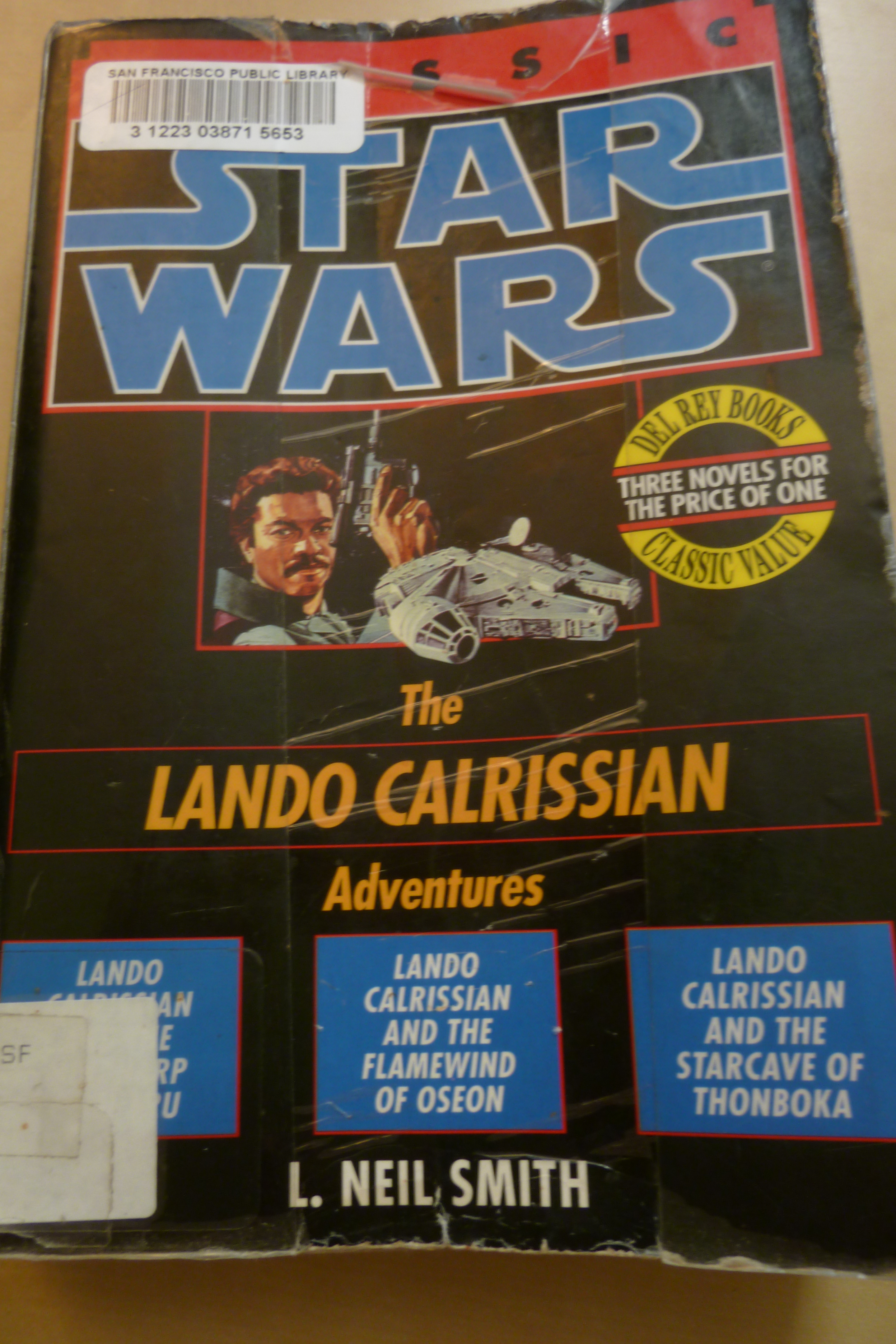
An omnibus, the title I read is covered by a sticker…oh well.

I’ve had a Star Wars itch lately.  It might be because I was listening to Professor Fears talk about the fall of the Old Roman Republic, giving way to the Empire.  The parallels, in terms and sometimes beyond that, are pretty obvious.  Or it might be because Asimov’s Foundation books made me nostalgic for another galaxy with humans on every planet and an enormous empire spanning the systems.

I’ve also had a bit of a memory itch.  Some time very long ago I read a book about Lando Calrissian.  There was a robot in it, they were in the ruins of an ancient civilization, and at some point they got separated and time started moving at different speeds for each of them.  And that’s pretty much all I remembered.

My Star Wars itch made me decide it was a good time to try to hunt down this vague book memory, and fortunately it wasn’t nearly as hard as you’d expect.  L. Neil Smith wrote a trilogy, The Lando Calrissian Adventures, and the first one, Lando Calrissian and the Mindharp of Sharu, involves a search for an ancient artifact.  I decided to gamble that was the one I remembered, and sure enough–there’s Vuffi Raa as his android sidekick, and that bit about time moving at different speeds was exactly the way I remembered it.

This was a really fun idea for a book series.  I can only comment on the first one, but it starts well.  Lando is not really in the original movies all that much, and I haven’t seen him in other books a lot either.  But he’s got that charming rogue thing going on that Han Solo has working for him too.  He clearly has plenty of adventures in his past, so why not some books about them?  This trilogy (or at least the first book) is set well before the original movies.  Lando recently won the Millenium Falcon in a game of chance, and if he’s met Han yet, it hasn’t come up.

Other than the ship, and of course Lando himself, there’s minimal connection to anything recognizable from Star Wars.  The technology and the universe structure is right, but there are hardly any references to the Empire and I can’t remember a single one to the Jedi (which makes sense, as during this period they were wiped out).  For a Star Wars fan, this is an interesting delving into a supporting character, and for a non-Star Wars fan, I think this could easily be read as an independent sci fi book.  Apparently this was written very early on, which explains a lot.

I really enjoyed the characters here.  Lando is a gambler, not a fighter.  He’s a rogue and a conman and he can fight if he needs to, but he’d rather avoid trouble when he can.  Vuffi Raa, as frequently happens with Star Wars droids, is the most endearing character.  He’s a mix of programming and independent thought–for instance, he’s programmed to be unable to commit violence, but he occasionally finds a work-around when the situation calls for it.  He’s very loyal, has a sense of humor, and has deep compassion for other machines (which baffles Lando, prompting a stern and insightful lecture).

The plot, as mentioned, is about a search for an ancient artifact belonging to a lost race.  It’s a decent quest, though the characters, the ruins (which are on an impossibly large scale) and the mystery of the lost race were what grabbed me.  In a funny way, this felt more like a Star Trek book than a Star Wars one.  I’ve always thought it was all about that last word for each of them, and this book is more about the journey than the battles–and, like Trek, about the characters and the alien races.  That doesn’t mean there aren’t fight sequences, and there’s good tension and climactic moments.  It wrapped up a little quickly, but that’s a minor criticism.

All in all, a very good book I think I could recommend to a wide variety of sci fi fans–the dedicated Star Wars fan, the tentative Star Wars fan, a Star Trek fan, or anyone who’s feeling a bit of a Star Wars itch!

Other reviews (by more dedicated Star Wars fans than me!):
Expanded Universe Project
MiB Reviews
Rancors Love to Read
Anyone else?

Enter Three Witches

I finally managed to read the first proper Witches novel in Terry Pratchett’s Discworld series, Wyrd Sisters.  This was another Shakespearean-inspired one, with heavy Macbeth undertones.  Except, of course, it’s a comedy!

Duke Felmet killed a king to gain the throne of Lancre, and now has a few problems.  For one thing, he can’t seem to get the blood off his hands.  And for another, there are three witches in the neighborhood.  Magrat is a well-meaning witch who thought it would be a good idea to form a coven with Granny Weatherwax and Nanny Ogg.  They don’t quite understand her interest in talismans and rituals (because it’s really headology that counts), but they join anyway.  The dead king’s baby son falls into their hands and they promptly pack him off with adoptive parents in a traveling theatre company.  Meanwhile the dead king is still hanging around as a ghost, there’s a Fool remarkably interested in Magrat, and the land doesn’t like its new ruler.

The witches are in fine form here.  This is the first with all three of them, but they’re already fully-defined.  Granny wasn’t quite there yet in her earlier book, Equal Rites, but she’s excellent here, with a will of iron–or harder.  Nanny is garrulous, irreverent and fun-loving, but don’t ever cross her (or invite her to sing).  Magrat, well…she tries so hard.  She wants to be a proper witch, with all the ceremony and theatrics, and doesn’t quite seem to realize it’s just not meant to be.

It may be the little touches I like best here.  The ghost king is thoroughly annoyed by all the other ghosts floating through his castle–it’s so crowded, and some are just blobs who have really let themselves go.  There’s a mystic stone out on a hill that’s so bashful it hides if anyone comes by.  There are frequent Macbeth quotes, as well as other Shakespeare references; the theatre company puts on a wide variety of identifiable albeit re-named plays.

And Death of course has a cameo, and he’s wonderful.  He’s much better at the role than the actor assigned to be Death in the play, and he’s very disturbed when a living character goes mad and decides to become a ghost (because…that’s just not allowed).

There’s a cartoon miniseries, which naturally is going straight into my Netflix queue.  Has anyone seen it?  Is it any good?

I think this would be a great place for someone to start the Discworld series.  It’s independent of earlier ones, introduces major characters, and is brilliantly funny.  It begins the Witches plotline, which spans several books that are more interconnected than most of Discworld.  It worked out for me, even though I read them in reverse order…but you might be better off going front-to-back!

Author’s Site: http://terrypratchettbooks.com/

Other reviews:
Books Writing Tea
Drown My Books
Sabrina’s Bookshelf
Anyone else?

The Wisdom of History

Something a bit different today–I rarely listen to audiobooks, but lately I’ve been listening to Great Courses.  They’re like the best parts of college classes, without the hard parts.  No papers, no exams, you’re never called on unprepared, and you get to study anything you want, whenever you want.  In essence, the Great Courses find really excellent college professors, and have them put lectures on CDs in thirty minute sets.  They have a huge variety available, so you can probably find whatever interests you.

I’m a fan of Professor J. Rufus Fears.  I admit I haven’t listened to a large number of Great Courses professors, but that’s in part because I keep listening to Professor Fears’ different courses.  He teaches history, as you might guess from my blog title.  You can listen to The Wisdom of History, which basically starts at the Big Bang (well, ancient Mesopotamia, at least) and goes forward.  Or you can get more focused with his course on Famous Romans, or even more focused with his course on Winston Churchill.  He has several other courses, but those are the ones I’ve listened to.

Professor Fears has certain lessons of history which he reiterates throughout his courses (one of which is, we never learn the lessons of history).  My favorite is the idea that history is made by individuals, not sweeping anonymous trends (this is quite at odds with Hari Seldon’s psycho-history, incidentally).  I think this is the key to why I so enjoy these courses.  Professor Fears is always talking about individuals and their stories–and he’s a wonderful storyteller.  He gives you the quirky details, the comedy and the tragedy, and brings ancient figures to life as real, complex people, not stern marble statues.

The Roman course has some wonderful pieces, especially about Hannibal, the Caesars, and the early emperors.  Did you know Hannibal had terrible Latin pronunciation?  It messed up his campaign when his native guide took him to the wrong place by mistake.  Or did you know Nero believed that he was really meant to be an opera singer?  Professor Fears also has a knack for bringing battles to life–sometimes in more detail than I really needed!  And he makes some alarming comparisons between the fall of the Roman Republic and the present day.

I’ve always loved Winston Churchill, and Professor Fears does too.  He brought out so many stories and anecdotes about Churchill.  You end up feeling like you know him, and everyone else in his life too.

If you want a sweeping coverage of human history, The Wisdom of History is for you.  Even with such a broad focus, Professor Fears picks moments and individuals within it to share.  This is not by any means dry and intellectual history.  The funny thing is, by looking at the individuals you also learn about the broader trends and larger shape of history.

It’s probably good that I mostly listen to these courses alone in my car, as I frequently find myself talking back.  It’s not exactly a class discussion, but sort of!  They’re immensely engaging.

So if there’s something you’d like to learn more about (some history, maybe?), you can explore the Great Courses catalog online.  Don’t be put off by the prices–they have near-constant 75% off sales, or even more.  And anyway, it’s a lot less than most actual college classes–and no exam at the end!

Following the Foundation into Book Two

Another partly-read series I’m working on  is the original Foundation trilogy by Isaac Asimov (which also fits my goal last year to read more classic sci fi).  I just read the second Foundation novel, Foundation and Empire–not to be confused with Second Foundation, which is the third book!

The Foundation books are set in a distant future where humans live on planets across the galaxy, under the rule of a Galactic Empire.  The impetus for the whole series is Hari Seldon, a master of psycho-history.  Not the history of crazy people 🙂 it’s a discipline of applying psychology to entire societies, to look at sweeping trends and predict the future with startling accuracy.  Seldon predicts the fall of the Galactic Empire and a period of 30,000 years of barbarism before a new Empire will rise.  He calculates that the solution is to gather the great minds of the time together into two Foundations at opposite ends of the galaxy.  This will set in motion necessary events to shorten the period of chaos to only 1,000 years.

Throughout the 1,000 years, there are certain crisis points, known as Seldon crises, which must develop and resolve a certain way for history to continue as Seldon predicted.  The novels primarily deal with these crisis points.  Foundation deals with the founding and first two hundred years of the Foundation.  Foundation and Empire picks up at the next crisis point, as the last vestiges of the Empire make an attack on the Foundation.

That’s Book One.  In typical classic sci fi fashion, the book is really two novellas, and though both good, I found the second one the more interesting one.  In the second section, a shadowy figure called the Mule has begun conquering worlds, heading towards the Foundation itself.  Seldon’s predictions deal with trends, not individuals, and the Mule is poised to set awry all of Seldon’s calculations.

I find that I tend to enjoy Asimov on a cerebral level.  He has interesting plots, and he deals with intriguing theories of societal trends and human nature and big macro-level things (like Seldon).  He tends not to be as satisfying on a micro-level, by which I really mean that his individual characters rarely make an impact on me.  Part of it is that there are often a lot of them, and they’re mostly intellectual men having serious conversations all the time.

That being said, Foundation and Empire was a pleasant surprise for having more relatable characters!  The first section features a well-developed character in the general attacking the Foundation, and there was also a former revolutionary and a merchant trader who had my interest.  I feel like those two should have been a little more than they were, but I still liked them.

The second section had two very solidly engaging characters.  There’s Magnifico, the Mule’s court jester who is cringing and slightly pathetic and yet comical as well.  And there’s Bayta.  And she’s a girl!  After a book and a half, I was beginning to think that Asimov was writing about a future society consisting only of men.  There’s a complete absence of female characters until Bayta comes on the scene, and it’s nice that when she does arrive she’s intelligent, warm-hearted, and even has a bit of a sense of humor.

These are not comedic books, and they’re mostly not emotional books either.  They’re not exactly light, although I wouldn’t say they’re heavy in a depressing way either.  They’re interesting and they’re intellectual, and I’m pleased about the improving trend in this one, and hopeful for the next!

Other reviews:
Kinda Silly Books
Reviews and Ramblings
Sci-Fi Book Review
Anyone else?

A Shadow of a Plot in a Shadow World

On my quest to finish series, I picked up The Shadow World by Jane Johnson, second book in the Eidolon Chronicles.  (Read my review of Book One, The Secret Country.)  The Eidolon Chronicles centers on Ben, an ordinary boy who finds out his mother is really the Queen of a magical country.  She came to our world to marry Ben’s father, but now they’ve discovered that in her absence, the magic is dying and the country is being taken over by the evil, dog-headed Dodman.

The second book picks up soon after the first.  Ben’s mother, Isadora, has resolved to return to her country to fight the Dodman.  Ben’s older sister Ellie follows her, and Ben and his father follow Ellie.  Isadora’s negotiations with the Dodman take a very difficult turn when he captures Ellie.  Ben and his friends, including Iggy the talking cat (my favorite character), have to go to the rescue.

This book was good for what it was and disappointing for what it wasn’t.  There was nothing exactly wrong with what was there, but there just wasn’t much.  As they say, there was no there there.  This felt very much like a sequel, especially one that’s Book Two of a trilogy.  It didn’t move anything much forward, either in plot or in character development.  Isadora goes back to the magic country at the very beginning, and a couple of villians join forces at the very end, and everything in-between felt mostly unnecessary to developing any larger story.  The main conflict was rescuing Ellie, but her capture felt contrived.

I don’t mean to make this an entirely negative review though.  The characters were still engaging, the magic was still interesting.  I just wanted more that was new.  I wanted the characters to be gaining more depth, or to encounter new and different magic.  There was a little of that, but it didn’t feel like enough.  We did get to know Ellie a bit better, and there was a little more of Awful Cousin Cynthia, who’s a great creepy villain.

This was a perfectly fun book, but it also seemed to lack any real purpose.  I’m still going to read the last book in the trilogy.  The first book introduced everything, and hopefully the third will tie everything up.  The second book probably just suffers from being, well, the second book of a trilogy, with no purpose except to mark time between the beginning and the end.  Still, if you read the first book and like it, it’s worth reading the second.  Just don’t expect too much, and plan to move quickly along to the third!

Author’s Site: http://www.janejohnsonbooks.com/

Other reviews:
Savage Reads
One Day at a Time
Anyone else?