A Brilliantly Brave Disney Princess

I’ve been looking forward to Brave for months.  I still haven’t seen Cars 2, Pixar’s last offering, but I went to see Brave this past weekend.  It was wonderful.  I already bought the soundtrack, and will probably get the DVD when it comes out.  I loved the movie on just about every level–the characters, the animation, the plot, the music.  It was like the best of Disney met the best of Pixar and it came out amazing.

Brave is set in Medieval Scotland, and focuses on Merida, the daughter of a clan chieftain.  Her mother Elinor, the clear power beside the throne, wants to teach her to be a proper lady and assume the responsibilities of a leader.  Merida dreams of running free among the hills.  Their dispute comes to a head when three other clans arrive with some very unattractive princes, here to compete for Merida’s hand.  Merida gets a spell from a witch to change her fate, and of course, everything goes horribly awry.

I love Merida.  She’s possibly the strongest Disney princess I can think of.  Some of the themes remind me of Pocahontas, with the struggle between responsibility and freedom, but Merida feels more vivid and more sure of herself.  She reminds me more of Princess Cimorene from Patricia C. Wrede’s Enchanted Forest books, not quite a proper princess and more interested in other things than being one.

It’s also nice to see a Disney princess with both parents.  Merida’s father is fun-loving and indulgent, and he and Merida have a good rapport.  The relationship with her mother is more complicated, with some good scenes near the beginning setting up both their bond and their conflict.  I could see both their points of view, and felt sympathetic towards both of them.  I’ve seen Elinor described as the villain in other reviews, but I just didn’t see that.  It was a conflict between two strong women who both have a point.  Elinor wants to give her daughter the best possible life, and is keenly aware of their responsibilities towards their people; Merida wants to be herself, to have choices and freedom.

Merida also has three hilarious little brothers, who cause endless mischief, especially racing about the castle.  There are some fun Merida-as-big-sister moments too.

There’s a lot that’s very funny in Brave.  All the characters have their moments, and the humor ranges from clever to just silly, but is very well done.

Stepping back from the characters and the plot, the soundtrack and the animation are both brilliant.  Other than one funny song Merida’s father sings about slaughtering a bear, there aren’t any musical numbers.  The songs are in the background, but even though I don’t usually notice background music, this soundtrack caught my attention.  There’s a beautiful, beautiful song, “Touch the Sky,” that plays while Merida is riding through the hills.  There are also frequent melodies with a Scottish-flavor that add to the feel and tone of the movie.

And the animation…I seem to have saved for last what will probably be noticable first.  The landscapes are gorgeous, soaring hills and forest glens.  The detail is exquisite, and even though I saw this in 2D, it frequently felt 3D.  Some of the movements are a little whooshy and hard to focus on at the beginning, but the movie seemed to adjust as it went and I didn’t notice that so much later on.  The animation of the characters is excellent as well, with subtle facial expressions and mannerisms.  And I want pretty much all of Merida’s and Elinor’s clothes–and Merida’s hair.

How gorgeous is this?

Brave has the princess-focus of a Disney movie, with the innovation and edge of a Pixar movie.  It’s not at all a princess-meets-her-prince story, focusing instead on Merida’s relationship with her mother, and her own growth into her responsibilities.  And it’s beautifully drawn and scored, and it’s very funny, and…well, just go see it.  That’s all, really.  You’ll have a wonderful time. 🙂

Movie site: www.disney.go.com
Delving into Complicated Dreams

Dreams–meaning hopes and goals and aspirations–can be a complicated business.  They usually aren’t, though, in Juvenile and YA books.  Usually the message there is that if you believe enough and work hard enough, you can achieve anything.  I believe that (to a point) and it’s a message with value.  But I was impressed that Aria of the Sea by Dia Calhoun, a definite YA book, tackles the question of dreams in a far more complicated way.

Cerinthe, the heroine, has always loved to dance.  She’s also a skilled folk healer, but when her skills fail to save her mother’s life, Cerinthe resolves to give up healing and sets off for the capital to join the Royal Dancing Academy.  After some slightly contrived difficulties getting in, Cerinthe quickly begins to shine at the Academy.  This puts her in fierce competition with Elliana, the reigning star pupil.

There’s a pretty good plotline and good characters, but it was really the setting and the themes that stood out to me.  Both the dancing school and other areas of the city are brought to vivid life through descriptions, and I enjoyed following Cerinthe through them.

It’s mostly the theme about dreams that has stayed with me after reading this book.  It’s a little more complex than this, but for discussion’s sake, let’s say that achieving one’s dream depends on three qualities–talent, passion and discipline.  Usually stories (and not only YA ones) assume that characters will have all three.  In Aria of the Sea, we see dancers who have the desire and the willingness to work hard, but simply don’t have the natural skill to succeed.  Elliana has the skill and the passion, but lacks discipline.  Another supporting character has the talent and the willpower but feels no joy in her dancing.  And Cerinthe–well, Cerinthe finds out another complicated thing about dreams.  Namely, it’s not always so easy to determine just what your dream really is.

In the old fairy tales, beauty and goodness (and conversely, ugliness and evil) are almost always equated.  A good character is always beautiful.  We’ve departed from that (somewhat), but I think there’s still a strong bias to make the good characters talented.  To some extent it just makes sense–a good heroine (or hero) is most of the time likable, and also possessed of qualities that will drive a plot, often some sort of talent.  As a rule I think it’s done because it works, but it’s also interesting to see a book that calls that correlation into question.  Elliana is deeply unpleasant but also extraordinarily talented–likability and talent don’t always equate.

I didn’t exactly love this book–the characters and plot were good but not landmark–but it was thought-provoking.  And another example of the depths that good YA can explore!

Other reviews:
Lectitans
The Reader’s Book Blog
I didn’t find many…anyone else?  Let me know and I’ll link yours!

Getting Inside the Outsiders

I first read The Outsiders by S.E. Hinton in 7th grade.  It was one of the major book projects of the year, and I remember the teacher passing out a boxful of battered black paperbacks.  I don’t think my copy is one of those, but it is the same edition—I can’t remember anymore where I got it, and to this day I can’t figure out which character is meant to be which on the cover!

The Outsiders is about Ponyboy Curtis (that’s his real name), and his friends, the Greasers.  Not quite hoods, the Greasers are poor boys from the rough part of town, with a nasty reputation that’s partially deserved.  Their sworn enemies are the Socs (short for Socials), the rich kids in town.

The plot is about Pony, his sad-eyed friend Johnny and tough guy Dally, and what happens to them all when an altercation with the Socs gets horribly out of hand.  The book is really more about Pony’s growth than it is about the plot.  It’s about how he sees the people around him and takes what happens to them to gain new insights on the world.

The voice is so strong in this book.  It’s a shock to know that S. E. Hinton is female, and therefore was never a fourteen-year-old boy.  There’s something wonderfully artless in the writing, the kind of effortless feel that probably requires a lot of work.  There are moments that should be bad writing—when most of the characters are introduced, Pony spends a paragraph or two describing each one.  Usually narration info-dumping to describe characters annoys me and takes me right out of the story.  I quit reading a book once because it spent the first two chapters doing that.  But it works for Pony.  It doesn’t feel like a narrator telling us about characters—it’s Pony telling us about the people he knows.

All the characters are vividly drawn—hard-working Darry; lazy, good-natured Sodapop; hard-edged, angry Dally; and poor Johnny, beat up by life.  I feel like I know all of them, and I care about them—which is actually kind of remarkable.  Most of the people Pony knows, Dally especially, ought to be terrifying.  They shoplift, they carry switchblades, and they have all the external signs of juvenile delinquents.  But we get to see them from the inside, from Pony’s point of view, and it doesn’t really matter if they’re likable, or admirable—they’re Pony’s family.  I hesitate to use the word “gang,” even though it’s the obvious one, because I think it has violent connotations a little beyond what the Greasers deserve.  Let’s say they’re a pack, with all those connotations of loyalty.

The Socs aren’t portrayed as extensively, but we do meet a couple of them, especially dreamy, tough Cherry, who gives us insights into the desperate, bored recklessness of the Socs.

I suppose the ultimate messages of this book are not too radical—it’s tough all over, don’t judge by what a person seems to be, don’t become jaded by the world.  But they’re good messages, and they’re conveyed through some of the most alive fictional characters I’ve ever met.

And this book is responsible for one of the few pieces of poetry I’ve ever memorized: “Nature” by Robert Frost.  It’s a lovely poem, inside an excellent, gritty novel.

Author’s Site: http://www.sehinton.com/

Other reviews:
Misbehavin’ Librarian
The Oubliette
Susan the Librarian
I didn’t find as many as I would have expected…did I miss yours?

Through a Maze, into the Past

Some books seem to make the rounds of all the blogs I follow.  That’s what brought me to The Freedom Maze by Delia Sherman.  So many bloggers loved it, I couldn’t resist giving it a read.  And I did enjoy it, largely for reasons that other people mentioned too…and I had a few reservations.  More on those in a bit!
The book is about Sophie Fairchild Martineau, thirteen years old and living in the American South during the 1950s, just as the Civil Rights movement is starting to take shape.  She’s bookish and awkward and doesn’t know how to be the proper, refined Southern lady her mother wants her to be.  Her mother has never forgotten that their family used to be wealthy plantation owners, before the Civil War.  Sophie is sent to spend the summer with her grandmother and aunt on what’s left of the family land, and wanders into the Maze, a labyrinth of hedges and paths.  She meets a strange Creature, and makes a wish…only to find herself back in 1860, where her Fairchild ancestors assume that this tanned, unkempt child must be a slave.

There’s a lot to love in this book, starting with Sophie.  I already loved her by the bottom of Page One.  She reminds me of Sym from The White Darkness, so obviously a thoughtful, lovely girl who’s being told by the people around her that there’s something wrong with her.  I love that Sophie likes to read–and she and I seem to have read all the same books!  It’s so much fun to have a heroine who has read Edith Nesbit and Edward Eager, and knows how this sort of adventure is supposed to go.  She knows the rules about wishes and magic creatures and native guides…but then nothing goes the way she expects.

I was so interested in Sophie and her family dynamics and life in the 1950s that I was almost disappointed when she went into the past.  But the family dynamics and the life in the 1860s turned out to be very interesting too.  The handling of the master/slave situation was fascinating.  The Fairchilds (with the exception of a very nasty daughter) are not cruel people, but they are slaveowners.  Through a combination of obliviousness, delegation of discipline, and a conviction of how the world is meant to be, they fully believe in their own goodness.  And in a way they are “good masters”–but that doesn’t mean the slaves are happy.  Neither are they desperately miserable in the day-to-day.  Sherman walks a narrow line to avoid falling into stereotypes in either direction, while vividly portraying the culture of the white society, and the community of the slaves.

Sophie is mistaken for the daughter of one of the men in the family, who’s currently living in New Orleans.  She has the Fairchild nose and tan skin from being in the sun, and so must be the offspring of a white master and his African slave–which makes her a slave too.  This was one of the most intriguing and disturbing aspects of the story.  I’ve certainly been familiar with the concept before, but I don’t think I had ever seen it brought to life.  Everyone, white and black alike, believes that Sophie is related by blood to the white family, but she’s still classed and treated as a slave.

Sophie meets many wonderful people, particularly among the other slaves, and somehow those characters are growing on me more as I get farther out from the book.  Strange!  The book takes on the feel of historical fiction the longer Sophie spends in the past, and I liked learning more about life in the time, though to some extent this was a more academic than emotional interest.

As interesting as it all was, it also began to feel somewhat purposeless.  It’s suggested, very clearly, that Sophie has been sent into the past for a reason, to do something.  I had to wait most of the book for any hint of what that might be, and at times I felt as though I was waiting for the main story to get going.  Sophie does ultimately end up helping another character in an important way, but the character wasn’t previously significant, and I didn’t have much reason to care.  If that was the whole point of it all…I could appreciate it from a humanitarian standpoint, but it didn’t have much emotional resonance for me.

The other point, I’m sure, was for Sophie to grow, to find a new view on the world, and to find the strength to seize her own freedom.  And I love that in theory…but in practice that aspect felt a bit rushed.

This book does many wonderful things–the way it does them doesn’t always feel quite as wonderful as they might have been.  But don’t let that dissuade you!  It is an enjoyable, fascinating book.  It takes what feels like a very familiar setting, finds new angles, and is thoroughly thought-provoking!

Author’s Site: http://deliasherman.com

Other Reviews:
Stainless Steel Droppings
Charlotte’s Library
Stella Matutina
Anyone else?

Retelling Cinderella on Screen

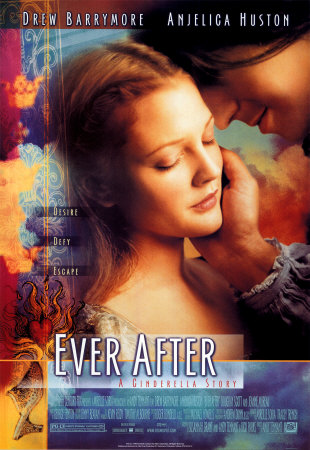
When I did my Fairy Tale Round-up for Cinderella a few weeks ago, I forgot a perfectly lovely movie.  Beedrill pointed it out, which sent me off to Netflix to request a disc and re-watch Ever After.

It’s a charming retelling of Cinderella, starring Drew Barrymore as Danielle, a smart young woman trodden-down by her stepfamily.  Set in Renaissance-era France, there’s no magic but plenty of whimsy, and definitely a fairy tale feel.  The plot is pretty standard fare, but the characters really shine.

Danielle is a wonderful Cinderella, well-read and keenly aware of the injustices of the society around her.  I do wonder a little why she never set out to find a place away from her stepfamily, but this is mostly justified by her circle of friends among the servants and her obvious attachment to her home.  There’s also an interesting dynamic between Danielle and her stepmother, the Baroness, as Danielle longs for acceptance from “the only mother she’s ever known.”

The stepfamily is wonderful–the Baroness is nasty, demanding, and selfish, while bemoaning how hard she tries and how little everyone around her appreciates all that she does for them, and can’t everyone just put in a little more effort, please.  It reminds me a bit of The Devil Wears Prada, actually.  The older stepsister, Marguerite, is beautiful but horrid and self-absorbed, while the younger stepsister, Jacqueline, is a sympathetic if largely passive character.

Danielle’s friends among the servants are mostly minor characters, but it’s so nice that they exist–so many characters, Cinderellas and others, seem to be utterly alone in the world, which just isn’t realistic.  Danielle’s friends collectively serve the role of fairy godmother, with some help from Leonardo Da Vinci.

Danielle’s prince is Henry, and if there’s an implausible aspect of the story it’s in what Danielle sees in him.  He’s handsome enough, and he’s a prince of course, but in the beginning of the story he’s also arrogant and immature.  He grows rapidly under exposure to Danielle’s philosophy and far more mature view of the world, so I suppose he does seem to have potential.  They have a good chemistry so I believe she likes him…I’m just not always sure why!

There are some excellent funny moments in here, especially involving Da Vinci, or the stepfamily.  There’s also a sequence near the middle involving a group of gypsies that I don’t want to spoil for anyone…so I’ll just say it’s wonderful!

Any criticisms…well, the dialogue is remarkably formal at times.  It’s occasionally off-putting, though mostly I think it works with the style of the movie.  The post-ball timeline is very unclear and it’s hard to tell how much time is elapsing between events.  I’m also a bit doubtful about how quickly they contrive to hold royal weddings, and the apparent ease with which people can get in or out of royal engagements…  But all of those are minor points, far secondary to the drive of the story.

This movie reminds me a little of Robin McKinley’s Beauty.  It’s not anything too radical or innovative, but it’s a lovely retelling with a strong heroine and a sweet romance.  And any comparison to a McKinley book can be considered a high compliment!