Following a Talking Cat to a Secret Country

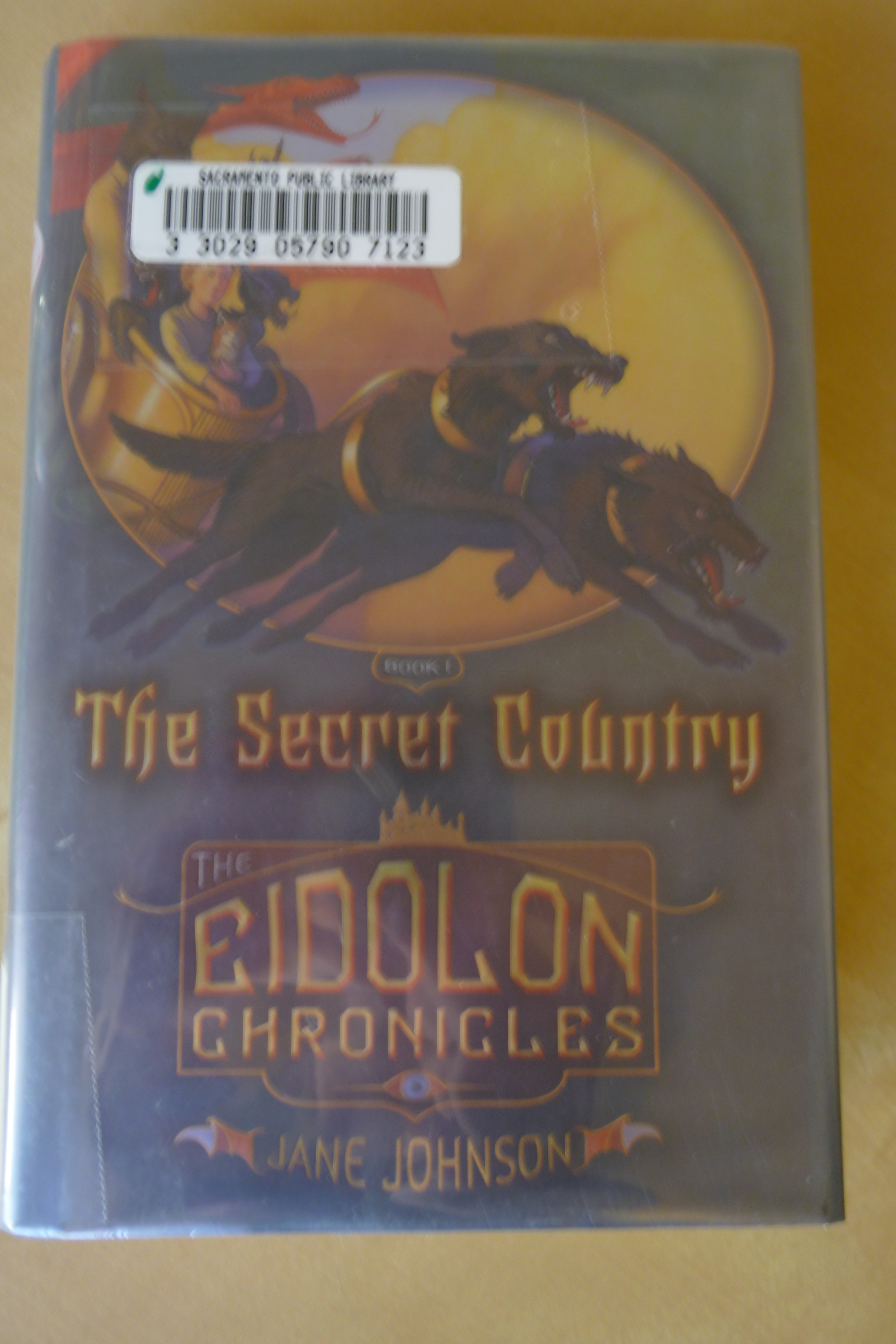
I read The Secret Country by Jane Johnson years ago–at least, I have to believe my book list when it tells me I did!  It was a book that I really couldn’t remember anything about (which is rare), except just one scene.  I decided to pick it up again, so that I could decide whether to read the rest of the books in the Eidolon Chronicles, as part of my goal to finish partially-read series.

Even though this obviously didn’t make much impression the first time 😉 I enjoyed reading it this time through.  It’s a fun kids book of a particular type–ordinary young boy confronted with magic and called upon to save a magical world.  In this case, the boy is Ben, who buys a cat at the pet store when the cat starts talking to him, demanding to be taken home.  The cat, Iggy, explains that he’s from Eidolon, also called the Secret Country, which is being threatened by an evil would-be king.  Part of the problem is that their queen is missing…and guess who turns out to be the prophesied prince.

I think talking cats always win the day.  I’m a cat person, and I’m writing a novel with a talking cat, so I’m biased–but snarky, funny cats who say out loud everything we know cats are thinking all the time…always going to be great.  I also thought Iggy had a surprising amount of depth, as a “great explorer” who knows he isn’t really very good at his profession.

Ben is a likable if somewhat generic hero, and he’s surrounded by interesting magical creatures (besides Iggy, there’s a selkie and a dragon).  Together they have to battle some truly nasty villains, and I like the way people in our world turn out to be villains in Eidolon–and they turn into horrible and creepy monsters when they change worlds.  I’m also hoping that later books in the series will have more on Ben’s sister, who so far had a very small part but has potential.

One side-note on a random point–I can’t decide whether or not to enjoy the Neil Gaiman reference when Ben is reading the Sandman comics.  I mean…yay, Neil Gaiman reference!  But at the same time, Ben is WAY too young to be reading Sandman (as is the target age group of this book).  That series was too twisted for me, and Ben is a kid.  If you’re going to reference Neil Gaiman, make it an age-appropriate book.

On the whole, a light but enjoyable read.  I am left with a question, though–the scene I thought I remembered wasn’t actually here!  I don’t think I read later books in the series…so I’m left with a mystery memory.  Does anyone remember a scene like this?  There’s a big fantasy battle, and in the middle of it a boy throws his lucky stone at the villain to protect a girl (a sister or a friend, I don’t remember), and the stone turns out to be some long-lost magical item of power.  Ring a bell with anyone?

Meanwhile, I do plan to finish out this series–maybe the scene will still pop up in a later installment after all!

Author’s Site: http://www.janejohnson.eu/

Other reviews:
The Alchemist’s Arcanabulum
Okbo Lover
Anyone else?

Making a Visit to Mayberry, in Honor of Andy Griffith

I was so sad last week to hear that Andy Griffith had died.  I know actors aren’t their characters, but Andy Griffith is always going to be Sheriff Andy Taylor of Mayberry for me.  The one consolation in his death is that I imagine a lot of people dropped by Mayberry last week, or have been inspired to watch the show some time soon.

I’ve actually been wandering through The Andy Griffith Show for the last several months, so I thought it would be a very timely review topic today.  I’ve probably seen almost every episode before, but it’s one of those shows I’ve caught here and there for my whole life, so I’ve enjoyed starting at the beginning and working forward through Netflix’s streaming collection.

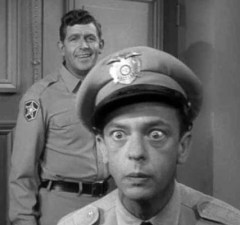
Andy and Barney

The TV show, running from 1960 to 1968, focuses on life in small-town Mayberry.  It centers on local sheriff Andy Taylor and his family and neighbors.  It’s a sweet, warm, innocent show, where the problems are real but never too big or too dark, where the characters genuinely care about one another, and where any crisis can be resolved in 25 minutes, usually through some common-sense wisdom from Andy.

The cast of characters follows one of my favorite rules for comedy, with your fairly normal lead surrounded by much funnier figures.  Deputy Barney Fife (Don Knotts) is desperate to be a real law man, intent on rules and regulations, full of big plans.  He’s at the ready with his citation pad and his gun–and one bullet, which he keeps in his shirt pocket.  Barney is a hopelessly incompetent deputy, and keeping his ego intact is an ongoing job for Andy.  Barney always tries so hard, and the feel-good nature of the show means that things always work out in the end.

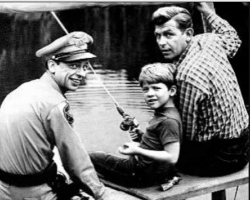
Andy and Opie

Andy is a widower with one son, Opie, played by a very young Ron Howard.  There are other shows from the same time period where the one kid character is either irritating (The Dick Van Dyke Show) or kind of a non-entity (I Love Lucy), but Opie is a genuinely good addition to the show.  He’s not just cute–he has good comedic timing, and he’s a smart kid without being unreasonably precocious.  Some of the Opie-episodes are a little saccharine, but others are really wonderful.  Sometimes Andy sets Opie straight on an issue, and other times Opie, in his child innocence, teaches Andy something.  There’s a very nice relationship between the characters, and if I was picking best TV dads, Andy would be in the top.

Other characters include the warm and kind Aunt Bea, slow but very nice Gomer Pyle, town drunk Otis Campbell (who lets himself into the jail after he ties one on of a Saturday evening), Barney’s very understanding girlfriend Thelma Lou, and a recurring host of others.  It’s an odd thing to say, but it’s really a show full of good people.  Sometimes the premise of a character-focused show is to have them fight with each other, but that’s rarely the case here.  People get themselves into trouble one way or another (Barney rushes into something, Aunt Bea is taken in by a conman, Opie and his friends have problems with a teacher), or there’s a larger conflict (the bank is robbed or Gomer loses his job), and Andy and sometimes others have to solve the problem.

It’s not supposed to be a good adjective to use, but it’s a really nice show.  It’s funny, it’s sweet and it’s positive.  It promotes good common sense values like honesty and loyalty, and while sometimes things do get gray and complicated, at the end of the day there’s right and wrong and some kind of answer.  In college, I had a roommate who liked to watch a show called Intervention, which was about exactly what it sounds like, dealing with drug users.  While she was watching that, I was watching The Andy Griffith Show, and I think we both had our world views and mental health be heavily influenced by what we were watching.  We can’t ignore the reality of the world, but we can choose what we focus on, and what entertainment populates our mental landscape.  I’d prefer to have Mayberry in mine, rather than the dark and twisted worlds that show up in a lot of modern TV.

So if you’d like to spend 25 minutes with some lovely people and enjoy a positive, simpler world, I highly recommend you visit Mayberry.  It’s streaming on Netflix, so choose any episode you like.  I suggest buying a jar of pickles and sitting down with them to watch The Pickle Story (Season 2, Episode 11), when no one has the heart to tell Aunt Bea that her prized homemade pickles are terrible…so they get stuck eating jar upon jar.  It’s one of the most popular episodes, very funny and it encapsulates the warm and caring nature of the show.  It’s a town well-worth visiting.

Celebrate the Fourth with Mr. Smith in Washington

What’s your favorite patriotic movie?  I’m a big fan of 1776, but one of my favorites for the Fourth of July is Mr. Smith Goes to Washington–even though it has nothing to do with the American revolution.
It’s an old Jimmy Stewart movie about party politics and idealism.  A governor needs someone to fill a senator seat until the next election, and is being pressured by various interest groups.  On his children’s advice and with a lucky coin toss, he ends up choosing Jefferson Smith (Stewart), the wholesome and naive head of the Boy Rangers.  In Washington, Smith is taken under the wing of established Senator Paine (Claude Rains).  Everyone figures Smith will sit quietly and cause no trouble, but when he proposes a bill to establish a boys’ camp, he inadvertantly sets events in motion that will expose Paine’s corruption, setting Paine and the political machine against him.

It’s really Smith’s wide-eyed idealism that makes this movie for me.  It’s not about the founding fathers, but Smith believes in all those principles they stand for.  You know, things like freedom and honesty and a government that works for the people.  There’s a wonderful scene when Smith first comes to Washington D.C., when he just wanders around to look at all the sights and all the monuments and is breathlessly blown away by history and meaning.

And there’s the famous filibuster scene, Smith’s last-ditch effort to fight back as the political machine turns everyone against him.  Jimmy Stewart plays exhausted desperation and sincerity very well.  He’s the perfect fit for the role throughout–he takes impossible naivety and makes you believe in it.  He’s the classic Everyman, and his Everyman is a really nice guy you’d like to know.

It doesn’t hurt to have Claude Rains in the movie either.  He forever endeared himself to me in Casablanca–come to think of it, as another corrupt government official.  Captain Renault was cheerfully corrupt and honest about it, while Senator Paine is less witty and more two-faced and devious.

It’s a classic Frank Capra movie (he also directed It’s a Wonderful Life and You Can’t Take It with You) and you know what you’re getting with Mr. Capra–idealism, strong values and warm feelings.  It’s a black-and-white movie with a black-and-white message, and even though I think life and certainly politics have a lot more gray most of the time, it is nice to celebrate the holiday visiting Capra’s idealized world.

And then, of course, to set off some fireworks.  How will you be celebrating the Fourth of July?

Other reviews:
Great Old Movies
Cinema 1001
Anyone else?

The Stories That Change Our Lives – Inspiration from Tamora Pierce

Today I have a post up on my company’s blog, PhilanthroPost, about how inspiring I found Tamora Pierce’s books when I was growing up.  I’d very much appreciate it if you’d drop past the blog to read it, and maybe leave a comment or a like!  Here’s the beginning of the post:

***************

“Girls are 50% of the population. We deserve to represent 50% of the heroes.”
– Tamora Pierce

Sometimes the people who inspire us never existed.  And sometimes it’s the people who created those fictional characters who furnish the inspiration.

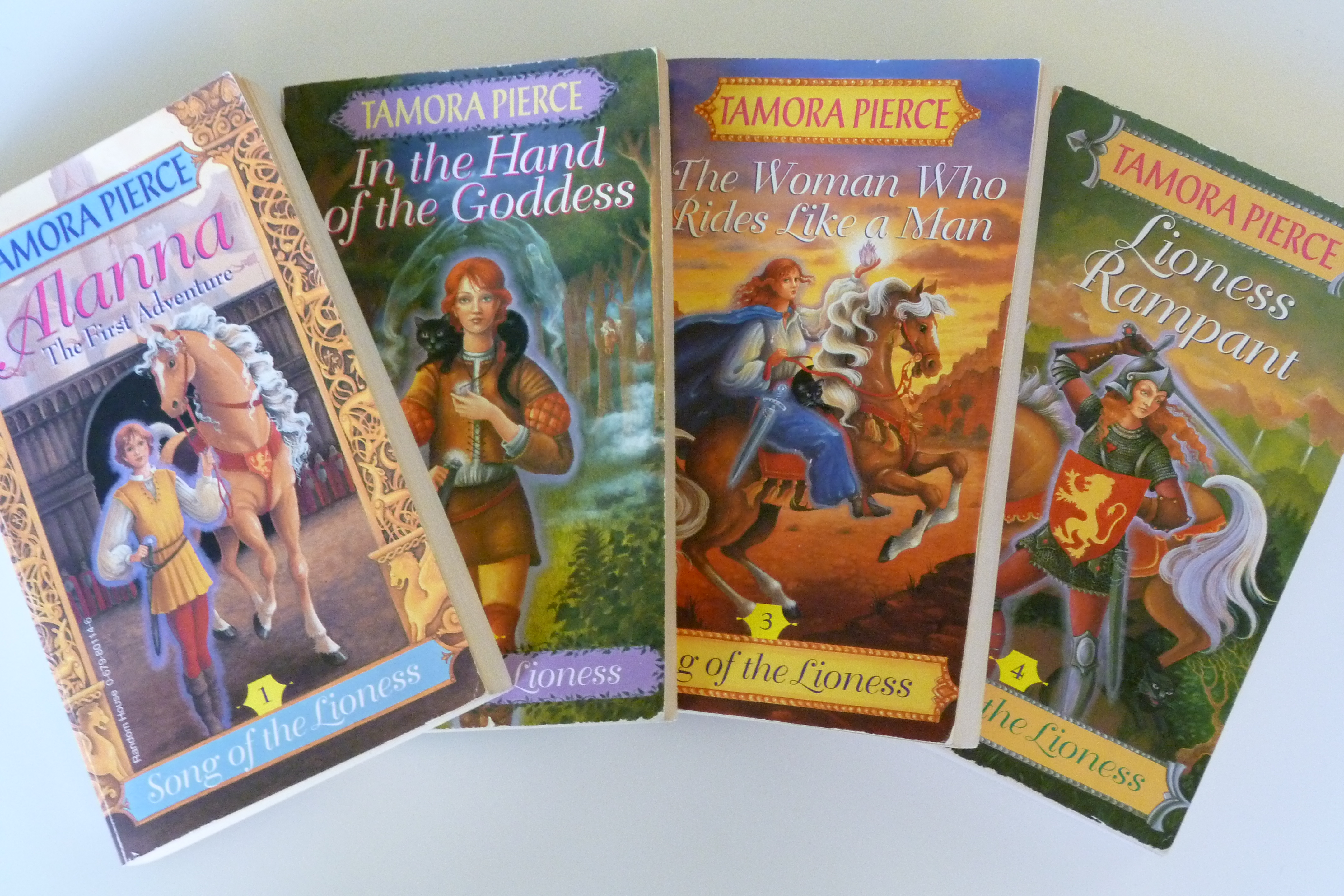
Tamora Pierce is an author of young adult fantasy novels, and at the risk of sounding like I’m exaggerating, I can tell you that she changed my life.  Tamora Pierce writes books about strong women, or “sheroes.”

When Pierce was starting out in writing, there was (and to some extent, still is) a belief that books about boys were more marketable.  The theory goes that young adult girls will read stories about male heroes, but young adult boys won’t read about female leads—write about a boy and you have twice the market, meaning there weren’t as many stories about heroic girls, and not as many role-models for girls to read about.

But almost thirty years ago, Pierce wrote Song of the Lioness

Read the rest of the story on PhilanthroPost!

A Sci Fi Retelling of Cinderella

First, a bit of business–the first post for the Going Postal group read goes up a week from tomorrow.  I contacted everyone who let me know they were interested, but there’s still plenty of time to join in–so let me know if you’d like to!  Now, on to the review…

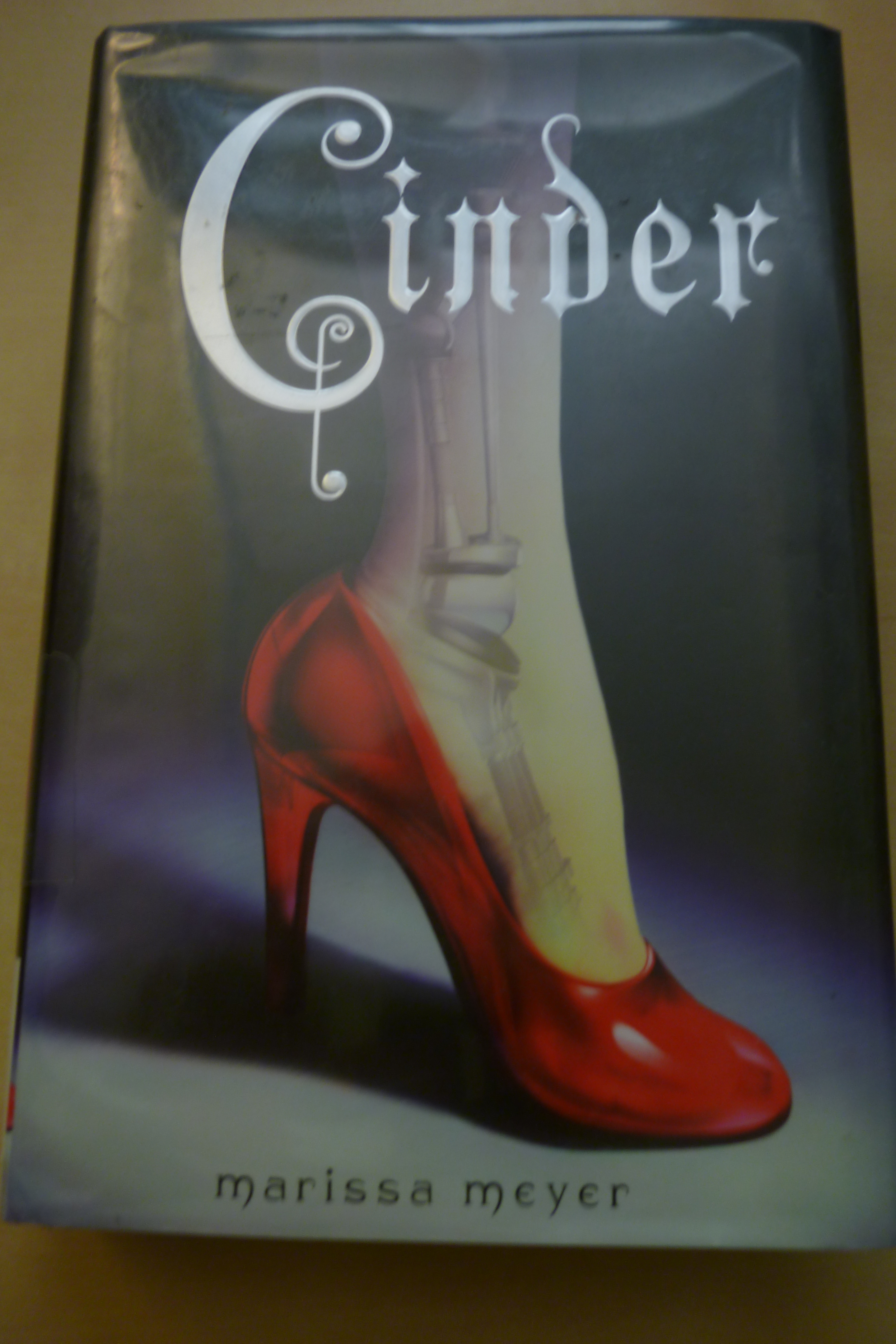
I put Cinder by Marissa Meyer on hold at the library at the beginning of the Once Upon a Time Challenge–in mid-March.  It’s only fair to say that my library usually runs through hold lists pretty quickly…but in this case, the book finally got to me in mid-June.  I managed to read it about five days before the OUaT Challenge ended!

So was it worth the wait?  Yes–because I was very curious about it.

As you may have guessed or known, Cinder is a retelling of Cinderella, though I was surprised by how loose a retelling it actually was.  Set a vague distance into the future, Cinder is a cyborg, mostly human but with a mechanical hand and leg, and circuitry in her brain.  While she is downtrodden by her (adoptive, not step) family, and there is a prince and a ball, the book mostly focuses on the search for a cure for a pandemic sweeping the globe, as well as rising tension with Lunars, the human moon-dwellers who have developed mental powers to manipulate others.

I quite liked Cinder.  She’s a strong Cinderella who’s plotting escape from her family and doesn’t actually care that much about the ball–she has bigger problems to think about.  I loved the cyborg-ness too, and wanted more of that element.  What was there was fun, from the low-tech (storing things in a compartment in her calf) to the high-tech (she can mentally connect to the internet, and her body warns her when she’s overheating).

Prince Kai was a nice guy, though a bit bland.  He served his role in the story perfectly well, and had a little more complexity in his uncertainties about how to fulfill his position as prince (and soon to be emperor), but he didn’t strike me all that much either.  In a bit of a reversal of that, my one biggest issue with the book was that I wasn’t sure why he was so struck by Cinder.  He starts singling her out almost as soon as he meets her–and I do appreciate that they meet and start developing a relationship well before the ball.  It’s just that I’m not sure what prompted him to pursue that relationship.  I mean, I like Cinder–but I’m really not sure why the prince, who has every girl in the country to pick from, decided he liked this particular one.  I’m all in favor of the idea that he saw something special in her, only I don’t feel like the book ever made clear what exactly it was, or even if there was something–I’m just assuming there must have been.

So it wasn’t a heart-stopping romance, at least not for me, but I am curious to see where it goes.  This book is the beginning of a series, and there are a lot of threads still to be explored.  There are some good tensions in Cinder and Kai’s relationship, like the political marriage he’s being manuevered into with the Lunar Queen, and the small fact that Cinder is trying to hide being a cyborg from him.  Cyborgs are looked down on as somehow less than human, in what I’m sure is intended to be a reimagining of the social structure of Cinderella’s original setting.

I would be remiss if I didn’t also mention Iko.  She (it?) is Cinder’s friend and somewhat fairy godmother-like figure, and she’s a robot.  She’s a robot who is also a hopeless romantic, quite forward, and often funny.  She wants Cinder to go to the ball more than Cinder does, and she’s really rather adorable at times.  The most moving moment in the book for me involved Iko’s personality chip–and that’s all I’m going to say, to avoid any spoilers!

So, to sum–fascinating concept, good characters (especially Cinder and Iko), okay romance, pretty good plot though at times it stretched on a bit, and one late-in-the-book twist was really obvious (maybe that was just me–but I don’t think so).  I liked the book–I didn’t love it–but I am adding it to my list of series, and plan to read the next one when it comes out!

Author’s Site: http://www.marissameyer.com/

Other reviews:
Stella Matutina
At Home with Books
Book Journey
Andrea’s Book Nook
Book Nut
I saw this on a LOT of blogs before it finally got to me…did I miss yours?