Stumbling Upon Diana Wynne Jones

I have somehow had the great misfortune to miss Diana Wynne Jones-related blogging events in the past–so I was thrilled to be in time for Diana Wynne Jones Days!  Thank you to Charlotte, who mentioned it a few weeks ago and tipped me off about it.  DWJ Days is a celebration of all things Diana Wynne Jones which started April 12th, featuring bloggers sharing their experiences with the wonderful, magical books of Diana Wynne Jones.

It’s a little complicated to explain how my reading of Diana Wynne Jones began, because I managed to stumble across her for the first time–twice.  Maybe three times.  The first first time, I happened across Witch Week on my library’s shelves.  I don’t know how old I was, only that I was young enough to have no context at all for the Guy Fawkes references (he isn’t heavily featured in American history books for kids!)  Considering that lack of crucial knowledge, I’m almost surprised by how much I loved the book.  I think the world-similar-but-different-from-ours concept still seemed new and exciting, I enjoyed the magical mix-ups, and I was intrigued by the boarding school setting, even if it was a bleak boarding school.

My memory of what I read that long ago has gone vague, but I think I read Witch Week at least two or three times.  And…I didn’t think about looking for anything else by the author.  I’m almost sure I also read and loved The Spellcoats at some point around this age, but I have no memory of connecting the two books at all.  I had no idea that both books were part of series, or that this (very prolific!) author had written so many other books.

Years go by.  During high school, I wrote about a character named Richard Samuel Jones.  I was still very much a browser at the library when it came to picking up new books, and there came a day when nothing on the shelves seemed to be appealing to me.  So, on a whim, I decided to go see if anyone named Jones had written anything interesting.  I found the Diana Wynne Jones shelf, and picked up something, I don’t know what but maybe A Tale of Time City.  Whatever it was, I loved it, and this time I had the good sense to keep looking for more books by the same author!

I eventually realized I knew The Spellcoats when I read an omnibus of the Dalemark Quartet, and discovered that I had already read Witch Week when I made my way through the Crestomanci books.  It turned out this “new” author was an old favorite all along…once I put the pieces together!

It was years more before I ever realized how important Diana Wynne Jones is in children’s fantasy.  I think it was really only when she died, and suddenly all the book blogs I follow started talking about her, and all the authors I follow turned out to have known her personally, that I really got it. In a way, I’m glad I didn’t know–because she was “my” author that I happened to stumble on in the silliest of ways.

And I mostly went on stumbling over her books.  I have too many books on the To Be Read list to browse much anymore, but I was a browser for years, and on days when I couldn’t find anything, I could be sure of discovering something by wandering over to the J shelf.

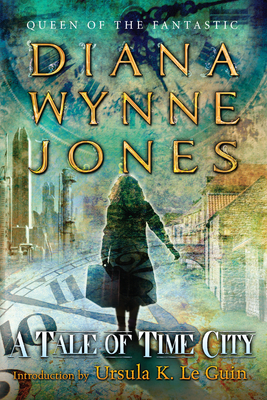
Part of the fun of Diana Wynne Jones Days is that Firebird is reissuing several of her books with new definitive editions.  Considering A Tale of Time City is one of my favorite books that I somehow don’t own, I may need to pick up a copy with that lovely cover up there.  Check out the list to see if they’re reissuing your favorite!

I’ve long since lost count of how many Diana Wynne Jones books I’ve read.  However, I’m a list-maker, so I can look it up for you–twenty-seven!  All in all, I think it’s a good thing I didn’t give Richard Samuel Jones the name Smith instead.  Maybe there’s some wonderful author named Smith…but it’s hard to believe it could be anyone who would top Diana Wynne Jones.
Another Lady Knight-to-be

As part of my personal quest to re-read all of Tamora Pierce’s Tortall series (18 books!), I re-read her Protector of the Small quartet during March…then took forever to get to this review!

The heroine of Pierce’s third Tortall quartet is Keladry of Mindelan.  The first time I heard about this series, she was described as a girl with a knack for animals who wants to become a knight.  And I thought…well, isn’t that just a combination of The Song of the Lioness, about Alanna who wants to be a knight, and The Immortals, about Daine with her magical knack for animals?  It kind of is–but in most ways it’s not.

Alanna had to disguise herself as a boy to get her shield, but after her friend Jonathan becomes king, he decrees that girls can become knights.  Then for ten years, no girl ventures to try it.  Finally Keladry comes along, the daughter of a diplomat’s family who has lived most of her life in the Yamani Islands (a very obvious take-off on Japan).  Alanna is her hero (should I say heroine?) and she dreams of becoming a knight so she can protect the defenseless.  She becomes a page, but faces fierce challenges from boys and even instructors who don’t think a girl can be a knight.

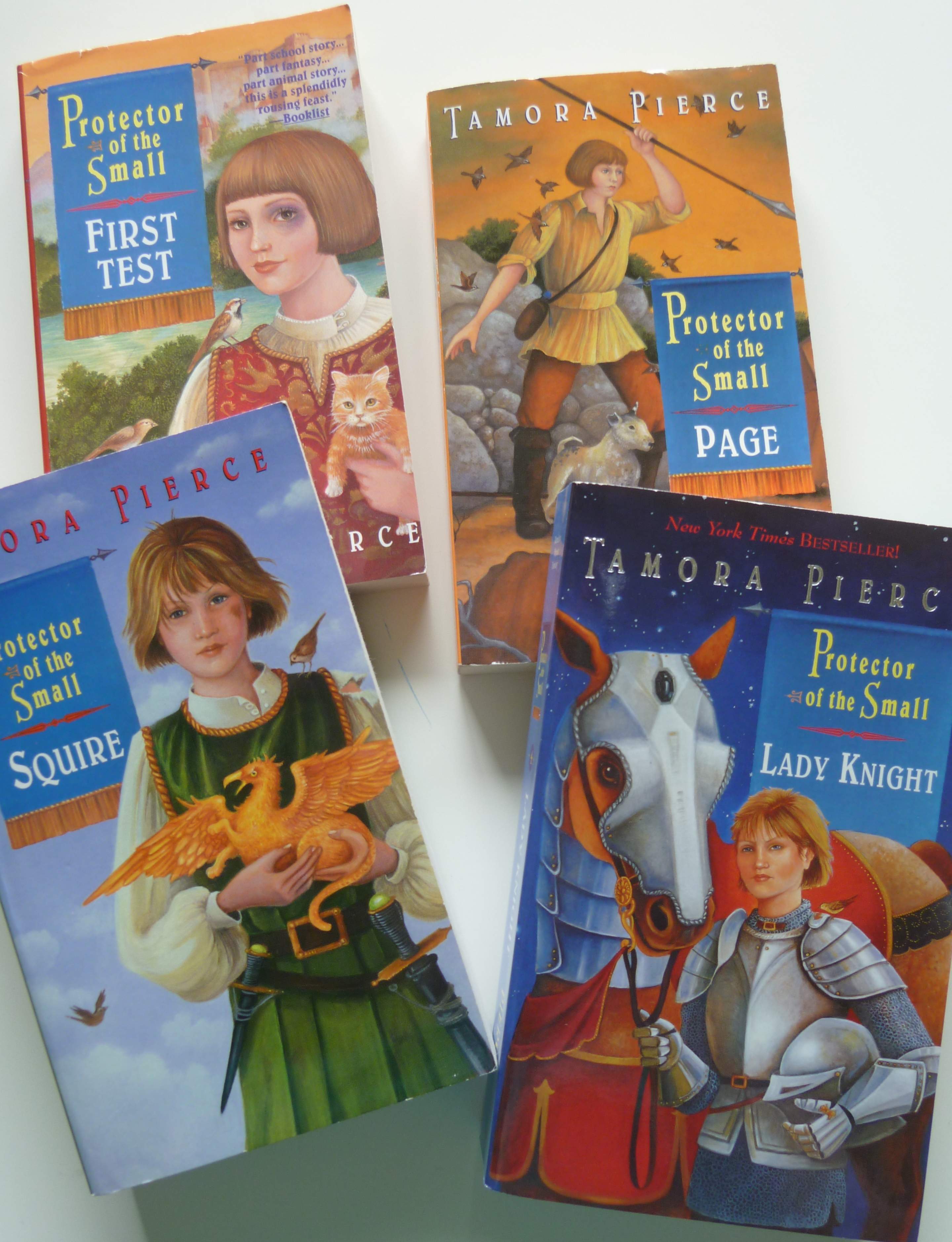
The first three books (First Test, Page and Squire) follow Kel through her training, and the fourth book, Lady Knight, is about her first adventure as a knight, mostly commanding a refugee camp during a war.  (Sorry if that was a spoiler to tell you she does eventually get her shield…) In the first book Kel is only ten, but like Alanna, she’s a very OLD ten-year-old.  To diverge slightly, I actually have a theory about this.  Pierce originally envisioned Song of the Lioness as an adult book.  I’m guessing when she decided to make it YA, some editor told her the characters had to be younger, so she dropped five years off their stated ages; all of Alanna’s peers act pretty consistently five years older than they’re supposed to be.  Once Pierce had established that pages start training at ten, she was stuck with that in this quartet too.  I think my actual point here is, don’t be off-put by a quartet that starts out about a ten-year-old.  Kel never feels that young, and she gets older quickly.

The animals turned out to be a relatively minor point; Kel has a bad-tempered horse, a disreputable dog and a flock of very clever sparrows, but the intelligence of the animals is largely chalked up to Daine’s presence at court.  She has powerful magic that sort of seeps into the animals around her.  Kel doesn’t have any magic of her own, the only Pierce heroine not to have some kind of magical ability.

Protector of the Small is in many ways a transition series, both for Pierce’s writing and my personal engagement with the books.  These were written when I was in high school, so I read them later and less frequently than the first two quartets.  I’m not sure, but this may be only my second time through the series.  I like them, but I don’t madly love them the way I do the first two quartets–but I don’t know how much of that is simply my personal history and familiarity with them.  I do know two people who say these are their favorites.

I like Kel, but I don’t love her.  I admire her very much–more than Daine, if I really stop to compare admirability.  Kel is tough and brave and, as the quartet title suggests, constantly trying to protect those around her.  She wages a campaign against bullying among the pages in the first book, and gets into the defense of battered women in the second.  In the fourth, she’s fiercely protective of her refugees.  She’s a great character and a wonderful role model for girls.  And I do like her–but somehow I don’t quite love her.  Maybe she’s a little too serious, or a little too righteous, or maybe I just met her later than I met Alanna and Daine.  She’s inevitably the other lady knight.

Alanna is back in a small supporting role, and I’m always thrilled to see her.  Jonathan, Daine, Numair and a handful of other major characters from earlier books also have roles again, most notably Alanna’s friend Raoul, who if anything has a bigger part here.  As ever, it’s fun to see how characters’ lives are going along.  There are many good new characters here too.  My favorite is Neal, Kel’s very funny best friend (him I love), probably followed by Tobe, an orphan Kel takes under her wing in the fourth book.  There’s also a perfectly dreadful villain, Joren, who matches Duke Roger for charming viciousness.

I mentioned transitions in Pierce’s writing–Protector of the Small is definitely a changing point from the simpler earlier books to the more complex ones she’s writing now.  It’s a little hard for me to explain how they change, because Song of the Lioness has complex characters and complicated plots and good writing…but somehow the more recent books feel denser and grittier and more mature.  They do get darker, especially the fourth book, and the third and fourth are both much longer than earlier ones.  They were written right about when Harry Potter was getting popular, and Pierce directly thanks Rowling for opening the door to longer YA books.

There’s something more realistic about this series, although I’m struggling to put my finger on it.  Tortall has felt like a real, complex world from the beginning, but there is a certain amount of sorcery and legend feel to Song of the LionessProtector of the Small has less magic, and it gets into practical things like politics, diplomacy, the complications of supplying a band of knights, the difficulties of the legal system…  Alanna went through tough training, but Kel seems to keep count of the specific training and the bruises involved much more.  It’s just a bit of a different feeling.

In a way this quartet occupies an unfortunate space–I think I’d be more enthused about Protector of the Small if I didn’t love Song of the Lioness so much.  It really only falls short by comparison–and to be not as good as one of my most favorite quartets ever…well, that’s barely a criticism, really.  So, if it isn’t already clear, let me just say that this really is an excellent set of books, a fantasy series that is nevertheless gritty, with characters that are engaging and very human.  Well-worth reading.

And now I’m down to just two more Tortall books to re-read!  Stay tuned for a review of the Trickster books soon.  🙂

Author’s Site: http://tamorapierce.com/

Other reviews:
Respectable Collection
Young Adult Fiction & Whiskey Sours
The Literary Tally
I found a strange lack of reviews…I know other people are reading Pierce!  Point me to your reviews!  🙂

A Former Cinderella Finds a Job

I don't actually like this cover...both characters look wrong.

The Fairy Godmother by Mercedes Lackey is a great two-challenges-for-one-book, fitting neatly into the Once Upon a Time challenge, and also my Finishing the Series challenge.  It’s actually the first book in Lackey’s 500 Kingdoms series, but somehow I contrived to pick up The Sleeping Beauty first, which is Book 5.  They seem to be self-contained, so I don’t think it much matters.

Life in the 500 kingdoms (I think that’s meant literally) is constantly influenced and directed by the Tradition, a nebulous force which wants everything to go as, well, tradition dictates.  In practice, this means that certain circumstances result in events being magically nudged (or shoved) along towards some very recognizable paths.  If a situation is starting to look like a Brothers Grimm or Charles Perrault story, the Tradition wants to make it go towards its proper conclusion.  Not that Grimm or Perrault are referenced, but that’s how it all plays out.  Only sometimes, it doesn’t quite work–and the Tradition can drive towards both happy and tragic endings.

The Fairy Godmother is about Elena, who should have been Cinderella–she has the stepfamily and the drudgery.  Unfortunately, the prince in her kingdom is only eleven, and Elena is stuck with an unfulfilled story, and a great deal of magical energy hovering around her.  Along comes Godmother Bella, who takes Elena under her wing to train her up as a Fairy Godmother.  Not necessarily fairies, the Godmothers nudge and influence and shape events, trying to push the Tradition towards the good stories and to mitigate the effects of the bad ones.

This book is really in two parts, first about Elena’s apprenticeship and then about her adventures as a Godmother, particularly in dealing with a difficult prince, Alexander, who she turns into a donkey and takes home to do farmwork in order to teach him a lesson.

I enjoyed the first chapters of the book very much, as Elena struggles with her Cinderella storyline.  The book bogged down for me a bit after Elena goes with Bella.  Lackey spent a lot of time on world-building, under the guise of telling about Elena’s studies to be a Godmother.  The funny thing is, it’s all fascinating ideas…only I don’t actually need to know the distinction between a Godmother, a witch and a sorceress unless it’s relevant to the plot.  I think this is a first-in-a-series problem, too much narration trying to establish the world, when many of the details aren’t based in any plot or character development.  It may not have helped either that I had read a later book in the series, so some of this I already knew.

The book picked up again in the second half, once Alexander came into it.  He brought an interesting dynamic into things; he certainly needed to go through some character growth, but I actually never thought he was as bad as Elena did.  Some parts are in his point of view, and I could quite often see where he was very reasonably coming from, while she was convinced he was being stupid or just generally nasty.  Also, Elena is supposed to be the heroine, but she fell into the same kind of behavior I always question about the traditional Fairy Godmothers.  You turned someone into a donkey to make him be more considerate of others?  Really?  That makes sense to you as a way to teach a lesson?  Of course it works out, because these things do, but I had a lot of sympathy for Alexander when he felt he was being badly treated.

The characters were good on the whole.  I liked Elena reasonably well, and Alexander was interesting and likable most of the time.  Elena also has a group of brownies working with her and they were rather delightful.

I really don’t think I’m giving anything away by saying that Elena and Alexander end up in a romance (it’s abundantly obvious, if only because there’s no one else she can get involved with).  I was a bit dissatisfied by that romance.  It turned out all right, but there wasn’t much basis for it.  It was mostly a matter of realizing they were physically attracted to each other, and that circumstances made them convenient romantic partners.  Sure, physical attraction can be fun, but I prefer a bit more substance when I read a romance.  The romance also takes this out of the YA category.

A good book–not a fantastic book–but a brilliant premise.  I’ll definitely be continuing with the series, because I do love the premise, and if we’ve got the world-building out of the way now, I hope for better things in later books!

Author’s Site: http://www.mercedeslackey.com/

Other reviews:
Reawrite
Book Buddies Online
Crooked Reviews
Anyone else?

Holmes Meets the Phantom–Again

I’ve been on a Phantom of the Opera kick lately–I mean, more so than the ongoing attachment I’ve had to the story for the last eight years.  I wrote a post about different versions, and learned about a new-to-me book, The Canary Trainer by Nicholas Meyer–thank you, Swamp Adder!

Now how I could resist the Phantom of the Opera meets Sherlock Holmes, written by the director of Star Trek: The Wrath of Khan?  Especially after rereading the flawed but enjoyable Angel of the Opera by Sam Siciliano, another Holmes-meets-the-Phantom story.  It may not be quite fair to compare them (especially since The Canary Trainer was published a year earlier) but it’s also unavoidable.  TCT was better than AotO…and worse, contradictory though that might sound.

The big problem with AotO was that it completely maligned Watson.  TCT at least did better in that regard, and that does make a big difference.  Watson was back in his proper place as Holmes’ closest friend.  Holmes regards Watson’s writing about him with outward disdain and secret but obvious pride–as it should be.  The book opens very well, with Watson visiting Holmes and discussing past cases, finally teasing a new story out of him.  Here we go into a book-length flashback, told from Holmes’ point of view.  I think I would have preferred a story that kept Watson’s POV, but this worked well enough–and better than bringing in a superfluous new narrator.

The story is from Holmes’ “lost years,” the time between Moriarty going off a cliff and Holmes’ return from the dead.  Apparently Meyer has written other books set in this time period, including one that brings Holmes and Freud together.  I haven’t read the others, and though they’re alluded to occasionally, I don’t think it’s necessary in order to read this one.  The story, as you’ve probably guessed, has Holmes deciding to go to Paris.  He’s incognito, since everyone presumes him dead, and has to find other, non-detective work.  He chances to hear that the Paris Opera is hiring a new violinist, and applies for the job.  Once at the Opera, he finds mysterious happenings involving the Phantom.  He also encounters Irene Adler, who is singing at the Opera.  She recognizes Holmes and asks him to help her new friend, Christine Daae–the “canary” who has a mysterious trainer.

And so it goes from there, with a falling chandelier, an inept viscount, a soprano in distress and a crazy man in a mask.  Like Siciliano, Meyer doesn’t make major plot changes.  Holmes is investigating the story we all know, and if nothing is greatly improved, nothing is done badly either, plot-wise.

You might say the same for Holmes.  He was reasonably well-drawn, nothing extraordinary.  If there’s anything reading other writers tackle Holmes has done for me, it’s made me appreciate Doyle’s ability to give Holmes clues and let him draw conclusions.  No one else seems to be able to do that to any great extent, although in one scene Holmes does figure out Raoul’s entire life circumstances just by looking at him.  But it was one moment, instead of a perpetual state.  I won’t say that the absence of deductive reasoning was acute enough to have the character actually off-track, but he wasn’t strikingly on-track either.  He also seemed to struggle a bit in his investigations.  I think he was more accurate to the original and more likable than Siciliano’s Holmes, but also less capable–and not as likable or as capable as Doyle’s Holmes.

We don’t see a whole lot of Christine and Raoul, and they were pretty standard when we did see them.  Raoul is immature and incompetent, Christine is hopelessly innocent and naive.  They both fulfilled their roles without doing much more than that–although Christine did get to score one point on Holmes.  She’s talking about her Angel of Music, and Holmes says he seems very angry for an angel.  To which Christine returns, “Haven’t you ever heard of avenging angels?”  Touche, Miss Daae.  But on the whole, she was pretty much sweet and stupid.  Looking at the basic plotline of Phantom, Christine has to be either very stupid or very clever, either a victim or the one who’s manipulating the whole thing.  I’d love to see a version where Christine is manipulative (think about it–who comes out ahead quite frequently?), but so far everyone’s been choosing to make her stupid or at least confused (though I think Webber is open for interpretation).

Anyway, now we come to the key question: the portrayal of the Phantom.  Usually, he’s a deeply complex character: tragic, sympathetic, terrifying, sometimes romantic, brilliant…certainly the most interesting one in the story.  That’s the later versions; in Leroux, he’s much more a monster.  Everyone else has been working on reforming him ever since.  Except Meyer.  The Canary Trainer is the first and only version I’ve found where the Phantom is actually less sympathetic than in Leroux (so…points for originality?)  This is the first time he’s gone the opposite direction and felt more like a character from a monster flick, stranger, crazier, and less sympathetic.  If you’ve read Leroux, you’ll know that making him crazier is really saying something.

This is the first time the body count has actually gone up.  In Leroux, one person is killed by the chandelier; in The Canary Trainer, it’s almost 30.  Four men who were drugged in Leroux to get them out of the Phantom’s way end up killed here.  You can make the point that the Phantom is a murderer regardless of how many people he kills, but I think there’s still little doubt that Meyer was deliberately creating a more villainous Phantom.  I don’t quite know what to make of that.  In a way I do applaud his decision to do something different.  But…there’s a reason everyone else made the Phantom more sympathetic.  He’s more interesting that way.

That may kind of sum up the book.  There’s nothing really wrong with it.  It’s not flawed in the same ways that Angel of the Opera is flawed, nor is it flawed in other serious ways.  But it didn’t do anything all that interesting either.  Holmes and the Phantom were both stripped of what makes them fascinating (Holmes’ deductive ability and the Phantom’s complexity), and in the end you get a book that is not bad–better than some versions–but not great either.  I don’t hate it, and I don’t love it.  I think it comes out about even with Angel of the Opera, but that’s because it’s neither as good in some ways nor as bad in others.  I’m glad to have read it; I’m endlessly intrigued by what people make of the Phantom story.  But I do think Nicholas Meyer accomplished something much more impressive with The Wrath of Khan.

Author’s Site: http://nmeyer.pxl.net/

Other reviews:
Here, There and Everywhere
A Bluestocking’s Place
Anyone else?

Off to Neverland, with Fairies

Long-time readers know that Peter Pan is one of my favorite books.  You might also know that I often have trouble with new writers telling stories about beloved characters.  So Gail Carson Levine’s Fairies series is a slightly dicey situation, with one of my favorite authors writing based on one of my favorite books.  If it had gone bad, it all would have been immensely sad.

So it’s a good thing that it’s a good series!  It’s very much a kids book, but it’s a sweet read.  I just read the last book as part of my challenge to complete more series.  This one is basically a stand-alone, so you could choose to start here if you like.  I started this series so long ago (2006!) that I don’t even remember my thoughts when I began, if I was worried about whether it would work.  But I remember I liked the first two books, and I can talk about why I think they do work.

As you might have already surmised, the series is not so much about Peter as it is about Tinkerbell, and a host of other fairies who live in Neverland.  Shifting the focus makes it easier for a new author to step in.  Barrie only gave us a few hints and glimmers (or should I say flashing lights?) about fairies, so Levine can build up a more complex world without contradicting what came before.  In the first two books, Peter Pan himself is just referenced, and he’s only a supporting character in this third one.

The first two books introduce us to Levine’s Tinkerbell, an emotional but well-meaning fairy who loves to tinker with metal objects.  It’s not the image people usually have of elegant Tinkerbell–but it’s exactly what Barrie said about her, and explains her name.  We also meet other fairies, like Rani, who loves water, and Vidia, a nasty fairy who loves to fly fast.

Knowing the characters would certainly provide more context for book number three, Fairies and the Quest for Never Land, but you could start here because the book really focuses on Gwendolyn, a descendent of Wendy, whose female ancestors have been flying off to Neverland with Peter ever since.  Gwendolyn can’t wait for her turn, especially when Wendy’s “kiss” (the acorn a confused Peter gave her) gives her tantalizing visions of the island.  Peter does eventually arrive, and when she gets to Neverland Gwendolyn rushes off to look for fairies.

That’s both the strength and the weakness of the book.  Gwendolyn gets to meet all the fairies, and their guardian, Mother Dove.  It’s lovely to find out about society in Fairy Haven, and to watch Gwendolyn learn what her own talent is as she struggles to be accepted by the fairies, and then to help them when a terrifying dragon is accidentally released.  It’s a sweet story, exciting in spots, rather cute throughout.

My trouble, actually, is Peter.  As long as he wasn’t in it at all (or just in a passing reference), I didn’t miss him–so the first two books were fine in that way.  But when he’s in it a bit, suddenly it bothers me that Gwendolyn seems to have no interest in him at all.  Likewise, Peter has very little interest in Gwendolyn (and keeps calling her Wendy).  Peter’s arrogance and forgetfulness are very well-established so I don’t fault the character portrayal.  But the magic of Peter appearing at the window to take someone to Neverland…well, part of it is a Cinderella story, that the special person sees you and chooses you and says that you’re special too.  Peter didn’t seem to think Gwendolyn was special at all.  I guess that’s all right, since what she really wanted was for Tink to think she’s special…but I think Peter’s special so it bothered me!

But that was mostly a side issue, a kind of absence of something that I thought should be there.  What actually was there was good.  It’s not Barrie’s Neverland–it’s a bit homier and a bit more practical.  But it’s not painfully not Barrie’s Neverland either.  And to be fair, the cover says it’s about “Disney Fairies,” so I suppose it doesn’t have to be based on Barrie at all, when it’s really coming from another source material.  With that in mind, Levine has actually written something that’s impressively accurate to Barrie, when she probably didn’t need to be at all.

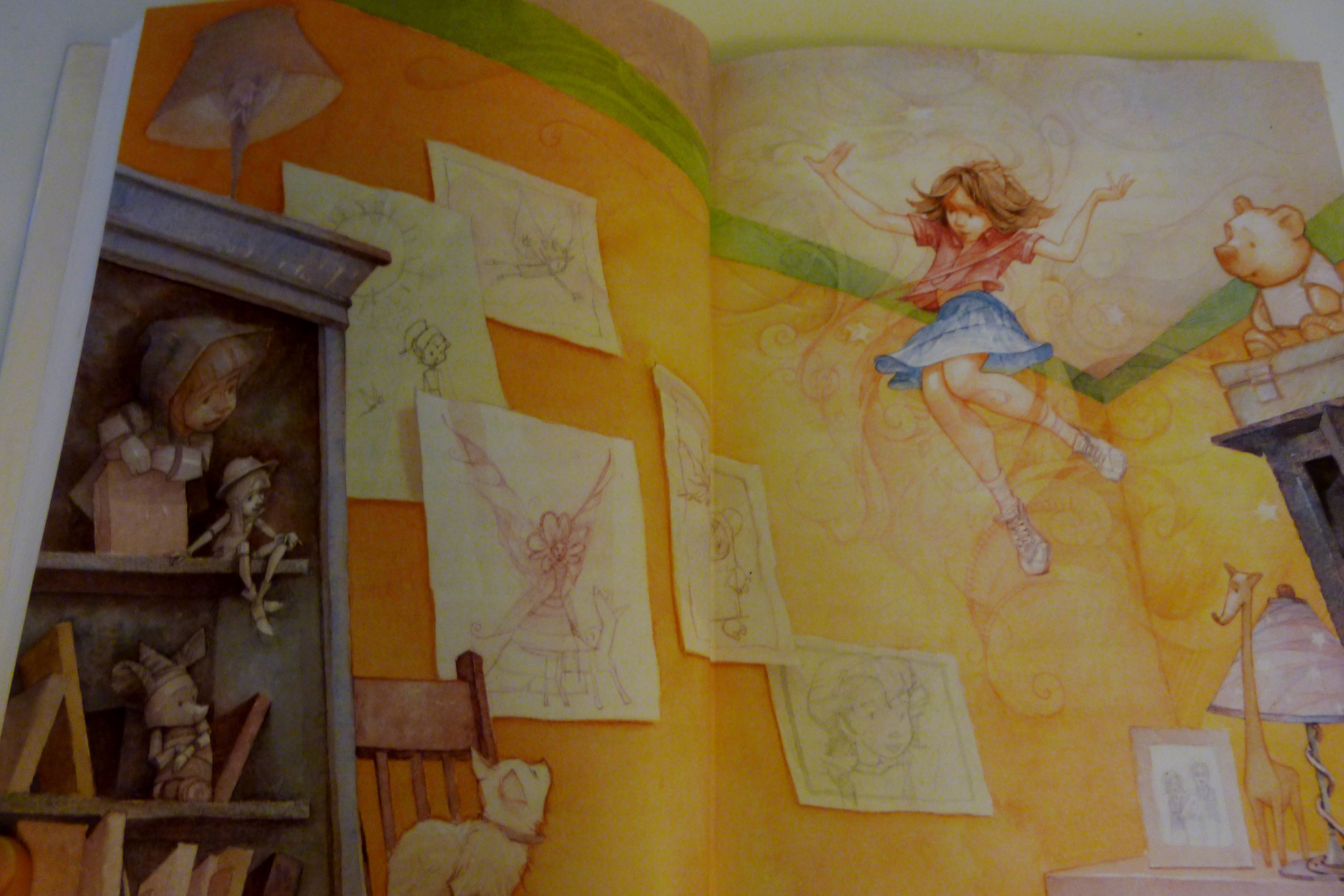
I would be remiss if I didn’t comment on the illustrations.  David Christiana did the illustrations for the entire series and they are absolutely beautiful.  There are many full-page illustrations (or two-page, and even one fold-out!) and they add a wonderful dimension to the story.  I like the book, but it’s actually the illustrations that are making me tempted to buy it!

This isn’t one of my favorite Levine books, but it is a fun look at Neverland from a different angle (even if sometimes a little TOO much that angle!)  This is a simple, sweet, fast read–I’m glad I finished the series, because it was a lovely book and when I did finally read it, it only took me a day!

Author’s Site: http://gailcarsonlevine.com/

Other reviews:
Reading All Year Long
Shannon Messenger
Confessions of a Book Habitue
Yours?