Scented Flowers and Lucky Frogs

When you see a title like Toads and Diamonds on the shelf, you know you’ve found a re-told fairy tale.  I was trying to remember the title of the original–it turns out it’s usually known as “Toads and Diamonds” too (or “Diamonds and Toads”), although Perrault called it by the not at all descriptive title, “The Fairies.”

Whatever you choose to call it, the story is about two sisters (sometimes step-sisters), who each encounter a magical woman.  One sister is enchanted to drop flowers and jewels from her mouth whenever she speaks.  The other speaks, and drops toads and snakes.  Either one definitely creates a lot of opportunity for bizarre results!  I’ve read some other versions of this, and usually authors like to play with whether the enchantments are really blessings or curses.

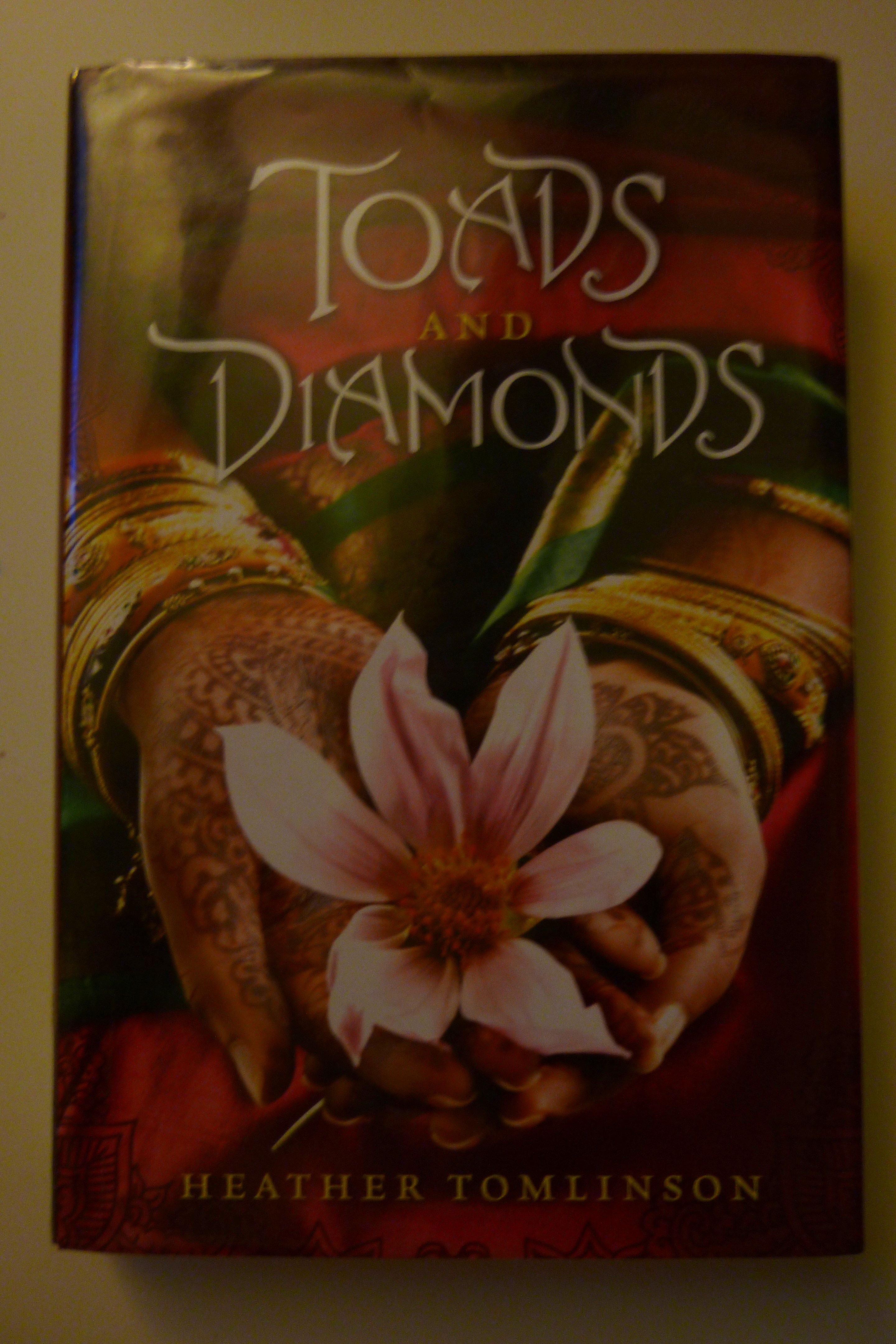
Toads and Diamonds by Heather Tomlinson follows this trend, but does so in masterful fashion.  It follows two sisters, Diribani and Tana, who live in pre-colonial India (with some fictionalizing) and are struggling to make ends meet since their father’s death.  They’re devout followers of a fictional, polytheist religion which I think loosely resembles Hinduism.  They each encounter the goddess Naghali; Diribani begins speaking jewels, and Tana drops reptiles.

From the beginning, though, there’s a twist on the usual presentation–in their culture, certain frogs and snakes are considered lucky or even blessed.  Right from the start, it’s not so clear which sister is blessed and which is cursed.  As the story goes on, both girls find both benefits and drawbacks to their magical gifts.

I liked the character development here, as each sister comes to terms with her gift and learns about herself and her role in the world in the process.  They tell the novel in alternating chapters of limited third-person narration.  This is handled very deftly, because even though Diribani and Tana are separated for much of the book, Tomlinson keeps the two parts of the story feeling connected.  Part of that is thematically, but it’s also that each sister keeps thinking about the other, so the reader keeps being reminded of the connection.

My favorite part of this book was the atmosphere.  The Indian culture is vivid and colorful, and the details are excellently handled.  I don’t think Diribani ever speaks a jewel or a flower without a mention of what kind it is.  Potentially that could drag, but it’s not dwelled upon, just quickly described, so that you have constant images of lilies and rubies and orchids dropping past.  Tana’s snakes and frogs are described too, and we also hear about clothes, food, scents…  I love the descriptions of colors.  Rather than saying that a rug is orange and red and tan, it’s described as mango and ruby and apricot.  It brings it all much more to life, with an exotic flare.

I enjoyed seeing a familiar fairy tale put into a very different setting, especially one so vividly realized.  Highly recommended!
A Servant’s Magic

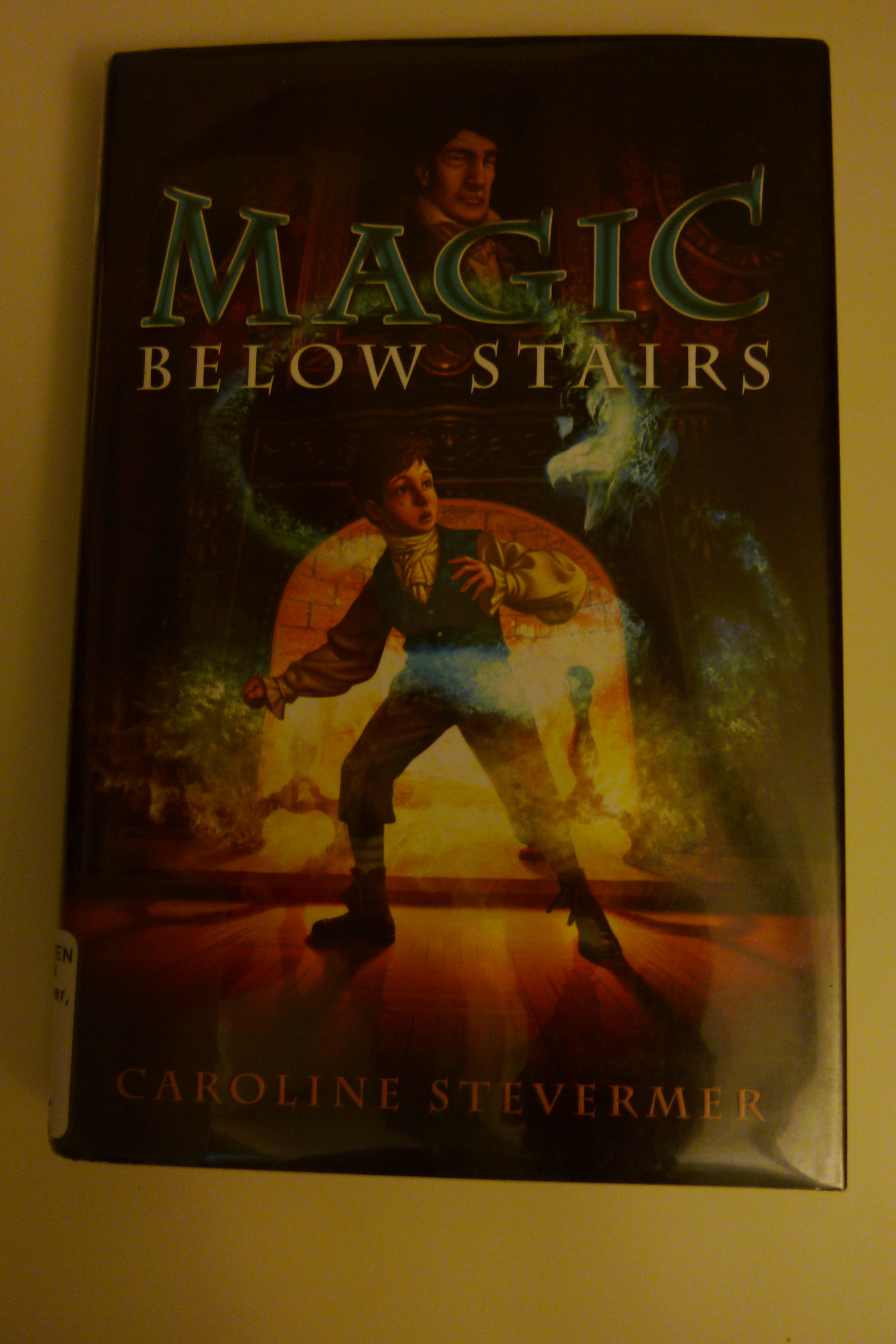
I love the Sorcery and Cecilia series by Patricia C. Wrede and Caroline Stevermer, so I was excited to stumble across a companion book recently.  Magic Below Stairs by Caroline Stevermer revisits the world of the series from a new point of view.  You don’t need to have read the rest of the series to enjoy this one, though I think it would add more meaning to some parts.

The series is about two women, Kate and Cecilia, who marry a couple of magicians, Thomas and James (respectively!)  They’re aristocracy of some sort; Magic Below Stairs comes from the other side of the social strata, and focuses on Frederick.  He notices strange happenings at the orphanage where he lives, and discovers that their cause is Billie Bly, a house brownie.  Billie Bly has attached himself to Frederick, and when Frederick is chosen to join Kate and Thomas’ household as a new servant, Billy Bly comes too–which Thomas does not appreciate at all.  Meanwhile, there’s also a nasty curse lying in wait.

This actually felt oddly like a Diana Wynne Jones book.  You have the earnest young boy, the absent-minded magician, and a looming threat.  And it’s all set in a grand English manor.

Stevermer’s website tells me this is set in Victorian Britain.  I’m not good at all at keeping straight different eras of British history (unless you give me an actual event to measure by–the Battle of Trafalgar, say, or the life of Shakespeare), so I just knew this was set somewhere back in the past when manor houses had entire staffs of servants hard at work below stairs.  Part of the fun of this book is seeing the world from that perspective.  This is especially true because this isn’t a book about the oppressed lower classes, which you do see sometimes.  The servants here actually seem a fairly contented lot who are fond of Thomas and Kate.

Saying that this reminded me of Diana Wynne Jones is a high compliment, of course.  🙂  This is a fairly short book without a huge amount of depth, but it’s a fun read with good characters and some nice humor at times.  And if you try it and enjoy it, you should definitely go on to the longer and more complicated Sorcery and Cecilia books!

Author’s Site: http://members.authorsguild.net/carolinestev/

Short Stories Near the Enchanted Forest

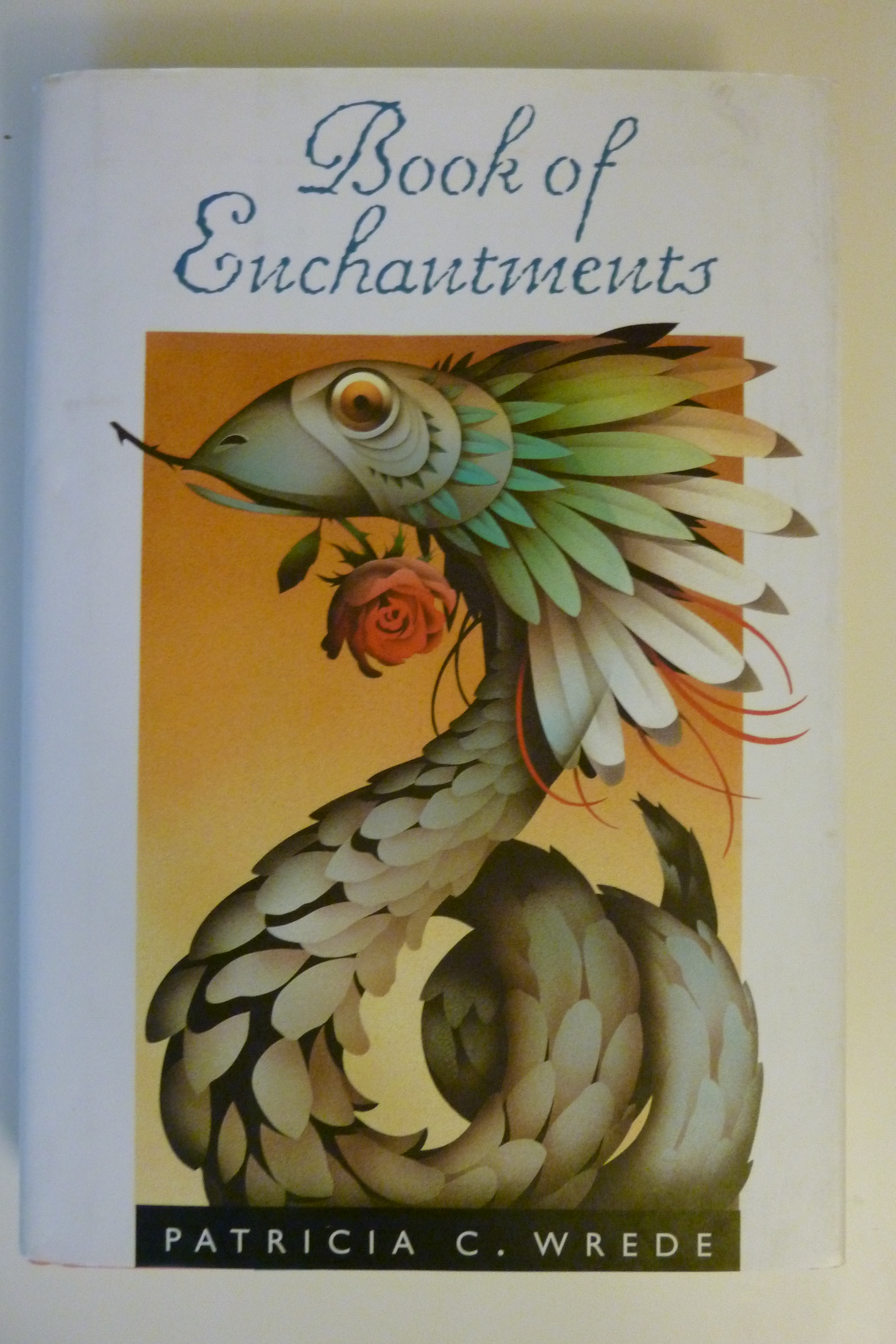
You may know that I’m a big fan of Patricia C. Wrede’s Enchanted Forest Chronicles.  I just recently bought another of her books–Book of Enchantments.  It’s a collection of short stories, and I’ve lost track of how many times I’ve read the library’s copy.

When it arrived in my mailbox, I went down the Table Contents.  I could vividly remember all but two stories, matching my memories to the titles–and I’m usually not good at remembering things like titles, especially when I haven’t read the book in probably a couple of years.

It’s a wonderful collection of stories.  They all deal with magic, but they vary widely in subject, setting and tone.  Some are funny; some are eerie; some are haunting.  And obviously, they’re memorable.

“Rikiki and the Wizard” has a fable-like quality to it, about Rikiki the blue chipmunk god, who’s obsessed with nuts (as a chipmunk naturally would be!)  “The Lorelei” combines a perfectly ordinary, modern student bus trip with the dangerous power of a siren.  “Cruel Sisters” and “Stronger than Time” both reimagine old fairy tales, bringing darkness but also more human characters.

Two of the stories are related to the Enchanted Forest Chronicles.  One, “Utensile Strength,” actually features major characters from the series, which is delightful simply in itself.  Combine familiar characters with a magical weapon called the Frying Pan of Doom, and I really don’t know how you could go wrong.  “The Princess, the Cat and the Unicorn” is less directly tied into the series, but it makes up for it by being amusing and lovely and a bit romantic.  It’s set in a magical kingdom where nothing goes quite right: “The magic carpet had a bad case of moths and the King’s prized seven-league boots only went five-and-a-half leagues at a step (six leagues, with a good tailwind).”  It has all the charm of the Enchanted Forest Chronicles, gently poking fun at how fairy tales are supposed to be.

Two of my favorites (aside from the two above) are very different from each other.  “The Sixty-Two Curses of Caliph Arenschadd” is about a caliph who works his way through a list of curses whenever anyone displeases him.  Most of the curses are funny, like turning people green or giving them monkey paws.  The story centers on the daughter of the Caliph’s grand vizier, who has to figure out a way around the worst curse of all.

“Roses by Moonlight” is set in the present day.  Adrian, a teenager, is unhappy with her life, jealous and resentful of her perfect younger sister Samantha.  One night a mysterious woman invites her for a walk in the garden, and Adrian finds herself in a rose garden she never saw before.  Adrian realizes that each rose she smells gives her a vision of a different future.  The woman tells her that she may pick one rose…  There’s something haunting about the idea of a garden of possibilities, letting you see all that could be, and then giving you the chance to choose your life by reaching out and plucking a flower.

But obviously they’ve all stuck with me to a greater or lesser extent.  Try the book–maybe they’ll stick with you!

Author’s Site: http://pcwrede.com/index.html

The Secret Lives of Rabbits

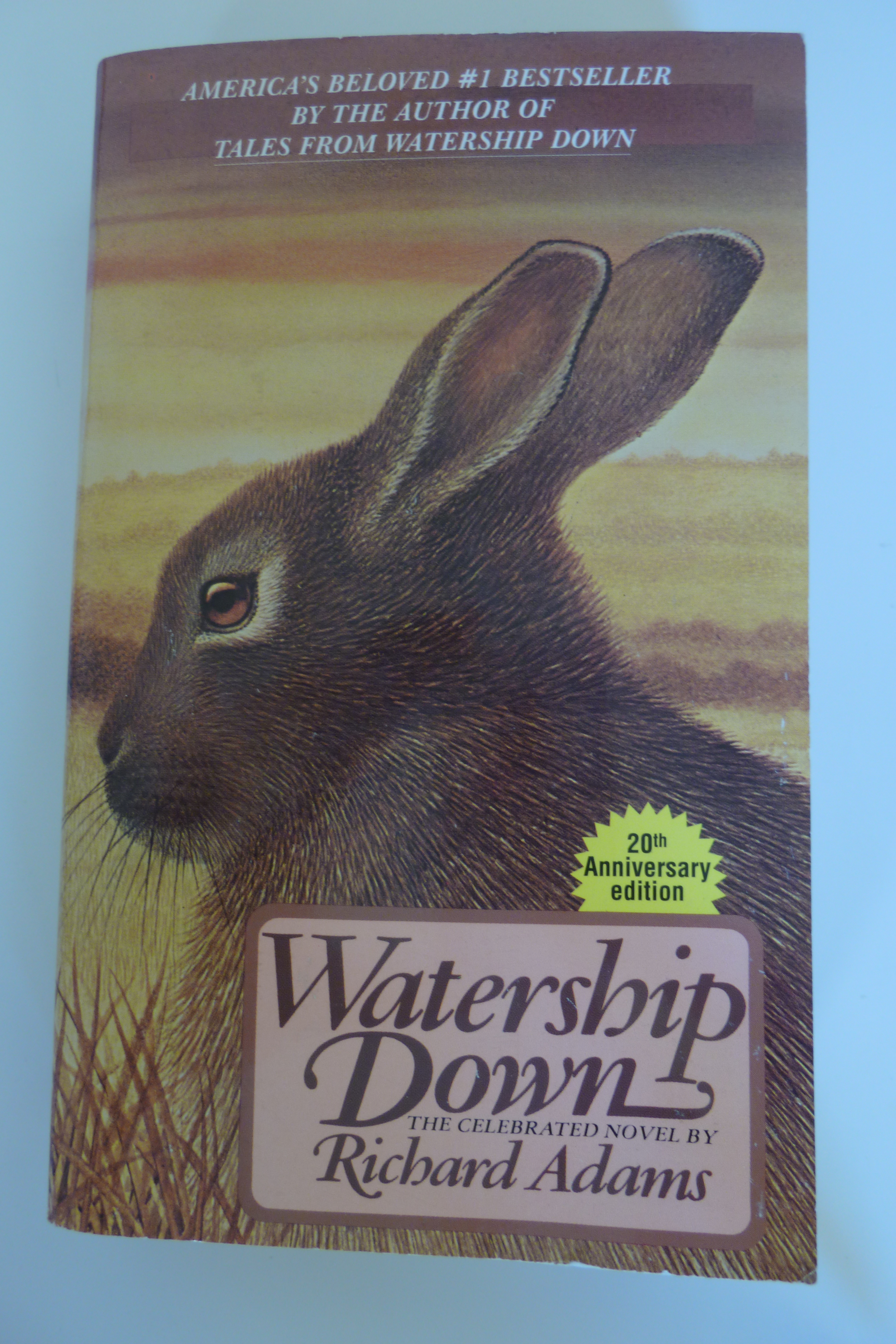
I didn’t mean to do a trend this week, it just happened…and then I couldn’t resist the title.  Actually, it’s not much of a trend, because Watership Down by Richard Adams has nearly nothing in common with The Great Good Thing.  No princesses–rabbits instead.

I have a feeling the story is fairly well-known, but here’s a quick recap anyhow.  Watership Down is the story of a group of rabbits who flee their warren, led by Hazel and guided by Fiver’s premonitions.  Through a series of adventures, they establish a new warren on Watership Down.  Along the way, they tell stories about El-ahrairah, a mythical figure who resembles Brer Rabbit and is the father of all rabbits.

I enjoyed this book on almost every level.  I liked the characters, especially Hazel, Fiver and their friend Bigwig (so named for the shock of fur on his head), although many of the more minor characters were well-developed too.  The adventures, especially in the later parts of the book, were exciting ones.  And I loved reading about how the rabbits lived their lives, a mix of science and anthropomorphising.  I’m fascinated by world building and by survival in foreign circumstances, and there was a bit of both in this.

One part that did bother me (and it turns out to be the same issue as in The Great Good Thing, randomly enough) was a total lack of romance–or of much in the way of female characters, for that matter.  I’ve read few books that were this male-dominated, outside of stories set on a British Navy ship.  I love strong female characters, but I can be okay with a mostly-male world, if it feels natural.  The trouble here is, the entire second half of the book is driven by the male rabbits’ realization that they’ve started a new warren without a single female (doe), and had better do something about that if they want to survive.  It would be so easy to have a romance.  There were even a couple of nice does who had a glimmer of character, and who could have been so much more.

Now, before the objection is raised–I know, I know, they’re rabbits.  So what if they only think about does in the context of breeding?  I know–rabbits.  However, they’ve been anthropomorphised in every other way.  They have an organized society, they tell stories, they play games, they clearly have meaningful relationships between brothers or between friends, and it’s even mentioned that sometimes mating pairs are devoted to each other.  But any romance is left completely undeveloped, and we don’t even know how most of them end up pairing off.  Nor does it help that the bucks have names like Dandelion and Holly, easy to say, while the does are mostly named things like Hyzenthlay and Thethuthinnang.  It’s kind of surprising, when apparently the book started as stories Adams was telling his daughters.

Well, now that I’ve gone on about what bothered me, let me backtrack and repeat that it really is an excellent book.  I feel like it might have been more, where the female characters are concerned, but it’s not really a fatal flaw.  It’s still a good read, and well-worth exploring.

The Secret Lives of Characters

The Great Good Thing by Roderick Townley has one of the best premises I’ve ever encountered.  Princess Sylvie lives inside a book (also called The Great Good Thing).  She and her family and friends act out their story whenever a Reader opens the book.  When the book is closed, they go on about their lives behind the scenes.  Everything begins to change for them when Sylvie breaks the rules to help a special Reader and her family.

I love this concept.  I love reading about what it’s like to be a character in a book.  I love when Sylvie rests her head on a large adjective, or goes swimming in the pool on page 36, or hides in the Acknowledgements page.  I think anyone who has ever felt a connection to a character in a book will enjoy the idea of a magic world between the book covers, where the characters live lives in and around the text we read.

The actual plot…is pretty good.  This is one of those books that leaves me thinking about how I’d take that premise and do something very different…but it is very enjoyable for all that.  I do like where it went–it’s just that with a premise like that, there are so many wonderful places to go!

One thing I’d do differently, and which I think is not just my preferences but an actual lapse in the book, relates to romance.  As it stands, there is none; that’s just not what the book is about.  But we catch glimpses of Sylvie’s story (the book within the book–let’s call it the Story for clarity).  There’s enough to tell us that at the end of the Story (and this really isn’t a spoiler), Sylvie rescues the Keeper of the Cave, who turns into a prince.  The Story being what it is, a kind of fairy tale, the natural order would be for Sylvie to get together with the prince–at least, in the Story.  But we don’t see that at all in the book we’re actually reading.  All the other characters hang out together while the book is closed, like actors who are off-stage, but we don’t see the prince (or even the Keeper of the Cave) at all.  One of Sylvie’s motivators is lack of a close companion, so I can see how a romance wouldn’t fit–but rather like showing a gun that never goes off, why have a prince at all if you’re not having a romance?

I recently found out there are two more books in this series, which I plan to read now, so maybe one of them will head in a romantic direction.  And even if they don’t, it’s still a fun story with interesting characters, and a good message about the power of a story and the importance of preserving it–and, of course, a fascinating premise!

Author’s Site: http://www.rodericktownley.com/