A Fascination with the Phantom

Today happens to be my birthday.  🙂  In honor of the occasion, I’ve decided to give myself over to emotive waxing on, run the risk of demonstrating a foolish attachment, and review one of my very favorite books: Susan Kay’s Phantom.
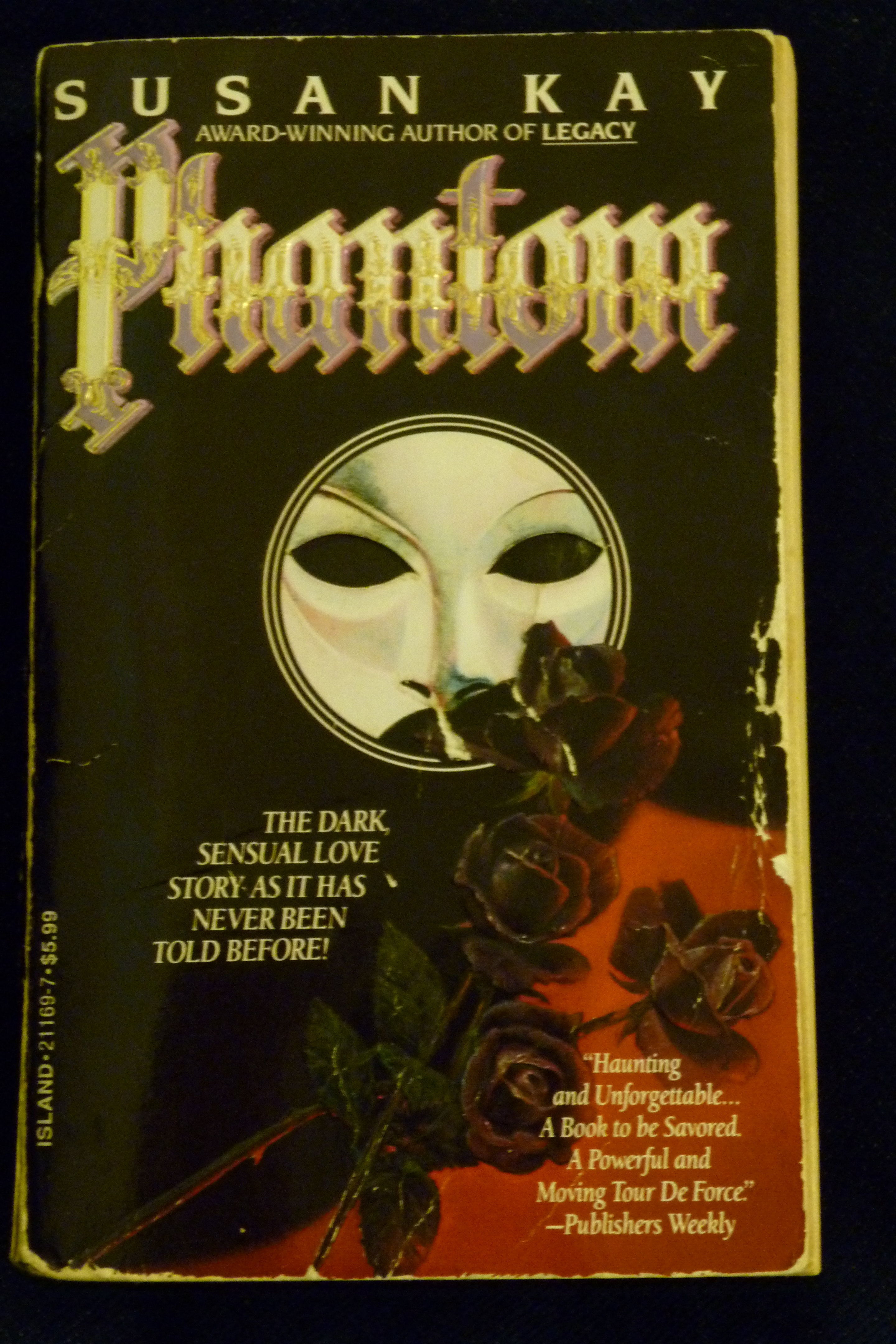
Technically it’s Phantom: The Novel of His Life by Susan Kay, but the convention is to always call it Susan Kay’s Phantom.  Maybe so that it can be put in a list with “the Claude Rains Phantom” or “the Lon Chaney Phantom” or “the Webber Phantom.”

I have a small (okay, enormous) obsession with The Phantom of the Opera.  I’m fascinated by the lead character: a brilliant musical genius who lurks in the shadows and, despite being a brilliant musical genius, is utterly convinced of his own unworthiness because he thinks he’s ugly–and by conventional standards he is, but I think the more imperative point is that he thinks he’s ugly.  I’m actually not that interested in the romance with Christine; it’s Erik, the Phantom, I’m fascinated by.  And I’m fascinated by exploring all the different versions, and how they’ve retold the plot and especially the character.  In this version he’s more arrogant–in that version he’s more shy–this version makes him more clearly a villain–that version emphasizes the romance.

And Susan Kay’s Phantom is one of the most fascinating of all the fascinating different versions.  Maybe it’s because the Christine romance is really just one part.  The book starts from before Erik’s birth and goes all the way to past his death.  With different parts of the book told by different characters, we follow the Phantom through childhood, to a gypsy freak show, to Italy where he learns from a master architect, to Persia and, finally, to the Paris Opera House.

For a long time this was out of print, and used versions averaged around $75.  So you see I’m not the only one with a considerable attachment here.  Fortunately for everyone, it’s been reprinted.

It’s beautiful, it’s tragic, it’s even funny and heartwarming at times.  The writing is amazing, rich and lush.  It reminds me a bit of Daphne du Maurier.  I feel I know all the characters personally.  There are few characters–maybe none–in fiction that I hate more than I hate Erik’s mother.  And there are few characters I’m more–here I go with that word again–fascinated by than Erik (and here I mean specifically this version).  Kay walks an amazingly fine line; he’s a very dark character, but just when he gets too dark,  something happens to make me love him again.  For example, things get bloody in Persia, and then some sweet bits turn it around again.

I found it a very emotionally intense book–not in the sense that it was a heavy subject matter, but that I was so drawn in.  And that may be the explanation for what might sound strange, after all this waxing on: I’ve only read it once.  I’ve flipped through it often–I’ve reread passages–I’ve marked all my favorite quotes–but I’ve never actually sat down and read it again.  I think it’s that I have to have a certain amount of emotional distance to a book before I feel I want to pick it up again.  If it’s too fresh, I don’t feel an urge to reread–it’s still there in my brain and there’s no reason to reread until it’s left.  And Susan Kay’s Phantom left such an impression that it’s still here in my brain.

It’s also saved the lives of a lot of spiders.  There’s a brilliant metaphor in here, relating Erik to a spider (and I so wanted to shake Christine for failing to see the connection).  Ever since reading this, I haven’t been able to bring myself to kill a spider–because “it’s not the spider’s fault that it’s ugly.”  So I’ve trapped a lot of spiders in glasses and released them into the wild instead.

I’d like to give you more quotes, but most of my favorites wouldn’t make any sense without a lot of context.  How do I explain why I melt into a puddle when Erik tells the Daroga, “Take care, mon ami.  Your tiresome health has become very dear to me.”  Or the incredible, heartbreaking power of “Please, God, let her love me and I’ll be good forever” and why I really, really want to yell at him, “No, no, don’t go up on the rooftop to pray, it’ll end badly!”

See, I knew I’d end up sounding crazy if I tried to review this book.  Here we go, one quote to demonstrate the wonderful language and convince you there’s something at the base of all this exhuberance: “My mind has touched the farthest horizons of mortal imagination and reaches ever outward to embrace infinity.  There is no knowledge beyond my comprehension, no art or skill upon this entire planet that lies beyond the mastery of my hand…  But as long as I live, no woman will ever look on me in love.”

One rational note: I seem to be straying from the young adult books this week, as this one isn’t YA either.  Probably appropriate for older young adults–things do get bloody in Persia, and there are some dark moments throughout.  The Phantom’s life is a tragic one.

But fascinating.  So very fascinating.
Sensible and Sensitive–If Not Altogether Clear

A different sort of book today–if you’ve read my posts about my reading challenges for the year, then you’ll know that one of my goals is to read more classics.  Despite a college preparatory high school and an English major undergrad, there are a lot of classics I have somehow missed.  High on the list are Austen and the Brontes.  Somehow I was never assigned any of them (unless you count a seventh-grade book report on Pride and Prejudice, but even that I think I picked myself from a list of suggestions).

I reread Pride and Prejudice some months ago, and found out that Austen is not nearly as challenging as the impression given to my twelve-year-old self.  I shouldn’t have waited so long to pick her up again!  I enjoyed Pride and Prejudice–it’s quite funny in spots, very memorable characters (Elizabeth Bennett and Mr. Darcy!  Need I say more?) and the society was fascinating.  Although I did want to shake Jane when she didn’t give us dialogue in the final romantic scene…

After Price and Prejudice, I recently tried Sense and Sensibility for the first time.  The society was still interesting, maybe even more so.  What would it be like to spend all your time simply traveling about and living in other people’s houses, sitting around having tea or going shooting (depending on your gender) and to expect to live on your inheritance or your interest entirely?  Earning money seems to be out of the question.  And the endless societal rituals…although sometimes I think the boundless rules for interaction might almost make things easier, like knowing all the rules to the game and what it means whenever anyone does something.  The book was funny in spots too, sometimes because of the boundless societal rules.  All that said, though, I can see why Pride and Prejudice is Austen’s more popular book.  I wasn’t as attracted to the lead characters in Sense and Sensibility, for one thing, but the chief dilemma for me was the romances.

You see, there are two triangles in this one, one for each of the two sisters, Elinor and Marianne.  Marianne is the one represented by “sense”–emotive and dramatic to an extreme.  Elinor, by contrast is, well, sensible.  The trouble is, Elinor is so sensible and restrained that, when she fell in love, I couldn’t tell she’d done it.  Her romance begins earlier in the book, while Marianne’s (which is abundantly obvious when it happens) doesn’t come along until later.  So I was left for chapters trying to figure out which of the vast cast of supporting characters actually mattered.  I enjoyed the book more in the second half, after I’d worked out the two triangles and could see what plot threads I was following.  But it took some time to get there.

I watched the 1995 movie version after reading the book, and decided I should have handled things in the opposite order.  It would have been so much easier to discern the romances in the movie–when Hugh Grant walks onto the scene, you know he’s an important character!  The movie held up very well, even though I watched it immediately after reading the book (which doesn’t usually serve movie versions well).  I thought it was a faithful retelling, and the cast alone is impressive: Emma Thompson, Kate Winslet, Hugh Grant, Alan Rickman, Hugh Laurie…it’s just too bad they didn’t get Judy Dench into it somewhere; I thought all British movies based on classics required Judy Dench.  But no matter, it was a very good movie.

And it was a good book too, though I think I’ll like it better if I ever reread it, and already know which characters to pay attention to.  I have a new policy with my classics reading, to watch a good movie version first.  So far I’ve tried it with Jane Eyre, and found the book much easier to read because I watched the Orson Welles/Joan Fontaine version first.  And I ended up staying up late reading because I knew a good scene was coming and wanted to get there…

I can recommend Pride and Prejudice entirely, and Sense and Sensibility with a few reservations.  But possibly not at twelve years old, considering it did scare me off for a while…

Meeting Old Friends, and New, in Tortall and Other Lands

When I did my end-of-year round-up of reading, I also mentioned the book I was most looking forward to in 2011: Tortall and Other Lands, by Tamora Pierce.  I finished it recently, and was pleased to find that it didn’t disappoint.

I admit I was a little worried about that “Other Lands” part of the title.  I was hoping she wouldn’t throw us one Tortall story, and then write about unfamiliar places for the rest of the collection.  But I should have had more faith–she gave us a great collection with a high number of stories in Tortall (or nearby countries), and the ones that were in other lands were good ones too.

The book is probably most appealing to people who already know Tortall, as several of the stories, especially the longest ones, revisit characters we’ve already met.  For fans of The Immortals series, Kitten the baby dragon gets her own story.  For fans of her Trickster series, we get to read a story about Nawat, Aly and their children.  Other stories feature minor characters from other books, or at least recognizable creatures–the Darkings, wonderful, funny inkblot-like creatures, are back in force.

The non-Tortall stories didn’t make a huge impression on me, but I remember them as enjoyable.  And how do you create a world as vivid in twenty pages as has been created in, let’s see, going on 18 books now.  Two of the stories, the last ones in the book, are set in the…well, I hate to say “real world” because it seems insulting to these other so vivid worlds, but let’s say the world you and I (I assume!) live in most of the time.  One was, I think, the first non-fantasy thing I’ve ever read by her–and I’ve read everything (really–I just checked her website bibliography to make sure!)  The other was a fantasy in the present-day, and darker than most.  A small warning that I think this one had an older target audience than most.

That story led me to an interesting observation on the distinction between Juvenile (or perhaps young YA) and higher level YA or adult fiction.  For the younger readers, people will still be shot by an arrow, but it will be in the shoulder, or just a vague, unmentioned place that may cause death.  In older-level books, you’re more apt to have someone be shot in the eye.  Or really any specific, gruesome location.  I never thought about that as a distinction before, but I think it’s true.

But I digress.  So watch out for “Huntress,” it’s dark.  And I highly recommend “Nawat” and “The Dragon’s Tale” and “Lost.”  And really all of the collection, but those three were my favorites.  And I enjoyed a little snippet of background on how Tamora Pierce wrote The Song of the Lioness quartet to begin with.

I would have loved a short story about Alanna, the heroine of The Song of the Lioness, but no such luck.  I’ve been hoping for a story about Alanna and her squire–they’re in The Protector of the Small series, and seem to have had wonderful adventures–but I’ll have to go on hoping for that.

No matter.  It’s a wonderful collection all the same.  If you’ve read my gushing earlier post about Tamora Pierce’s books, I’m sure it doesn’t surprise you that I felt that way!  A fun note also–that best friend I mentioned in that post, who I met because we both were reading Tamora Pierce, loaned me Tortall and Other Lands.  So we’re both still reading her, almost ten years later.

Author’s Site: http://www.tamorapierce.com

…and Blog: http://tammypierce.livejournal.com/ Just discovered this while I was writing this review!  (I swear I’ve tried to find a blog by her in the past…) Kind of thrilled to discover it.  🙂  And to discover that she uses her cat as her avatar…

A Shy Heroine, and a Hero Named for a Vegetable

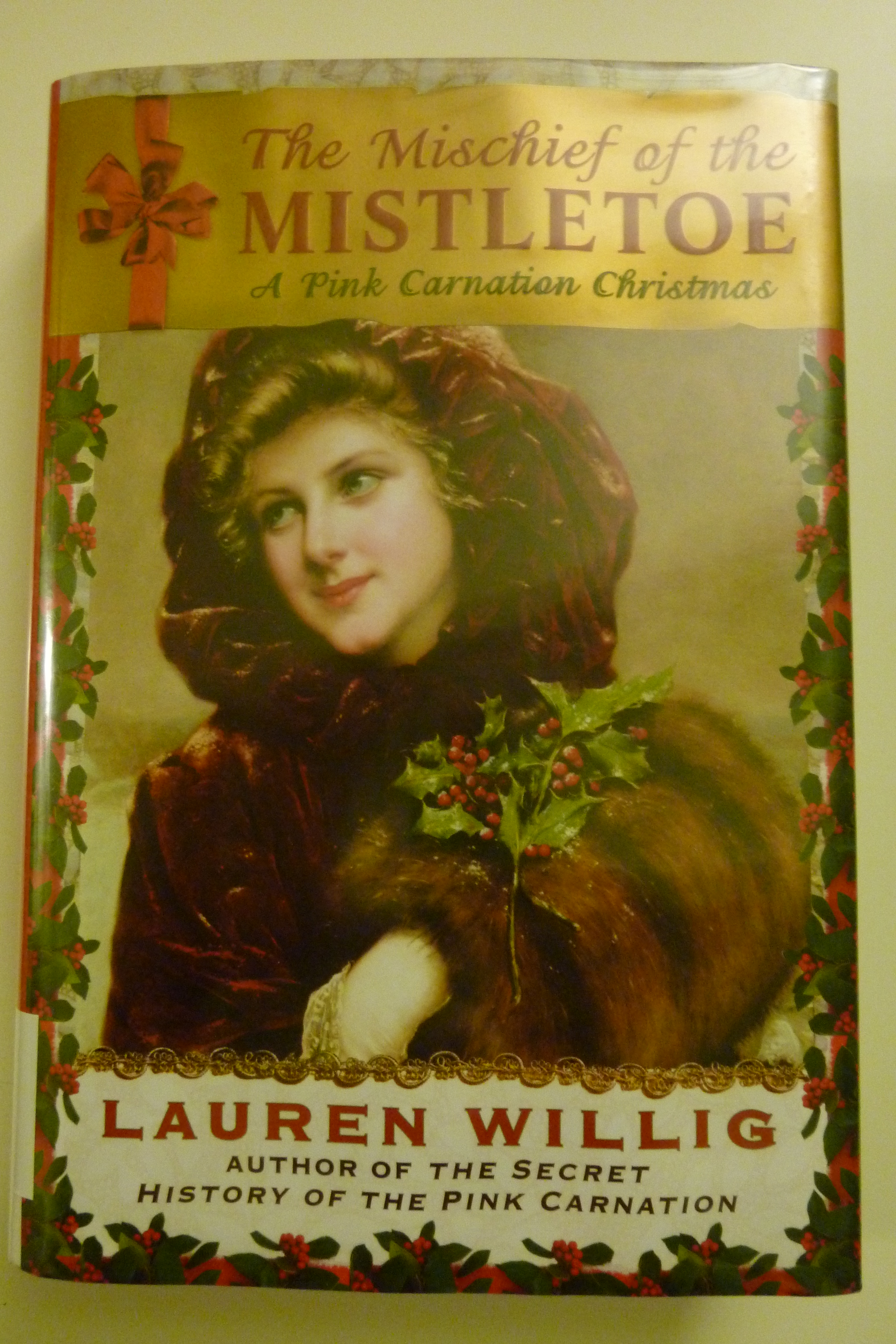
I had The Mischief of the Mistletoe by Lauren Willig on reserve at the library since before Christmas.  I added it when I saw it on a list of Christmas novels, and decided I wanted to read a good Christmas story.  Apparently other people had the same idea, and it didn’t reach me until mid-February.  But I’m so glad I didn’t decide to cancel my hold on December 26th, or even after Epiphany, when Christmas stories stopped really feeling appropriate.  For one thing, this wasn’t that strongly a Christmas story.  And more importantly, it was excellent!

The book is set in Regency England, what I can only think of as Jane Austen’s England.  Jane herself is in the book as a supporting character, as the sympathetic friend of the heroine, Arabella.  Arabella is the lead character of the book, but has clearly been a supporting character all her life.  A shy, unassuming wallflower, she’s the one at the party whose name no one can remember.  I have a soft spot for characters who think they’re unimportant.  I love watching them discover their inner depths and come into their own, and I loved watching Arabella find new strength and confidence.  Here we have the extra bonus of watching the other lead, Turnip, also discover Arabella’s value.

Reginald “Turnip” Fitzhugh…where to begin?  The name, I suppose.  I can’t tell you how much I love it that the hero has a vegetable for a nickname.  And not even a tough vegetable (I don’t know what vegetable would be tough–asparagus spears, maybe?–but I’m pretty sure turnips are not the heavyweight champions of the vegetable world).  It fits him–and he’s a wonderful character!  Endlessly well-meaning, charming and gallant, not a brilliant intellect, capable of throwing a punch when the situation calls for it, but not really all that good at derring-do and dashing exploits, frequently bumbling, very thoughtful, addicted to outlandish waistcoats.  Somehow, it works so well and is so much fun.  I love dashing heroes, but this time I really enjoyed a hero who stumbles more than he dashes–but rushes forward anyway, well-intentioned and grinning.

So you can check off the first requirement for a good book–great characters.  If you couldn’t tell already, lots of good humor too.  Occasionally this book tries a little too hard to be witty, especially in the dialogue, but most of the time it succeeds.  Third, we’re given a very sweet romance.  So, check, check, and check!

Fourth, there’s an engaging plot as well.  If it had been up to me to name this, I would have called it The Puzzle of the Pudding (to keep some nice alliteration).  Mistletoe barely features, while the plot is mostly set in motion when Arabella and Turnip discover a hidden message in the wrapping of a Christmas pudding.  This launches a series of intrigues and efforts to uncover the truth, which kept me and the characters guessing until the end about whether they were dealing with international spies and a threat to England’s security,  or with pranks among schoolgirls–or both.  Turnip staunchly believed the former, while Arabella mostly leaned towards the latter.

It turns out that this is actually Book Six, in the Pink Carnation series.  The Pink Carnation is England’s most elusive spy (in the style of the Scarlet Pimpernel).  As near as I can tell from reading plot summaries, the books are all set in the same social circles, but focus on different characters.  It’s obviously possible to start with the Mistletoe and enjoy it, since I did!  I probably missed a few things, but I don’t think it seriously impacted my reading. 

I read The Secret History of the Pink Carnation afterwards (it came much more quickly at the library) and enjoyed it as well–not quite as much, as I liked Turnip, Arabella and their romance better.  Good enough that I will definitely go on to the rest of the series though!  And if you go look up a plot description for the first book, every one I’ve read has been wildly misleading–it looks like it’s about a modern-day character doing historical research, and it is, but she’s only a very small part and most of the book is set in the past.

Since I normally review young adult books, one note I should make: this series is in the grown-up section, and while Mischief of the Mistletoe has a discreet,  Austenish feel that I think keeps it appropriate for younger readers, The Secret History of the Pink Carnation is not so discreet.  Fair warning given.

The Mischief in the Mistletoe was dedicated in part to “everyone who asked for a book about Turnip.”  I completely understand where those requests came from.  If I do a round-up of favorite characters met in 2011 at the end of the year, I expect Arabella and Turnip to be strong contenders.

Author’s Site: http://www.laurenwillig.com/index.php

Chasing After Ghost Children

I wanted to like The Children of Green Knowe by L. M. Boston.  It’s usually not a good sign when a review begins that way, is it?  You see, I saw it reviewed on a blog I follow, and it sounded intriguing.  Well…while I still respect that blogger’s opinion 🙂 I won’t be adding this to my list of favorite British children’s fantasy classics (a long list I ought to post some time!)

The book is about Tolly, a little boy who goes to live with his great-grandmother at his family’s ancestral home, a castle called Green Knowe (or Green Noah).  His great-grandmother tells him stories about his ancestors who lived in the house, especially three long-ago children, Toby, Alexander and Linnet.  Tolly quickly realizes that the children are still at Green Knowe, as ghosts.

I really like the concept, and I liked the setting.  I loved one small bit, when Tolly first meets his great-grandmother, and she’s eager to see who in the family’s past he’ll resemble–because all the faces return to her eventually.  I rather enjoyed the family stories the grandmother told.

But Tolly’s story fell pretty flat for me.  It might have helped if I had known his age sooner.  I finally figured out most of the way through that he’s six or thereabouts, when he comments that six-year-old Linnett is as big as he is.  Prior to that, he seemed sometimes older, sometimes younger, making his more childish moments disconcerting.  For that, and in a general way, it was hard to get a handle on the character.

But my bigger problem was the ghost children.  They seemed to have no depth at all.  They’re not creepy, scary ghosts; they’re not ghosts with unfinished business; they’re not ghosts who need something from the living, or even who want to do something for the living.  They’re perfect paragons who never struggle.  Gail Carson Levine, on her blog, often writes about the importance of making your characters suffer sometimes, and these characters never do.  They simply wander through the book as happy ghosts who spend all their time playing.  Their favorite game seems to be hide and seek, which doesn’t even facilitate getting to know someone.  Even when they make themselves more available, I never felt that Tolly or I could really enter a friendship with them.  I don’t think Tolly saw it, but they seemed to me to be just too self-sufficient unto themselves.  They were friendly to Tolly, but they never seemed particularly interested in him either, simply taking him for granted as a new playfellow, if they felt like playing.

And the animals.  You know that scene in the Disney Snow White when she makes friends with the entire forest?  It was like that.  The ghost children have a horse, and a deer, and a fox, and a rabbit, and a fish, and a hedgehog, and a whole flock of birds, including a peacock, and possibly one or two other animals I’m forgetting.  It was a bit much.

It may be that I came to this book too late in life.  If I had picked this up as a child, maybe I wouldn’t have seen some of the character issues, and to be honest I probably would have thought the menagerie was neat.  But I had trouble coming to this book at an older age.  My apologies if I’m pulling apart a beloved childhood favorite of anyone else–and by all means, tell me what you love about it that I managed to miss!