Eight Characters In Search of a Shore

You may remember I spent much of the fall watching Hitchcock movies for the R.I.P. Challenge.  Today I have another one that I never got to a review of during the challenge: Lifeboat, from 1944, about the survivors of a German u-boat attack, trapped in a lifeboat together with one German soldier.

I realized over the course of my Hitchcock kick that my favorites where the ones “in which nothing happens,” and this seemed like another good rewatch for that goal.  I figured–how much can happen in a lifeboat?

Although the external crises are certainly an impetus to the story, mostly this is about nine people stuck together and how they react off each other and the circumstances.  Connie Porter (Tallulah Bankhead) is the most striking; a wealthy journalist, she arrived on the lifeboat with her fur coat, jewelry, camera and luggage, but gradually loses everything–and gains some heart–as the movie goes on.  Alice (Mary Anderson) also has an interesting story, as she was en route to London to be a nurse–and to meet a man she had previously carried on an affair with.  A married man, and for 1944, I’m surprised the censors let that plot element in!

I think I was most fascinated, though, by the German soldier, Willy (Walter Slezak).  The whole movie I wondered where it was going to go with him, because there were moments when it seemed to me he could be played from a sympathetic angle.  A complicated sympathetic angle, considering we know all along that he shelled the original boat, and is now deceiving the survivors about certain things like their heading.  But for most of the movie, I could still see where he was coming from too.  He was acting as part of a war, and he’s now in a very precarious position among a group of British and Americans.  And I can’t really blame him for hoping to find the German supply ship in the area, rather than striking off for the very distant Bahamas.

However…the movie was made in 1944, so I don’t think it’s much of a spoiler to say that Willy does not ultimately turn out to be a good guy.  It’s too bad, because I feel like he could have been a complex character and morphed instead into an almost caricature villain.  He was a villain not because there was a good in-movie reason for it, but because of the climate of when the movie was made.  It’s hard to present a sympathetic Nazi soldier now; I’m sure it was impossible in 1944.

Of all of the Hitchcock movies I watched recently, Lifeboat is the only one I’d particularly like to see a remake of.  I’d be very curious to see how Willy’s character could be done now, almost 70 years after the war ended.  Although on the other hand, the blood and the horror of it all, so discreet under Hitchcock, would probably be so awful in a modern movie that it wouldn’t be worth it!

Other reviews:
MovieFanFare
Cinema 24/7
Derek Winnert
Anyone else?

Buy it here: Lifeboat

The Magician’s Nephew

I have been meaning for ages to reread C. S. Lewis’ Narnia series…in part because Jessica keeps reviewing them!  I have such a stack of other books, though, that I kept not getting to them, until I finally hit on the idea of audiobooks–which should have been obvious to me, considering my first Narnia experience was when my dad read them to me as a kid.  So I just listened to The Magician’s Nephew, read by Kenneth Branagh, and am very happy to say that the story was even more delightful than I remembered.

Set chronologically before The Lion, the Witch and the Wardrobe, this installment gives the origin story for certain elements of the later novels, and provides a Narnia creation story.  That said, it’s largely stand-alone, apart from a few references at the end along the lines of “and so this led to that and much resulted, but that’s quite another story…”  This story is about Digory, his friend Polly, and his Uncle Andrew, a rather nasty man who has been dabbling in magic.  Uncle Andrew has devised magic rings which he believes will send people to another world, and tricks Polly and Digory into taking the trip.  They reach the magical Wood Between the Worlds, and venture first into dying Charn, where they meet the evil Empress Jadis, and then into Narnia, on the day of creation.

Digory and Polly fit in amongst Lewis’ collection of child heroes, imperfect but basically good, generally courageous and honorable though apt to falter at times in a very human and believable way.  They provide a solid center to the story, while the surrounding characters are in some ways more complex.

Uncle Andrew is wonderfully painted in his egotism and cowardice, so sure of his own inherent greatness but so obviously a petty, narcissistic man.  Jadis shares some of Uncle Andrew’s narcissistic tendencies, but is clearly in a class all her own for sheer cruelty and coldness.  Once Jadis arrives on the scene, Uncle Andrew shrinks dramatically as a villain, so obviously upstaged by the real villain.  Lewis does something rather brilliant in that, as soon as Uncle Andrew loses power as a villain, he’s turned into a comedic figure instead, equally effective in that role.

I madly loved the setting of this book–all the settings, actually.  I don’t know how Lewis resisted doing an entire extended series just centered around the Wood Between the Worlds.  I mean, it’s an endless forest full of pools of water, and each pool goes to another world.  And we only went through three pools, counting the one to our world.  The untapped possibilities!

And then Charn was just fascinating.  Lewis has never before reminded me of Tolkien (though I hadn’t read Tolkien before either…) but Charn with its enormous marble edifices, apparently ancient history, and epic battles, reminded me of Middle Earth (less trees, though).  It had a similar quality of existing on an unimaginably epic scale.

I loved the creation of Narnia too.  How lovely to have a world spring into being through a song!

Just when everything was getting very solemn and epic and sweeping, when it might have become a little too much–it didn’t, because there’s a wonderfully funny episode of Narnia’s newly-created animals trying to decide what ought to be done with the raving Uncle Andrew.  They aren’t quite sure if he’s an animal or a tree…

If you’re thinking about starting Narnia, you could begin here (and if you’re thinking about the audio, Branagh was excellent).  It’s listed as #1 in a lot of editions, since it is first chronologically.  However, I think you’d be better off starting with The Lion, the Witch and the Wardrobe, for the sake of all those “and then it led to other adventures” references.  But once you’ve read Lion, I don’t see any need to go through the next several books, in their original publishing order, before reading the very delightful Magician’s Nephew.

Other reviews:
The Bookworm Chronicles
Sonya’s Cannonball Read
Stray Thoughts
Here There Be Books
Kristina Yarn
Anyone else?

Buy it here: The Magician’s Nephew

Peril On Screen Round-Up

I’ve been on a definite shadowy-movies kick these last two months, and have fallen thoroughly behind in reviewing them–they go by faster than books, you know!  I thought I’d do a round-up of several movies I’ve watched recently that fall into the Peril on Screen category for R.I.P.

***********

Dark Passage (1947) is an excellent film noir murder mystery–you can’t go far wrong in film noir when you have Humphrey Bogart as your lead.  Vincent Perry (Bogart) is wrongfully convicted of murdering his wife; he breaks out of San Quentin and goes on the run into San Francisco.  Luckily for him, Irene Jansen (Lauren Bacall) is on hand to help him hide.  Unluckily, the police have set a manhunt in motion, and the only way to escape recapture is to change his face.

This movie strains credulity in places with coincidences and how neatly things unroll.  On the plus side, it employs a fascinating device–rather than casting two actors as Vincent, the movie avoids showing his face for the first 45 minutes or so.  Almost everything is from Vincent’s eye view…until he’s bandaged up post-plastic-surgery.  And of course, when the bandages come off, he’s Humphrey Bogart.  The biggest strain to credulity (maybe) is when someone Vincent used to know well completely fails to recognize his voice.  The face may be different, but Bogie’s voice is unmistakable.

My favorite part is actually a random interlude–a small time conman tries to blackmail Vincent, and in the middle of the whole thing he starts giving advice on how Vincent can go on the run…go through Arizona, you’ll need fake papers, I know just the guy you should go to–didn’t you learn anything in Quentin?  They’ve got real smart guys in Quentin!  It’s a great bit of humor in a mostly grim movie.

***********

To Catch a Thief (1955) is a Hitchcock film, later than most of the ones I’ve been reviewing.  Cary Grant plays a former jewel thief, out to catch a copycat robber when he’s accused of the crimes.  It’s essentially a whodunnit, with Grace Kelly thrown in as a love interest.  It’s pretty good on the whole, although the twist on the culprit feels a bit dated…and I’ll leave it at that to avoid spoilers!

Thinking about this movie, it occurred to me that my favorite Hitchcock films are the ones where nothing happens.  The ones where people are going about what, on the surface, appears to be ordinary life…with a lurking terror underneath.  On the surface, Suspicion appears to be about happy newly-weds; Rebecca, ditto; it’s only the woman’s suspicions that indicate something is wrong.  Rope is about a dinner party and Strangers on a Train is mostly about one character being stalked through his ordinary life.  It’s the illusion of normalcy that gives power to the tension.  Not many people actually stay at creepy castles on stormy nights, and even fewer hunt jewel thieves on rooftops, but everyone goes to parties.

To Catch a Thief is a good movie, but it’s less a psychological suspense film and more a straight mystery where things happen–and all against the backdrop of the Riviera, by the way.  The scenery is practically another character.

***********

Double Indemnity (1944) centers around a murder–although it’s not exactly a murder mystery, as it opens with Walter Neff (Fred MacMurray) confessing to the crime.  He proceeds to narrate how it all happened, in a very Sunset Boulevard style.  Neff is an insurance man who fell for a client’s wife (Barbara Stanwyck)–and decided to help her commit the perfect murder on her husband.  A “double indemnity” is a special clause to double the insurance payment if someone dies in a highly unlikely way.

This one is more psychological, a murder story without a drop of blood that centers around the puzzle of how to pull off the murder–and then how it unravels.  Edward G. Robinson is particularly good as Barton Keyes, a claims investigator with an instinct for sniffing out false claims.  I’m fascinated by the way he views it as a puzzle too, apparently less concerned with the fact of murder than with the insurance fraud involved.

Even though there’s no actual hard-boiled detective in this one, Neff and Keyes both have their hard-boiled moments, and there’s a definite film noir feel.

***********

I fit in one last Hitchcock film with Rear Window (1954), another later film.  After my observation with To Catch a Thief, I decided to rewatch another Hitchcock where not a whole lot happens…and sure enough, I liked the film very much!  Jimmy Stewart plays a photojournalist who broke his leg (pursuing a photo), and is stuck in his apartment for weeks.  He passes the time watching his neighbors out his window.  Things turn sinister when he suspects one neighbor killed his wife.  Love interest Grace Kelly gets a bit more to do here than she did in To Catch a Thief.

This one is mostly an elaborate puzzle, with Stewart and Kelly trying to work out how the murder might have been done, and how they can prove it.  There’s some action at the end, and I do like that the male lead’s broken leg gives the female lead a chance at a bit more daring-do.

My favorite part of this movie, though, was less the murder mystery, and more the other stories playing out through the window.  We also get to see into five other apartments, each with their own inhabitants and their own narratives.  Hitchcock does a lovely job of carrying each of them along (and with virtually no dialogue, since it’s all observation) and giving a nice wrap-up at the end of the movie.  Those stories were less dramatic, but they were more focused on the individual and what they were experiencing, and perhaps that’s why I liked them!

***********

It’s funny…I didn’t make any movie-viewing plans at the beginning of R.I.P. but that turned out to be my favorite part this year!

On Fairy Tales and Masks

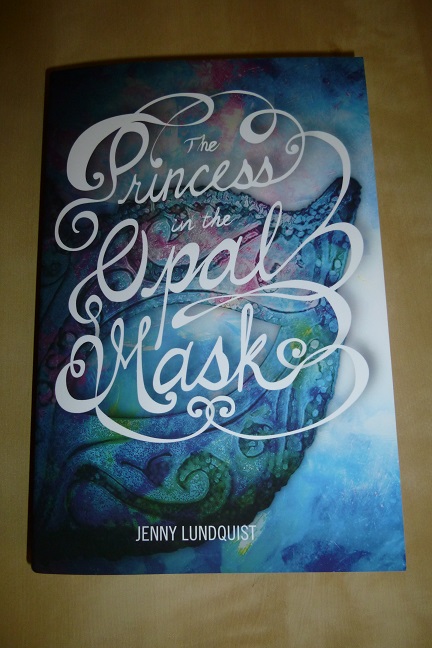
Princess in the Opal MaskA couple of common threads around here include retold fairy tales, and the masked Phantom of the Opera…so The Princess in the Opal Mask by Jenny Lundquist, with its Cinderella spin and masked princess, seems tailor-made, no?  🙂  It also turned out to have strong female characters, a well-developed world and an excellent fantasy feel, all things I enjoy in a book!

The story alternates narration between two girls: Elara who has a Cinderella-like existence among her adopted family, and no knowledge of her birth parents; and Wilha, a princess who has never been allowed to show anyone her face, not even her own father.  And…it’s hard to say more without spoilers, but suffice to say both girls end up central players in a tentative and uncertain peace treaty with a neighboring kingdom.  There’s intrigue and romance and backstabbing and conspiracies–and Wilha’s mask is only the most visible one.

I really loved the idea of the princess in the mask, and was so intrigued by the mystery–even Wilha herself doesn’t know why she has to wear a mask all the time.  All sorts of rumors fly, that her face is cursed or blessed, and the book explores Wilha’s own confused feelings and fears.  The Phantom of the Opera at least knew why he was hiding his face–Wilha has no answers, except a fear that showing her face will mean death for anyone who sees her.

Wilha also struggles to be seen as a person, not as The Masked Princess.  Most of us don’t go around in physical masks all the time (or hardly ever…) but the struggle to be seen as our true selves is much more universal.

Clearly I warmed to and related to Wilha right away.  Elara took longer–part of her struggle is that she doesn’t want to let anyone get close to her.  Considering her life, that does make sense.  Unfortunately, I felt like I couldn’t get close to her as a reader either.  However, she emerged more in the second half of the book, making more connections to others–and me!

The worldbuilding is another very strong element of the book.  Much of what happens, particularly with the neighboring kingdom, is grounded in the country’s history.  Lundquist does a nice job conveying a lot of information about past events, without getting bogged down or dry.

Description is a strong element here too.  Those masks may be imprisoning Wilha…but they’re beautiful too.  I want an illustrated version of this, mostly just to see the masks.  The cover is pretty, but it really doesn’t do justice to the elaborately-described masks!

There were plenty of unexpected turns in here, and it genuinely kept me guessing in the romance department.  A sequel has been promised for next Fall, and I’m looking forward to it!  Wilha and Elara are both on paths towards claiming their own lives and I can’t wait to see where they go next–and I’m hoping the sequel will pick up some threads (romance included) that were left unresolved here.  If this book was any indication, more twists and mysteries will be in store!

Disclaimer: I received a copy of this book from the publishers in exchange for an honest review.

Author’s Site: http://jennylundquist.com

Buy it here: The Princess in the Opal Mask

Plants and Stones and Magic

Battle MagicTamora Pierce’s latest book, Battle Magic, takes us back to the Circle of Magic universe, to revisit familiar characters and explore new countries and magic.  Although I get more excited for her Tortall books, this one promised a new adventure with some of my favorite this-universe characters, Briar, Rosethorn and Evvy, so I was still anticipating the read–and it didn’t disappoint!

Briar and his teacher, Rosethorn, are plant mages; Briar’s student Evvy possesses stone magic.  All can speak to and control the forces they have magical affinity with.  They’re on a long journey away from their home country, first to the welcoming and magical-laden country of Gyongxe, and then to the wealthy and ambitious country of Yanjing.  Yanjing’s emperor initially welcomes the group, but he is cruel, ruthless and power-hungry.  Soon armies are marching, and Rosethorn, Briar and Evvy are enmeshed in warfare.

Slotting this one into the rest of the series, Battle Magic is set after Street Magic and before The Will of the Empress; Briar is 16, Evvy is 12. This is more or less stand-alone, but I think there are a lot of references that would be hard to sort out without reading the earlier books (at the least, Briar’s Book and Street Magic).

I was most looking forward to revisiting favorite characters, and that was a great part of the book.  I always enjoy Briar’s plant magic, and it was interesting to watch the characters’ growth, especially because of the way this fit in between the other books.  The relationship between Briar, Rosethorn and Evvy is really lovely.  They’re essentially a family unit, if an unconventional one.  I love the way Briar sometimes jokingly calls Rosethorn “Mother,” and she does mother both Briar and Evvy–in her own stern, undemonstrative way.  At the same time, Briar is fiercely protective of both “his girls,” and even Evvy has moments of defending the others.

I also love the magic.  I prefer the Tortall books in general, but I really love the way magic works in the Circle of Magic series.  Pierce does so well dealing with things outside of normal senses, describing how Briar and Rosethorn understand and engage with plants, and Evvy with stone.  And I always love massive, impressive displays of magic.  As you might expect from the title, the magic in this book is mostly used in warfare, in remarkably creative ways–like when Briar or Rosethorn cause wooden weapons of the enemy to start sprouting leaves, or even develop into full-grown trees in seconds.

Pierce’s books have in some ways grown more violent in recent years.  There were always swordfights and hostile magic, even in the original Song of the Lioness quartet, but the violence has become more real and less vague epic-battle.  This book is no exception.  I think it still falls under the YA category, but it is, after all, called Battle Magic.  It’s not too graphic in its goriness, but there is a lot of fighting and a lot of dead bodies (not all soldiers–or humans, if animal death particularly bothers you).  There’s also one torture scene of a major character, which I don’t think is quite as bad as the phrase “torture scene” implies, but it’s definitely clear and unpleasant.  If you’ve read Pierce’s recent books, there’s nothing shocking here, but if you’re jumping from earlier books, be warned.

I would have liked something a little less war-focused, but this did have the strengths I look for in Pierce’s books–strong, well-developed characters, fascinating magic, complex cultures and interesting magical creatures.  Another solid installment from a favorite fantasy author.

Author’s Site: http://tamorapierce.com/

Other reviews:
Bookyurt
My Life Is a Notebook
Homewood Public Library
Anyone else?

Buy it here: Battle Magic