Sinking Into Gaiman’s Ocean

Ocean at the End of the LaneI have finally read The Ocean at the End of the Lane by Neil Gaiman.  If you’ve been following along, you know I was in line at the library for several months!  It’s an odd book, almost a novella, not quite sure if it’s adult or juvenile.  If you’ll let me wax metaphorical for a moment, the book is not unlike the ocean of the title–small yet vast.

The frame story gives us a middle-aged man who comes back to the place where he lived as a child.  He goes out to visit a neighboring farm, and becomes lost in memories by the duck pond–which Lettie Hempstock called her ocean.  He remembers being seven years old, and having a glimpse of a strange, vast world very different than anything he knew.

It’s very hard to explain the plot of this book.  To tell you that it’s about a fight with a monster who slips into our world would be true, but somehow minimize the strangeness and wonder of it.  It is about a monster, and about eleven-year-old Lettie (though she won’t say how long she’s been eleven years old) and about an unnamed narrator who takes comfort in books and eats a lot of delectable meals at the Hempstocks, in between world-shattering terrors.

Maybe it’s hard to talk about the plot because the plot isn’t really the point here.  Rather like some Hitchcock movies, it’s much more about the atmosphere and the character depth.  It’s not really the plot that mattered most to me here (though it’s thoroughly creepy and engaging).  It’s the mysterious Hempstock women (never fully explained) who intrigued me, and it’s the boy-narrator who lives his life in books who drew me in.  And if I read this book again, it’s going to be because of the odd bits of philosophy and little sparks of wisdom and observations about life.

Even though the narrator is seven, don’t come to the conclusion that this must be a book for children of about that age.  Even though it comes in at the child-friendly length of 170 pages, the writing style is sophisticated and mature, and there are at least a few moments that are not child-friendly at all.  And it didn’t feel like 170 pages–it’s not slow, but like Lettie’s ocean, it felt bigger than it looked.  I’ve seen this described as a children’s book and as an adult book; I’ve no idea what Gaiman intended, but I’m calling it a short but lengthy book for adults about a child.

A fun note for Gaiman fans: Lettie went to a magical market at one point, and I like to think it must have been a related franchise to the one you can find in London Below, and the one that goes on near Wall.  A fun note for Doctor Who fans: I spotted at least three ideas that I’m convinced Gaiman must have picked up from Doctor Who episodes.

Don’t open this up looking for a sweet story about a boy on a farm–but if you’re open to a mysterious fantasy with dark undertones, much strangeness and beautiful writing, then it’s well-worth the read…if you can get a hold of it!  At last check, my library still had a hold list 250 people long…

Author’s Site: http://www.neilgaiman.com/

Other reviews:
Bookshelves of Doom
Escape Pod
Mission to Read
Book Riot
Acid Free Pulp
And many, many more.  Tell me about yours and I’ll add a link!

Buy it here: The Ocean at the End of the Lane

Robin McKinley’s Shadowy New Novel

I’ve been hearing about Shadows by Robin McKinley for months and months…because I follow McKinley’s blog, in which she occasionally (not often enough) talks about how the writing is going.  All in all, it made me feel very invested in her newest book.  And it conveniently came out at just the right time for R.I.P. too!

Despite watching the ups and downs of the writing process, I didn’t actually have much of a grasp of the plot of the book–if you read McKinley’s blog, you may understand this, as she tends more towards stream of consciousness than things like explanations!  However, it didn’t really matter, because McKinley is one of those authors I will always read (although the vampire book did give me pause…)

No bloody vampires in this one, I am happy to report, though it does remind me more of Sunshine than her other novels.  It’s another urban fantasy, in a modern but decidedly skewed world.  The heroine is Maggie, who loves animals of all kinds (especially dogs) and hates her stepfather.  Val’s horrible shirts are bad enough, but the real problem is the mysterious shadows Maggie sees clustered around him.  Magic is strictly forbidden in Maggie’s country, and things like periodic rents in the space-time continuum (my phrasing) are handled in a scientific way.  Which is fine…until the shadows want to communicate, Maggie’s best friends turn out to have some very odd abilities, and Maggie’s origami creatures (and algebra book) take on lives of their own.

Maggie is one of those wonderful heroines who is very normal, who then discovers extraordinary abilities, without setting out to do so or losing her normalcy along the way.  Some of the book is about fighting threats (rents in the space-time continuum and a rather questionable government) but mostly it’s about Maggie’s growth, and realization that the world is vastly stranger than she ever knew.  Plus there’s a love interest (two, actually), Maggie has a pretty great dog named Mongo (short for Mongrel), and there’s a wide assortment of other critters, including an amazingly defiant cat, and a love-sick sheep (really).

The critters are fantastically brilliant, and I also love Maggie’s friends.  The romance I’m a little more iffy on–it’s sort of…abrupt.  I don’t dislike it.  But a little more development, a few more moments of internal realization, a bit of clarifying conversation…on the other hand, I should warn you that I like long, slow romances, so this may be a personal preference thing.

McKinley has never been one for reader hand-holding, and it takes a little work to get a footing in the world.  I wouldn’t say it’s ever actually confusing, and there may even be more explaining going on than in some of her books (Chalice comes to mind), but be warned that you do have to pay attention because world-building elements are rarely spelled out.  There’s also quite a bit of slang and magical language which requires some attention to vocabulary–it only gets really out of hand once or twice, and once you learn that gruuaa are magical shadows (sort of), you’ll be all right.

I warn you because, of course, I assume you’re going to read this, right?  I mean, it’s a fantasy from Robin McKinley–that’s enough for me.  For you, I can vouch that it’s an always excellent, sometimes humorous, exciting, mysterious or romantic read.  Go on.  Read it and find out more about gruuaa.

Author’s Site: http://www.robinmckinley.com/

Other reviews:
Cuddlebuggery Book Blog
Bookyurt
Bibliophilia, Please
The Flyleaf Review
Tell me about yours!

Buy it here: Shadows

Soaring Over Fairyland with September

Girl Who Soared Over FairylandYou may have noticed–or guessed–that I was eagerly awaiting the new installment of Catherynne M. Valente’s Fairyland series, The Girl Who Soared Over Fairyland and Cut the Moon in Two.  I jumped (flew?) in as soon as the book arrived, and was so very happy to find that it was once again delightful!

Fairyland 1 (review here) introduced us to September, a girl from Omaha who flew away to Fairyland, where she met a Wyverary named A-through-L and a Marid (a kind of sea genie) named Saturday, and fought the wicked Marquess.  Fairyland 2 (review here) brought September back to Fairyland a year later, to confront her own shadow, who was stealing shadows and magic from Fairyland.

Fairyland 3 picks up again a year later.  September is beginning to grow up, with new responsibilities, including learning to drive.  She’s only fourteen, but I suppose the driving-age rules were lax in rural Nebraska, in the 1940s (or possibly 1910s–I’m not positive which World War September’s father fought in).  She still has no hesitation when the opportunity presents itself to return to Fairyland, this time chasing the Blue Wind who has carried off a neighbor’s automobile.  September lands in Westerly, the city of the winds, and makes her way to Fairyland’s moon, where she reunites with Ell and Saturday, and sets off to fight a fearsome moon-Yeti.

Valente continues the lush and beautiful writing style of the previous two books.  There are so many beautiful turns of phrase and twists of thought.  We’re still guided along by Valente’s sly narrative voice, who if anything is a little more present here than previously.

I was desperately anxious to start reading this book, but once I did, I didn’t feel any need to keep hurrying through.  This is not a page-turner, and I mean that in a good way.  I normally devour quickly books I enjoy, but this one required savoring.  As I read, I was also looking forward to rereading, because I felt like I couldn’t take it all in on one read!  These aren’t books driven by the plot and the need to know what comes next–it’s more like a delightful opportunity to linger with September and her friends and enjoy the sights of Fairyland.

There may have been a little too much lingering in the first portions of the book.  September meets several new characters, and while they’re interesting, I kept waiting to reunite with familiar ones.  Ell and Saturday do eventually come in, but I would have liked them sooner–though I can imagine that on a reread, when I know where the book is going, this may bother me much less.

The growth from Fairyland 1 to Fairyland 2 continues here, as September continues to grapple with what it means to grow up.  In particular, she’s trying to work out what she’s coming to feel for Saturday (and realize that he feels for her), and both September and Saturday have to deal with the question of Fate vs. choice.

We get to visit more wonderful landscapes here, including a city (and people) made out of paper, and a photography city all in black and white and two dimensions.  This series would be amazing in an animated movie!

So I got this far without gushing…let me just wind up by saying this is a lovely, lovely series, and while you shouldn’t start on Fairyland 3, if you haven’t read the first two, go read them!  And if you like classic children’s fantasy and brave heroines and fantastical landscapes and poetical writing style, move them to the top of your to-read list!

And with a cliffhanger at the end of Fairyland 3 which may (or may not) change the structure of future books, and with loose threads from Fairyland 2 still left loose, I am now anxiously awaiting Fairyland 4…

Author’s Site: http://www.catherynnemvalente.com/

Other reviews:
Sturdy for Common Things
Consumed by Books
Bunbury in the Stacks
Tell me about yours!

Buy it here: The Girl Who Soared Over Fairyland and Cut the Moon in Two

Back to Boston with Jacky Faber

I’ve been reading the Jacky Faber series by L. A. Meyer since high school.  I think there were only two or three books when I started.  Last month, I was very excited to read the latest installment–Book Eleven, Boston Jacky.
I’ve previously reviewed the (amazingly brilliant) audiobooks (Book One and Books Two through Five), as well as last year’s Book Ten.  The series follows the adventures of Jacky Mary Faber, a London street orphan who disguised herself as a boy to join a Royal Navy ship (hoping for regular meals).  Her adventures have taken her around the world as a pirate, a spy, a deep-sea diver, an artist’s model, a singer…and sometimes a fine lady.

Book Eleven sees Jacky back in her beloved port of Boston, where she buys a tavern, scraps with the local gangs, has a falling out with beloved friend Amy, and may finally lose her long-time and long-separated love Jaimy Fletcher (but I doubt it).

The last few books have been wild geography tours, taking Jacky to Australia, China and Spain, and fun though that was, I was happy to see that we were heading back to familiar locales.  This let us focus less on the strange landscape and more on the characters–with plenty of familiar ones back, like Amy Trevelyne, Mistress Pimm, Clarissa Worthington Howe (of the Virginia Howes) and the endlessly-supportive Higgins.  The cast makes this a good one for people who have read the series…but not a good one to jump into if you haven’t!

Far less happens in this book than in the previous one, and I think that’s a good thing.  Book Ten felt like a mad whirlwind of too-briefly touched-on incidents with far, FAR too many flirtations.  This book felt like a short but effective chapter in Jacky’s career.  It didn’t move the story forward very far, but it was a better trip for what was covered.  And maybe I wasn’t the only one who felt serious sparking with five men (I counted) in a short book was a bit much in Book Ten–this one toned it down, and while Jacky still has her moments, it was all with old familiar characters instead of an endless parade of new ones.

We also get another installment of miscommunication and missed-opportunities with Jacky’s “own true love” Jaimy.  I have been thoroughly over the Jacky/Jaimy romance since Book Five, and really wish Meyer would give up the ongoing separations and misunderstandings coming between them.  Either have them marry, or break them up permanently–or Jaimy could die, I’d be comfortable with that.  I don’t dislike him, but I really don’t think he’s right for Jacky…so at this point I’m actually rooting for them to not resolve their endless obstacles.

I will say that at least this particular romantic mishap is fairly amusing, and at least doesn’t get in the way of the more interesting plot developments, like the fight with the Ladies Temperance League, or the abduction of two children Jacky has taken under wing.

On the whole, this book was a solid installment in the series, and if not extraordinary, it was an improvement on Book Ten.  It left me deeply curious where Meyer plans to go next–not because of the specific cliffhanger, but just because I’m wondering if this one (or the next book) may signal a change in direction.  I love irrepressible Jacky, but she’s only aged about four years since Book Two, and I’m thinking I’d very much like to see an older, more mature (though still irrepressible!) Jacky.  I feel like settling down in Boston is our best chance at a more stable future in the series…  Or maybe Jacky’ll set sail again in Book Twelve and we’ll see where the wind takes us.  For now at least, I’m still willing to continue the ride.

Author’s Site: http://www.jackyfaber.com

Other reviews:
In Bed with Books
Lori Twitchell
Kid Lit Geek
Anyone else?

Buy it here: Boston Jacky

Esmeralda of Notre Dame

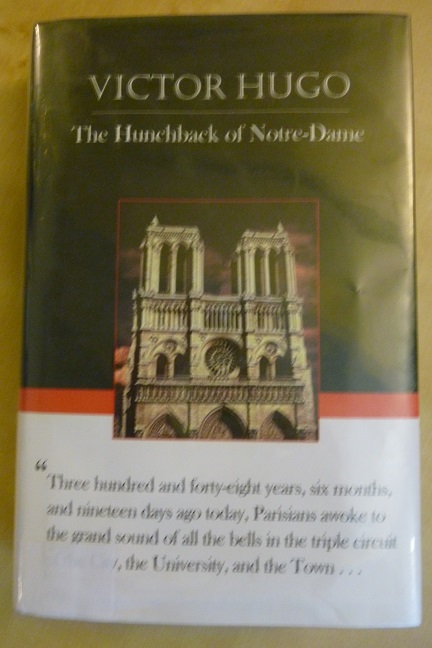
Hunchback of Notre DameI’ve been working on intimidating books this year…and diving into shadowy mysteries and Gothic literature for RIP…so September was clearly the month for The Hunchback of Notre Dame by Victor Hugo.  I enjoyed it quite a lot–I had been thinking I might take a break and read something else in the middle.  Instead, I ended up being so engaged that I didn’t stop after all–even though I had the new Jacky Faber book arrive while I was reading (but that’s a topic for another review).

The copy I read mentions on the jacket flap that Hugo despised the title The Hunchback of Notre Dame, which only arrived for the English translation.  Hugo called it Notre Dame de Paris–1482.  Not so catchy, but more accurate.  The Hunchback is just one member of an ensemble cast, and if I was going to pick one character as the lead, it would have to be the gypsy Esmeralda–hence the title of this post!  Because it really is centered around Esmeralda…and the men around her.

After my experience with Les Mis, I felt comfortable skipping or skimming when Hugo seemed to be off-plot, which happened a lot in the first hundred or so pages.  In fact, the main character of the first section of the book (if there even is one), is Pierre Gringoire, a destitute poet, and the story didn’t really pick up for me until he reached the Court of Miracles, where live the gypsies and vagabonds of Paris.

This is one of those books that’s worth sticking with, though, as it really does improve as it goes (with a few side diversions into history or cultural background…but that’s Hugo).  Gringoire has an interesting adventure or two, then disappears for most of the book as we finally focus on beautiful Esmeralda, terrifyingly sinister Frollo, sad hunchback Quasimodo, and surprisingly awful Phoebus.  For all the cultural weight and the number of pages, it’s essentially a story of unrequited love: Frollo wants Esmeralda who wants Phoebus who doesn’t value her–and no one wants Quasimodo, who was struck to his core by one act of kindness Esmeralda showed him.

Esmeralda is the center of the story, in that all the other characters circle around her and the plot is mostly driven by how they feel about her.  I couldn’t get much sense of Esmeralda herself, though.  She’s something of a will o’ the wisp, always flitting about but we don’t get into her head much.  She almost irritatingly enamored of Phoebus, and it’s a shame that that becomes such a driving part of her character.  She could be fascinating, as an independent woman who makes her own way in the world, on her own terms.  In a sense Fantine of Les Mis is independent, but her life fell apart; Esmeralda is actually getting along fine.  We don’t get much of that, though.

I was also rather disappointed by the lack of relationship between Esmeralda and Quasimodo.  She does show him kindness once in an extreme situation, but later on she’s still deeply uncomfortable around him.  Oh well, I should have known Disney would make it all rosier!

And on that subject–for a man named after the Sungod, Phoebus was horrible!  I deeply missed Disney’s courageous, noble captain, when Hugo gives us instead a philandering cad who can’t actually remember Esmeralda’s name…

This may be weird, but I think I was most fascinated here by Frollo.  Hugo’s heroine may have left a bit to be desired, but you can trust him to provide a complex villain.  It shouldn’t be surprising that we descend into the depths of his sordid obsession and twisted desire for Esmeralda.  I mean, even Disney didn’t manage to clean that up entirely!  I was more surprised by how openly sordid and at times sensual the book was, considering the time of the writing…maybe I’m just used to restrained British Classics, and it’s different when the French were writing them?  🙂

So how about the not-actually-title-character?  Quasimodo reminded me SO much of Leroux’s Phantom.  And I think that was just me and my particular, um, interests.  Hugo’s Quasimodo is dark, at times hostile, but also coming from a place of deep sadness.  His hostility towards the world is founded on the world’s rejection of him and that makes me feel so very bad for him.  I love his love for the cathedral, and I was thrilled to see a line where he’s talking to his favorite gargoyle statue…and it’s heartbreaking that that line is, “Why can’t I too be made of stone?”  Sad sad sad.

And he’s also like Leroux’s Phantom in that I think they both had authors who didn’t realize what they’d created.  Leroux spent far more pages on Raoul than he did on the much more interesting Phantom, and Hugo could have given us more of Quasimodo and less of some others…but what we got was very good.

This is only about half as long as Les Mis (so, 500 pages…) and some parts require a bit of wading, but on the whole I thought it was an excellent, very readable story with extremely engaging characters–even if some were less likable than I had hoped!  Once the book gets into its stride, it’s also hugely exciting.  I read the last hundred pages straight-through.  And, of course, the ending is deeply tragic.

I’ll probably still watch the Disney movie more often than I’ll read Hugo 🙂 …but I did thoroughly enjoy reading the original.

Other reviews:
My Turn to Talk
The Yellow-Haired Reviewer
A Good Stopping Point
Anyone else?

Buy it here: The Hunchback of Notre-Dame