Thirty-Seven Plays in Ninety-Seven Minutes

Reduced ShakespeareI’ve lost track of how many times I’ve seen The Complete Works of William Shakespeare (Abridged).  I’ve seen it live twice, and the DVD more times than I can tell you.  I was introduced to this brilliant production by my quite brilliant high school Shakespeare teacher–and it’s a lot of fun when you can then quote the production in Shakespeare class and the teacher gets the joke too!

The players of the Reduced Shakespeare Company declare that they “descend among [us] on a mission from God and the literary muse to spread the holy word of the Bard to the masses.” And they do–with high hilarity besides.  They do not spread literary, scholarly, or particularly deep or analytical Shakespeare to the masses, but an audience member with no familiarity with Shakespeare will leave with a working knowledge of the plot of Romeo and Juliet and Hamlet, a rougher idea of Othello, Macbeth, and Titus Andronicus, some exposure to Shakespeare’s language, and—most important I’d say—a clear and lasting impression that Shakespeare can be interesting and fun!

Complete Works presents all thirty-seven plays in ninety-seven minutes (or so their tagline says).  Three actors play every part, and they do a credible impression of making it all up as they go along.  Props fly, lines are spouted accurately or in parody, the audience is invited to participate (as Ophelia’s psyche), and all in all, Shakespeare becomes a hysterically funny, high-impact sport.  I could give you a long review about pros and cons and ups and downs…but honestly, it’s just bloody funny, and the best review may simply be to tell you some of the hilarious moments.

The Comedies wind up condensed down into one play, while the Histories are turned into a football match, tossing the crown about the stage.  More attention is given to the tragedies–because it turned out they were funnier.  Titus Andronicus appears as a cooking show.  Macbeth is performed with extreme rolling of Rs.  Romeo and Juliet features a lot of Shakespeare’s lines, though also a surprising amount of pantomimed-vomit.  After a brief confusion involving plastic boats and the correct meaning of “moor,” Othello is presented in rap (“About a punk named Iago, who made himself a menace, ’cause he didn’t like Othello, the Moor of Venice.”)

Act Two is entirely devoted to Hamlet, going almost scene-by-scene.  They cut out Rosencrantz, Guildenstern and the pirates, but otherwise you get the complete plot, and there are even a few more serious moments.  There’s an amazing performance of the “What a piece of work is man” speech, and the final deaths are affecting.  Although, of course, there’s also a sock puppet play-within-the-play, a literal sock playing the ghostly king, and the aforementioned audience participation as Ophelia’s psyche.  Among other things…

Reduced Shakespeare’s Complete Works provides an evening of great fun for anyone.  Those who know Shakespeare well will pick up on a number of relatively subtle jokes and those who don’t know Shakespeare will leave knowing a good deal more than they did before, and with plenty of encouragement to seek out even more.  Either way, no one who watches the Complete Works will ever read Shakespeare in quite the same way again.  See it live or get the DVD–it’s not to be missed!

Actors’ website: http://www.reducedshakespeare.com/

Classic Review: The Bagthorpe Saga

I’ve been looking back at old favorites in rereads lately.  Today I thought I’d share an early review of one of my favorite series, The Bagthorpe Saga by Helen Cresswell.  These are among the zaniest, most hilarious of books…

***************

Some of my favorite characters live inside of Ordinary Jack by Helen Cresswell.  Ordinary Jack is Book One of the Bagthorpe Saga.  The Bagthorpes are a family of geniuses, each with a precise number of “strings to their bows.”  That is, a number of talents (and each one can quote how many he/she has).  That’s true for all except Jack, who is ordinary, and politely disdained because of it.  Jack is complaining about the situation to his Uncle (by marriage) Parker one day, who hits on a scheme to convince the rest of the family that Jack is in fact a gifted psychic who can see visions and predict the future.  Chaos ensues.

Jack and Uncle Parker are a fairly rational pair, who will chart you through the madness of the rest of this cast of truly hilarious characters.  There’s Mr. Bagthorpe, a TV writer who loudly and frequently complains that everyone is disrupting the delicate vibrations he needs to write.  There’s Grandmother, who cheerfully starts an argument with everyone, and is in years-long mourning for her beloved pet cat Thomas, who everyone else remembers as the worst-tempered animal who ever lived.  There’s Uncle Parker’s daughter Daisy, who is four years old and likes to write on walls and set fire to things, often with literally explosive results.  There’s one scene involving a birthday party and a box of fireworks hidden beneath the table…  Daisy’s mother, Celia, is a poet and far too ephemeral and dreamy for this world, who feels Daisy’s spirit shouldn’t be restrained.  For reasons Jack never quite understands, Uncle Parker is madly in love with her.

That’s only a sampling.  They are all people I would never want to know in real life, and would definitely never want to let into my house (especially Daisy!) but they’re enormous fun to read about.

There are ten books in the series, taking the Bagthorpes through adventures including television fame, a haunted house, and more than a few explosions.  The later books do vary in quality somewhat–they’re all fun, but at some point Cresswell stops having plots and just starts throwing the characters together and letting them react off of each other, and some of the results are better than others.  But the first few are excellent and all are enjoyable.

And Ordinary Jack is worth the read if only for the scene about the birthday party and the fireworks!

Other reviews:
A Tapestry of Words
Letters from a Hill Farm
Anyone else?

Buy it here: Ordinary Jack: Being the First Part of The Bagthorpe Saga

Dark Poets and Untimely Death

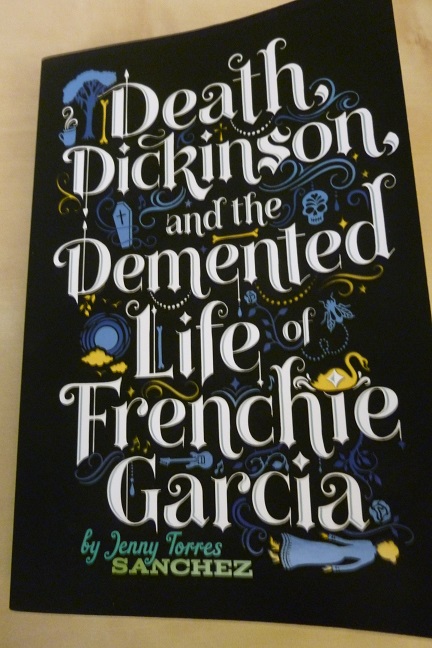
Death DickinsonFrenchie Garcia likes to talk to Emily Dickinson.  The cemetery near her house has a grave for Emily Dickinson, and though it’s not the famous one, Frenchie likes to pretend.  She views “Em” as a kind of imaginary friend–and that idea was what drew me into reading Death, Dickinson and the Demented Life of Frenchie Garcia by Jenny Torres Sanchez.

As you might already guess, Frenchie is a somewhat unusual teenage girl, considering she feels a kinship with a reclusive poet, and thinks about death a little more than may be healthy.  Frenchie is struggling with changes in her best friend, doubts about her plans post-high school, and a depression no one else seems to recognize the depths of.  What no one realizes is that Frenchie’s worries are tied to one wild, unexpected evening she spent with Andy Cooper, a near-stranger but long-time crush.  Andy committed suicide just hours later.  Wracked with guilt and uncertainty, Frenchie sets out to re-create her evening with Andy, hoping to find answers.

Despite being about depression and death (and Dickinson), this book isn’t nearly as much of a downer as you might expect!  Frenchie is experiencing a lot of darkness, but the book is fast-paced and ultimately more about life than death–so if you’re turned off by the apparent bleakness, I can tell you that I personally didn’t find it to be a depressing read.  (Hmm, lots of Ds in that paragraph…)

Frenchie’s voice and character are strong even when she’s feeling lost.  Many of her feelings are very relatable, even if she’s experiencing them to a more extreme degree than (I hope) most readers.  There are questions about friendship, choosing a path in life, how well you can know a person, how to handle changes and let-downs, and what it all really means.  Some of Frenchie’s apparently profound revelations felt a little basic, but I am older than both her and the book’s target audience, so that may be a factor there.  On the whole, it addresses some powerful issues.

My favorite aspect to the book is actually a kind of subplot, around Frenchie’s best friend, Joel, and his (relatively) new girlfriend, Lily.  The book is first person from Frenchie’s point of view, so we only have what she tells us about Lily–but it’s handled carefully enough that I could tell Frenchie wasn’t a reliable narrator on this subject.  Most or all of her hostility towards Lily is unjustified by who Lily is.  Though at the same time I can understand completely why Frenchie feels the way she does, so I felt sympathy for her.  It was a nicely-handled presentation of a familiar scenario in teen books, but without the conventional conclusion to the situation.

My biggest reservation, on the other hand, is Colin, Frenchie’s choice to accompany her on this re-created night.  He’s a near-stranger, which is what she needs for the situation, but I never quite believed that he was willing to go along for this apparently irrational ride.  I get that he thinks she’s cute…but there was more than enough to scare just about any guy off.  While so many other characters (Andy included) were complex and effective, Colin I found less believable.

I won’t tell you the ending, but I will say that it’s satisfying, without being too pat or neat.  It ends positively, but not in a place of implausible solutions or easy answers.  After all, you can’t have too happy an ending, when your book has “Dickinson” in the title!  And, you know, “death” too.

Disclaimer: I received a copy of this book for free from the publishers, in exchange for an honest review.

Author’s Site: http://jennytorressanchez.com/

Other reviews:
YA-aholic
Candace’s Book Blog
Teen Librarian’s Toolbox
Anyone else?

Buy it here: Death, Dickinson, and the Demented Life of Frenchie Garcia

Witches and Hangings and Swampland, Oh My

ChimeI’ve been hearing about Chime by Franny Billingsley for quite a while now.  What finally drew me in to pick it up, though, was the opening line: “I’ve confessed to everything and I’d like to be hanged.  Now, if you please.”  So intriguing!  What does it mean, what’s the story?  Dark, but rousing my interest wonderfully.

Well…the mystery was better than the solution.  This was a good book but, as sometimes sadly happens, it was never quite as good as I hoped it would be.  Since a lot of people really loved this one, my reaction may be a product of my waiting too long to read it, and building the whole idea up just a bit too much!

Chime is narrated by Briony, who believes she’s a witch—Stepmother explained it to her.  Briony has the Second Sight, the ability to see the wide variety of magical creatures living in the swamp outside her village.  She believes that when she loses control of her temper, terrible things happen to the people around her—like the accident that left her twin sister Rose with the mind of a child, or the great wave that crippled Stepmother.  Briony is careful to present a smiling mask to the world and to remember to hate herself and her wicked deeds—until she meets Eldric, who makes her wish witches could love.

Briony should have been an intriguing character, and in some ways she is.  The trouble is, while I grew to like her, I also got frustrated with her very quickly.  Certain twists became obvious (to me) almost immediately, and I wanted to shake Briony for not figuring them out.  Considering certain trauma she had been through, her inability to see was probably realistic and I acknowledge that—but that didn’t make it less frustrating to read.  There are additional twists and revelations as the book goes on, some of them more unexpected, although most I worked out sooner than Briony did.

That may be part of the fundamental problem of Briony’s character.  She’s supposed to be very clever—but she doesn’t act that way.  Briony and Eldric also felt consistently younger than they were supposed to be.  To me, they often felt more like fourteen, instead of seventeen and twenty-two, respectively.  I think Eldric was meant to be witty, and at times he was…but he came across as silly a bit too often.  And I must say, having a man and a woman form a “Bad Boys Club” in the style of Tom Sawyer really doesn’t seem like the best of ideas for setting up an adult romance…  There were some satisfying moments in the end, but it was rough in patches along the way.

I did find the magic more effective, once I got into it.  It was initially difficult to figure out the setting—there’s a strong New England and Salem Witch Trials feel to the little town, and since it’s supposed to be an (old country) English village in the early 1900s, that threw me some.  But—once I got grounded, I did like the world of spooky, magical creatures in the swamp—everything from a Brownie to ghost children to a Dead Hand—and the ways the villagers had learned to deal with them.

In some ways, Rose, Briony’s sister, became one of my favorite characters.  She has more depth than was immediately apparent, and in her own obscure way, she really is clever.

The book picked up as the action did and the second half is at least an engaging ride that ultimately presents some good twists.  And there is a reason Briony wants to be hanged—now, if you please.  Not a wonderful book—not a bad book—a pretty good book that almost might have done better with not quite such an intriguing opening.  Perhaps I would have enjoyed it more expecting less!

Author’s Site: http://www.frannybillingsley.com/

Other reviews (some who liked it much more than I did):
Things Mean a Lot
That’s What She Read
Good Books and Good Wine
The Allure of Books
Anyone else?

Buy it here: Chime

Glorious Gryphon Tales from Andre Norton

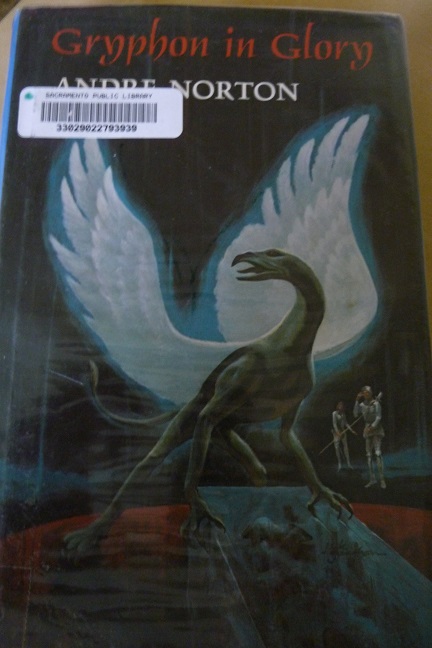
Just so you know, I hate this cover.

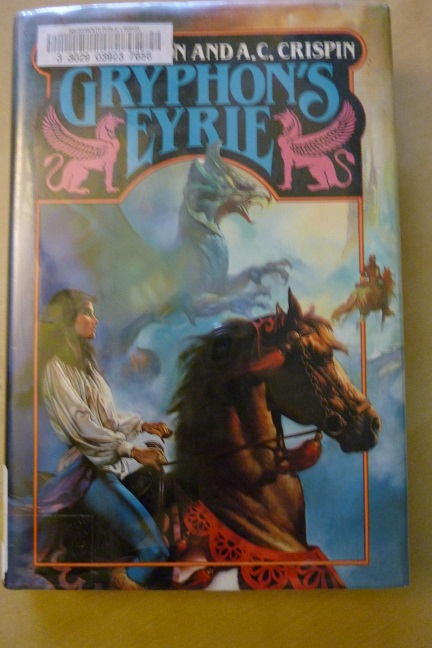
I recently reviewed The Crystal Gryphon by Andre Norton, and since then I’ve read the other two books in the trilogy, Gryphon in Glory and Gryphon’s Eyrie (co-written with A. C. Crispin).  They’re not long, so I thought I’d take them together today.

The trilogy is about Kerovan, who has always considered himself apart from other men due to his questionable magic heritage, showing itself in his amber eyes and his hooves.  He was married as a child to Joisan, a strong young woman whose destiny as a noble lady was changed by a war devastating the country.  Though they met and fell in love in the first book, there are still problems between them in the books that follow.

Gryphon in Glory begins with the two apart, largely because Kerovan believes Joisan is better off without him.  Disagreeing (adamantly), she follows him into the Waste where, separately and apart, they encounter strange creatures and ancient magic.  Gryphon’s Eyrie sees them still seeking a place to belong, as well as a true understanding with each other.

I do love Joisan on this cover.

There’s so much I love about this trilogy.  The world is amazing, with so many layers, so many strange creatures and different cultures.  Their land is one with an elaborate, complex past that continues to influence the present.  The second and especially the third book get farther away from the war that dominated the first book, leaving more room for other elements of the world to emerge.

I love the characters so much, Joisan especially.  She continues to grow and mature and find new strength throughout the trilogy.  I love watching her come into her own, finding increased abilities and confidence.  She feels like the driving force in the relationship, in a way that works very well.  The concept of a woman who refuses to let go of a man who keeps trying to end things sounds awful, but it actually works very well here, without ever compromising Joisan’s strength of will or self-respect.

I love Kerovan’s character as well; he’s so lacking in a sense of self-worth, and while I do want to shake him occasionally, mostly it makes me sympathetic to him.  Kerovan goes through extensive character growth too, although for him it tends to be two steps forward, one step back.  I might have liked to see his growth move more consistently forward, as at times it felt like we were continuing to tread through the same territory again and again.  But in the end it does come to a satisfying conclusion, both in Kerovan’s growth and in the romance, as they find their way to being true partners.

And then of course the writing is beautiful too.  It can be a little formal at times, but in a way that’s really lovely.  The third book, with its added co-author (A. C. Crispin) made me nervous, but I didn’t observe a significant change to the style—which was a good thing!

With a warning that the character growth takes its time now and then, this trilogy comes highly recommended.

Author’s Site: http://www.andre-norton.org/

Buy them here: Gryphon in Glory and Gryphon’s Eyrie