A Journey Back to Middle Earth

Hobbit 1I saw The Hobbit this weekend, and it was so much fun to go back to Middle Earth.  The movie is excellent on so many levels, from the characters to the action to the vistas…and to the return to Middle Earth.  Also–Martin Freeman!

This is a prequel that is self-aware of its own sequel, but that works.  The movie begins, I believe, the same morning as The Fellowship of the Rings.  Bilbo is writing his memoirs and nephew Frodo is eagerly anticipating the arrival of Gandalf the wizard for Bilbo’s party.  And then we flash back sixty years…to watch an unchanged Gandalf select a much younger Bilbo for an adventure–along with thirteen dwarves who invade Bilbo’s home in a very funny fashion.  Bilbo reluctantly embarks on “an unexpected journey,” and soon finds himself engulfed in a quest to fight a dragon to reclaim the dwarf homeland, fighting orcs and trolls and even stranger creatures along the way.  Meanwhile, Gandalf and others are worried about the rise of darker powers in a pretty obvious foreshadowing–but no matter, it gives it a nice all-tied-together feeling.

Let’s start with Bilbo.  To reiterate–Martin Freeman!  This actually makes the long wait for Sherlock feel worth it.  Freeman is playing the character he plays best, the ordinary chap who just wants a peaceful life (and perhaps a hot cup of tea), only to find himself thrust into chaos far beyond his scope.  He has to rise to meet it, and discovers he has a zest for adventure in the process.  Such is Arthur Dent, Dr. Watson, and most definitely Bilbo Baggins.  Starting from a scene where he firmly tells Gandalf that no adventures are wanted here, they’re inconvenient and make one late for dinner, Bilbo grows into a hero almost in spite of himself.  At the risk of a slight spoiler, I will say that he eventually shows courage in battle–but I think I was more impressed by a scene afterwards when he shows that he understands what they’re fighting for, believes in the rightness of the cause, and is willing to persevere to make it happen.  That’s more indicative of character growth than hitting an orc with a sword.

The other biggest character in the movie is Gandalf the Grey Wizard, wise and yet at times very humanly unsure too.  Ian McKellan is excellent, conveying all sorts of depth of emotion with just a twinkle of the eye or a curl of the lip somewhere behind that enormous beard.

It’s a movie of beards, by the way, since we spend most of it in the company of dwarves with some fantastic beards.  Thorin, the dwarf king, is the most serious and complex of the group, the leader of the quest and the somewhat Aragorn-like figure of the movie: rough and sometimes terse, but good-hearted and a brave leader.  The rest of the dwarves shine largely as comic relief, but provide the occasional dramatic insight too.

One of the most striking characters of all is Gollum.  I doubt he was in the movie for more than fifteen minutes, but they are among the most memorable fifteen minutes.  He’s completely mad, big-eyed and sad one moment, snarling the next, and just so excellently done all the time.

There are also cameos by other old friends–Frodo was mentioned above, and we also see Elrond, Galadrial and Sarumon.  I confess I was rather hoping for Legolas (I don’t care what the purists say about his not being in the book), but IMDB tells me he won’t be along until the third movie.  I was also watching for Benedict Cumberbatch, never saw him except in the credits, and figured out after I got home that he was the Necromancer–who I think was only seen in silhouette for about five seconds.  Next movie, I hope for more.

But on the subject of old friends–it is so much fun to come back to this world, to see some of the same faces, to recognize the same creative style.  I am by no means a major Lord of the Rings fan, and it’s been years since I watched the movies.  Yet there’s something so nostalgic about The Hobbit.  This may be enhanced by the fact that we’ve come back to what is, in a way, a simpler time in Middle Earth.  Sauron is just starting to rise, Smaug is a comparatively small villain, and the movie is more light-hearted, at least in spots.

There are certainly epic sword fights and large-scale battles with hideous monsters, and moments that are just so deliciously Tolkienesque.  I don’t really know how else to describe it, because I think he set the definition.  He set the standards that so many others are emulating and going back to the original just brings it to some kind of pinnacle of fantasy.

But there are also funny parts, particularly the beginning as the dwarves run rough-shod over Bilbo’s home, and most especially a scene involving a trio of gourmet if stupid trolls who want Dwarf for dinner.

There are also incredible views.  If Lord of the Rings has led you to expect scenes of footsore travelers traipsing across mountain paths with breathtaking vistas behind them…you will not be disappointed.  The setting is really remarkable throughout, from the sweeping views to the beautiful Rivendell set amidst waterfalls, to the truly horrible troll kingdom, to the cozy homeyness of the Shire.  It’s all so vivid, so beautifully realized…and I saw it in simple old 2D.

I’d be remiss if I didn’t reflect on the fact that this is a long movie.  And it’s part one of three.  It reminds me of Harry Potter 7, Part 1, in that it feels like someone set about to include every detail they could.  The Hobbit is not a slow movie, but it is a movie that takes its time.  It will not be rushed, it will not leave anything out, and if there is an element of backstory or a moment of foreshadowing to be told, it will tell it.  No need to hurry, just relax and enjoy the scenery.  It’s almost a little cosy, if I can use that word to describe a movie involving orcs and swords and falling off of mountains.

I have to admit I’m not quite sure how there are going to be two more movies after this, but I’m content to sit back and see where the journey takes us.  I look forward to continuing to visit Middle Earth, because it’s an amazing place where so many fantastic things can happen.  I mean, there are dwarves, and elves, and a city built amongst waterfalls, and stone giants!  It’s just–wow!

Also–Martin Freeman! 🙂

Movie site: http://www.thehobbit.com
Godmothers and Fairy Tales and Tradition

I’ve been reading my way through Mercedes Lackey’s 500 Kingdom series, and I keep meaning to review each book…but I reviews piled up and I haven’t got to them.  So I thought maybe I’d better review the series on a whole.  It may be best looking at them all together anyway, because I have definite feelings–mixed.

The series has been rather hit and miss for me, both in that some books are better than others and that some aspects of books have been better handled than others.  The biggest advantage of this series is a blissfully brilliant concept–in the 500 Kingdoms (take that literally) life is constantly influenced by the Tradition, a vague, overarching, not-quite-intelligent magical force which tries to push people and events onto…well, traditional paths.  Therefore life tends to conform to familiar fairy tales, for good or for ill.  The Godmothers are a network of powerful magical women, who work through and around the Tradition, trying to create happy endings.

I love that concept.  I love all the playing with traditional fairy tales, and I love the clever ways they get retold.  I love the ways people find to manipulate the Tradition, and the sometimes silly things that have to be done to keep the Tradition happy.

Things get more mixed with the characters–from book to book, some have been strong while others have never felt fully realized.  Likewise, I have mixed feelings on the plots–some are good, but several have felt distinctly scattered.  But perhaps I’d better look at this book by book. Continue reading “Godmothers and Fairy Tales and Tradition”

When Redshirts Fight Back

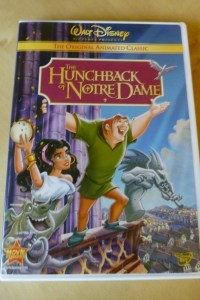
Redshirts by John Scalzi has one of the most fantastically brilliant premises I’ve ever run across.  As soon as I figured out that it really is about what I think of when I hear “redshirts,” I knew I had to read it.
Ensign Andrew Dahl and his friends are newly arrived on the starship Intrepid, and swiftly realize that there are strange things going on.  There seems to be a strangely high number of casualties among the crew, events frequently defy the laws of physics or logic, and everyone gets awfully nervous about the subject of landing parties.  Dahl eventually connects with Jenkins, a crewmember who became unhinged after his wife was killed aboard the ship, and has taken to hiding in the crawlspaces–but who seems to have a firmer grasp on what’s really going on than anyone else.  Jenkins has figured out that their lives are dictated by the scripts of a TV show–a bad one–and Dahl and his friends conclude that the only way to escape a meaningless death is to go back in time and find their writers.

Two brilliant things here: this book takes all the weird absurdities of the original Star Trek and sci fi shows like it, drags them out to be even more extreme, and then has characters actually realize how irrational it all is.  Second, this is so meta–characters inside of a story have to deal with what it means to be characters.  I’m not sure if it’s applicable philosophy,  but it’s certainly intriguing philosophy.

Two criticisms: this will sound nitpicky, but Scalzi has a speech tag problem.  For non-editors, those are he said, she replied, he asked, etc.  Generally authors drop them when they can without losing clarity.  Scalzi keeps them, particularly in ‘s a scene near the beginning with two characters swapping dialogue back and forth and a speech tag at the end of every line.  It may be a deliberate stylistic choice, but it still made me twitch.  Second, and this is very ironic–I couldn’t keep Dahl’s friends straight.  They’re all redshirts, all with carefully crafted paragraph-long backstories, and I struggled to remember who was who, or see any depth in most of them.  Again, maybe deliberate–or Scalzi fell into the same trap he’s parodying.  We’ll say it was deliberate…

I did really enjoy Dahl as a character, as well as Jenkins.  In some ways I think I felt for him the most.  And then there was Kerensky, one of the TV show regulars.  He’s the regular character who gets injured or threatened but pulls through–again and again and again.  He’s also incredibly arrogant and very entertaining.

The main story comes to a close with a strange number of pages left in the book, because it’s followed by three codas.  The first is supposed to be the blog of one of the TV show writers.  I had trouble with this story.  The writer is very argumentative, and I’ve never liked narrators who come across as hostile to the reader.  The second is…harder to explain, but suffice to say it’s in second person (so the main character is “you”) and I couldn’t get into that somehow.

The third story, though, is about the actress who played Jenkins’ deceased wife, and I really liked her story.  She’s trying to grapple with this revelation about the characters of the Intrepid, and with larger life questions and…really fascinating.

All in all, for whatever its quirks and misfires, this book is still worth reading for that so fantastically amazing premise.  If you’re a Star Trek fan, at least.  I mean–the redshirts figure out what’s going on and try to save themselves.  And it’s fast-paced and funny and–well, how could that not be fantastic? 🙂

Author’s Site: http://scalzi.com/

Other reviews:
Stainless Steel Droppings
Little Red Reviewer
Tia’s Book Musings
Anyone else?

Climbing Notre Dame with Quasimodo

HunchbackOne of my top places to see in Paris last September was Notre Dame Cathedral–for the architecture and because I like big old churches and because it’s an icon.  But also very much because of The Hunchback of Notre Dame.  I’ve never actually read Victor Hugo’s novel (though I have put it on my list since visiting the cathedral) so when I say that Hunchback influenced my Parisian sight-seeing…I mostly mean the Disney movie.

I can’t remember being particularly attached to this one as a kid, but in recent years it’s been emerging as one of my favorite Disney cartoons.  That makes sense, because this is not at all a typical Disney cartoon, and has a much more adult feel.  I love typical Disney and I don’t mean to criticize it in the review that follows, but I do feel this one is on a different level.

I’d really like to know how the first person looked at the book and said, hey, let’s make a cartoon!  Instead of a star-crossed princess and her prince, we have Quasimodo, the hunchbacked bellringer of Notre Dame.  His only friends are three gargoyles (two of whom are named Victor and Hugo–love that) and though he dreams of entering the world he’s watched, this has always been forbidden by his master, the stern magistrate Frollo.  Quasi finds a little daring, the beautiful and bewitching gypsy Esmeralda comes on the scene, and everything changes.

I love Quasi and his growth as a character, as he overcomes his fears and realizes his own value.  Sure, it’s not quite the complexity of Susan Kay’s Phantom, but there’s still a depth here that goes beyond perfect-princess-meets-perfect-prince.  Likewise Esmeralda is a strong, intelligent character, very aware of larger societal issues of class and prejudice.  I even like the prince figure, the handsome Phoebus, who I find more likable than, say, Raoul from Phantom.  Phoebus has his own depth, as a soldier who struggles with a new position and orders he doesn’t like–and he has a sense of humor.  Disney heroes who have funny scenes with horses to seem to work well with me…  And how do you go wrong when he says to his horse, “Achilles–heel.”

Frollo is also a villain with fascinating depth, and he’s a very mature villain for a Disney movie.  His interest in Esmeralda is on a totally different level than Jafar’s decision to marry Jasmine in Aladdin.  I really don’t know how the scene “Hellfire” got into a Disney cartoon.  Frollo is singing about lust and temptation and damnation, while there are flames and demons and hooded figures chanting “mea culpa.”  It’s fantastic and wonderful, but–in a Disney movie?  Really?

I love the songs, especially “Out There” which is one of my favorite songs ever.  It’s just so beautiful and heartfelt, and is one of the main reasons I felt I had to spend time in Paris “strolling by the Seine.”  The only time I got out my iPod while walking around was to listen to “Out There,” sitting on a wall next to the Seine.  I also love “God Help the Outcasts”–again, there’s a depth to it, and to Esmeralda’s character.  From the opening lines, “I don’t know if you can hear me, or if you’re even there–or if you would listen to a gypsy’s prayer,” she’s having a complex religious experience.  It’s deep, it’s emotional, leading up to the end, “please help my people, the poor and downtrod–I thought we all were children of God.”

My only significant reservation on the movie is the last two minutes.  After such a beautifully nuanced movie, it tied up with more of a simple Disney happy ending.  Quasi gives his blessing to Esmeralda and Phoebus, and then is embraced by the crowd.  And…I don’t buy either idea.  He may accept how Esmeralda feels about Phoebus, but I’d find it much more believable if he was less pleased about it.  A little wistfulness, maybe?  And after all the times that crowd has made an about-face, I wouldn’t trust it to stay welcoming for the span of five minutes.

I’m not sure what ending I want.  I don’t want Quasi to die, or even to retreat back into his belltowers (because then what was the point of the character growth?)  But after all the rest of the movie, I feel like they could have managed a more subtle, less conventional ending.  Maybe he retreats to the towers but it’s implied he’ll come out again in the future?  A little wistfulness on the romance question but also make it clear that Esmeralda and Phoebus will be his friends into the future, opening up the possibility that he could venture out farther someday?  There had to be some kind of bittersweet or lightly hopeful ending they could have managed.

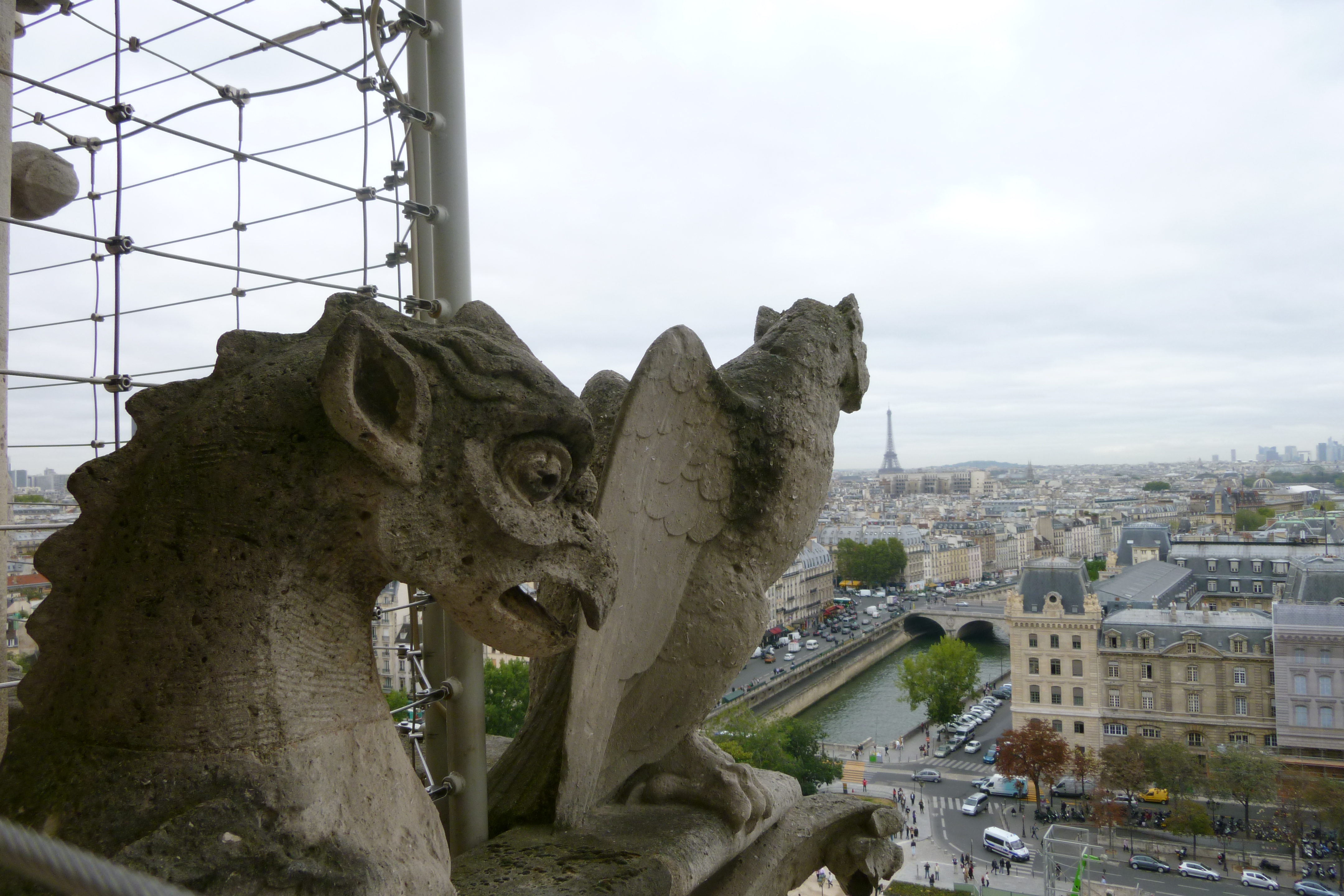
I still love the movie–and I loved watching it shortly after visiting Notre Dame.  Someone animating this really knew what Notre Dame looked like, and when I watched it again I kept reacting to things I recognized.  If you go to Notre Dame, you can easily go into the church, which is very beautiful.  I recommend also going around the corner to the left and getting in line to visit the belltowers.  There are a lot of stairs (a LOT of stairs), but it’s worth it to see the gargoyles and the view.  You don’t really get to see Quasi’s bells (just one) or the space where he lives in the cartoon, but it’s still neat–and you can see the whole of Paris below.

I’m planning a Notre Dame Saturday Snapshot for this weekend, so come by for more pictures then!

The Fairy Tale Behind the Ballet

The holidays are creeping up on us!  I always like thinking about favorite books and movies to help put me in the spirit.  This year, I was fortunate to find a new (to me at least) book with a Christmas theme: Nutcracker by E. T. A. Hoffman, illustrated by Maurice Sendak.
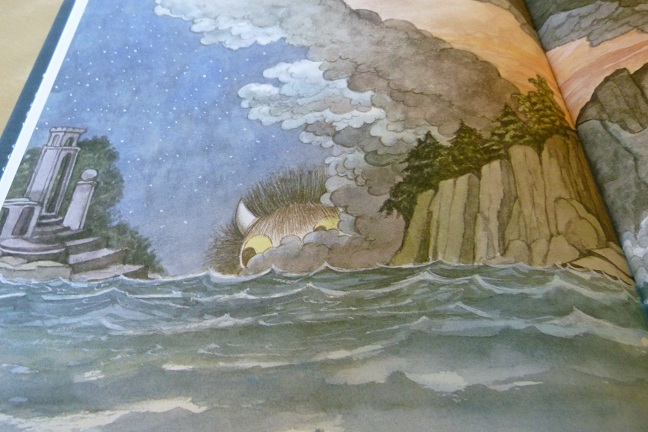
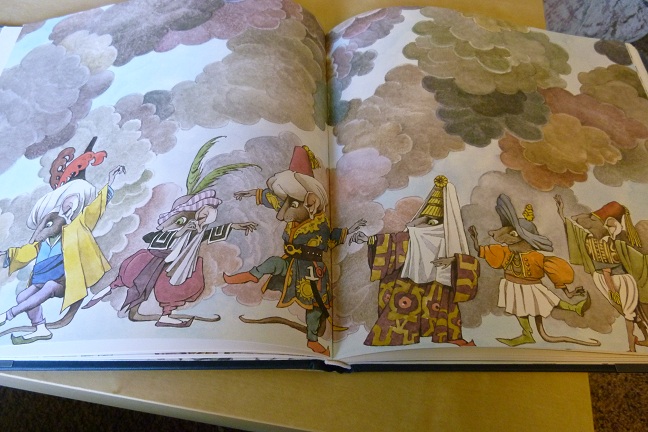
You may be familiar with the Nutcracker ballet–and this is not quite that.  The ballet is based on the story, and you can certainly see the same outlines.  But as often happens when stories are translated from one medium to another, things changed along the way!  The plot is a bit different and, in this particular edition, so is the atmosphere created by Sendak’s illustrations.

Like the ballet, the story begins with Christmas Eve, as Marie (or in the ballet, Clara) and her brother Fritz open their Christmas presents.  Marie’s favorite is the wooden Nutcracker.  That night, after everyone else has gone to sleep, Marie is in the parlor with the toys.  She witnesses a fight between the toy soldiers led by Nutcracker, and the fearsome, seven-headed Mouse King–or did she just dream it?  Here the story diverges from the ballet.  Marie is injured in the fight (or did she just put her arm through a glass cabinet?) and while she’s sick in bed, Godfather Drosselmeier tells her a fairy tale story of how the Nutcracker was cursed, and the roots of his enmity with the mice.

This is a lovely Christmas tale, with much the same charm and feel as the Brothers Grimm (though maybe less grim than their darkest!)  The book is really a novella, including the long story-within-a-story in the middle.  The odd story about the cursed princess who can only be cured when a magic nut is cracked is great fun, and Marie has her share of adventure too.

The illustrations are obviously a big part of this book, and there are some beautiful ones.  Don’t expect the tinsel and glitter of most productions of the ballet, but Sendak brings the characters to life with his own unique style–and with particularly elaborate costume details.  There are many full-page spreads, including a series of pages in a row when Marie and Nutcracker travel to the magic country.  There’s even what looks like a “Wild Thing” peering around a rock in one of those pictures!

My favorite thing about the book may be the charming narrative voice.  J. M. Barrie has won my heart forever by being the most charming of narrators, and so when I say Hoffman reminded me of Barrie in some moments, it’s a high compliment.  He has the same trick of addressing the reader that I enjoy so much, and there’s also some great tongue-in-cheek humor.

The edition I have was just released last October, and it’s physically a beautiful book.  It’s a large hardback, and seems designed to make a wonderful holiday gift!

Other reviews:
Rhapsody in Books Weblog
Minding Spot
A Patchwork of Books
Anyone else?

Disclosure: I received a free copy of this book from the publisher in exchange for an honest review.