Rise of the Anthropomorphic Manifestations…er, Guardians

When I went to see the adorable Wreck-It Ralph a couple of weeks ago, I saw ads for another animated movie, Rise of the Guardians.  Pretty much all I knew was that it was about Santa Claus and Jack Frost and the like, and there was a monster to fight…but this put it close enough to fairy tales to pique my interest, and so I went to see it this past weekend.  And it was excellent!

The movie focuses on the great mythical figures of childhood–I’m not sure quite what to call them, and “anthropomorphic manifestations” is too long, so let’s call them fables for convenience.  The main fables are Santa Claus, the Easter Bunny, the Tooth Fairy, and the Sandman–and Jack Frost, our lead character.  The first four are Guardians, protecting children through the centuries.  Now childhood is threatened by Pitch Black, the Bogeyman, and the Guardians are seeking Jack Frost’s help to fight back.

Jack has his own worries to think about–no humans can see him, no children believe in him and he doesn’t know what his purpose is meant to be–but he’s pretty sure he doesn’t want to be a Guardian.  Irresponsible and free-spirited, he doesn’t see himself as Guardian material, yet finds himself pulled into the fight against Pitch.

It’s a good plot that keeps moving at a quick pace, and the movie is enormous fun.  I love the way they play with the portrayal of the fables.  These aren’t the simple, saccharine characters who show up on Hallmark cards.  Santa (Alec Baldwin) seems to resemble a Russian mob boss who runs the North Pole with the help of tiny, hilariously-inept elves and a lot of Yetis.  The Easter Bunny (Hugh Jackman) is Australian, wields a boomerang with deadly effect, and uses magic rabbit holes to get around.  The Sandman is a tiny gold man with clouds of sand around him all the time, who doesn’t speak but flashes symbols above his head.  The Tooth Fairy (Isla Fisher) is a hyperactive cross between a humming bird and a human who is a little too interested in everyone’s teeth, and is surrounded by a crowd of tiny, hummingbird fairies.  And Jack Frost (Chris Pine) is an outwardly-tough prankster with a good heart, who is in fact deeply lonely.  Pitch (Jude Law) is suitably frightening, although I must admit a sneaking sympathy with him too.

The characters are engaging, both fun and appealing, and the humor is great–and this movie is SO beautiful.  It’s not the kind of beautiful animation you see in Brave, with all those landscapes (and Merida’s amazing hair!), but the animated medium lets them do incredible things with the magic.  It’s more like some of the scenes from Fantasia, with lights and shapes and beautiful patterns.  Jack leaves lacy flowers of frost behind him everywhere he touches, and there’s a wonderful opening scene as he leaps around a frozen lake leaving patterns in his wake.  The Sandman sends dreams as golden streamers of light soaring through the air to each sleeping child.  And Pitch’s nightmares are horrifying black stallions that stream shadows behind them.  It’s all so vivid, and so magical.

I have one criticism–the holidays are very much simplified down, and the movie exists in a world where Easter simply won’t happen if there aren’t any eggs, and Christmas is irrevocably and entirely ruined if Santa doesn’t come.  I don’t appreciate that message…but I’m also somewhat resigned to it in this kind of story.  Movies almost always equate Christmas with Santa, and I guess I’ll have to watch The Nativity Story if I want something else–or A Charlie Brown Christmas.

Aside from that, this actually has a quite nice message, about the wonders and joys of childhood and their importance.  The story takes a J.M. Barrie-esque twist, as it turns out that the Guardians need the belief of children to give them strength.  I like that balance, of the children needing the Guardians but also the Guardians needing the children.  And even if Santa isn’t really the deepest part of Christmas, this is a fairly deep Santa–somewhere inside the Russian mob boss, that is.

Technically, this is set around Easter, but it feels very much like a Christmas movie.  After all, two major characters are Santa Claus and Jack Frost, and most of the settings feature snow.  It has a Christmas movie atmosphere too.  As the cliche phrase puts it, it would be “fun for the whole family.”  I know it made me smile all the way through!

Movie site: http://www.riseoftheguardians.com/
Classic Review: A Squire’s Tale

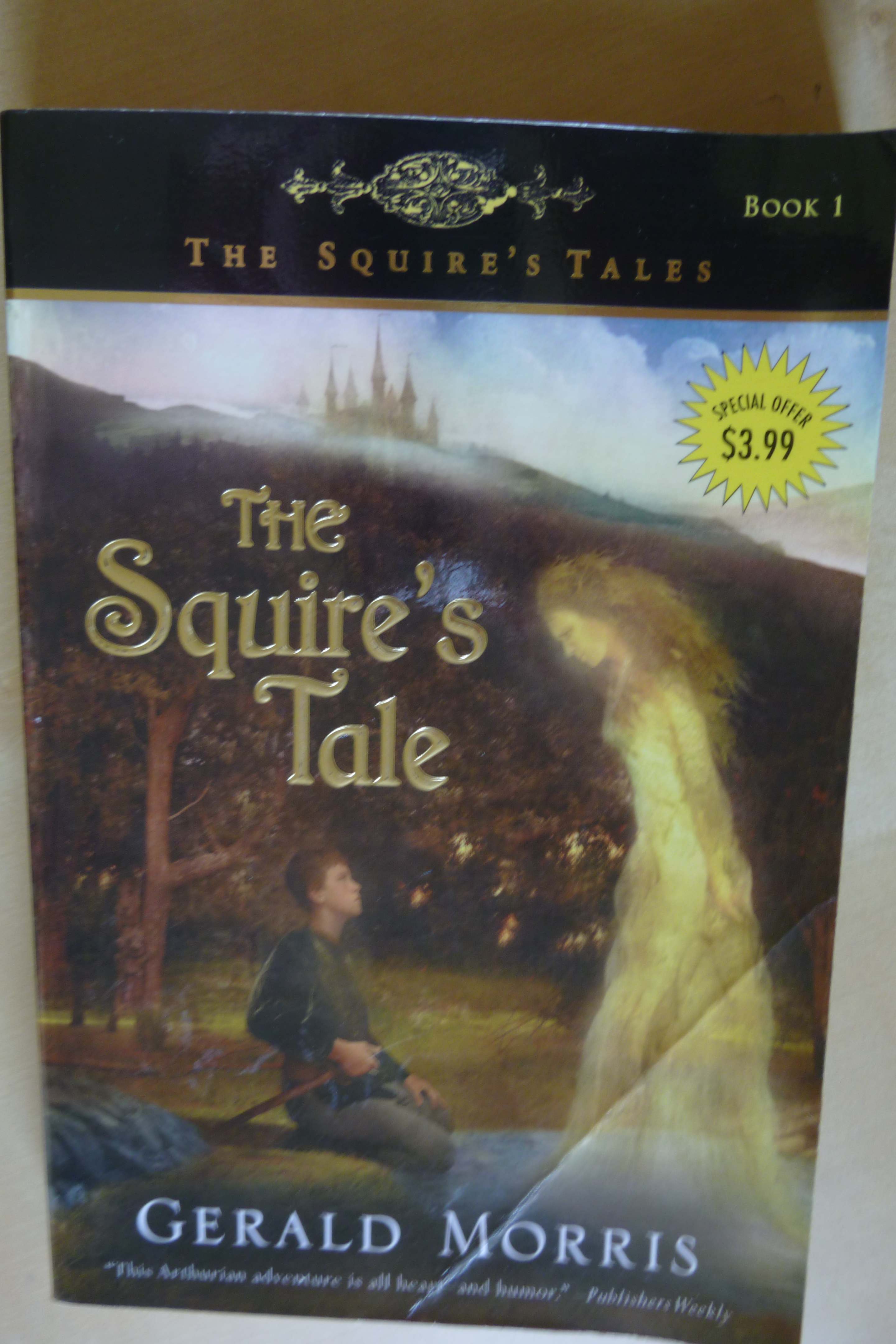
One of my favorite retellings of Camelot is The Squire’s Tales series by Gerald Morris.  It’s a ten-book series that he recently finished, retelling different Arthurian legends.  I admit the quality varies from book to book, but there are truly excellent ones in here, and I love the world he created.  The first book, reviewed below, is one of the excellent ones.  Somehow I still haven’t reviewed the later ones…I really should some time!

***************************

Who was King Arthur’s greatest knight?  I haven’t polled anyone, but I have this feeling that if I did, the answer would come back as Lancelot.  But not if I asked Gerald Morris.  He’s of the opinion that it was Sir Gawain–and after reading his Camelot series, I’m in his camp on this one.

The first in the series is The Squire’s Tale.  The squire in question is Terence, and, as you no doubt expect, he’s squire to Sir Gawain.  From Camelot to the fairy realm of the Other World, the two embark on a series of adventures, some hilarious and others suspenseful.

Terence is one of those heroes who is charmingly unassuming.  I’m sure it never occurs to him to think of himself as a hero–after all, he’s “only” a squire.  Sir Gawain probably knows he’s heroic–he’s got the horse and the armor and the sword, after all, along with the knighthood.  But he’s also wonderfully down to earth and practical.  For instance, when he encounters a knight who wants to fight anyone crossing a river, Gawain wants to know why, and doesn’t the man have anything better to do with his time?

I think I love Morris’ books, not only for the wonderful characters, but equally as much for the world they live in.  Morris tells Camelot the way it ought to be–Arthur is wise and noble, his knights are brave and loyal, there are recreant knights to fight at every crossroads, and mysterious magical beings (including one bearing a marked resemblance to Puck) lurk behind the trees.  And all of it with that practical bent that pokes a little fun at the more absurd parts of the legends.  I suppose there’s a place for stories of the darker side of Camelot, but I like Morris’ sunlit version.

And it’s not that there aren’t villains and danger, or that anyone is so saccharinely good that it gets dull.  The adventures are exciting, the characters are human, and watching Gawain and Terence grow as people and as friends adds more depth to the story too.  I love stories about comrades in arms–people who have fought together and struggled together and would die together if it came to that.  Except it probably won’t, because they’re good at what they do, and they’re even better together.  That’s why I like Star Trek too.  But that’s another review.

At the end of each book, Morris includes an author’s note about the Arthurian legends he drew on for his story.  Terence is original, but many of the other characters and plot elements come from older tales.  Some are familiar, and others are very surprising–especially some of those more absurd ones.

And if you’re wondering where the Green Knight is…that’s the second book in the series.  And another review.  🙂

Off to Sea with Bloody Jack

I have finally ventured into the wonderful world of audiobooks, which I entirely blame on all the bloggers who keep raving about them.  I’ve resisted because I work from home–no regular commute to make convenient listening time.  But I’ve increasingly had longish drives for social events, and thought I’d try an audiobook–and now I strongly suspect I’m hooked, for at least nine books.

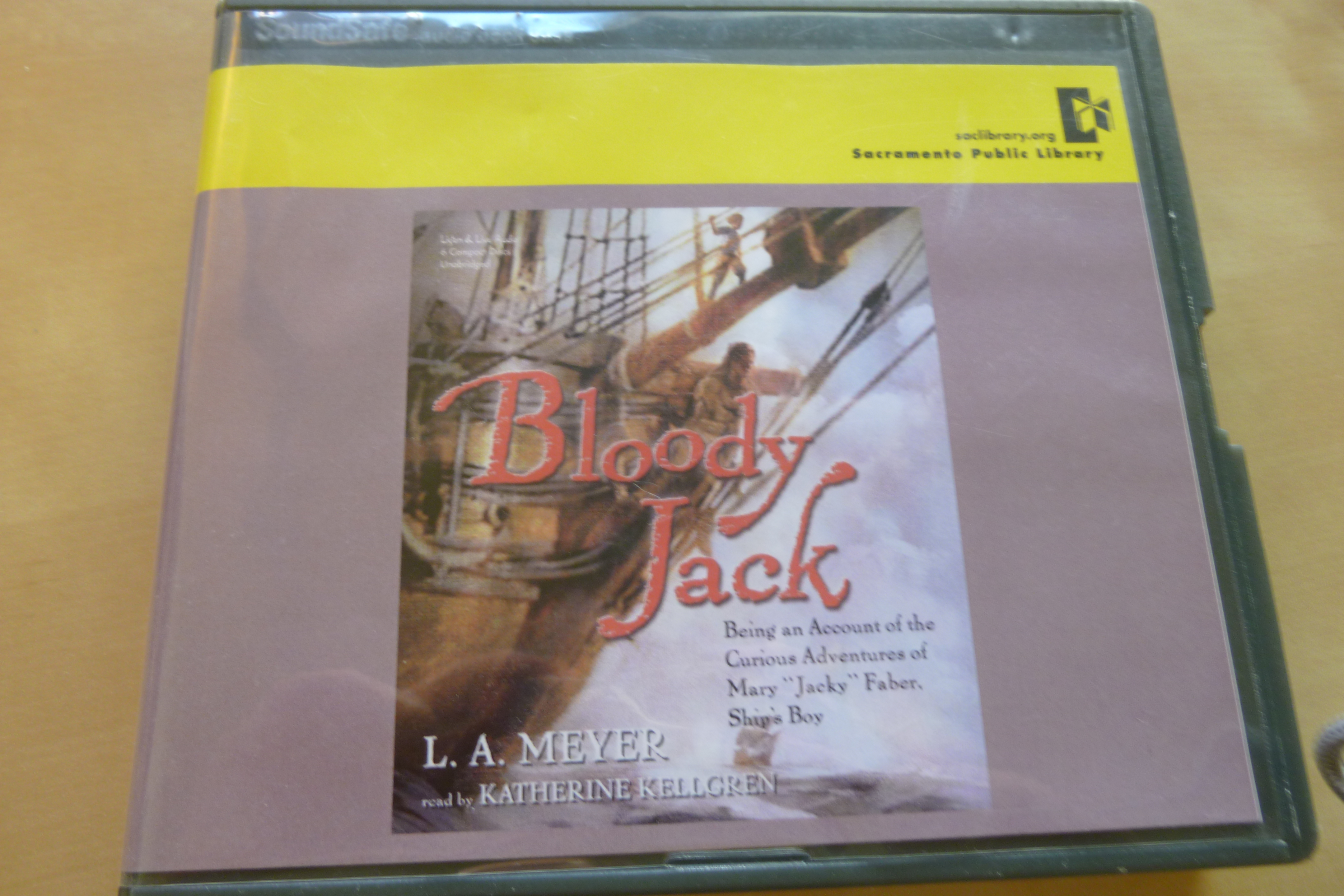
I’ve started listening to the Jacky Faber books by L. A. Meyer on audio, and now I think I’m in for the series.  I’ve been reading the books for years as they come out–I recently reviewed number ten, Viva Jacquelina.  It’s been a long while since I read the early ones, but I have too many books lined up–where was I going to fit in nine re-reads?  Audiobooks seemed like a natural solution, especially because I was guessing these would be particularly good read aloud–and I was right!

The first book in the series is Bloody Jack, and begins the tumultous adventures of Jacky Faber.  An orphan girl living on the streets of London, Jacky disguises herself as a boy and talks her way onto a Royal Navy ship as a shipboy.  Mostly, she’s hoping for a decent meal–and she longs to see “the Bombay rat and the Cathay cat and the kangaroo.”
Katherine Kellgren does a wonderful job with the reading.  It never sounds like she’s reading–it sounds like Jacky telling you her story, cockney accent and all.  The book is in first person, present tense, making it very immediate.  It’s fast-paced (especially as the series goes on) and the audio swept me right along.  Jacky is very emotive and dramatic, and Kellgren manages to bring believability to Jacky’s most over-the-top exclamations.

Jacky is without question the best part of this very good series.  She’s daring and exhuberant and never, ever manages to stay out of trouble.  She swears she’s really a coward, but that never stops her from diving into scrapes when the situation calls for it.  She’s staunchly loyal, endlessly charming, and one of the most engaging heroines I’ve ever met.

Jacky inevitably gathers friends and enemies around her, and it was fun going back to this first book where we get to start meeting major characters.  Kellgren gives characters different voices in the dialogue, without getting cartoonish about it.  Liam has an Irish accent, the captain sounds stern, and you can just tell immediately that Jaimy is handsome and well-born.

The story is wonderful as a book or on audio.  The adventures are exciting, Jacky is delightful, and, well, it’s just irresistable find out what she’ll do next!

Author’s Site: www.jackyfaber.com

Other reviews:
Good Books and Good Wine
Audiobook Heaven
Finding Wonderland
Anyone else?

The World Behind the Game Screen

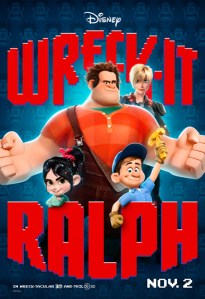
I headed to the movies this weekend to see Wreck-It Ralph–and it was adorable!

The premise centers around the magical question: what if all the imaginary characters really were alive?  What if toys came to life when we weren’t looking, what if characters crept out of books to hang out together when the library was closed, what if the Tiki Room birds really did get up every morning and perform dozens of shows a day?

And what if the characters in arcade games were going about their lives somewhere behind the screen?

As you might guess, this is a question that has always fascinated me!

Wreck-It Ralph is an enormously fun romp through arcade games, with endearing characters and a surprisingly warm message–without getting saccharine, despite an over-abundance of sugar!

Ralph (John C. Reilly) is the villain character in Fix-It Felix Jr., whose role is to wreck the apartment building every game.  After thirty years, Ralph is tired of always being treated as the villain, even when the game is turned off.  In a slightly contrived plot-turn, he vows to leave his game and go win a medal, proving that he can be a hero too.  The quest takes him first to Hero’s Duty, a violent shooter-game, and then into Sugar Rush, a candy-themed racing game.  In Sugar Rush, he meets Vanellope, a little girl who dreams of being a racer but has been banned because she’s a “glitch,” a program error who visually shorts out when upset.  Meanwhile, Fix-It Felix Jr. is in danger of being turned off without Ralph, and all is not well in Sugar Rush…and a fair amount of havoc ensues.

The concept of this is SO much fun.  I love that arcade game characters can travel between each other’s games.  The support group for Bad Guys is held in Pac Man, and when they’re off-duty, characters hang out in Tapper’s, a bar game.  The animation is great for portraying this world, because it can change as characters go from one game to another.  And there are so many gaming references in here; I’m not much of a video or arcade game player, but some things everyone can get–and I suspect the more you know, the better it is!

This has great characters as well–Ralph is likable as a “Bad Guy who’s not a bad guy,” who’s been trapped in his role all his life.  Vanellope (voiced by Sarah Silverman) walks a very fine line, somehow being  annoying yet ultimately sympathetic too.  And I loved Calhoun, the tough-as-nails, single-minded female soldier from Hero’s Duty.  She’s voiced by Jane Lynch, who you might recognize as Sue from Glee.  I think all three characters are sympathetic in part because you come to realize they’re not nearly as hard or as tough as they want to act.  And then there’s Fix-It Felix (Jack McBrayer), who is not remotely tough, but literally bounces through life (with sound effects very reminiscent of Mario), wonderfully polite and eager to please.

I have to also note King Candy, the affable yet sinister monarch of Sugar Rush.  I didn’t realize until writing this review that he was voiced by Alan Tudyk, beloved of geeks for his role as Wash in Firefly.  He was plainly channeling Ed Wynn (Uncle Albert in Mary Poppins)–from listening to the voice, I would have sworn it was Ed Wynn if I didn’t know he couldn’t possibly still be alive.

To give due nod to a very minor character, I love that the main human we see playing the arcade games is a girl.  And she’s not just playing Sugar Rush–she’s playing Hero’s Duty too.  Way to break the stereotypes!

If you can’t tell already, this is a wonderfully funny movie, from Felix’s bouncing to Ralph and Vanellope’s banter, from the ridiculous characters in Sugar Rush to the parodies of games–and sometimes life.  Whenever he passes through Game Central Station between games, Ralph gets stopped for security screening and is convinced he’s being profiled.

The plot is occasionally contrived, but the humor is excellent, the characters are endearing, and ultimately it’s a wonderful story about finding yourself.  You may want to bring some candy into the theater–Sugar Rush will make you want it–and you may want to plan some time for arcade games too!

Movie Site: http://disney.go.com/wreck-it-ralph/ (But be warned, the trailer is so-so.)

IMDB Profile: http://www.imdb.com/title/tt1772341/ (with a better trailer!)

Classic Review: Percy Jackson and the Lightning Thief

Things are a little busy around here for NaNoWriMo right now…so I’m opening up my archives and sharing another Classic Review.

Right now I have kind of a thing for fairy tales.  When I was younger, though, I had a mythology thing.  Some interests never quite go away, and so I’ve been enjoying Rick Riordan’s mythology-based novels immensely.  I’ve read all of his Percy Jackson books and the Kane Chronicles, and can recommend them all.  Today, here’s a look back at the first Percy Jackson book.

****************************

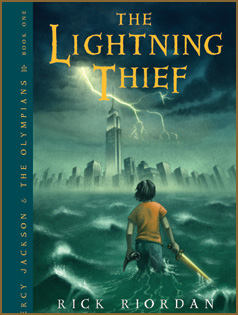
I wish Percy Jackson and the Olympians by Rick Riordan had been around when I was twelve.  I went through a period when I was obsessed with Greek mythology, and I think I would have LOVED these books.  Or else I would have had fits over every tiny detail that was inaccurate–it could have tipped either way.  But since my adult self didn’t actually notice any inaccuracies, I’m guessing my 12-year-old self would have been a big fan.

I read The Lightning Thief, the first book in the series, and while I don’t think I’m going to develop a raging obsession now, I did enjoy the book quite a bit.  The basic premise is that all the characters from Greek and Roman mythology have carried on into the modern world, still essentially doing what they’ve always done.  One of the things they’ve always done is to have children with mortals, which means there are still a lot of half-god children running around.  Percy Jackson finds out his absentee father is actually the water god Poseidon, just in time to get tangled up in a quest for Zeus’ stolen lightning bolt.  Its theft is perilously close to bringing on a war between the gods that could destroy the world as we know it.

I love the concept of these books.  I love the Greek gods brought into the modern day, and I’d really love to see more of how they’re fitting in with modernity.  Hermes has sneakers with wings and Ares rides a really tough motorcycle, for example.  I think it would be fantastic to find out, say, that Apollo (god of music) is completely obsessed with iTunes and thinks Rock Band is pretty awesome, or that Aphrodite (goddess of love) is actually running eHarmony.  How fun would that be?

Percy is good as a character; I can’t say he made a huge impression on me.  Maybe there’s too many slightly-screw-up characters who find themselves as heroes.  I’m not criticizing him as a character…but the one who I feel fonder towards is Grover, his satyr (half-goat) friend.  I think he’s more unique, as an environmentally-conscious satyr who really likes food, especially burritos and aluminum cans.  I also rather cherish the mental image of Grover careening through the air wearing Hermes’ out-of-control sneakers.

One criticism I do have of the book is that the quest felt a bit random.  Percy, Grover and their friend Annabeth set out, and along the way encounter several adventures, but they seem to just sort of bump into these adventures.  I would have liked to feel that there was a reason they were encountering the villains they were meeting, or going to the places they were reaching.  One caveat–I saw the movie first, and maybe I’m not the only one who felt this, because in the movie they definitely did have certain places to go and then set about going there.  This in turn may be why I felt particularly that they were a little aimless when I then read the book.

I actually haven’t heard Percy Jackson referred to as the next Harry Potter, the way everyone kept saying when Twilight became popular, even though it’s certainly closer in terms of themes and target audience.  I also think all three series have something in common, which may be a clue to why all three are popular.  It’s something Cleolinda Jones zeroed in on with her Twilight analysis, and that’s this element of suddenly finding your place.

You know you’ve been out of place and unpopular and kind of a screw-up your whole life?  That’s okay, you’re not really unworthy, you’re special!  And now you’re being transported to a new place where everyone realizes that what seemed like flaws are really gifts, and now you’re going to make new friends and be good at things and succeed like never before.  In some ways, Percy Jackson is even more transparent about this than Harry or Twilight (or Cinderella, for that matter).  Percy’s dyslexia is because his brain is wired for ancient Greek, and his ADD is to help him stay alive in battle.  When he goes to Camp Half-Blood, the training place for half-gods, he doesn’t become immediately popular (neither does Harry at Hogwarts, although Bella does in Forks), but he does become the prodigy of Chiron (trainer of Hercules, among others), and altogether begins to fit in.  And while I may poke at the idea a little bit as being a formula…it’s one that works very, very well.

A knowledge of Greek mythology would be helpful here, but I doubt it’s essential.  But you do need an interest, because by the time you’re done, you’ll have at least a little knowledge.  The Lightning Thief is a fun book and an exciting one, even if I don’t love it the way I might have at twelve!

Author’s site: http://www.percyjacksonbooks.com/