
The Graveyard Book Read-Along, Week Three

This month, I’m participating in a read-along of Neil Gaiman’s The Graveyard Book, as part of R.I.P.  We’re looking at a few chapters a week, with no specific questions for each post.  This week’s discussion is on the last two chapters.  See my first post here.

So much to love in these last two chapters–and so much to be desperately sad about!  Since we’re talking about the end, there will be spoilers…  Warning duly noted, let’s jump in!

Chapter seven is practically a novella, and right from the title, “Every Man Jack,” it promises us resolutions to the arching plot of the book.  I love how this chapter ties bits and pieces together from almost every earlier, disparate chapter.  A teenage Scarlett (chapter two) comes back to town, and finds her way to the graveyard and to Bod.  She also meets Mr. Frost, a soft-spoken academic…who in a brilliant twist turns out to be the man Jack.  I love that too–and you’d think I’d remember it!  But I didn’t, so I got to be surprised again.  This is why I enjoy rereading.

Meanwhile, Silas has disappeared from the graveyard on mysterious business.  We find out that he’s with Miss Lupescu (chapter three) and other comrades in a desperate fight against a group of enemies.  And I love that we have a last stand featuring a mummy, a werewolf and (though it’s never said, it’s pretty obvious) a vampire.  I love that we get all the classic horror monsters, and in this case they get to band together and be the heroes.  Love that.  I do have to admit, though, that parts of this confused me.  It eventually becomes clear they’re fighting the Jacks, but exactly where and how…I found that muddled.

Back at the graveyard, Bod finally has to confront not only the man Jack but several of his associates, the creepy men from that rather creepy convention we saw in the Interlude.  I love their names: Jack Dandy, Jack Nimble, Jack Tar.  I don’t get Jack Ketch–is that a reference I don’t know?  I love that Bod has to use all his knowledge and friendships from growing up in the graveyard to protect himself and Scarlett–he makes use of the ghoul gate (chapter three), gets help from Liza the witch (chapter four) and ultimately uses his experience of the Sleer (chapter two) to defeat the man Jack.

I love that Bod has to really embrace who he is as a child of the graveyard–realizing that he doesn’t need to “learn” his name.  He is Nobody Owens.  He uses all that he’s learned to protect himself and his friend.  And I love that Gaiman manages to handle all the men Jack without Bod actually killing any of them.  As a writer, I know that requires much more creativity than just killing the villain.

I am desperately, desperately sad about Scarlett.  Bod felt so drawn to her, and she was his only human friend…and then she becomes afraid of him…!  It’s such a tragic twist, that in the process of embracing his own identity and vanquishing his enemy, Bod ends up losing his friend.  He protected her, and then she rejects him for it.  I love the emotional tug of it–brilliant storytelling–while being so sad for him, and so disappointed that Scarlett couldn’t make the leap to accept him.

Chapter eight is very bittersweet as well.  Almost an epilogue chapter, Bod is growing up and that means leaving the graveyard.  It’s so sad that he can no longer see this community that he’s grown up in, while at the same time it’s exciting that he’s going to go explore the world beyond the graveyard.  The ghosts and the graveyard become a metaphor for childhood as he has to leave it behind to become an adult.

I get the metaphor, and it’s effective.  But I do wish the graveyard could still be there for him to go back to, the way some of the joys and wonder of childhood can still be found by adults.  And also, the idea of a sixteen year old boy with scarcely any experience of the world going out into the world alone–it sets off all kinds of screaming alarms in my head.  Silas, this is not responsible guardianship!  At least take him on a Grand Tour before sending him off by himself!

Though on the other hand…Bod set off into the world alone as a toddler, and made his way to the graveyard.  Now, at sixteen, he’s continuing that journey.

And I love his last exchange with Silas.  Love.

And I love to think that someday, after a long life full of lots of adventures and meeting people who won’t run away, I love to think that Bod comes back to the graveyard.

I’d also love to see a sequel about Bod’s adventures in the world.  Such potential for so much more.

In the meantime, I have thoroughly enjoyed taking a leisurely trip through this book again, and loved all the thought-provoking discussion on everyone’s blogs.  Big thank you to Carl for hosting, and to everyone for all your wonderful thoughts!

Reveling in Revels Below Fairyland

I spent this past weekend reading The Girl Who Fell Beneath Fairyland and Led the Revels There by Catherynne M. Valente.  I loved it.  It’s my second contender for “favorite new book this year” which is not altogether surprising–since it’s tied with The Girl Who Circumnavigated Fairyland in a Ship of Her Own Making.
I already reviewed the first book in the series, and all the wonderful things from that book carried over here–the magic and the whimsy and the beautiful, beautiful writing.  This series combines so much of the loveliness of classic children’s fantasy with more complex characters facing more complicated choices.

The last book promised us this sequel was coming, and I think it’s worth quoting that line again: All stories must end so, with the next tale winking out of the corners of the last pages, promising more, promising moonlight and dancing and revels, if only you will come back when spring comes again.

The second book begins with our heroine, September, eagerly looking forward to a return to Fairyland.  I’m drawn in right at the beginning, as Valente explores how hard it really would be for Dorothy to go back to Kansas–I mean, for September to go back to Nebraska.  It doesn’t take long for her to fall back into Fairyland, where she eagerly anticipates fun adventures with her friends–only to discover that something has gone awry.  September lost her shadow in the first book, and now she finds out that someone has been stealing shadows (and with them, magic) away from Fairyland.  September must go on a quest into Fairyland Below–and there we find “moonlight and dancing and revels.”  September meets old friends strangely changed and many new creatures and places that are decidedly odd indeed.  Fairyland Below is a darker, more mysterious place and September doesn’t always know who she can trust.

The Girl Who Fell still has L. Frank Baum’s whimsy and J. M. Barrie’s charming way of addressing the reader, with an added dash of Lewis Carroll.  September goes to a quite strange tea and coffee house, and we see chess references occasionally too.

Unlike Peter Pan (or really all the endlessly-young, never-changing children of classic fantasy), September is begining to grow up in this volume.  She feels things a little deeper, thinks a little more, and there are just a few hints of romance.  I love September; she’s a brave, resourceful girl who wants to solve the problems around her and do the right thing.  But she doesn’t always know what the right thing is, and she struggles to know who she is herself, and what role she’s meant to play.

Many major characters from the previous book, like A-through-L, September and the Marquess return in this one–but Fairyland Below is dark and mysterious and all may not be quite as it seems.  We also get to go to a Goblin Market, meet a minotaur and a dodo bird, and seek out a sleeping prince.  There’s philosophy and there’s lyrical writing and we even get to play a bit with fairy tale tropes.

It is perhaps not a perfect book.  There are a few time-jumps that are slightly disconcerting, and the ending is maybe a touch convenient.  Though the ending makes me happy, so I don’t actually mind that much.  And even if it’s not perfect, it comes very close.  Unquestionably one of the best new books I’ve read this year.

Really, I don’t know how to do justice to this book.  I loved it.  I really, really, really loved it.  I follow Valente on Twitter and she’s been referencing work on Fairyland 3.  I will be pre-ordering that one as soon as it becomes available!

Author’s Site: http://www.catherynnemvalente.com/

Other reviews:
Little Red Reviewer
The Book Smugglers
Books Writing Tea
Anyone else?

Riding the Orient Express with Hercule Poirot

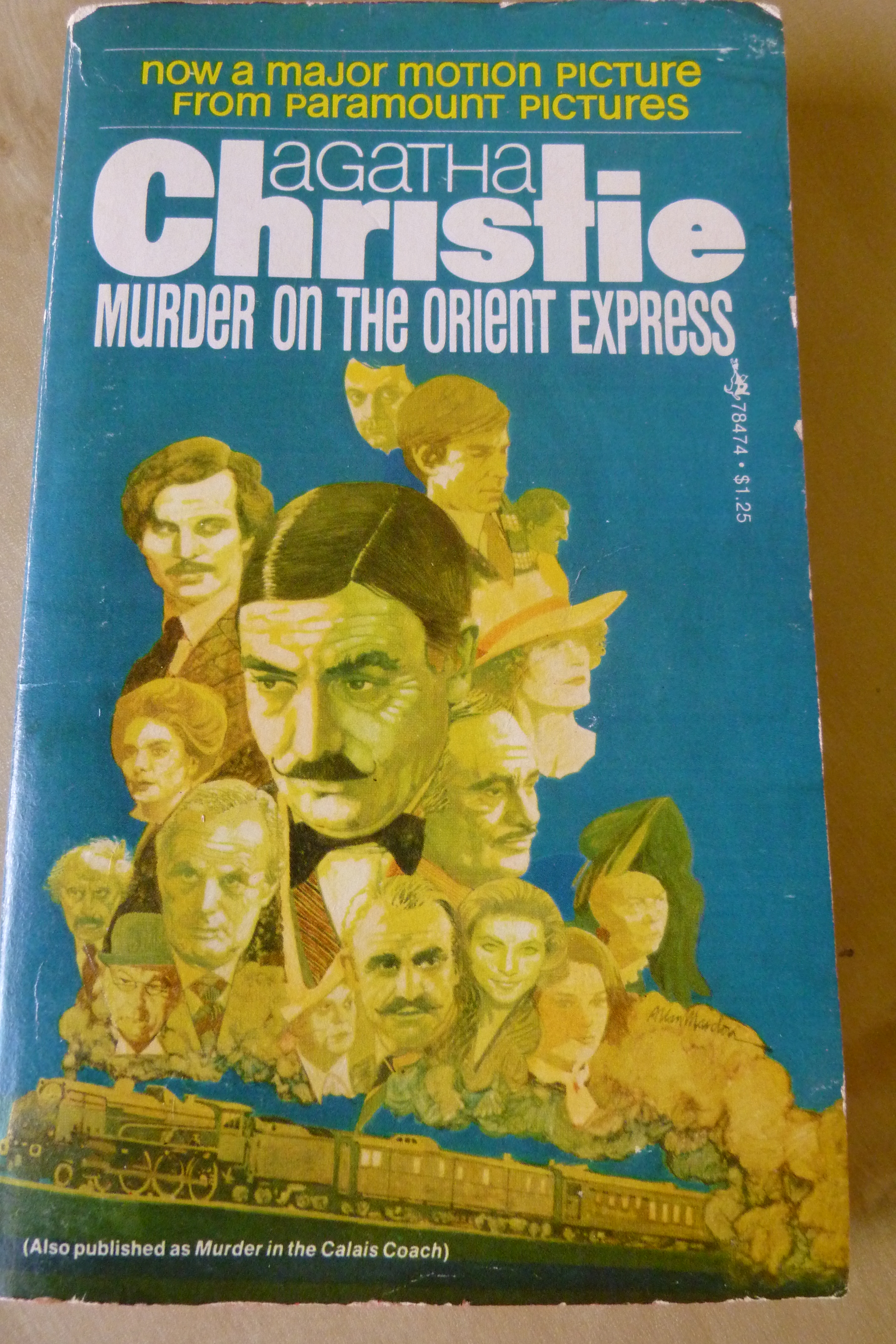
I’ve been meaning to read Agatha Christie for ages.  She’s one of those authors you hear about–and L. M. Montgomery enjoyed her–and she showed up on an episode of Doctor Who!  So I decided to bring a mystery along to London with me.  I asked readers for suggestions and found out I know a lot of Christie fans.  🙂  I ended up reading Murder on the Orient Express, which I’m counting as another book for the R. I. P. Challenge.
Reading Christie was similar, I think, to reading many classics, in that there’s a frequent feeling of–oh, this is where that comes from!  It wasn’t a particular reference, but rather a set of circumstances and a way of unraveling them.

Murder on the Orient Express is, as the title suggests, the story of a murder committed on the Orient Express, while the train is stranded in a snow bank.  No one could come in, no one could go out, and detective genius Hercule Poirot must examine the evidence to determine which of the passengers commited the crime.

It feels like such a classic mystery situation–a group of people trapped together, and one of them is a murderer–but which?  A gloomy manor house would be a little more classic, but no matter.  The book is laid out very neatly, with a long middle section examining each point of evidence and each passenger’s story, and then it all comes together for the classic reveal at the end.  Poirot brings everyone together and expounds upon his thought process and his conclusion.

The mystery is engaging, especially as it develops and more oddities and connections are revealed.  The conclusion is clever–and I certainly won’t give it away!

I know Poirot appears in a number of novels, and I’d like to read more of him.  He was a decent character, though I don’t really have strong feelings about him.  I do think (in this novel at least) as a character he was of secondary interest to the puzzle itself–which is not necessarily a bad thing in a mystery.

Sherlock Holmes tends to be my benchmark by which I compare all other detectives, and Poirot was intriguingly different in a comparison.  He focuses on the psychology of the people involved, rather than the clues.  Holmes, of course, is all about the clues, and isn’t  that interested in individuals.  I haven’t read enough of Christie to form a definite opinion on whether I like Poirot’s method of exploring a mystery, but if looking at psychology means exploring characters more fully, that does appeal to me.  But then, I love Holmes stories too…

All in all, I think it was a good opening foray into Christie’s novels.  Anyone want to give me their top suggestion for what I should read next? 🙂

Other reviews:
Unfinished Person
Harry’s Desk
The Yellow-Haired Reviewer
Anyone else?

The Graveyard Book Read-Along, Week Two

This month, I’m participating in a read-along of Neil Gaiman’s The Graveyard Book, as part of R.I.P.  We’re looking at a few chapters a week, with no specific questions for each post.  This week’s discussion is on chapters 4-6.  See my first post here.

I want to start by saying I’ve really enjoyed reading everyone else’s thoughts on the book; it’s definitely made me think about new aspects of the story, or consider some angle I hadn’t thought of.

For instance, I’ve seen some comparisons to Tim Burton–and I can completely see that!  There’s a very Burtonesque aspect to the depiction of the ghosts and the supernatural beings, who come across in some ways as more “alive” and engaging than the living characters.  That’s the entire focus of Corpse-Bride, and we see it here too.  Bod’s friends and loved ones are all dead or supernatural.  In this section of the book particularly, we see Bod venture out among living people–who are far less friendly and much more threatening.

This line of thought has also led me to very much want an animated movie (or maybe miniseries, it’s so episodic) of the book–screenplay by Neil Gaiman and directed by Tim Burton.  Obviously that would mean Johnny Depp as the voice of Silas, Helena Bonham Carter as the voice of the Lady on the Grey, and possibly Christopher Lee as the voice of the man Jack.  So if it ever happens, remember–you saw it predicted here!

Anyway, on to this section of the book…

I think Chapter 4 is one of my favorite chapters.  Bod meets the ghost of Liza, who was drowned and burned (both) as a witch and buried without a marker.  He decides that he wants to buy her a headstone, and ventures out of the graveyard to find a place that sells them.  I love Liza, who is so up and down and friendly and spooky all together.  I love that Bod wants to get her a headstone just because it’s right for her to have one.  It would be so easy to make her really nice or a perfectly innocent victim.  Then it would still be admirable, but somehow I think it would make his action less.  It would become an act of charity, or simpler in some way.  As-is, I think he’s doing it just because it’s right.

Chapter 5 is about “the dance Macabray,” the rare night when the dead and the living gather in the old town and dance together.  I love the eeriness of that concept, and I love the descriptions of the unearthly music and the magical dance.  I do have to say that as someone who normally pronounces macabre as “ma-cob,” the constant use of “Macabray” made me wince…but I looked it up and apparently there are multiple correct pronunciations.  Maybe it’s a British/American thing.

After Chapter 5, we have a brief interlude that shows us the man Jack again, though it doesn’t tell us much except that he’s still after Bod.  He’s a convocation, and even though the speaker is talking about philanthropic work, the mere fact of the man Jack’s presence makes me deeply suspicious about this group.  And I am reminded of a group in The Sandman Chronicles.  There was a kind of murderers convention, especially for really twisted murderers.  That was aroundwhen I stopped reading those graphic novels, so it’s just as well we don’t get more specifics here about the man Jack’s group…

Chapter 6 sees Bod attempting again to venture out of the graveyard, this time to go to school.  There are some fantastic things in here–I mean, he uses graveyard powers to fight bullies!  Love that!  Though I do think Silas could have been a little more proud of him, even if it was a bit stupid.

As touched on above, Bod meets far more frightening people among the living than he does in the graveyard, and I love that inversion of expectations.  It’s also interesting that Bod doesn’t decide to hide among the ghosts–he still feels drawn towards the living.  There’s a lovely bit (which of course I can’t find right now!) when Silas talks about how, for the living, there are always possibilities, always the potential for growth and change and making an impact on the world.

That’s my philosophical thought for this section. 🙂  I believe the next (final) section will be tying up some of the background threads from the beginning of the book, and I’m looking forward to seeing it all come together.

And, of course, to seeing everyone else’s thoughts on this part of the book!

Reading Phantom in Paris

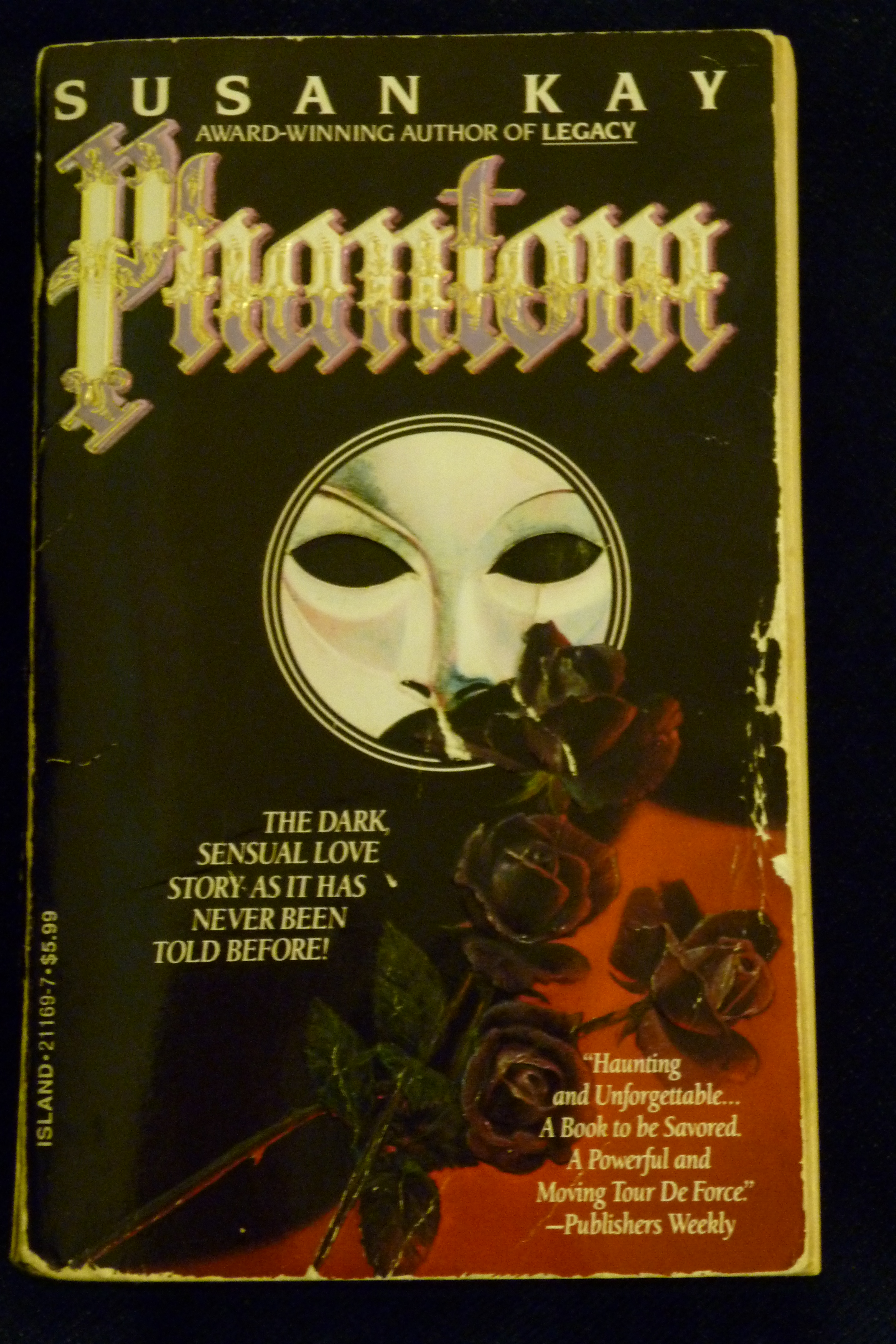
When I went to Paris in September, I decided it was a good opportunity to finally reread Susan Kay’s Phantom.  I read it once seven years ago, it completely blew me away, and it made such an impression that I always felt like it was too soon to reread–it was still there in my mind.  And I think I was afraid that I couldn’t repeat the experience twice!

But I brought it along to Paris to read again–and it was amazing.  I’m also counting it for the R. I. P. Challenge.  I reviewed Susan Kay’s Phantom once already, but I think it’s worth doing it again.  This review is basically going to be structured as a summary, a lot of gushing, and then circle back to Paris to talk about visiting the Opera House.  You’ve been warned if you want to skip some of the gushing!

My copy of the book doesn’t have a sub-title, but I’ve also seen this called Phantom: The Story of His Life, and that’s really what it is.  The story begins with the Phantom’s mother, goes on through his entire life and on past his death.  Kay brilliantly grounds us in each period, telling the story in sections with different first-person narrators.

First there’s Erik’s mother, Madeleine, telling her own story and taking us through his very troubled childhood.  Erik takes over the narration when he runs away from home at nine, falling in with a band of gypsies.  Later we see him as a teenager in Rome; this section is told by Signor Giovanni, the master architect who saw a spark of genius in this strange masked boy, and took him under his wing–for a time.  The Daroga tells us about Erik’s time in Persia, and a very sad and bloody time it is.  Erik picks up the thread again when he returns to France, meets Charles Garnier, and becomes obsessed with work on the building of the new Paris Opera House–which he ultimately decides will be his escape from the world.  And then Christine comes on the scene, and she and Erik tell the most familiar part of the story in alternating scenes, until the final section is narrated by–but perhaps I won’t give that away!

Kay does something truly masterful here.  Every narrator has his or her own story, with their own passions and tragedies, while at the same time the book never loses its focus on Erik.  It’s a brilliant balance that gives us the Phantom through so many eyes, and tells so many stories, without feeling fragmented or like we ever get lost on some side-plot. Every character is brought to life and I care deeply about all of them–even Madeleine.  I hate her, so caring might not be quite the right word, but I do feel deeply about her.  Although on a second read, I felt more sorry for her than I did the first time around.

The most significant character, of course, is the Phantom.  As on my first read, I fluctuate between finding him scary, and wanting to hug him.  He is so dark, and so unstable, and SO SAD.  And brilliant–completely, unbelievably brilliant.  Unlike other books I could name, Kay doesn’t pin all of Erik’s problems on the facial deformity.  That’s a huge part of the book, of course, but there’s so much more.  Erik is rarely shown kindness, so he doesn’t trust it when he sees it.  His biggest problem is not that he’s so ugly no one could love him; it’s that he believes he’s so ugly no one could love him.  It’s a fantastic, vital distinction that makes him so much more complex.  And something that’s not going to be solved by a moonless night.

The scope of the book is magnificent.  Without feeling long, it still feels like it crosses continents and covers decades.  When an adult Erik remembers his childhood dog, I don’t feel like I just read about her a hundred pages ago–it was years in the past!  Despite the huge scope, it doesn’t feel like an overview.  Everything is immediate and present as it happens.

There are so many very small, very wonderfully told moments.  The first to come to mind is Erik’s fifth birthday, when his mother insists that he tell her what he wants, and all he really wants is a kiss (one now, and one to save for later) and…it doesn’t end well.  And I hate Madeleine.  There are some nice moments of friendship with the Daroga, and later with Charles Garnier, the Opera House’s architect.  There’s a very funny exchange when Erik makes a joke to Garnier about how the then-under-construction Opera House really ought to have a ghost, and perhaps they should advertise.  Services of one ghost needed, tenor voice preferred.

And then near the end–just before everything goes horribly, horribly awry with Christine–Erik goes up to the roof of the Opera to pray.  And he doesn’t know how, because he hasn’t since he was a little boy, and the only prayer he can come up with is Please God, let her love me, and I’ll be good forever.  It just makes me want to cry and cry.

The book is so beautiful, emotional, moving–and so deeply tragic.  Phantom descends to the depths and aspires to the heights of human emotion, and does it beautifully and believably.  In 500-odd pages of dealing with that level of complexity, I felt like Kay hit a false note only once.  There’s a near-miss, where Erik might have been able to have a better relationship with his mother and the opportunity is lost; that was the only moment that didn’t feel real.  I didn’t believe Madeleine could make the leap, and it felt dragged in for tragedy’s sake.  However, I make that observation mostly to say how amazing the rest of the book is–because every other moment I completely believed and was swept along with.

It may also be worth saying that I’m completely invested in my own concept of the Phantom, who he is and how his life post-Leroux (if he wasn’t dead) ought to turn out–and this isn’t that at all.  But it’s so good, that doesn’t even bother me.

If I haven’t been clear enough yet, Susan Kay’s Phantom is easily among my top five favorite books I have ever read.  Maybe my absolute favorite.  I wouldn’t recommend reading this without either reading Leroux or knowing the Webber musical; there is an assumption of some knowledge, particularly once Christine comes in.  But if you have a little grounding and you’re intrigued by the Phantom–read this.  It’s mind-blowing.

Well, now that I’ve gushed plenty, let’s talk about Paris.  This is also a great book to read if you’re visiting the city, particularly the Opera House.  Most of it is actually not in Paris, but key sections are.  When I visited the Opera House, the guide was telling us about the history and I kept thinking, “I know, that was in Susan Kay’s Phantom!”  The book is set at the same time they were redesigning Paris, so it talks about the broad boulevards and the large-scale apartments, and they’re what you’re seeing as you walk around the city.  It gave me a nice grounding, and of course, it populated the Opera House for me.  There’s a monument to Charles Garnier near the visitors’ entrance, but Susan Kay’s Phantom brought him to life for me.  And it made me happy that, even though we call it the Paris Opera House here, in Paris it seems like they mostly call it the Opera Garnier.

If you’re interested in Paris history, architecture, music, or of course the Phantom of the Opera, the Opera House is great to visit.  It’s very beautiful on the inside–Garnier went way over budget!  I recommend the tour–they do one in English, and you get to see the theatre, the grand staircase, and the foyer, along with a few other rooms.  You don’t get to go into Box Five–but I did get the guide to point it out while we were in the theatre (Erik has good taste, it’s one of the best boxes), and I saw the door from the hall too.  And there’s the famous chandelier.

The foyer is gorgeous, all gold decorations and mirrors and yes, chandeliers.  But you know my favorite thing about the foyer?  It’s mostly gold paint.  Garnier was struggling with his budget!  Gold paint was cheaper!  But I LOVE that.  It’s an Opera House–everything’s illusion.  Stay tuned for pictures for Saturday Snapshot!

Final word on the subject: read Susan Kay’s Phantom.  It’s just the most beautiful of books, the most heart-rending of stories…and if you’re anything like me, you will be haunted by the Phantom of the Opera.

Other reviews:
The Written World
A Fair Substitute for Heaven
A Night’s Dream of Books
Anyone else?