Star Wars: The Thrawn Trilogy

I’ve spent a lot of time in the Star Trek universe these past two months for the Sci Fi Experience, but I also spent some time in another major sci fi franchise, rereading Timothy Zahn’s Thrawn trilogy.  These three books are set about five years after Return of the Jedi and, I believe, largely set the stage for the Star Wars Expanded Universe in the books.  The story begins in Heir to the Empire and continues in Dark Force Rising and The Last Command.

Thrawn Trilogy

Following the victory at Endor, the Rebel Alliance has pushed the Empire back into the fringes of the galaxy.  They have retaken Coruscant and set up the New Republic in the old Imperial Palace.  Trouble begins brewing with rumors of a new and brilliant tactician leading the Imperial forces.  Grand Admiral Thrawn is frighteningly intuitive with a flair for multi-layered plans and intrigue.  Meanwhile on Coruscant, Leia and Han are expecting Force-strong twins, and Luke worries about someday training them to be Jedi.  More immediate worries arise when Leia becomes the target of repeated kidnapping attempts.  And then we also have thrown into the mix Joruus C’baoth, a dangerously unstable Jedi Master with an obsession about Luke and Leia; the Noghri, a gray-skinned alien race with a complex and tragic history; and Mara Jade, second-in-command to smuggler Talon Karrde, with a mysterious history and a burning enmity for Luke Skywalker.

As you can see, lots going on here!  The complex web of plot stretches through all three books, and keeps the action tense and the excitement high.  There are clever twists to the plot and usually some kind of complicated strategy going on at Thrawn’s direction at any time.  In some ways it becomes a galactic chess match, with moves and counter-moves, victories and defeats for both the New Republic and the Empire.  Or maybe it’s more like poker, considering there’s plenty of bluffing and psychology at work too.

The plot is solid, and the characters are equally good.  Luke, Leia and Han are all strongly present, feeling very much like the movie characters, plus more insight and depth that’s hard to show on film.  Lando and Chewie also get plenty to do and some very nice moments.  C3PO and RT-DT felt a little under-represented, though they are definitely present.  More impressive, perhaps, even some minor (but important) characters from the film, like Mon Mothma, Admiral Ackbar and Wedge Antilles, have their stories continue here.

Many of the new characters are just as strong and compelling as the familiar ones, Mara Jade in particular.  With her shadowy past and Force-sensitivity, she’s complex and hard-edged yet still sympathetic–which is saying a lot, considering one of her driving goals (stated, at least) is to kill Luke.

Thrawn is a brilliant villain, very different from the Emperor or Vader.  The terrifying thing about Thrawn is that he is not mindlessly evil.  I think it’s telling that he wears a white uniform.  Vader is famous for strangling subordinates if they make any mistake; Zahn does a nice play on that.  Thrawn does kill one subordinate for a mistake–and in a later scene commends another for original thinking, even though the man’s effort failed.  Thrawn thinks before he acts–though when he acts, he is ruthless and cold.  We always see Thrawn through the eyes of his second-in-command, Captain Pellaeon.  He’s a fascinating character too, a good soldier who really believes in the Empire.  He can be a little contemptuous at times, but there’s nothing really villainous about Pellaeon.  He’s just on the wrong side.

Seeing the continuing lives of familiar characters is of course a strong appeal here.  Having seen other franchises go into bizarre places with characters, I think I owe thanks to Timothy Zahn.  At the end of Return of the Jedi, I (most of us?) want Leia and Han to get married, and Luke to become the new leader of the returning Jedis.  And that’s what happens in the Expanded Universe books, I think because Zahn set it up in these three.  There might instead have been new romantic triangles for Leia and Han, beloved characters could have gone over to the Dark Side, someone might have been tragically killed…and all of that would have created plot and drama, but I’m so glad Zahn found his plot in other ways, and sent the characters down the path I for one feel they should have the opportunity to walk.

Beyond the plot and the characters we also have the universe.  In three books, there’s enough time to visit many planets, and I love that.  We get little glimpses into many, many different cultures and civilizations.  It doesn’t generally get into the kind of depth that Star Trek offers, but in a way I like the sampling.  It gives a sense of the vastness and variety of the galaxy.  It actually reminds me of The Magician’s Nephew or The Lives of Christopher Chant, with the opportunity to travel to many different worlds, whether in different planes of existence or just different star systems!

The usual rule (in Star Trek, at least, and I think elsewhere) is that for cross-medium franchises, film counts as officially canon while books do not.  For my personal canon of the Star Wars universe, the status of the prequel trilogy is decidedly iffy, but these three books are definitely accepted.  I’ve read many good Star Wars books, but I recommend this trilogy as the must-read for fans!

Other reviews:
Speculiction
Reviews and Musings From a Geek
Sci Fi Bloggers
Randomly Yours, Alex
Anyone else?

Buy it here: Thrawn Trilogy

TGKA: Star Trek Into Darkness

star-trek-into-darkness-benedict-cumberbatch-posterFor the past couple months for the Sci Fi Experience, I’ve been following the story of Khan Noonien Singh through books and television.  My main goal for The Great Khan Adventure was to follow the original arc, but just for fun I decided to wind up with a rewatch of Star Trek Into Darkness.

The story centers around a hunt for a fugitive terrorist.  When the Enterprise successfully captures him (sort of) on the Klingon homeworld of Kronos (which used to be Qo’noS…), they learn that he’s a genetic superman from the 20th century who has been in cryogenic sleep.  Khan is dangerously charismatic, with an alarming story about corruption in Starfleet.

I enjoyed this movie the first time around, with reservations—and I enjoyed it the second time around, with bigger reservations.  On this go-around, I found myself very focused specifically on Kirk (Christopher Pine) and Khan (Benedict Cumberbatch), probably because this viewing followed directly on all that other reading and watching I’ve been doing.

Remember how in Wrath of Khan I had to fight the urge to feel too sympathetic towards Khan?  Well…this Khan was a lot darker and a lot more violent and I was pretty clear that I don’t like him at all—but he was still a MUCH more compelling character than Kirk.

My big issue with the movie, really, was Kirk.  It may in part be because, without question and unequivocally, TOS Kirk (William Shatner) is my favorite Star Trek captain.  He always had a streak of arrogance, but I love him because he really is as good as he thinks he is.  Reboot Kirk, on the other hand, seems to be far more arrogant and far less competent.

I was trying, really, to figure out what exactly Reboot Kirk did that was good in the movie.  (Spoilers ahoy!)  He starts out by breaking the Prime Directive (saving Spock and an intelligent species, true) which bothers me less than that he failed to get away with it, because TOS Kirk always knows exactly how to bend the rules in just the way to pull it off.  Reboot Kirk then sets out to capture Khan, nearly gets his landing party killed by Klingons (I’m pretty sure TOS Kirk would have talked them around, or maybe challenged the Klingon Captain to single combat), and only catches Khan because Khan chose to surrender.  Reboot Kirk goes on to bring Khan over to the Vengeance, and then lets him take control of it.  Khan neutralizes (with questionable means) the threat of Admiral Marcus, is taken out by Spock, and still nearly destroys the Enterprise.  Kirk successfully saves the ship, but meanwhile Khan crash-lands into San Francisco (a major population center!), to then be caught by Spock.

About the only accomplishment from Kirk was rescuing the Enterprise, which happened at the same time that the villain was taking out San Francisco and presumably killing thousands of people.  On the whole…not a very impressive track-record for the hero of the movie.  Especially for a man who runs rough-shod over good advice from virtually every other character, and is quite confident that he knows all, understands all, can achieve all, and is a marvelous gift to Starfleet and the galaxy.  Ahem.

Meanwhile, Reboot Khan is pretty far removed from TOS Khan (Ricardo Montalban), but in a way that worked much better than the changes to Kirk.  Reboot Khan’s history is thoroughly glossed over and he definitely doesn’t resemble the Sikh prince of Cox’s trilogy…  But he does carry the strong sense of superiority, the loyalty to his crew, and the conviction that he’s meant to rule over the lesser beings of the galaxy.  I missed Marla in this incarnation, as well as the sense of the benevolent (yet ruthless) leader he was trying to be in Cox’s trilogy.  What we did get was a sense that Khan really is smarter, faster and stronger than anyone else.  Not necessarily wiser, but in some ways he seems more like a genuine superman than the TOS version.  In fact, he’s arrogant—but he really is as good as he thinks he is.  The problem isn’t the arrogance so much as the contempt he feels for everyone else.

He’s far too violent for me to feel much sympathy for him, but he’s still an extremely fascinating character, with a lot of the charisma that was sadly lacking from Reboot Kirk.  I’d quite like to see more stories with this character, especially if he could be less violent but still just as brilliant, arrogant and eminently capable.

Oh wait, that’s the BBC’s Sherlock

So much for comments on the hero and the villain–and perhaps I’ll just leave it at that.  For a fuller discussion, check my original review.  I still stand by it, although the lack of professionalism bothered me less (that’s not acceptance, just resignation) and I noticed a few more plot holes (exactly how do you blow up a starship in orbit of Earth and expect to get away with it?)  I definitely still feel there wasn’t enough McCoy.

And so ends The Great Khan Adventure.  It was a fun and very geeky ride, and as I believe the Vulcans like to say, I found that the whole was greater than the sum of the parts.  Cox’s books were inspired by the TV show and movie, and the books in turn brought more depth to the shows and the movie.  Now how about the adventure continues in the next movie, with a return of Khan and maybe an introduction of Marla McGivers?  I’d be excited. 🙂

Buy it here: Star Trek Into Darkness

TGKA: Star Trek: The Wrath of Khan

khan-posterThis year for the Sci Fi Experience, I’m off on The Great Khan Adventure, tracing the story of Khan Noonien Singh through books and movies. So far I’ve watched a few episodes of Star Trek: The Original Series, and read Greg Cox’s Khan trilogy (Eugenics Wars: Volume One  and Volume Two, and To Reign in Hell).  Getting down to the end of the Adventure, I spent New Year’s Eve watching The Wrath of Khan, The Search for Spock and The Voyage Home.

To Reign in Hell ends almost precisely where The Wrath of Khan begins.  Chekov and his new captain, Terrell, beam down to Ceti Alpha V (thinking it’s Ceti Alpha VI–DON’T ask) looking for a test planet for the Genesis Project.  There they encounter Khan and his followers, who, with the help of mind-twisting eels, take over their starship and set out to pursue Khan’s quest for revenge against Kirk.  Meanwhile, Kirk and friends are aboard the Enterprise with a crew of trainee cadets.  They rush to investigate when an urgent call comes in from Carol Marcus, reporting that someone is trying to steal Genesis, a device to “create life from lifelessness.”

It was fascinating (to coin a phrase) watching this movie directly after reading To Reign in Hell.  There’s so much more room in books than in movies for details and background and character expansion.  Don’t get me wrong, The Wrath of Khan is a great movie, full-stop, period.  However–To Reign in Hell, despite some flaws, provides so much context and insight and character details.

For instance: we get a story on why Khan’s wearing that glove all movie, not to mention why he’s wearing a Starfleet emblem.  Joachim becomes a fully-fleshed character in the book; in the movie, you know him as Khan’s lieutenant, and the only one in Khan’s crew being paid for dialogue.  His name doesn’t come up until the very end of the movie, but I figured all along that he had to be Joachim, based on the book.  In the movie Khan references his wife twice but never actually says her name; presumably he means Marla (and I see no reason to think otherwise) but by comparison, the book makes her a major character and explores their romance.

Of course, the order of creation is a little odd in that Cox watched the movie and then wrote the backstory–but I think that worked, because I felt like I got more from the movie when I was keeping Cox’s backstory in mind.  Strangely enough, I’m not sure it would have worked the other way.  Reading the book, I occasionally thought I might be getting more from it if I had watched the movie recently–but after watching it, I think that might have made the book feel more forced.  Since the movie was fuzzy in my head, I didn’t get every single reference in the book, which, based on how many I noticed when I did watch the movie, might have become a bit much while reading…

Stranger yet, all this backstory and Khan-focus made me feel, well, strangely sympathetic towards him as a character.  Don’t get me wrong, I know he’s a terrible person, and I dearly love Kirk, Spock and McCoy…but Kirk did strand him on Ceti Alpha V and poor Marla got killed and it was all really, really awful and you can see how a person could lose it a bit at that point…even if Khan’s reaction is rather beyond the stretch of justification.

Ah well, a purely reprehensible villain wouldn’t be very interesting.

It also felt rather strange when the events of The Wrath of Khan set up the next two movies–and yet Khan never gets mentioned again.  Granted, Kirk has other things on his mind, but still.  Khan seems to have loomed bigger in the audience’s mind than in the characters’.

Another interesting sidenote: I’ve been complaining ever since Star Trek Into Darkness came out that these people are not qualified to be crewing a starship, and I find Wrath of Khan justifies the complaint.  Imagine if, at the end of the movie, Saavik was made captain and the trainee cadets were handed officer positions and told to go exploring.  That’s basically what happens at the end of the 2009 movie!!  Mumble mumble implausibility grumble…

On that subject, after watching the three classic movies and Khan-a-la-Ricardo-Montalban, I plan to finish up the adventure with a rewatch of Into Darkness and Khan-a-la-Benedict-Cumberbatch…which ought to be interesting directly after Wrath of Khan.  Stay tuned!

Buy it here: Star Trek II: The Wrath of Khan

TGKA: Star Trek: The Exile of Khan Noonien Singh

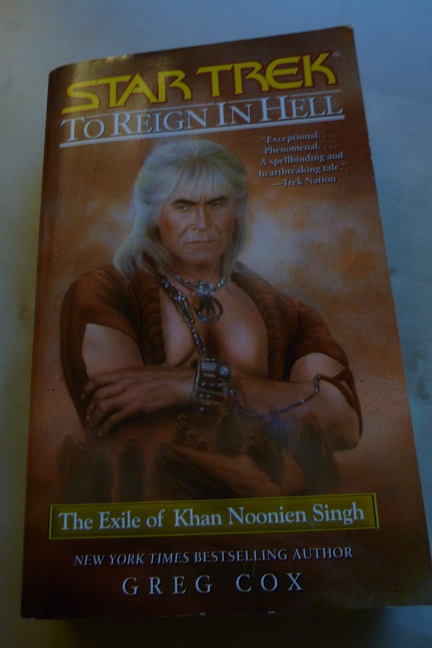
To Reign in HellThis year for the Sci Fi Experience, I’m off on The Great Khan Adventure, tracing the story of Khan Noonien Singh through books and movies. So far I’ve watched some of Star Trek: The Original Series, and read the first book  and the second book in Greg Cox’s Khan trilogy.

The final book jumps ahead from the 1990s and the Eugenics Wars, past “Space Seed” to Khan’s time on Ceti Alpha V: To Reign in Hell: The Exile of Khan Noonien Singh.  We watch Khan and his crew’s transport down to the planet, the colony’s hopeful beginnings…and then the increasing struggle to survive after Ceti Alpha VI explodes, and the ecosystem on Ceti Alpha V collapses.

The story is told from the alternating points of view of Khan and Marla McGivers, the Starfleet officer who fell in love with Khan and chose exile with him.  As I hoped, we get more depth into Marla and see her emerge as far stronger than she did on the TV episode.  She faces down Khan’s hostile crew, stands up to Khan himself, and perseveres through very trying circumstances.

In part this is possible because Cox also softens Khan, particularly towards Marla.  I think I know now why Khan’s brutality in “Space Seed” surprised me—I had read To Reign in Hell more recently than I’d seen the TV show.  Cox takes Khan on a journey from a well-intentioned, if fierce, leader to a madman obsessed with revenge; it’s a compelling journey, except that I think it downplays how violent and ruthless he was to begin with.

Cox has a nice way of tying things together to explain the little inconsistencies that crop up in Trek.  I was wondering where Marla was, as ship’s historian, when the Enterprise visited the 1960s; the book comments that she was disappointed not to be included on the landing party, and only had the opportunity to assist on the wardrobe.  When Khan and crew first beam down, Chekov is the officer who sees them off, explaining how Khan could recognize Chekov in The Wrath of Khan, when Chekov didn’t join the TV show until the next season (in the real world, Walter Koenig has admitted that he knew that line of the script didn’t add up, but didn’t point it out because he was afraid of having his part cut…)  Cox also explains some details in The Wrath of Khan, like why all of Khan’s crew in the movie is much younger than him, not to mention blond…

This book is effective as a chapter in a larger story, filling in the gap between the TV show and the movie.  Taken in isolation it’s an odd beast, because we spend it exiled with the villain.  I found myself missing Seven and Roberta, mostly for the role they fill as opposing forces to Khan.  Khan and Marla have their virtues and their flaws, but they never really feel like they become heroes of the story—they’re the villain and the woman who fell in love with him.  That complicates the emotional pulls of the story, and isn’t resolved by a very brief frame story with Kirk, Spock and McCoy.

I also think Cox exploded Ceti Alpha VI too soon.  I enjoyed watching the hopeful days of the colony; once disaster strikes, it becomes a hopeless slog for Khan and the reader both, especially when we know how this turns out…and it isn’t good.

The emotional complications are actually increased by the brief frame-story, of Kirk, Spock and McCoy visiting Ceti Alpha V after Khan’s death.  Kirk feels guilty about never checking in on Khan over the years.  Because he’s Kirk, I want a conclusion that says it wasn’t really his fault and of course we all still love him.  Instead, the book makes me feel like he damn well should have checked in…  I’ve had to conclude for myself that it is, in fact, ridiculous to feel that Kirk had personal responsibility for the situation; a colony of genetic supermen clearly falls under the jurisdiction of Starfleet, not one starship captain whose job is not to monitor colonies.  I would have quite liked Cox to make that point for me…

Despite some reservations, the book does fill in a significant chapter in Khan’s story.  It provides a lot of insight into Khan’s character, and expands Marla into a compelling character in her own right.  There’s also quite a bit of action, and of course all those little touches Cox is so good at of tying everything together.

Next up, I’m heading back to the screen for The Wrath of Khan

Author’s Site: http://www.gregcox-author.com/

Other reviews:
The M0vie Blog
And…that’s it.  Anyone else?

Buy it here: Star Trek: To Reign in Hell

TGKA: Star Trek: The Eugenics Wars, Volume Two

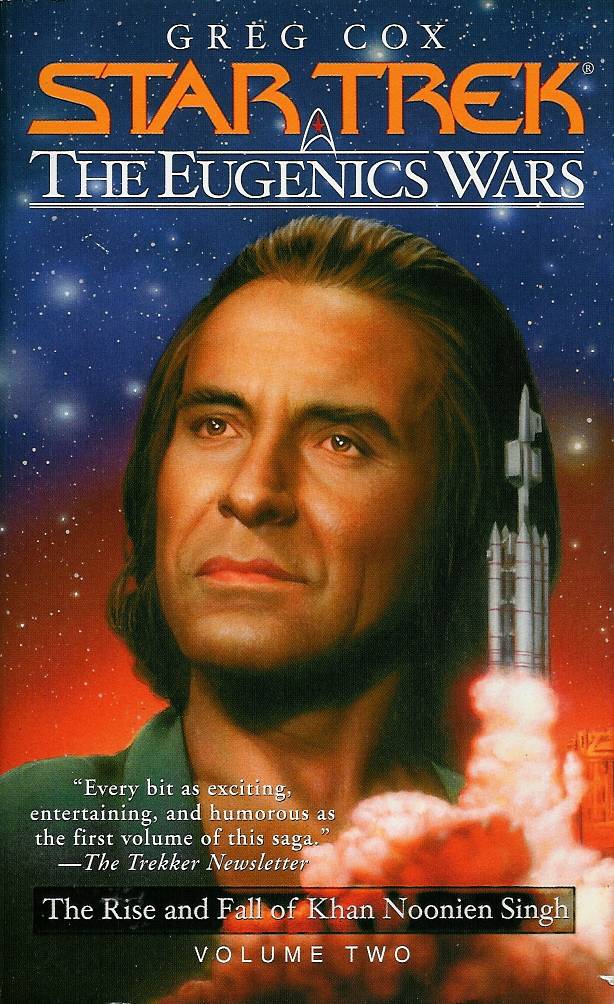
Eugenics Wars, Volume 2This year for the Sci Fi Experience, I’m off on The Great Khan Adventure, tracing the story of Khan Noonien Singh through books and movies. So far I’ve watched some of Star Trek: The Original Series, and read the first book in Greg Cox’s Khan trilogy.  Today I’m looking at the second book, Star Trek: The Eugenics Wars: The Rise and Fall of Khan Noonien Singh, Volume Two.

The first book covered Khan’s childhood and adolescence, focusing mainly on Gary Seven, Roberta Lincoln and mysterious cat Isis, and their work to protect the Earth during the Cold War.  This book brings us into the 1990s, with an adult Khan and his quest to conquer the Earth.  We still have plenty of Seven and Roberta, and their efforts to contain the threat of Khan and the other genetic supermen (and equally powerful superwomen).

I enjoyed this book quite a bit, though I have to note that it may not be what all readers are looking for.  Cox’s goal appears to be to reconcile Star Trek history and real history; I find that hugely interesting, but as a result of that choice (rather than simply presenting altered history–an alternate timeline, perhaps) the Eugenics Wars goes on in the shadows.  Khan “rules” a quarter of the Earth by pulling the strings of officials from behind the scenes.  Presenting a war where most of the population doesn’t know it happened…well, that limits the potential for large-scale conflict.  There’s still plenty of action, but mostly in small, pitched battles between individuals.

Cox also gives ample time to other genetic supermen (and women–there’s no easy way to say that–superpeople?) which I have somewhat mixed feelings about.  Many are extremely interesting, especially Chen Tiejun and her Amazons, but they at times start to feel like a distraction too.  Roberta spends a lot of time infiltrating General Morrison’s Army of Eternal Vigilance in Arizona, and it feels like, well, a lot of time not spent on Khan.

However–we get lots of time on Khan too, and we see him develop as a ruthless but nuanced villain.  He sees the many problems in the world and believes that he is destined to eradicate hunger, war and want–by conquering the planet, and when anyone gets in his way, his retribution is swift.  I like that complexity of benevolent intentions through villainous means–and we also see Khan grow increasingly harsh and merciless as the story goes on.

On the hero side of the story, there’s an older and more confident Roberta, but one who still hasn’t lost her “flower child” origins, and still carries a good bit of snark with her into intense situations.  Seven has some good moments too, increasingly playing the wise mentor type…which is good, except I think Cox overplays Seven’s aging.  I don’t need to be reminded about Seven’s creaking bones every scene (especially when he isn’t really all that old!)

We also see the Enterprise crew in a frame-story.  It continues the story of a colony of genetic super…people, and while there’s some excitement, it’s very much backseat to the Khan and Seven story.

It’s not much of a spoiler to say that the novel ends when Khan and his followers leave Earth.  The next chapter for Khan is waking up from suspended animation in the Enterprise‘s Sickbay (and promptly threatening Dr. McCoy’s life).  I already watched “Space Seed,” so the next step on The Great Khan Adventure is the final book by Greg Cox, To Reign in Hell: The Exile of Khan Noonien Singh.  Stay tuned!

Author’s Site: http://www.gregcox-author.com/

Other reviews:
A Star Trek Literary Adventure
The M0vie Blog
Anyone else?

Buy it here: The Eugenics Wars, Vol. 2