The Author Who Brought Together So Many Classic Literature Elements in a Book of Her Own Making

I’ve mentioned, haven’t I (I have), that I love classic children’s fantasy.  So to those familiar with the book, it will be no surprise that I found The Girl Who Circumnavigated Fairyland in a Ship of Her Own Making by Catherynne M. Valente to be absolutely delightful.

The Girl Who Circumnavigated Fairyland follows the time-honored traditional fantasy plot of an ordinary child spirited away from the drab world to strange and magical lands, to meet dear friends and fight evil and have adventures.  This book was a bit The Phantom Tollbooth and a touch Alice in Wonderland, with more than a little L. Frank Baum, a dash of C. S. Lewis at the end, had a narrator who could be sitting in a pleasant study somewhere with J. M. Barrie–and there was some that was just pure Valente.

The story centers on September, who lives in Omaha until one day she’s carried away by the Green Wind to go to Fairyland.  In Fairyland she accepts a quest to help a witch named Good-bye, meets A-through-L, a wyverary (a cross between a wyvern, which is rather like a dragon, and a library), and finds herself pitted against Fairyland’s oppressive ruler, the Marquess.

The characters and the places September visits have all the whimsy of L. Frank Baum.  The capital city of Fairyland is Pandemonium, which good Queen Mallow wove out of thread–so all the cities are cloth.  September catches a ride with a herd of bicycles, and goes to Autumn, where it’s perpetually Fall.  She meets a community of Nasnas, where the people are halves (right down the middle vertically), and are only whole when they join up with their twins.  It’s strange and sometimes funny and very whimsical.

The narrator came from the same school of storytelling as J. M. Barrie.  My favorite character in Peter Pan is the narrator, who really seems to be sitting somewhere telling you the story, complete with occasional moments when I-the-narrator directly addresses you-the-reader.  Valente uses the same trick here, comparing one place to your grandmother’s house, and promising that I-the-narrator hasn’t forgotten about a subplot you may be wondering about.  Like Barrie, it’s charming.

This is the first novel I’ve read by Valente, so I’m not much qualified to comment on her overall writing style–but I did read a short story, in Troll’s-Eye View, which was what led me to The Girl Who Circumnavigated Fairyland.  I had heard about the book, but somehow it didn’t quite grab me.  Then I was so blown away by her short story, I decided I had to try the book.  The short story was beautifully written–magical, dark, creepy and wonderful.  Parts of this book were dark, a bit was creepy, and a lot of it was beautiful and magical and wonderful.

The dark bits brought just a little realism into the fairy story.  I love Baum and Barrie and all the rest, but no one ever bleeds, or gets really, really tired, or really, really hungry, or has to deal with deep-down-scary choices.  September gets into some very hard spots.  It was just enough to make me think, yes, this is what a child questing through Fairyland would really go through, without being too much and losing all the magic and whimsy.  The creepy bit was primarily at one point when September starts to turn into a tree–a crumbling, winter tree, with cracking branches and shedding leaves.  Beautifully written.  So scary.

If you’ve read the classics, read this book.  If you haven’t read the classics, read it anyway, then go read the classics.  And then, hopefully, come back to Valente again–I’ve been searching her website and I can’t find a promise of a sequel there, but the book itself promises one.  I think I’ll end with that quote (no spoilers)–and it’s such a beautiful line, it may do more than anything I can say to convince you of the loveliness of this book:

All stories must end so, with the next tale winking out of the corners of the last pages, promising more, promising moonlight and dancing and revels, if only you will come back when spring comes again.

Author’s Site: http://www.catherynnemvalente.com/

Other reviews:
Things Mean a Lot
The Little Red Reviewer
Tethyan Books
Tell me about yours and I’ll add a link!
Twelve More Dancing Princesses

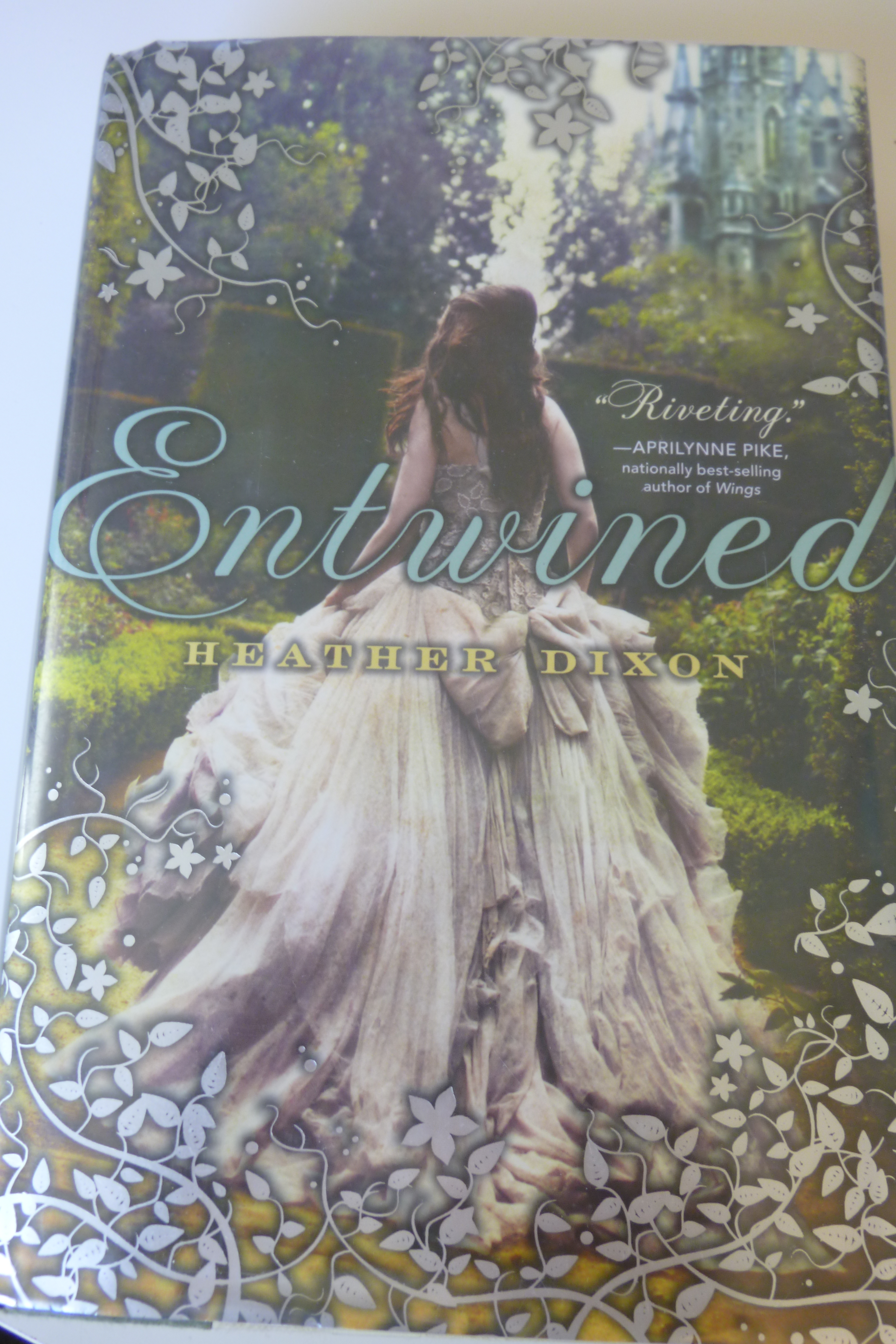
Entwined by Heather Dixon is one of those books I saw make the rounds of several blogs I follow.  And of course I was intrigued–it’s another retelling of “The Twelve Dancing Princesses.”  I reserved this at the library months ago, but the hold list was so long, it finally looked like it was about to come in during November.  Since I was spending November writing my own retelling of the same story, I didn’t want to read this then–I was sure I’d end up subconciously plagiarizing something!  So I put my request on hold, and finally read it in January, after finishing my own novel.

Entwined centers on Azalea and her eleven sisters, all named for flowers or plants and helpfully in alphabetical order: Azalea, Bramble, Clover, Delphinium and so on.  I frequently had to run through the alphabet to figure out the approximate age of, say, Jessamine or Kale.  The princesses’ mother dies early in the book, and the official rules of mourning restrict them from dancing for a year (among other things).  The girls discover a hidden passage leading off their room, relic of a magician-king from two hundred years ago.  They find an enchanted silver forest and a pavilion, whose guardian, the Keeper, tells them they are welcome to come and dance every night.

This book started slow for me.  The first half was only so-so, but it did pick up in the second half.  The turning point for me was when Keeper started threatening the soul of Azalea’s mother, to force Azalea to free him from captivity in the magic pavilion.  It was the first time Azalea seemed to have any significant motivation, and also when she finally figured out how creepy Keeper was–which had been pretty obvious to me from the beginning.  Prior to that, really wanting to dance just didn’t seem like adequate motivation to defy their father and go dancing every night in a pavilion owned by a very sinister stranger.

The romances also pick up in the second half of the book, for Azalea as well as Bramble and Clover.  This actually did a lot for Bramble and Clover as characters.  Prior to that, Clover was very quiet and Bramble was very immature.

That leads me to another point–this book made me think about what is perhaps the first fundamental question of retelling this story.  Namely, which sister to focus on?  The oldest?  The youngest?  Someone in between?  This is a larger question than it might seem, because there seems to be an unwritten rule that the heroine has to be around sixteen or seventeen.  If you give your seventeen-year-old heroine eleven younger sisters, simple math tells you that most have to be children.  Making her one of the younger ones means she can have adult sisters.  In a way, it’s a choice between giving your heroine a circle of peers, or making her a baby-sitter.  The fact that I put it that way probably tells you already that my heroine is at the younger end, #9, with sisters ranging between the ages of 15 and 25 (with a couple sets of twins).

Azalea is the oldest princess, and she spends a lot of time looking after younger siblings.  Most of them completely run together for me.  Even though Bramble should be about 15, she spends the first half of the book seeming very young.  It gets better when she and Clover get a little more screen time, a little more maturity, and can serve more as equals for Azalea.

Another major arc of the book was the relationship between the princesses and their father.  The King starts out as very cold and apparently aloof, but ultimately develops into a caring father (who simply doesn’t always know how to relate to his daughters).  Sometimes that transition is jarring, but it does come together in the end.

There are things I liked about Entwined too.  Some of the description was good, and I liked the treatment of the dancing.  Dixon clearly knows something about dancing, and there’s plenty of discussion about what kind of dance the princesses are dancing, and how they feel.  I do feel convinced about the importance of dancing to Azalea, and there’s good description of what it means to her–for one thing, it’s a connection to her mother, and it also gives her a sense of freedom and of magic.  I believe dancing is important to her–it just doesn’t seem quite important enough for some of the choices she’s making.

This was a good book, with a great climax, and nothing really wrong with it (other than some bland sisters, but with twelve there’s only so much you can do).  It didn’t quite spark for me, though.  Good–but not fantastic, and not particularly distinctive compared to other versions of the story I’ve read.  Aside, that is, from the cover–definitely one of the most beautiful books I’ve read in a while!

Author’s Site: http://www.harperteen.com/authors/37209/Heather_Dixon/index.aspx

Other reviews:
Between the Stacks
Charlotte’s Library
While We’re Paused
Yours?

100 Years Ago at the South Pole

Scott and Party at the Pole, Jan 17, 1912

On January 17, 1912, Captain Scott and his team of explorers reached the South Pole, 100 years ago today.  They weren’t the first ones there–Roald Amundsen’s Norwegian team beat them there by a month.  Scott also found that getting there was the easier part.  All five of the men who reached the Pole died trying to get back again.

So why am I telling you this depressing story?  I suppose because I don’t actually find it depressing.  Tragic, yes; depressing, no.  They did fail–but that’s usually not how the story is told.  They died martyrs to the adventure and heroes of history, proving the length of man’s endurance and determination, pushing out the frontier and chasing the impossible dream.

Also, Titus Oates, one of Scott’s men, has a major role in one of my favorite books, The White Darkness by Geraldine McCaughrean.  I freely admit that most of my impression of Scott and his journey came from her book.

So in honor of the anniversary, here’s to impossible dreams (hopefully with better planning!) and I’m re-posting my review of The White Darkness.  It was only the third book review I ever posted here, so most of you probably weren’t here to read it the first time anyway.  🙂

**********************

“I have been in love with Titus Oates for quite a while now—which is ridiculous, since he’s been dead for ninety years.  But look at it this way.  In ninety years, I’ll be dead, too, and the age difference won’t matter.”

This is one of my all-time favorite opening lines of a book (right up there with “All children, except one, grow up”).  I read this in a bookstore and knew immediately that I had to read The White Darkness by Geraldine McCaughrean. Continue reading “100 Years Ago at the South Pole”

An Enchantress or an Alien–or Both

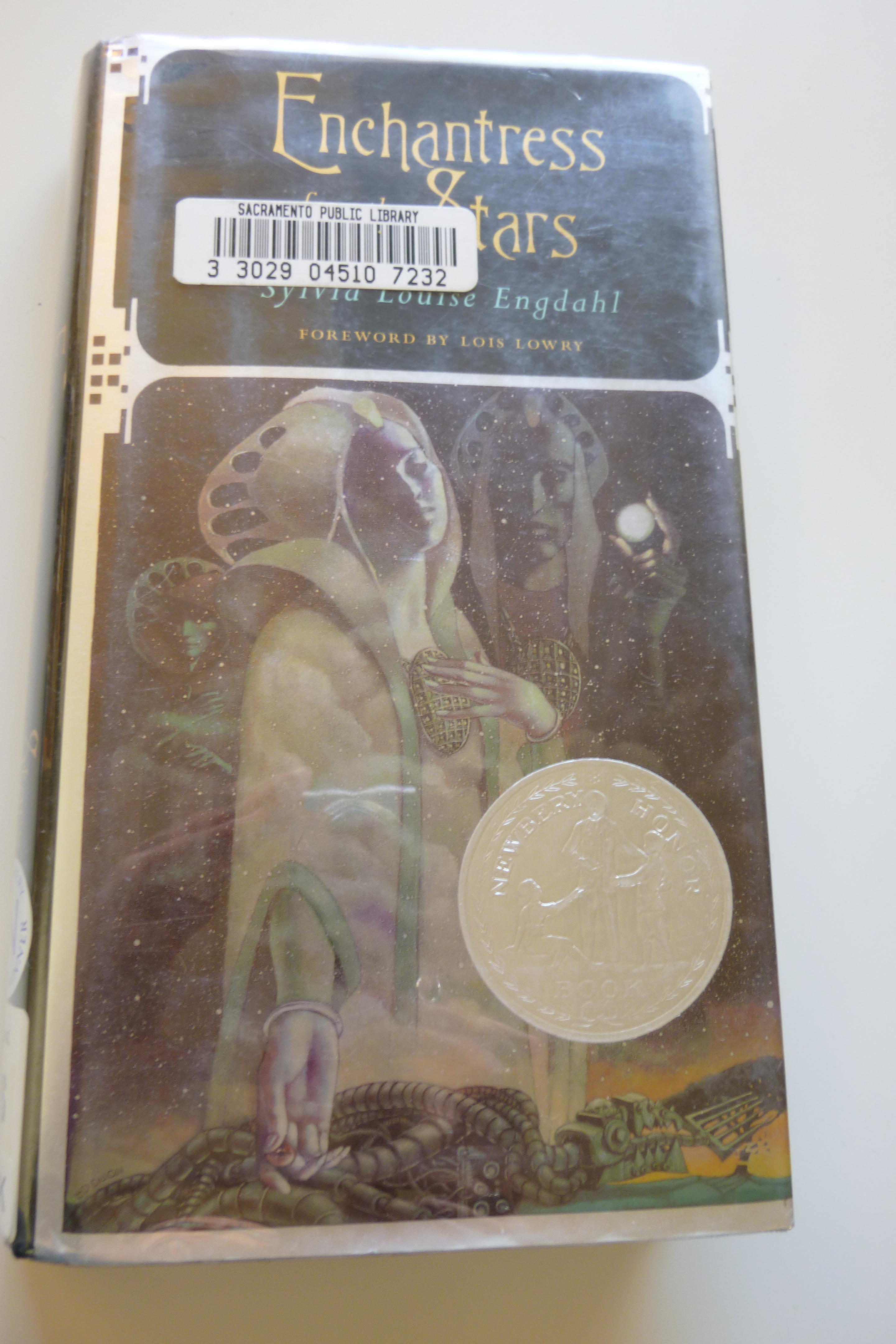
Science Fiction and Fantasy get lumped together all the time, in discussions, in “Best of” lists, in the bookstore.  But you rarely see them together in a single novel.  Enchantress from the Stars by Sylvia Engdahl is a brilliantly-devised story that could be in Earth’s distant past–or even more distant future.

The story is told by Elana, who belongs to a society far advanced beyond present-day Earth.  She is part of a Federation of many planets, joined together in peaceful cooperation.  They study less advanced worlds, but have a strict non-interference policy, believing that it’s best for cultures to develop without knowing about more advanced races.

(For the Star Trek fans–I know, I know.  All I can tell you is that this was written in 1971, but feels less like Star Trek when you’re actually reading it.)

Elana is training to be one of the scientists who studies Youngling worlds, when she stows away on a mission to Andrecia.  Andrecia’s native people are at roughly a Middle Ages level of development.  Their future is threatened by colonists from another world–the Imperials have developed space travel, but have not yet achieved the level of Elana’s people, either technologically or culturally.  The Federation team’s mission is to induce the Imperials to leave, without harming either race’s culture.

Elana ends up taking on the role of Enchantress, to relate to the Andrecians in a way they can comprehend–she especially connects with one, Georyn.  She teaches him magic spells (combinations of technology and telekinesis), so that he can go fight the dragon (the Imperials’ digging machine).  The hope is that if an Andrecian uses powers the Imperials can’t understand, they’ll be convinced to give up their colony.

The brilliance of the story is that it’s told from three very different points of view–Elana, from her advanced, enlightened perspective; Georyn, who tells a Brothers Grimm-style story about a beautiful Enchantress, a dragon served by terrifying demons, and magical spells; and Jarel, an Imperial who questions what his government is doing but doesn’t know how to act–and is probably the closest to all of us who are reading.

The three perspectives are intertwined and so different, yet work so well together.  It’s emphasized, in Elana’s sections, that Georyn’s perspective on events isn’t wrong either–he simply has a different understanding, a different way of viewing what’s happening.  In some ways, he proves to be the most intelligent and the most insightful of any of the characters.

Elana is very interesting too, because we see her as the uncertain, often naive girl she is on the mission; as the strong and wise enchantress Georyn sees her as; and as the more mature voice telling the story after it’s all over.  Her character growth, throughout the story and from the after-perspective, is very excellently done.

This is a good adventure with compelling characters, and it’s ultimately a very hopeful story.  Engdahl is careful to place Andrecia, Elana’s home world, and the Imperials’ home planet all in the position of third from their stars.  It notes in the introduction that any of them could be Earth–this could be a story about our past, or a story about our future.  Ultimately, I don’t think it matters.  We’re all of them.  The hopeful part is that the book makes it clear that Georyn’s people, and Jarel’s, and us, can all learn and grow and eventually reach the wisdom of Elana’s people.

In that way I guess it is like Star Trek, as a vision of a hopeful future.  But if you want to take this as science fiction, as fantasy, as philosophy, or even as something with some of the same elements as Star Trek, it’s worth reading–it’s a wonderful book.

Author’s Site: http://www.sylviaengdahl.com/index.htm

Other reviews:
Book Snatch
Jenna St. Hilaire
Yours?  Let me know!

Hunting a Lost Prince

I’ve been promising a review of Mastiff, the final book in the Beka Cooper Trilogy by Tamora Pierce.  It was a good resolution to the story, an exciting adventure that tied up plenty of ends.

It begins a few years after the previous book, as Beka mourns the death of her never-before-mentioned fiance (more on him later).  It turns out she was on the verge of breaking up with him, and she’s glad of the distraction of a new Hunt–slang for a case to be solved.  In some ways this is the most focused book of the trilogy–Beka and her friends are on the trail of a kidnapped prince, and the entire book centers around this journey.

There are some strong villains in here, and I loved Beka’s friends too.  The lady knight, Sabine, had a bigger role in this book, and we had more of Pounce, Beka’s black cat.  There’s also Farmer, a new character who’s a very interesting mage.  I love it that he’s very powerful, but hides that behind a bumbling, cheerful exterior–although he really is wonderfully cheerful!

Despite a very cheery new character, this is darker than Pierce’s earlier books.  Dark things have always happened–death, slavery, violence, kidnappings.  The Beka Cooper Trilogy has always got more into the grittiness of it, though, and that’s very true here.  There’s more detail and more description of the disturbing elements.  One scene about a dead slavegirl is enough by itself to make this upper Young Adult, while Pierce’s earlier books often bounce between the Juvenile section and YA.

On the more positive side, there’s eventually some romance here, although it takes a while.  Though considering my chief problem with Bloodhound was that the romance was too fast, I won’t complain about this one!

Actually, the romance I wish there had been more of was the one with the dead fiance.  The book begins with the fiance already dead, and we only get hints about Beka’s relationship with him.  I was hoping for some kind of extended flashback, but it never came.  The hints are enough to suggest that it may have bordered on an emotionally abusive relationship, and in a strange way I think that would have been a wonderful story for Pierce to tell.  Her stories about strong women are so inspiring, and it would have been so valuable to portray one of these strong women getting emotionally mixed up and into trouble.  Beka is very capable in some ways, but she has uncertainties about relationships.  I would never believe that she’d stay with a man who hit her, but I could believe that she could be emotionally manipulated, and that would be so good for girls to see–that you can be strong and capable and still get into a bad relationship, and it doesn’t make you pathetic or worthless.

But that’s my idea, and evidently not Pierce’s vision for the book, and I can’t really criticize her for not taking the story the direction I wanted it to go.  One more serious objection I have involved a traitor in Beka’s group.  They realize someone is probably betraying them as they travel, but Beka doesn’t give much attention to that.  When the traitor’s identity finally comes out, it didn’t ring true to me.  It feels more like someone acting out of character than like a shocking reveal.

Those problems aside, it’s a great adventure with strong characters and an engaging world.  And now I can go back to looking forward to Pierce’s next book!

Author’s Site: http://tamorapierce.com

Other reviews:
YA in the Second City
Sew Skate Read
Ms. Martin Teaches Media
Yours?