Empowerment–and Terror

I had originally been thinking of Daughters of Eve by Lois Duncan for a Halloween review.  She’s that kind of author.  But I decided it’s not really that kind of book.  In some ways it is horror, but not the Halloweenish type.  Maybe it’s too real.

The Daughters of Eve are an exclusive high school club.  The members claim each other as sisters, and are deeply loyal to one another.  This year, they have a new teacher as moderator, Irene Stark.  Irene encourages the girls to think for themselves and seize their rights–but what starts out as healthy women’s empowerment quickly becomes a terrifying brand of violent man-hating.

The character depiction is amazing.  There are ten Daughters of Eve, plus Irene.  Most of the girls have family members who appear at some point.  It’s an enormous ensemble cast, and yet I feel like the vast majority of the characters are vividly, clearly drawn–and this isn’t a long book.  The point of view (limited third person) shifts among many of the characters, which I think helps give each moments of depth and insight.

The subject of women’s empowerment is brilliantly handled.  The book was originally published in the seventies, but the gender attitudes of the town feel more like the fifties–all women become housewives, daughters help around the house while sons don’t, girls don’t need to go to college…  Duncan’s depiction of Irene is masterful, as her advice goes from positive and even inspiring, all the way to completely insane.  She’s believable–her conclusions are mad, of course, but she makes compelling, reasonable-sounding arguments, and I believe that the girls would get confused and end up following her.  Irene also has depth–she’s terrifying, but we see what in her past led her here, and in her own twisted way, she really does want to help the girls.

The male characters are realistic too.  There’s Cain, and there’s Abel.  Some are really good guys, even sweet.  One is abusive.  A lot are clearly products of being raised with gender stereotypes, but even those range from horrible to well-meaning.  Duncan demonstrates, and without feeling heavy-handed about it, exactly what Irene can’t see–that people are individuals, and can’t be judged by their gender alone, women or men.

Duncan often deals with the supernatural, or with psychic phenomena.  That’s only a small element here–one girl has special feelings and premonitions.  It enables some foreshadowing and adds tension, but it’s not a huge part of the story.

Daughters of Eve is an excellent book.  Besides for all the reasons above, it also has the simplest and yet most chilling final line I’ve ever read.  I can’t tell it to you–it’s a spoiler–but trust me, it’s brilliant!

Author’s Site: http://loisduncan.arquettes.com/
Scented Flowers and Lucky Frogs

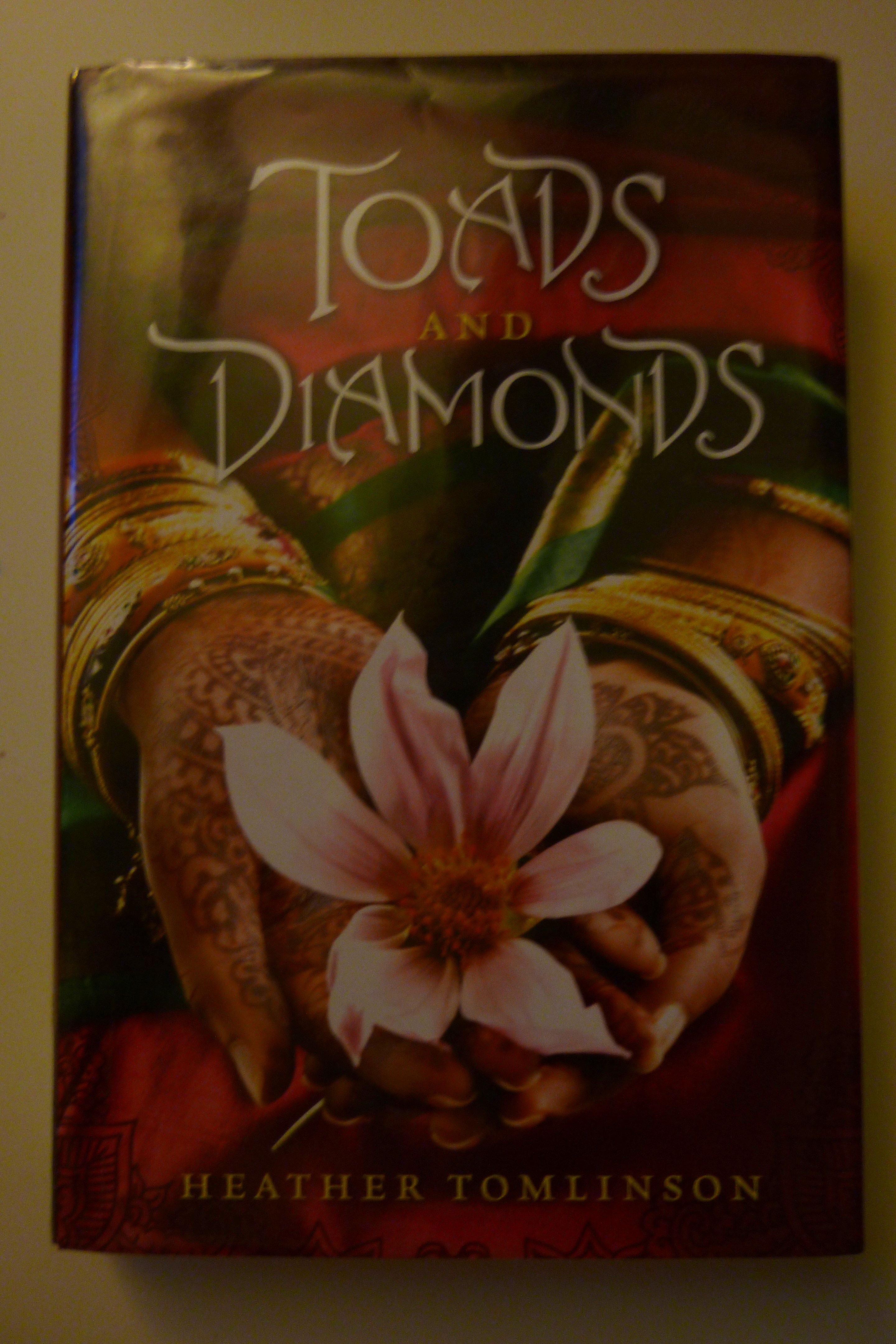
When you see a title like Toads and Diamonds on the shelf, you know you’ve found a re-told fairy tale.  I was trying to remember the title of the original–it turns out it’s usually known as “Toads and Diamonds” too (or “Diamonds and Toads”), although Perrault called it by the not at all descriptive title, “The Fairies.”

Whatever you choose to call it, the story is about two sisters (sometimes step-sisters), who each encounter a magical woman.  One sister is enchanted to drop flowers and jewels from her mouth whenever she speaks.  The other speaks, and drops toads and snakes.  Either one definitely creates a lot of opportunity for bizarre results!  I’ve read some other versions of this, and usually authors like to play with whether the enchantments are really blessings or curses.

Toads and Diamonds by Heather Tomlinson follows this trend, but does so in masterful fashion.  It follows two sisters, Diribani and Tana, who live in pre-colonial India (with some fictionalizing) and are struggling to make ends meet since their father’s death.  They’re devout followers of a fictional, polytheist religion which I think loosely resembles Hinduism.  They each encounter the goddess Naghali; Diribani begins speaking jewels, and Tana drops reptiles.

From the beginning, though, there’s a twist on the usual presentation–in their culture, certain frogs and snakes are considered lucky or even blessed.  Right from the start, it’s not so clear which sister is blessed and which is cursed.  As the story goes on, both girls find both benefits and drawbacks to their magical gifts.

I liked the character development here, as each sister comes to terms with her gift and learns about herself and her role in the world in the process.  They tell the novel in alternating chapters of limited third-person narration.  This is handled very deftly, because even though Diribani and Tana are separated for much of the book, Tomlinson keeps the two parts of the story feeling connected.  Part of that is thematically, but it’s also that each sister keeps thinking about the other, so the reader keeps being reminded of the connection.

My favorite part of this book was the atmosphere.  The Indian culture is vivid and colorful, and the details are excellently handled.  I don’t think Diribani ever speaks a jewel or a flower without a mention of what kind it is.  Potentially that could drag, but it’s not dwelled upon, just quickly described, so that you have constant images of lilies and rubies and orchids dropping past.  Tana’s snakes and frogs are described too, and we also hear about clothes, food, scents…  I love the descriptions of colors.  Rather than saying that a rug is orange and red and tan, it’s described as mango and ruby and apricot.  It brings it all much more to life, with an exotic flare.

I enjoyed seeing a familiar fairy tale put into a very different setting, especially one so vividly realized.  Highly recommended!

Short Stories Near the Enchanted Forest

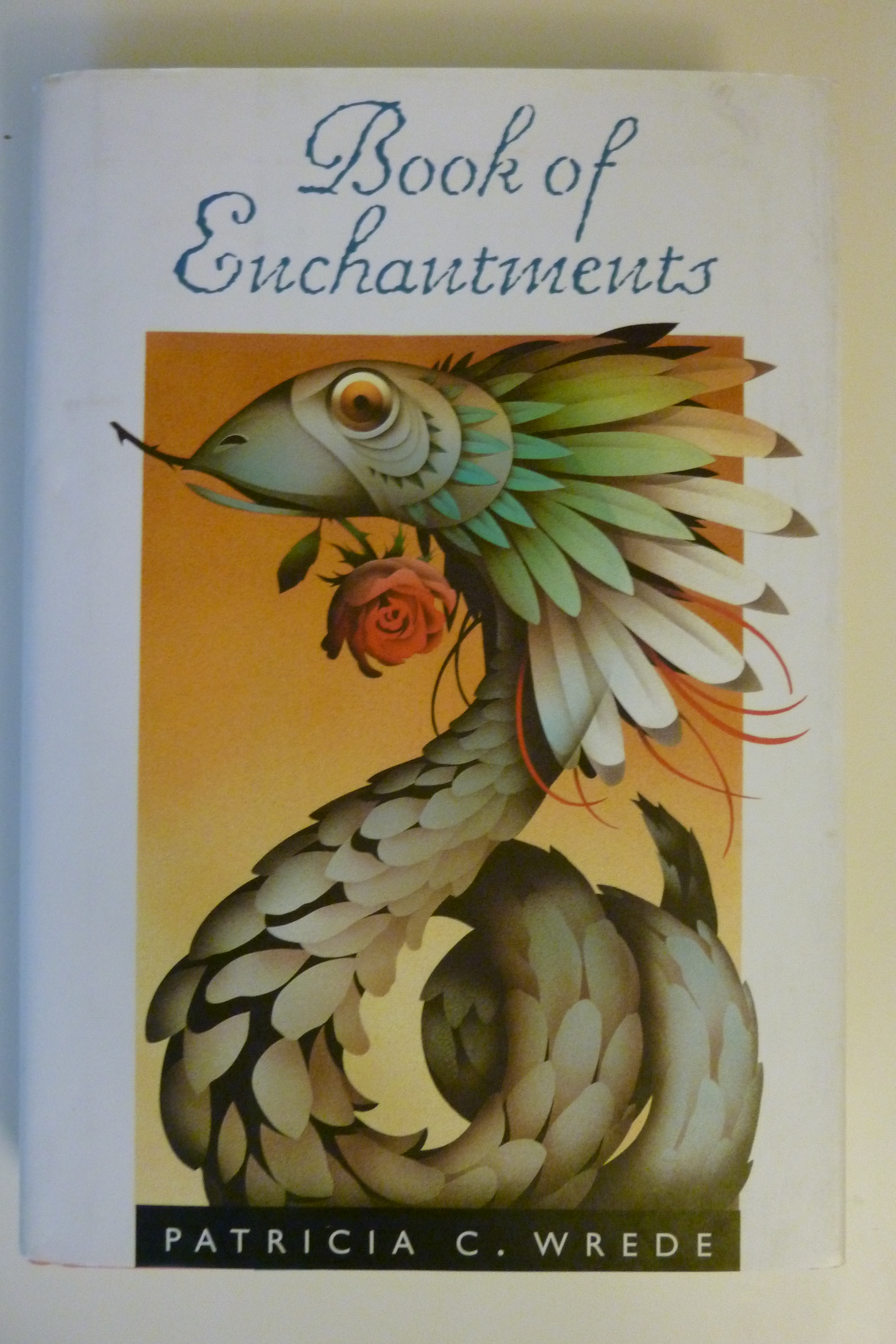
You may know that I’m a big fan of Patricia C. Wrede’s Enchanted Forest Chronicles.  I just recently bought another of her books–Book of Enchantments.  It’s a collection of short stories, and I’ve lost track of how many times I’ve read the library’s copy.

When it arrived in my mailbox, I went down the Table Contents.  I could vividly remember all but two stories, matching my memories to the titles–and I’m usually not good at remembering things like titles, especially when I haven’t read the book in probably a couple of years.

It’s a wonderful collection of stories.  They all deal with magic, but they vary widely in subject, setting and tone.  Some are funny; some are eerie; some are haunting.  And obviously, they’re memorable.

“Rikiki and the Wizard” has a fable-like quality to it, about Rikiki the blue chipmunk god, who’s obsessed with nuts (as a chipmunk naturally would be!)  “The Lorelei” combines a perfectly ordinary, modern student bus trip with the dangerous power of a siren.  “Cruel Sisters” and “Stronger than Time” both reimagine old fairy tales, bringing darkness but also more human characters.

Two of the stories are related to the Enchanted Forest Chronicles.  One, “Utensile Strength,” actually features major characters from the series, which is delightful simply in itself.  Combine familiar characters with a magical weapon called the Frying Pan of Doom, and I really don’t know how you could go wrong.  “The Princess, the Cat and the Unicorn” is less directly tied into the series, but it makes up for it by being amusing and lovely and a bit romantic.  It’s set in a magical kingdom where nothing goes quite right: “The magic carpet had a bad case of moths and the King’s prized seven-league boots only went five-and-a-half leagues at a step (six leagues, with a good tailwind).”  It has all the charm of the Enchanted Forest Chronicles, gently poking fun at how fairy tales are supposed to be.

Two of my favorites (aside from the two above) are very different from each other.  “The Sixty-Two Curses of Caliph Arenschadd” is about a caliph who works his way through a list of curses whenever anyone displeases him.  Most of the curses are funny, like turning people green or giving them monkey paws.  The story centers on the daughter of the Caliph’s grand vizier, who has to figure out a way around the worst curse of all.

“Roses by Moonlight” is set in the present day.  Adrian, a teenager, is unhappy with her life, jealous and resentful of her perfect younger sister Samantha.  One night a mysterious woman invites her for a walk in the garden, and Adrian finds herself in a rose garden she never saw before.  Adrian realizes that each rose she smells gives her a vision of a different future.  The woman tells her that she may pick one rose…  There’s something haunting about the idea of a garden of possibilities, letting you see all that could be, and then giving you the chance to choose your life by reaching out and plucking a flower.

But obviously they’ve all stuck with me to a greater or lesser extent.  Try the book–maybe they’ll stick with you!

Author’s Site: http://pcwrede.com/index.html

Disappointed with the Mockingjay

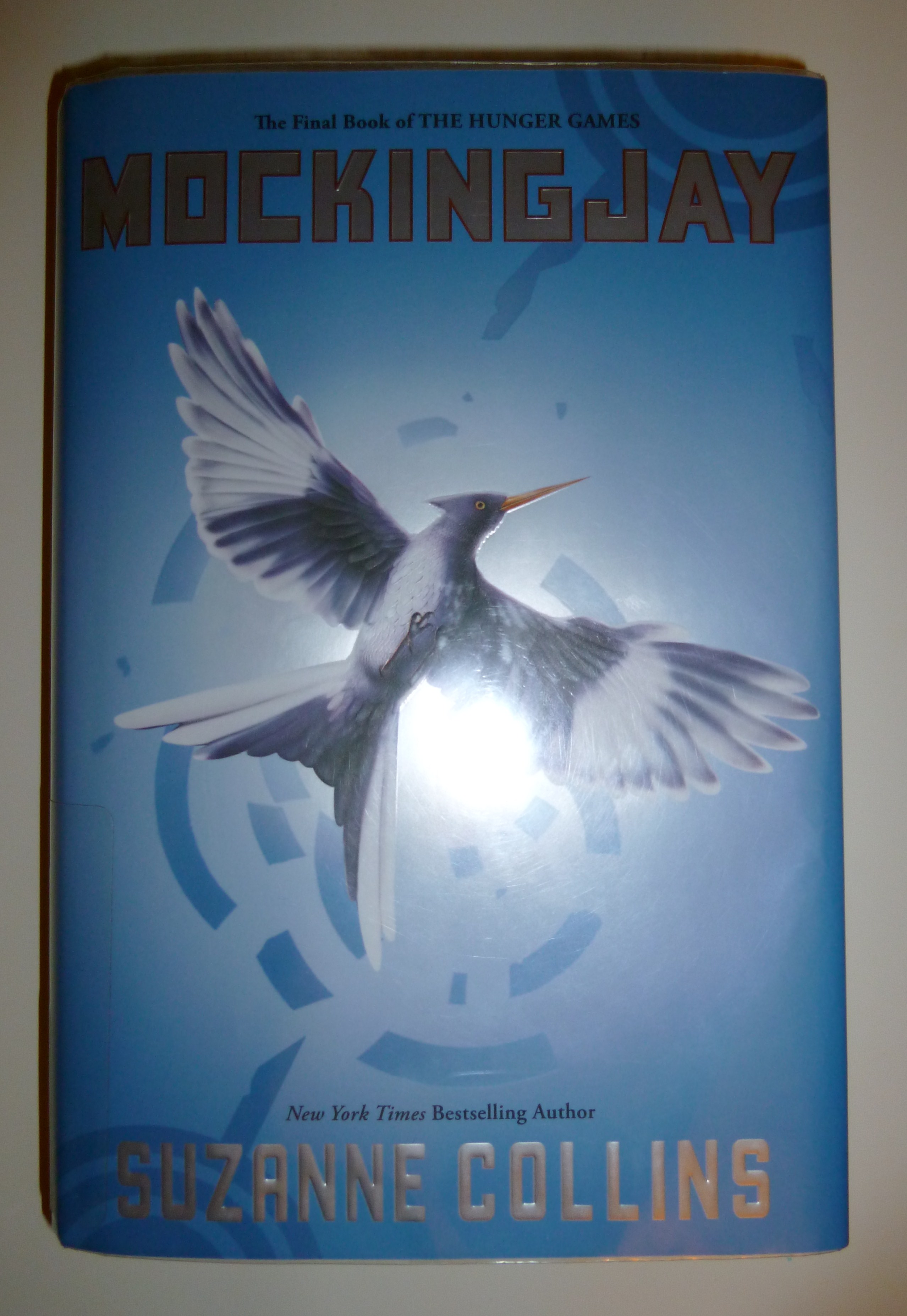
I am so sorry to say this, but–I was disappointed by Mockingjay.  If you read my earlier reviews, you know that I thought The Hunger Games was brilliant.  Catching Fire had flaws, but was promising.  And Mockingjay never fulfilled on the promises.

My Katniss problems of the second book magnified enormously in the third.  She carries on with her inability to figure out what to do.  I had hoped that this was a second book, bridge-segment issue, and that it was just setting up the third book’s resolution.  But no.  The rebellion is in full swing by this point, but Katniss still spends large portions of the book moping and moaning and debating what she should do.  Even after she makes some decisions, she still spends way too much time hiding in closets (yes, literally), heavily medicated, or sunk deep in depression.

Part of me wants to be understanding.  She has, after all, been through Hell, and is in some ways still there.  But so has everyone else.  And a lot of people are handling it much better than Katniss.  People are literally fighting and dying for their freedom, Katniss is in a unique position to help the cause–and she can’t seem to rise to it.

That, I think, is the crux of the problem.  I wanted the story of Katniss taking her pain and her horror, using it all to become a stronger person, and to grow into her role as the Mockingjay, the rebellion’s symbolic leader.  Instead, I feel like I got the story of how Katniss (and Peeta, Gale, Haymitch, Finnick…everyone, really) has been severely damaged by all they’ve been through, and will never fully recover.  It’s probably very realistic.  But it’s not narratively satisfying.

I find myself looking at stories from two angles.  Is it realistic–can I believe that it could be real?  Yes.  But was it a good choice for the writer to make?  I don’t think so.  Maybe Katniss really would lose it completely.  But I can’t imagine why a writer would choose to have her protagonist fall to pieces for the second half of a trilogy (starting midway through book two and going on until the end).

Another problem is that we’re so removed from the rebellion in many ways.  Katniss is a symbolic leader, but she’s not a strategic leader and she only occasionally engages with real fighting.  Mostly, she’s used by the rebel leaders for PR purposes (which actually are some of the best parts, because at least she’s doing something).  In a way it makes sense, but it also traps us in the point of view someone who is only peripherally engaged in this huge sweeping conflict.

I really liked Gale.  He does develop a ruthless streak that certainly wasn’t admirable, and he doesn’t always know the right thing to say to Katniss.  He’s flawed.  But he takes an active role in the rebellion, he engages with what’s going on and understands what they’re fighting for, and he’s still trying to protect the people he loves.  There’s a scene where the community is threatened, and it’s actually Gale, not Katniss, who makes sure that Katniss’ sister is all right.  He’s still thinking straight.  Unfortunately, he’s not the protagonist.

It’s still an exciting book, and I did find it absorbing–although one reason it was a page-turner was because I was trying to get to a more satisfying part of the book, and then I never did.  I liked the grayness of good and evil, which we saw before and was even more evident now.  The character development, so good in the others, was lacking.  When new characters were introduced, they didn’t feel as vivid as similar minor characters in the first two books.

As to the love triangle.  Well.  It was resolved, but it was resolved quickly, and ultimately I didn’t find it that satisfying.  Maybe this just wasn’t the right setting for a romance.  But the first book managed such a nice balance with that, I feel like there must have been a better way to do it.

I realize that some of what I wanted from the book may be cliches.  Maybe Collins was trying to tell something really different, that didn’t follow the normal conventions of a coming-of-age story, or of a traditional romance.  But you know something?  Some devices are used a lot because they work.

I still think The Hunger Games is one of the best books I’ve read this year, and it was worth reading the other two just to find out what happened.  I just wish I’d liked what happened!

Author’s Site: http://www.thehungergames.co.uk/

A Human and Hideous Snow White

Reading A Tale of Two Castles put me in a mood to reread a favorite Gail Carson Levine book, Fairest.  Set in the same world as Ella Enchanted (and very loosely connected), this one is a retelling of Snow White.

The main character, Aza, has milky white skin, blood red lips, and coal black hair–the traditional Snow White.  Except that Levine takes this to its literal and logical conclusion.  Pay no attention to the cover–Aza is ugly.  As someone would be who had literally white skin, red lips, and black hair.  In her favor, Aza has a kind disposition, a loving family, and a magnificent singing voice.  She’s not a princess, but she ends up visiting the castle for the King’s wedding to his new bride, and finds herself caught up in intrigue–and intrigued by the handsome prince.

As with Ella Enchanted, Levine has given us a very clever, practical and creative retelling of a familiar fairy tale.  Many of the original elements are there, but reshaped.

Aza is the best part of this.  Besides the part about her appearance, she’s a wonderfully human character.  She’s not perfect, but she’s sympathetic.  She wants to do the right thing, but doesn’t know what to do in some difficult situations.  She has to find her own strength, and her own value.  She struggles a lot with her appearance, and sometimes gives in to temptations.  She’s both likable and realistically flawed.

This is definitely an excellent Snow White retelling–one of the few.  It occurred to me I hadn’t read many, and a recent search didn’t turn up much.  Anyone have a suggestion for another good retelling of Snow White?

Author’s Site: http://gailcarsonlevine.com/