The House on Durrow Street

House on Durrow StreetIn another read for Once Upon a Time and my continuing efforts to finish series, I read The House on Durrow Street by Galen Beckett.  (Read my review of the first book, The Magicians and Mrs. Quent)  I loved revisiting the world of Invarel, and I feel like I’m fonder than ever of the characters.

This book kept up some of the style of Austen and Bronte, without adhering to their plotlines (as in the first book).  In fact, I didn’t feel like plot was a strong point of the book–but that was okay!  Rather than strong plot elements, it felt like we were just reading about the continuing lives of the characters, and though I feel like I should object, in actual fact I found it entirely satisfying.

Picking up not long after we saw them in the last book, we continue with the same three major characters, Ivy Quent, Mr. Rafferdy (who must have a first name, but I don’t remember it), and Eldyn Garrett.  Ivy is overseeing the refurbishment of her father’s house (on Durrow Street…) and enjoying whatever time she can snatch with her husband, when he isn’t busy with his work as an Inquirer.  Mr. Rafferdy is being dragged into responsibility by his father’s poor health, which has forced his son to take his place in Assembly (rather like the House of Lords), despite his best efforts to have no impact at all.  Eldyn is working as a clerk for the church, but finds himself continually drawn by the illusion plays–and by one of the actors.

Swirling around these more ordinary affairs are continuing magical mysteries, and hints of much bigger troubles afoot.  There’s political upheaval, growing revolts, and even the heavens are falling out of line, as the ever-reliable almanacs can no longer predict the length of day and night with accuracy.  The funny thing is, most of this seems to be going on in the background somewhere–the characters observe it or touch on it peripherally (and a little more directly, near the end) but usually it’s not the focus.

I felt like that should annoy me–but actually, I kind of enjoyed watching ordinary people carry on their relatively ordinary lives.  It felt wonderfully realistic somehow.  All that said, I probably will be bothered if some of these elements don’t become more central in the third book!

This book followed the same pattern as the first one, switching between viewpoints of the three major characters, with a slight variation.  This time Ivy alternated chapters with either of the two men, instead of cycling evenly through all three (most of the time).  I approved–I always liked Ivy’s chapters best.  I think it’s that Ivy is interesting whatever she’s doing, while Eldyn and Mr. Rafferdy are only interesting when they’re doing something interesting–which they did for most of the book.  That distinction was true in the first book, but may be less so now, as I think I grew increasingly attached to both of the men throughout this second book.

But I continue loving Ivy as a character, and enjoyed her relationship with Mr. Quent.  I wish he’d been more central!  They have moments together, but he spends a lot of the book off doing something else (which could make a great companion book…)  Considering the third book is titled The Master of Heathcrest Hall, I hope he’ll be more directly involved.  When they are together, it’s wonderful how much they obviously love and trust each other.  In fact, he’s so trusting that there are moments when I just have to wonder…is he really sure that he’s really that glad that she’s getting on so well with Mr. Rafferdy?  Really?

Mr. Rafferdy undergoes some very nice character growth here–he was already starting to find himself a bit in the last book, and he continues that process here.  Since he also continues to be in love with Ivy, I’m really wondering how that’s going to turn out for him…

Eldyn went through quite a bit of self-revelation as well, and I thought he was posed with some very interesting conflicting pulls.  It was a little disappointing in that I thought it ultimately worked out too neatly, by having circumstances make his choice much more clear than it had been (or might have continued to be).

I know I’ve come to this trilogy a bit late, but here’s where it pays off–because now I can go swiftly on to the next book instead of waiting for it!  I have several others I very much want to read too, so I won’t get to Book Three immediately…but it’s definitely on the short-list to be read soon.  I’ll let you know how it goes!

Author’s Site: http://wyrdwood.net/

Other reviews:
Fyrefly’s Book Blog
Stella Matutina
Fantasy Book Critic
Anyone else?

Buy it here: The House on Durrow Street

Stardust Read-Along, Part Two

Welcome to the second (and final) installment of the Stardust Read-Along!  As part of Once Upon a Time, we’ve been reading Neil Gaiman’s Stardust.  This week we’re discussing the second half of the book–so spoilers abound!  (And somehow, spoilers for Star Wars got in here too.  You’ve been warned.)
I…have quite a lot to say here.  And I’m a bit afraid people are not going to like it.  But I think I’ll just dive into Carl’s questions and go from there…

In the first part we saw a naive, wool-headed and self-involved Tristran.  What are your thoughts about Tristran and his personal journey now that the book has ended?

This is definitely the classic arc of the hero taking a journey and growing in the process.  We see some of it when Tristran wakes up to how badly he treated the Star (Yvaine, that is), and when he confronts the witch at the inn, and even when he can’t remember Victoria’s eyecolor.  However…I have some trouble here, because I just can’t shake the feeling that an awful lot of Tristran’s character growth happened in Chapter Eight, in between being picked up by the flying ship and meeting Ditchwater Sal.  That span covers weeks, miles, several adventures…and six pages.  Those six pages irritate me immensely, because I’m convinced that Gaiman summarized some very important parts of the story–like too much of Tristran’s character growth.  So much of this is wonderful that I want so much more of that section that we jumped past so quickly.

So, yes, Tristran is different.  He has a taste for adventure, he’s at least a bit more insightful, and no one in Wall recognizes him anymore.  But I’m not sure I saw enough of exactly how and why he changed.  But for now, on to the next question.

The star, who we now know as Yvaine, also experienced a transformation of her own.  So I ask the same question, what are  your thoughts about Yvaine and the journey she took?

I think the biggest change for Yvaine was around her feelings towards Tristran, with resulting changes to her attitude and choices.  Initially she makes her vow to stay with him, and there are hints and suggestions near the end that it’s not only about the vow anymore.

But…and here we go again…while I can see that Yvaine fell for Tristran at some point, this romance doesn’t speak to me much.  It feels like an awful lot of the falling in love part must have happened…in Those Six Pages.  They’re mostly tolerating each other when the flying ship picks them up, and by the time they meet Ditchwater Sal, there already seems to be much more connection.  Nothing in between but Those Six Pages.  I think Gaiman summarized right past the love story too.  Not all of it–some of it comes in at the end–but I would have loved to see that middle section much more expanded.

And while we’re on the subject of love stories–I was disappointed by Dunstan and Lady Una.  There was such a beautiful story with the two of them in Chapter One, and I really believed that there was a connection between them (and I don’t even like love at first sight stories normally), but then in the end…neither one seems to have the slightest bit of interest in the other one!  Granted, Dunstan is married, which makes it all a bit awkward, but…but…fizzle.

The villains of the story came to interesting ends, but not necessarily expected ones.  How do you feel about Neil Gaiman’s handling of the Stormhold brothers (who had remained at the end of Part 1) and the two witches, the one Lilim and Ditchwater Sal?

I already talked about issues with Those Six Pages above, but I’m sorry to say that it’s with the villains that I get into real problems.  They were such wonderful villains and then they fizzled!  Can you imagine if Darth Vader lurked around for two movies, confronted Luke near the end of the second, and then Return of the Jedi opened with the news that Vader had been shot by a stray laser beam and was dead?  That’s more or less what it felt like.

We did get a confrontation with the Lilim at the inn, and that was an excellent middle-of-the-book action scene (i.e., Vader and Luke in Cloud City).  But then…nothing!  No second Death Star.  Tristran and Yvaine never have to take their new strengths and abilities and relationship and use it all to confront the villains because the villains just sort of…defeat each other.  And while in theory I like the idea of evil consuming itself, in practice…it all felt a bit pointless.  Why create amazing villains, Mr. Gaiman, if you’re never going to have your hero fight them in a final epic confrontation?

Granted, this way was doing something unexpected and non-cliche…but things become cliches because they work.  Stories have patterns, and patterns become archetypes because they work, and building up to a final epic confrontation…it works.  Having Vader turn on the Emperor–unexpected, non-cliche, still works.  Having Luke and Vader never meet up again?  Well, that would be disappointing…

There is one scene when Yvaine meets the exhausted Lilim, and shows her pity by letting her go her way (or doesn’t show pity, if you believe that was a worse fate).  I do like what this says about Yvaine’s character…but I still feel like the villains’ long hunt was leading up to something much more dramatic than where it turned out.

What are your overall impressions of the story now that it is done?

I still think there’s a lot that’s lovely in here.  Gaiman’s writing is always beautiful, and the glimpses we get into the creatures and features of Faerie are so fascinating.  There’s so much that is so very clever, like the Babylon candle, and so very magical too.

But…with apologies to those who love this book (and I know you’re out there)…I was ultimately disappointed.  I had read this before, and I remembered being vaguely dissatisfied.  Memory had blurred the particulars though, and I jumped in again because it was a read-along, and especially because I liked Neverwhere so much better on a reread.  I was hoping to repeat that.  I read the first half of Stardust, and really thought I had been wrong before.  It was lovely, magical, excellent villains.  Then I read the second half, and remembered why this is not one of my favorite books.

I love Gaiman’s ideas.  I love the world he set up, I thought the characters had huge potential and the arc is a good one.  I just don’t like how that arc was portrayed (too much went on in Those Six Pages) and I don’t like how it finally turned out with the villains.  So, while I liked a lot, in the end I was disappointed.  Though on the plus side–it was all quite fascinating figuring out why I have troubles with this book.  From a writing perspective, it was an enormously helpful read!

If Gaiman were to return to Wall/Faerie, would you take another journey there?  If so, are there any adventures hinted at in Stardust that you would like to see Neil expand on?

Odd though it might sound, I absolutely would.  I loved the world, and I’d be very curious to explore further.  Hopefully the whole experience would turn out better for me!  And if Gaiman wanted to write a companion book, expanding Those Six Pages out into 300 pages, I would read it in a heartbeat.

Is there any interest in doing a Book vs. Film group discussion?

Yes!  I already had the movie at the top of my Netflix queue.  Because I did like the movie, very much.  While I normally object to movies that change the book, this movie changed a lot of the things about the book that bothered me.  Carl posted today that we’ll be doing a book vs. film discussion on April 28th, so stay tuned!

Final thoughts…now that I’ve somewhat flayed a much beloved book of a lot of people…I would like to say that I’ve thoroughly enjoyed the read-along, regardless of my ultimate feelings about Stardust.  I loved reading everyone’s thoughts on Part One, and will be VERY curious to see the thoughts on Part Two, positive and negative.

And for those of you in the positive camp, by all means, try to change my mind!  I wanted to love Stardust.  I still want to love Stardust.  I don’t really see it happening, but do please tell me about why you love it.

Princess of the Silver Woods

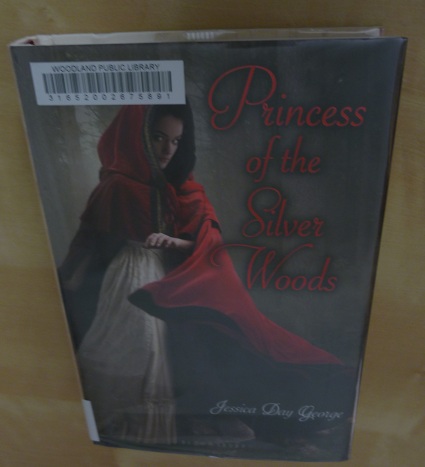
Princess of the Silver WoodsI recently reread Princess of the Midnight Ball by Jessica Day George (review), which turned out to be great preparation for reading the third book in the series, Princess of the Silver Woods.  Thank you, Lark, for letting me know it existed!

The first book retells the story of the Twelve Dancing Princesses.  There’s a second book, loosely retelling Cinderella, Princess of Glass (review).  As the cover makes clear, the third one draws from Little Red Riding Hood—if very loosely!  Fairy tale or not, this is definitely another good one for Once Upon a Time.

The third book focuses on Petunia, the youngest of the princesses, who starts the book traveling through the woods to visit an old friend from a neighboring royal court, the Grand Duchess Volenskaya.  Along the way, she runs afoul of bandits wearing wolf masks–particularly their leader, Oliver, who abducts Petunia more or less by accident.  She makes it eventually to the Grand Duchess’ and all should be well—except that she and her sisters have recently been plagued by particularly vivid nightmares, shadowy forms are lurking in the garden, and the Grand Duchess may have ties to their old enemy, the King Under Stone.

There are elements of Red Riding Hood here and there, but mostly this novel is a second confrontation with the King Under Stone and his macabre court.  This felt like a much more closely connected sequel than the second book, which was primarily a separate adventure.

I really enjoyed seeing the twelve sisters again.  George managed her deft juggling of many characters once again, and I didn’t feel troubled trying to sort out which princess was which.  As in the first book, it’s always self-evidently obvious—Jonquil must be the hysterical one, because she’s always collapsing whenever we see her.  Poppy (the lead of the second book) is obviously the bold one, because she’s always being bold.  It was nice seeing Galen again (who really is lovely), and I liked that we got a little more of Heinrich, who just barely shows up in the first one.  And I love that all the princesses’ have taken up knitting!

Petunia didn’t blow me away as a heroine, but she’s scrappy and likable, and I do enjoy when she starts ordering her demon-suitor around.  Oliver is a bit of a Robin Hood figure, a displaced earl who turned to banditry to feed his people.  Again, likable, if a little typical-hero-type.

The romance didn’t do much for me.  There was nothing wrong with it—it just didn’t feel like it added much to the adventure.  Petunia and Oliver have very few opportunities to interact, and while that was true for Rose and Galen too (Galen even makes a comparison at one point), somehow I felt the romance in the first one much more than I did here.  And I was a bit annoyed with Oliver when both Petunia (a girl he had barely met) and his men (who he had lived with and fought with all his life) were in mortal peril, and he seemed to find these concerns equally troubling, with a possible slight edge to Petunia.  Really?

But while the romance may have been a bit of a non-thing, the adventure was excellent.  The King Under Stone and his brothers are thoroughly creepy, and the fact that they were defeated once already doesn’t at all seem to lessen the threat.  George did a nice job of re-exploring familiar territory, while convincingly raising the stakes and the tension.

Overall, I’d say that Princess of the Midnight Ball was the stronger book, but this third one was good fun to read as well—and I enjoyed spending more time with the twelve princesses, and getting a little more of their story.  The first one can stand alone, but I’d recommend the next two as well.

Author’s Site: http://jessicadaygeorge.com/

Other reviews:
The Bookwyrm’s Hoard
Escaping Reality (One Book at a Time)
Tressa’s Wishful Endings
The Book Smugglers
Anyone else?

Buy it here: Princess of the Silver Woods

What Are You Reading?

itsmondayIt’s been a while since I joined in with the Book Journey meme, “It’s Monday, What Are You Reading?”  Maybe it’s time for an update!

I’ve been reading lots of fantasy for Once Upon a Time, which has been enormously fun.  And I can’t believe we’re almost a month in already!  I have so many more books to read…

Right now I’m midway through A Hat Full of Sky by Terry Pratchett, because I’ve been meaning for months to read more of the Tiffany Aching books, which feel a bit more like a proper series than the rest of the delightfully mixed up Discworld books.

Coming up next I have a big one to tackle: Fellowship of the Ring by J. R. R. Tolkien.  I read The Hobbit years ago (and reread it recently), but I’ve never read the Lord of the Rings trilogy.  I was bound and determined to make the attempt this year, and now’s the time!

I am probably way over-focusing here…I reread The Hobbit and watched the movie of Fellowship in preparation, then made sure I cleared through my stack of library books before turning to Tolkien.  So I’ve been counting down to Fellowship for about six books now.  Wish me luck!

I have new ones coming in from the library as well, for once I get to the other side of Middle Earth.  I’m planning on Heir to Sevenwaters, the next in the series by Juliet Marillier, and The Blue Sword by Robin McKinley, which I read so long ago I barely remember it.

As you can see, we’re continuing the fantasy adventures…

Blog Hop: Genre Hopping

An interesting Book Blogger Hop question this week…  What was the last book you read from a genre you don’t normally read?

book blogger hop

I suppose Fantasy is my primary genre, but I bounce into Science Fiction and Historical Fiction fairly frequently too.  For something completely different 🙂 I have to go back to January, when I listened to an audiobook of Walden by Henry David Thoreau.  He has some moments that are excellent philosophy–and other moments that aren’t!  But I do like his thoughts on simplicity, and at least some of his thoughts on nature.

Before that, there was The Paradox of Choice by Barry Schwartz, about how more choices actually make us less happy.  I’m fascinated by how the mind works, so it was a very interesting nonfiction book.

And technically I guess I’m in the middle of an unusual-genre book, as I’m midway through The Complete Journal of L. M. Montgomery, the PEI Years.  Journals (or memoirs) are not something I normally read.  But since I do read, well, everything by L. M. Montgomery with great frequency, it doesn’t really feel like anything unusual. 🙂